Blogs
Blogs  Leap Digest
  Events
  About Us
 Expert Insights
Software Engineer in Germany: Step-by-Step Guide for Indian Professionals
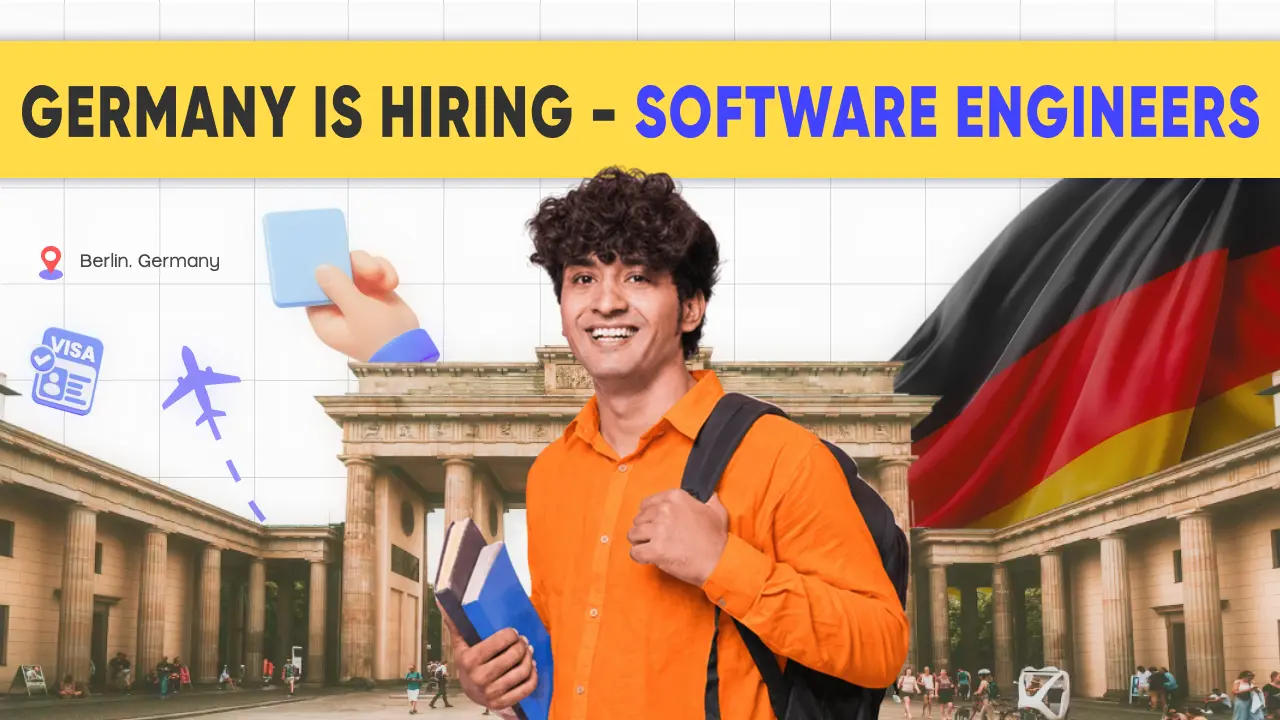
Germany has roughly 109,000 unfilled IT roles. Its median software engineer salary is EUR 73,164 per year (approximately Rs. 79.83 lakh/year). Public university tuition is EUR 0 in 14 of 16 states. Indians received 21% of all EU Blue Cards issued in 2024, the highest share of any single nationality.
If you are an Indian software engineer planning to relocate to Germany or a student building toward that goal, every step of that journey is covered below.
Currency note: 1 EUR = Rs. 109.10 as of July 6, 2026 (BookMyForex/Wise mid-market rate). All salary figures are gross annual amounts before tax. Always verify current rates before financial planning.
Step 1: Understand the German Software Engineering Market
Germany's demand for software engineers is structural, not cyclical. Automotive firms are rebuilding themselves as software companies. Banks and insurers are migrating to the cloud. The Mittelstand, the dense layer of mid-sized, often family-owned firms that powers the economy, is digitizing late and fast. According to Bitkom's August 2025 survey, 85% of German companies are actively hiring IT staff, and 79% expect the shortage to widen as the economy recovers.
Salary by experience tier (gross annual):
- Entry/Junior (0-2 years): EUR 45,000 to EUR 60,000 (Rs. 49.10 to Rs. 65.46 lakh).
- Mid-level (2-5 years): EUR 65,000 to EUR 85,000 (Rs. 70.92 to Rs. 92.74 lakh).
- Senior/Staff (5+ years): EUR 90,000 to EUR 130,000+ (Rs. 98.19 to Rs. 1,41.83 lakh+).
- Median across all levels: EUR 73,164 (approximately Rs. 79.83 lakh/year).
On take-home pay: On a EUR 60,000 gross salary, approximately 21.6% goes to social insurance, and income tax is deducted on top. Net monthly take-home is approximately EUR 3,063 (Rs. 3.34 lakh/month).
Step 2: Choose Your Target Ecosystem
Which of the three ecosystems you join determines your salary ceiling, culture, language requirement, and how fast you get your first role.
Global Tech Giants: Google Munich, Meta Berlin, Amazon, Microsoft, and Stripe. Highest compensation, fully English-speaking, Silicon Valley-style culture. Hardest to enter, strong on equity.
Startups and Scale-ups: Zalando, N26, Trade Republic, Celonis, Personio, HelloFresh. Most accessible for international graduates: flat hierarchies, English-first teams, modern stacks, quick ownership. Check the funding runway before signing.
Corporates and Automotive: BMW, Mercedes-Benz, Volkswagen, Bosch, Siemens, SAP, Allianz, and the Mittelstand. Largest absolute employers, strong job security, 30+ vacation days, structured progression. German is more useful here.
Step 3: Know the Skills German Employers Screen For
German employers screen hard for engineering rigor.
Technical skills that are non-negotiable:
- SQL and PostgreSQL: required at every company. Model data and reason about indexes and transactions.
- Cloud: AWS is most common; Azure dominates large corporates. Know one well rather than three superficially.
- Docker and CI/CD: Docker is essential. Know how code moves from commit to production.
- Testing: Germany values TDD strongly. Be ready to explain exactly how you test your code.
- System design: mid-level and above must reason about scalability, failure, and trade-offs.
Stack by ecosystem:
- SAP, BMW, Bosch, and most large corporates: Java and Spring Boot are close to non-negotiable.
- Berlin scale-ups: more polyglot, Go, Python, TypeScript, Kotlin.
- Automotive: C, C++, and increasingly Rust.
Soft skills that matter equally:
- Direct communication. If a colleague says your code has a bug, they are being helpful, not hostile. Most Indian engineers take about three months to adjust.
- Documentation discipline. "Done" in Germany means tested, documented, reviewed, and deployable.
- Autonomous judgement. Raise problems early rather than wait to be directed.
Step 4: The Academic Route: Study in Germany First
For Indian students who have not yet graduated, studying in Germany is the most reliable relocation pathway. It gives you German work experience, a local network, and EU Blue Card eligibility on graduation.
- Tuition: EUR 0 at public universities in 14 of 16 states. Semester contribution: approximately EUR 300 to EUR 400 (Rs. 32,730 to Rs. 43,640).
- The Werkstudent program lets you work up to 20 hours per week during the semester. German practical experience secured during studies converts far better toward a first role than applications made after graduation.
Key universities for CS and software engineering: TU Munich, RWTH Aachen, KIT Karlsruhe, TU Berlin, and University of Stuttgart.
The dMAT exam is mandatory from 2026: Indian students applying for master's programs in engineering and CS must now sit the Digital Master Test (dMAT) as part of the APS verification process. Registration opened June 29, 2026. First exam: September 26, 2026. Fee: EUR 150 (Rs. 16,365). Registration deadline: September 15, 2026. This applies from the Summer Semester 2027 onwards. Read the full dMAT guide on Leap Scholar Digest.
Step 5: Secure the Right Visa
EU Blue Card (the primary route):
- General salary threshold: EUR 50,700/year (Rs. 55.31 lakh/year).
- STEM threshold: EUR 45,934/year (Rs. 50.12 lakh/year).
- No annual cap. No lottery. Processed in 2 to 8 weeks typically.
- Leads to PR in 2 years, or 21 months with B1 German.
- Indians received 21% of all EU Blue Cards issued in 2024.
Opportunity Card / Chancenkarte (for those without a job offer yet):
- 12-month visa to enter Germany and search for work. No job offer required to apply.
- Introduced in 2024, the Opportunity Card (Chancenkarte) has replaced the old Job Seeker Visa for applicants from outside Germany. It uses a points-based system (minimum 6 points) assessing qualifications, language, experience, and age.
- Requirements: A1 German or B2 English, proof of funds (~€1,091/month), degree, or recognized vocational training.
- Work up to 20 hours/week and undertake 2-week trial placements during the 12-month search period.
- Switch to the EU Blue Card or Skilled Worker Visa once a qualifying role is secured.
Note for students who completed studies in Germany: A separate 18-month job search extension (Section 20(3) AufenthG) is available; this is different from the Opportunity Card and applies only to those already in Germany post-graduation.
PR and citizenship timeline:
- EU Blue Card: PR after 2 years (21 months with B1 German).
- Skilled Worker Visa: PR after 4 years.
- Citizenship: after 5 years, reduced to 3 years for special contributions.
Step 6: The Job Application Process
Where to find roles: LinkedIn (most international roles), XING (strong for Mittelstand), StepStone.de, Indeed.de, and company career pages directly.
Application structure: Cover letter (Anschreiben), CV (Lebenslauf), and certificates. Address the cover letter to the hiring manager by name. German applications are more formal and specific than Indian ones. Connect your experience directly to the role.
Interview format:
- Technical screen: coding challenge on HackerRank, LeetCode, or take-home task.
- Technical interview: system design for mid-level and above.
- Cultural fit: behavioral questions on conflict, feedback, and ambiguity.
- Offer stage: salary negotiation is expected.
A first software role typically takes 3 to 6 months of active applications. Werkstudent experience or a prior German internship is the single biggest accelerant.
Step 7: Prepare for Relocation
Documents to gather before departure:
- Degree certificates with certified translations.
- Employment contract (required for visa).
- APS certificate for Indian university graduates applying through the German consulate.
- Proof of German accommodation. An Anmeldung address is required within 2 weeks of arrival.
- Health insurance is mandatory. Your employer enrolls you on your first day.
On arrival: Register at the local Einwohnermeldeamt within 2 weeks to get your Meldebescheinigung (registration certificate), which you need to open a bank account and get your tax ID. N26 can be opened entirely online before you arrive, useful for day-one expenses.
German language: B1 gets you PR in 21 months on the EU Blue Card. B2 is increasingly useful at corporates and automotive firms. For scale-ups and global tech giants, English is sufficient for the job.
The Full Picture in One Place
The Leap Scholar Software Engineer Germany Guide covers everything beyond this blog: the complete visa document checklist, a city-by-city cost-of-living breakdown (Berlin vs. Munich vs. Frankfurt vs. Hamburg), the full tax and social insurance breakdown at different salary levels, the Werkstudent application strategy, and a month-by-month planning timeline from study application to PR. Read the complete guide →
Talk to a Leap Scholar counselor to build a personalized Germany relocation plan and map the full pathway from your current profile to your first German job offer.
Sources: Bitkom IT Labour Market Survey, August 2025 | BA Entgeltatlas, Software Engineer Median Salary 2026 | BookMyForex, EUR to INR July 6, 2026 | Wise, EUR to INR July 5, 2026 | Official German government Blue Card page | Opportunity Card clarification

Kirti Singhal
Kirti is an experienced content writer with 4 years in the study abroad industry, dedicated to helping students navigate their journey to international education. With a deep understanding of global education systems and the application process, Kirti creates informative and inspiring content that empowers students to achieve their dreams of studying abroad.
Users also read

Top 10 Industries That Create the Most Billionaires in 2026: Guide for Indian Students

Stanford MBA Career Diversity: Industries, Salaries and What Indian Students Need to Know

Anthropic Academy: 16 Free AI Courses With Certificates in 2026 That Indian Students Cannot Afford to Ignore