Blogs
Blogs  Leap Digest
  Events
  About Us
 Expert Insights
Ivy League Universities Are Dropping Loans from Financial Aid: What Indian Middle-Income Families Need to Know
Most Indian families rule out Ivy League universities without calculating the one number that actually matters: what they would pay after financial aid. It is not the Rs. 85 lakh sticker price per year. What matters is the number after grants are applied.
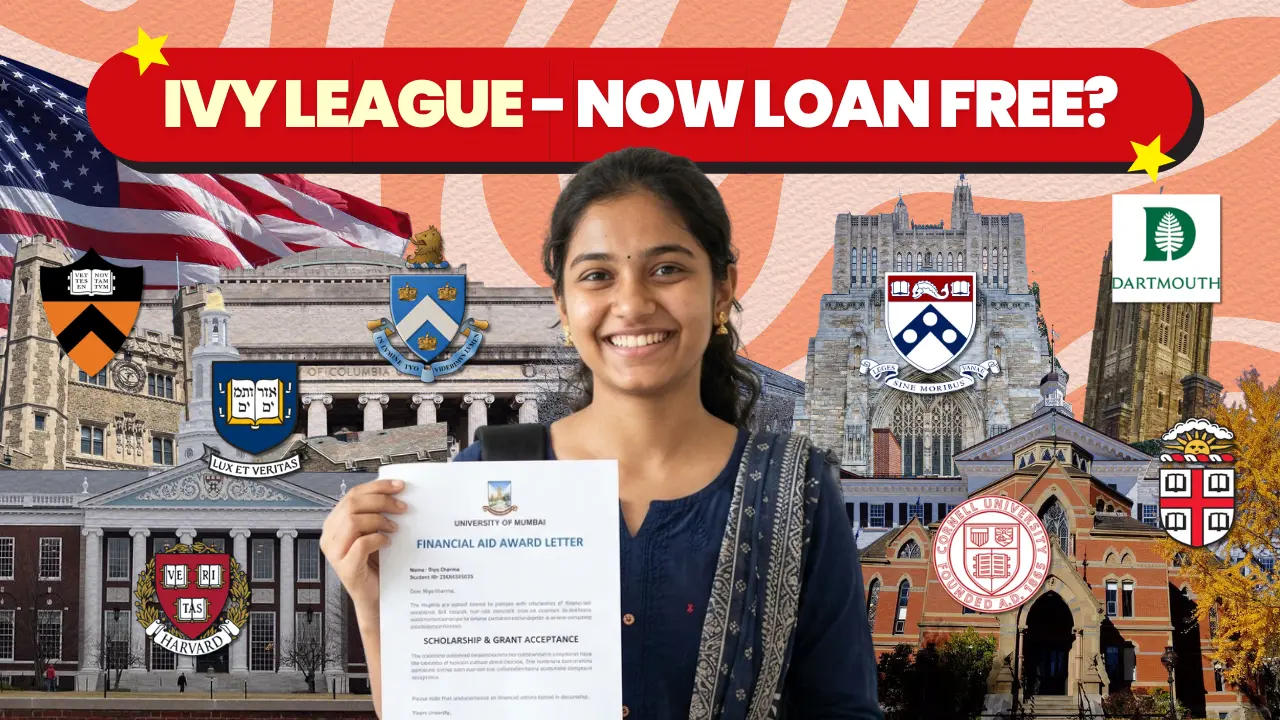
In 2025-26, seven of the eight Ivy League universities eliminated loans from their financial aid packages entirely. Harvard, Princeton, Yale, Brown, Dartmouth, Columbia, and Penn now award aid exclusively as grants, money that never needs to be repaid. Cornell offers optional loans in some packages but maintains no-loan norms for lower-income students.
For Indian families earning roughly Rs. 50 lakh to Rs. 1.5 crore a year, this matters more than most people realize. These families have historically fallen into the gap: earning too much for the most generous grants at most universities, but not enough to pay full fees comfortably. The Ivy League has been systematically closing that gap, and 2025-26 is one of the most significant expansions to date.
Currency note: 1 USD = Rs. 95.62 as of May 13, 2026. Always verify the current rate before making financial decisions.
What No-Loan Actually Means
A standard financial aid package has three components:
- Grants: Free money, never repaid
- Work-study: Part-time campus jobs contributing toward costs
- Loans: Borrowed money, repaid with interest after graduation
The loan component is what leaves middle-income students in debt even after they receive aid. The no-loan policy removes it entirely. Every dollar in an aid package from Harvard, Princeton, or Yale is a grant. No borrowing. No institutional debt upon graduation.
Princeton started this program in 2001. By 2025-26, all eight Ivies had effectively adopted it, making the Ivy League among the few university groups in the world where a middle-income family from any country can receive substantial aid with zero loan obligations.
What Each University Actually Covers
The income thresholds differ by school, but the direction across all eight is identical: more coverage, at higher income levels, than at any point before.
Harvard
- Family income under Rs. 95.62 lakh (USD 100,000): All costs covered, including tuition, housing, food, and health insurance. Zero parent contribution
- Family income under Rs. 1.91 crore (USD 200,000): Full tuition covered. A modest contribution expected for room and board only
- Extra: Rs. 1.91 lakh (USD 2,000) start-up grant in the first year, and a Rs. 1.91 lakh launch grant in junior year, both for families under USD 100,000
Princeton
- Family income under Rs. 1.43 crore (USD 150,000): Full cost of attendance typically covered
- Family income under Rs. 2.39 crore (USD 250,000): Most families pay zero tuition
- The average grant for 2025-26 exceeds Rs. 76.50 lakh (USD 80,000)
- No loans are available in any package, regardless of income level. Princeton has maintained this since 2001
Yale
- Family income under Rs. 95.62 lakh (USD 100,000): Full cost of attendance covered, including tuition, housing, and meals. Rs. 1.91 lakh (USD 2,000) start-up grant in first year
- Family income under Rs. 1.91 crore (USD 200,000): Full tuition is guaranteed and confirmed for 2026-27 cycle
- 55 percent of Yale students receive need-based aid. Average scholarship in 2025-26 was nearly Rs. 41.6 lakh (USD 50,000) per year
Brown
- Zero parent contribution threshold: Rs. 1.19 crore (USD 125,000)
- Loans replaced entirely with grants. 52 percent of undergraduates receive grants averaging Rs. 57.02 lakh (USD 59,626)
Dartmouth
- Zero parent contribution threshold: Rs. 1.19 crore (USD 125,000)
- Families earning up to Rs. 1.67 crore (USD 175,000) pay no tuition
- Need-blind for international students since 2022
Columbia
- Full coverage for families earning under Rs. 1.43 crore (USD 150,000)
- Families under Rs. 71.72 lakh (USD 75,000) have all expenses covered
Penn (UPenn)
- Quaker Commitment: families earning up to Rs. 1.91 crore (USD 200,000) guaranteed at least full tuition
- Families under Rs. 71.72 lakh (USD 75,000) have all expenses covered
- Key change for Indian families: Penn stopped counting primary home equity in financial aid calculations. Property you own in India will no longer inflate your assessed ability to pay
Cornell
- No-Loan Initiative Threshold: Families with an income under Rs. 71.72 lakh (USD 75,000) and typical assets qualify for an entirely loan-free package composed purely of university grants.
- Capped Obligations: For families earning between USD 75,000 and USD 150,000, student loans are capped at a minimal maximum of USD 2,500 to USD 5,000 per year rather than the full cost of attendance.
- Admissions: It remains need-aware for international students, making it essential to present a robust financial profile on your application.
What Indian Families at Different Income Levels Actually Pay
The Ivy League sticker price in 2025-26 runs between Rs. 85 lakh and Rs. 95 lakh per year. Here is what it looks like after aid, across three realistic Indian income brackets.
Actual packages depend on assets, savings, the number of children in education, outstanding loans, and how each university's aid office reads your documentation.
Family earning Rs. 80 lakh per year:
- Harvard: likely Rs. 0 to Rs. 5 lakh in total annual costs
- Princeton: likely Rs. 0; grant covers all expenses
- Yale: Rs. 0 on tuition, modest contribution toward room and board
Family earning Rs. 1.2 crore per year:
- Harvard: Rs. 0 on tuition, small room and board contribution
- Princeton: most families at this income pay no tuition
- Yale: substantial grant, likely covering full tuition
How the Application Works for Indian Students
Financial aid and admissions run simultaneously. You apply for aid at the same time as you apply for admission, not after.
The CSS Profile is what matters for Indian students. FAFSA applies only to US citizens and residents. Indian students use the CSS Profile, administered by College Board, which is live now for the Fall 2026/Spring 2027 cycle. It asks for:
- Family income and tax documentation: ITR filings, Form 16, and salary certificates
- Bank account balances and savings across all accounts
- Property and asset information, with each university treating this differently
- Unusual expenses: medical costs, other children's education, outstanding loans
One thing to get right: The CSS Profile captures assets, not just income. Document every liability, every loan, and every genuine expense carefully. Accuracy is what gets you the right package. The CSS Profile is free for families earning under Rs. 95.62 lakh (USD 100,000).
The timeline Indian students should follow for the 2026-27 cycle:
- Now to August 2026: Research target universities, run each school's net price calculator, and gather financial documents (ITR filings, bank statements, salary certificates)
- August 2026: Common App opens. Create your account and begin filling in basics. Start your CSS Profile on cssprofile.collegeboard.org
- November 1, 2026: Early Decision and Early Action deadline for all Ivy League schools. CSS Profile must be submitted by or before this date if applying early
- January 1 to January 5, 2027: Regular decision deadlines. Harvard, Princeton, Columbia, Dartmouth: January 1. Cornell and Yale: January 2. Brown and Penn: January 5. Submit CSS Profile alongside or before your RD application
- Late March 2027: Ivy Day, when all eight Ivies release regular decision results simultaneously. Financial aid offers come with admission letters
Which universities are need-blind for international students?
- Need-blind (applying for aid does not affect your admission): Harvard, Princeton, Yale, Dartmouth, Brown, Penn
- Need-aware (financial situation is a factor in admission): Columbia and Cornell
The One Thing the No-Loan Policy Does Not Change
More generous aid has made Ivy League universities more accessible financially than most Indian families assume. It has not made them easier to get into.
- Harvard acceptance rate, Class of 2029: approximately 3.6 percent
- Princeton: approximately 4.7 percent
- Yale: approximately 3.7 percent
More generous aid attracts more applicants each cycle. More applicants means more competition for the same number of seats. The financial strategy and the admissions strategy are two different conversations, and both need to be strong.
Before You Rule It Out
A family that has already decided Harvard is too expensive may be ruling out a university that would cost less per year than a private Indian engineering college. That gap between assumption and reality is worth calculating before you decide.
Book a free session with a Leap Scholar counselor to understand what your family's income and financial profile translates to at each Ivy League university and how to prepare your CSS Profile documentation and which universities give Indian students the strongest combination of admission odds and financial support.
Sources: Harvard College Financial Aid, How Aid Works | Princeton University Financial Aid , 2025-26 | Yale University Financial Aid | Penn Quaker Commitment | CNBC , Ivy Leagues Boost Financial Aid 2025 | Essay, Middle-Income Ivy League 2026 | Cornell Financial Aid | Brown University Financial Aid | Dartmouth College Financial Aid | Columbia University Financial Aid

Kirti Singhal
Kirti is an experienced content writer with 4 years in the study abroad industry, dedicated to helping students navigate their journey to international education. With a deep understanding of global education systems and the application process, Kirti creates informative and inspiring content that empowers students to achieve their dreams of studying abroad.
Users also read

Top 10 Industries That Create the Most Billionaires in 2026: Guide for Indian Students

Stanford MBA Career Diversity: Industries, Salaries and What Indian Students Need to Know

Anthropic Academy: 16 Free AI Courses With Certificates in 2026 That Indian Students Cannot Afford to Ignore