
Quick Read
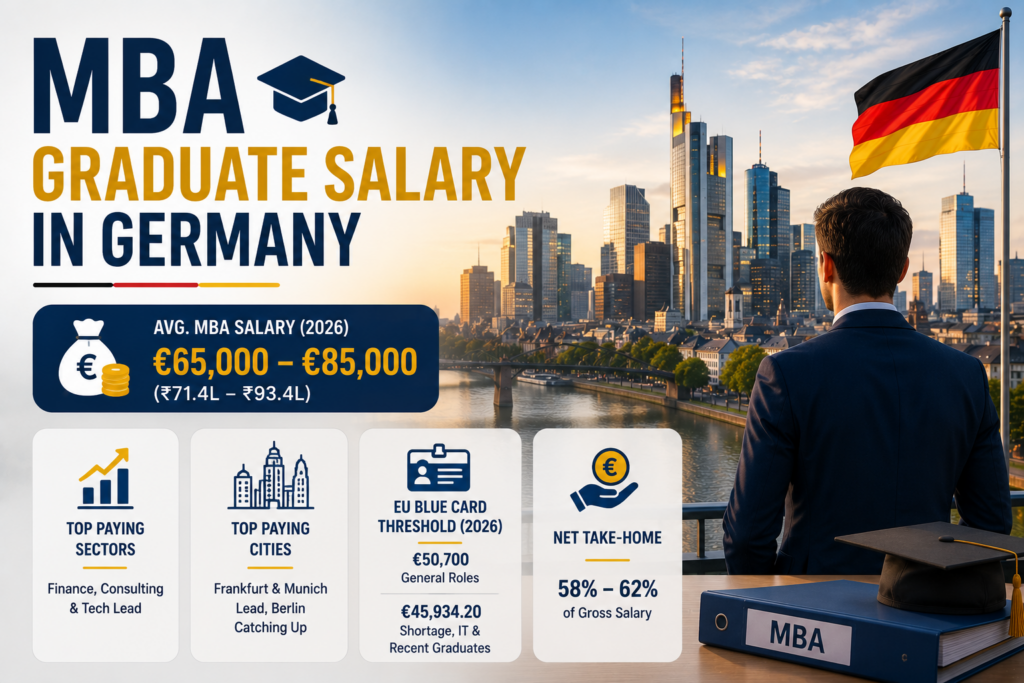
- Average MBA graduate salary in Germany in 2026: €65,000 to €85,000 a year (₹71.4 lakhs to ₹93.4 lakhs).
- Finance, consulting, and tech pay the highest MBA jobs in Germany salary packages.
- Frankfurt and Munich lead on pay; Berlin is catching up fast.
- The EU Blue Card threshold for 2026 is €50,700 for general roles and €45,934.20 for shortage occupations, recent graduates, and qualifying IT specialists.
- Net take-home typically runs 58% to 62% of gross salary after tax and social contributions.
Average MBA Graduate Salary in Germany in 2026
In India, an MBA usually gets treated like a fresh graduate’s ticket into the job market. Germany doesn’t work that way. Employers here read it as a post-experience qualification, so what you did before business school ends up mattering more than your GMAT score or which specialization you picked.
| Metric | Amount in EUR | Amount in INR |
|---|---|---|
| National average starting salary | €65,000 to €85,000/year | ₹71.4L to ₹93.4L/year |
| Monthly gross equivalent | €5,417 to €7,083/month | ₹5.95L to ₹7.78L/month |
| Median MBA salary (Glassdoor data) | €74,997/year | ₹82.4L/year |
Sources: Munich Business School Insights, Glassdoor Germany MBA Salaries

Choose your dream country
 UK
UK
 USA
USA
 Germany
 Australia
 Ireland
 Canada
 UAE
UAE
 France
 Sweden
 Italy
Italy
 Other
Other
When do you want to study abroad?
What's your highest level of education?
Have you completed Class 12th?
What was your Class 12 CGPA/percentage?
Are you a student or a parent/guardian?
What do you want to study?
Select your current city
How Leap will help you

Personalised University Shortlist

Express Applications with Quicker Admits

End-to-End Application Support
Counselor insight: Students often lock onto the highest number they've seen online and assume that's their starting point. The €65,000 to €85,000 band is what most Indian candidates with average profiles can realistically expect. Anything above €90,000 in your first year should be treated as an exception.
MBA Salary in Germany by Experience Level
The table below shows how the starting salary of an MBA in Germany, both per month and per year, changes as your pre-MBA experience increases.
| Where you're coming from | Pre-MBA Experience | Annual Gross Salary (EUR) | Annual Gross Salary (INR) | Salary Growth: Year 1 / Year 5 / Year 10 (EUR) |
|---|---|---|---|---|
| Fresher, early career | Less than 3 years | €55,000 to €65,000 | ₹60.4L to ₹71.4L | Year 1: €55,000 to €65,000 Year 5: €75,000 to €90,000 Year 10: €100,000 to €130,000 |
| Solid mid-level hire | 3 to 5 years | €65,000 to €85,000 | ₹71.4L to ₹93.4L | Year 1: €65,000 to €85,000 Year 5: €90,000 to €115,000 Year 10: €130,000 to €160,000 |
| Senior specialist | 5 to 8 years | €85,000 to €110,000 | ₹93.4L to ₹1.21 Cr | Year 1: €85,000 to €110,000 Year 5: €115,000 to €140,000 Year 10: €150,000 to €190,000 |
| Leadership / executive | 10+ years | €120,000 to €180,000+ | ₹1.32 Cr to ₹1.98 Cr+ | Year 1: €120,000 to €180,000+ Year 5: €160,000 to €220,000+ Year 10: €200,000 to €260,000+ |
Sources: Munich Business School Insights, Glassdoor Germany MBA Salaries, GMAC Alumni Perspectives Survey (methodology for Year 5/10 projection).
Disclaimer: The Year 5 / Year 10 figures are an indicative projection, not a single cited data point. They assume typical German market progression (roughly 6% to 8% compounded growth per year, factoring in promotions and job changes), consistent with the compound annual growth rate approach used in the GMAC survey above. Actual outcomes will vary by function, employer, and how actively you negotiate.
If you're a genuine fresher with zero work experience, expect more competition from specialized Master's in Management graduates and a starting salary closer to €45,000 to €55,000. That works out to roughly €3,750 to €4,580 a month before tax.
If that's your situation, our guide on MBA in Germany without work experience will walk you through what to realistically expect at the entry level.
Counselor insight: The biggest jump isn't between 0 and 3 years of experience; it's between candidates who can point to a specific budget or team they owned and those who only list a job title. Two candidates with the same years on paper can land offers that are €10,000 to €15,000 apart based purely on how concretely they can describe ownership in interviews.
MBA Graduate Salary in Germany by Industry
Your specialization is arguably the single biggest factor affecting your MBA salary in Germany.
| Industry | Salary Range (EUR) | Salary Range (INR) | What's Driving It? |
|---|---|---|---|
| Finance and Banking | €89,000 avg; €82,400 to €120,000 for M&A/corporate finance | ₹97.8L avg; ₹90.5L to ₹1.32 Cr | Frankfurt hiring holds up; growing premium for ESG and green finance roles |
| Management Consulting | €70,000 to €140,000; Tier 1 firms start above €100,000 | ₹76.9L to ₹1.54 Cr; Tier 1 above ₹1.1 Cr | MBB firms pay well above Big Four advisory arms |
| Technology and Product Management | €70,000 to €95,000; Product Managers average €76,700 | ₹76.9L to ₹1.04 Cr; PMs ₹84.3L | Most English-friendly sector for candidates without C1 German |
| Automotive and Manufacturing | €70,000 to €100,000; OEM project managers €88,000 to €108,000 | ₹76.9L to ₹1.1 Cr; OEM PMs ₹96.7L to ₹1.19 Cr | EV transition at BMW and Mercedes driving supply chain hiring |
| Marketing and Digital Marketing | Entry €35,000 to €45,000; Mid €50,000 to €70,000; Senior €70,000 to €85,000+ | ₹38.5L to ₹49.5L; ₹54.9L to ₹76.9L; ₹76.9L to ₹93.4L+ | Digital-first roles growing faster than traditional brand marketing |
Sources: Munich Business School Insights, Glassdoor Germany MBA Salaries
Counselor insight: Indian candidates with an IT or engineering background often default to tech roles because it feels like the safe, familiar option. But some of the strongest outcomes we've seen come from candidates who pivoted into supply chain or operations roles in automotive and manufacturing, sectors with less applicant competition from other Indian MBAs and comparable pay.
Germany MBA Salary vs US and UK MBA Salary
Indian students often shortlist Germany against the US or UK, so it helps to see the numbers side by side.
| Factor | Germany | USA | UK |
|---|---|---|---|
| Average MBA tuition | €20,000 to €35,000 total | $60,000 to $185,000 total | £40,000 to £75,000 total |
| Average starting MBA salary | €65,000 to €85,000/year | $115,000 to $125,000/year (national median) | £55,000 to £80,000/year |
| Typical breakeven period | Faster, due to low tuition | Longer, due to high debt load | Moderate |
| Work authorization pathway | EU Blue Card, fast PR track | H-1B lottery, uncertain | Graduate visa, 2 years |
| German/local language need | Helps a lot for leadership roles | Not applicable | Not applicable |
The US and UK post higher headline salaries, but the tuition gap is so wide that Germany's MBA graduate salary, while lower in absolute terms, often produces a better return on investment simply because you're not clawing back six-figure debt first. When students run a straight Germany MBA salary comparison against the US or UK without factoring in tuition and debt, they usually reach the wrong conclusion.
MBA Jobs in Germany: Top Recruiters and Monthly Pay
Beyond the annual figures, here's what a monthly MBA salary in Germany actually looks like in Indian rupees at real companies.
| Recruiter | Job Role | Monthly Salary (EUR) | Monthly Salary (INR) |
|---|---|---|---|
| Deutsche Bank | Investment Banking Associate | €10,000 | ₹10.99L |
| Bain & Company | Management Consultant | €10,000 | ₹10.99L |
| Siemens | Strategy Consultant | €5,300 to €7,000 | ₹5.82L to ₹7.69L |
| BMW Group | Project Manager | €6,800 | ₹7.47L |
| Allianz | Financial Analyst | €6,000 | ₹6.59L |
Sources: Glassdoor Germany, company career pages
If you're budgeting around a specific offer, work out the monthly figure rather than just the annual one. Rent and daily expenses get billed monthly, not yearly. For context, the 2024 World Happiness Report placed Germany 24th out of 143 countries. Not a chart-topper, but decent, and something to factor in beyond pure pay.
Top Universities and Starting Salaries of MBA in Germany
The business school you attend acts as a strong signal to German employers. It matters more here than in some other markets, since Germany never really built up the MBA-hub reputation that the US has.
| University | Category | Reported Post-MBA Salary (EUR) | Reported Post-MBA Salary (INR) |
|---|---|---|---|
| Mannheim Business School | Tier 1, "Triple Crown" accredited | Average of $110,264 for the Class of 2023 (roughly €100,000+) | Roughly ₹1.1 Cr+ |
| WHU Otto Beisheim School of Management | Entrepreneurship focus | €82,750 average including bonus, up from a €33,163 pre-MBA base | ₹90.9L average |
| Frankfurt School of Finance & Management | Finance specialist | Broadly in line with the €74,000 to €97,000 Frankfurt market range | ₹81.3L to ₹1.07 Cr |
| TU Munich (TUM School of Management) | Public, technical focus | Broadly in line with the €60,000 to €70,000 public-university market range | ₹65.9L to ₹76.9L |
| University of Cologne Business School | Public university | Broadly in line with the €60,000 to €70,000 public-university market range | ₹65.9L to ₹76.9L |
Counselor insight: Brand name matters less at public universities than students assume. TUM and Cologne graduates who specialize in a technical or analytics-heavy track often out-earn private-school peers in general management tracks, simply because the market has fewer of them to choose from.
For a complete list of institutions and what they cost to attend, see our guide to the best MBA colleges in Germany.
Curious if a post-study work permit is guaranteed after your MBA? See what our counselors tell students who ask this exact question.
MBA in Germany Salary: Taxes and Net Savings
Here's the part students tend to skip until they've already signed the offer letter: gross salary is not what lands in your account. Germany taxes fairly heavily, and the gap between "€80,000 a year" on paper and what you actually get to spend surprises many people. Take a €80,000 gross salary under Tax Class I, the bracket for a single professional, and walk through it:
| Line Item | Amount (EUR) | Amount (INR) |
|---|---|---|
| Gross annual salary | €80,000 | ₹87.9 lakhs |
| Tax and social contributions (38% to 42%) | Deducted at source | Deducted at source |
| Net monthly pay | €3,800 to €4,000/month | ₹4.18L to ₹4.40L/month |
| Typical monthly living costs | €1,500 to €2,000/month | ₹1.65L to ₹2.20L/month |
| Realistic monthly savings | €1,500 to €2,000/month | ₹1.65L to ₹2.20L/month |
| Equivalent India gross salary needed for similar savings | Not applicable | ₹40L to ₹50L/year |
Sources: Bundesministerium der Finanzen (German Federal Ministry of Finance) income tax bracket data, Deloitte Germany: Working & Living in Germany tax guide
Regional Salary Trends: Frankfurt vs Munich vs Berlin
Germany doesn't have a single business capital, and salaries shift noticeably by city.
Frankfurt is the mandatory stop for finance MBAs, with a high concentration of English-speaking roles and salaries typically between €75,000 and €89,000.
Munich is home to BMW and Siemens, with the country's highest average salaries, often €75,000 to €90,000, but also the steepest cost of living, with rents regularly crossing €1,600 a month.
Berlin, the startup hub, is the most internationally accessible city, with salaries slightly lower at €65,000 to €80,000, though rents there are climbing fast too.
Sources: Munich Business School Insights, Glassdoor Germany city-level compensation data, Numbeo Germany cost of living comparison
For context on how these numbers compare across professions more broadly, our guide to the average salary in Germany by sector and experience level is a useful companion read.
What Determines Your MBA in Germany Salary Offer
1. The language barrier is real.
You can survive professionally in Germany with English alone, especially in tech and finance-adjacent roles, but reaching director-level positions at legacy firms like Volkswagen or Bosch is genuinely difficult without C1-level German. Graduates with B2 or higher German enjoy better job security and access to the so-called Mittelstand hidden champions, the mid-sized industrial firms that quietly dominate their niches.
2. Work authorization through the EU Blue Card.
This is the main legal pathway for most Indian MBA graduates. As of 1 January 2026, the salary thresholds were revised: €50,700 a year for general occupations and €45,934.20 a year for shortage occupations, recent graduates within three years of finishing their degree, and qualifying IT specialists. Since the average MBA graduate salary in Germany comfortably clears both thresholds, most graduates qualify automatically, putting them on a path to permanent residency in as little as 21 months with B1-level German, or 27 months without.
Source: EU Blue Card Germany Minimum Salary 2026, RT & Partner
Counselor insight: Students frequently ask us whether clearing the Blue Card salary threshold is the challenging part. It usually isn't, since most MBAs clear it comfortably. The real bottleneck is timing: employers often want you to start within 4 to 8 weeks, while Blue Card processing and appointment scheduling can take longer than that if you haven't pre-organized your documents.
If you want the full walkthrough on permanent residency eligibility after your MBA, check out this guide.
Planning Timeline: When to Start Your Germany Job Search
This timeline shifts depending on which intake you're finishing from. Winter-semester graduates, who typically wrap up around September or October, are job hunting through the European autumn hiring cycle, which tends to be the busier recruiting window for finance and consulting roles.
Summer-semester (spring) graduates finishing around March run into a quieter corporate hiring calendar right after, so the 6-to-8-month networking window matters even more for them, since fewer campus recruiting events land in that gap.
If you're on the summer intake, it's worth starting conversations with recruiters earlier than the table above suggests rather than assuming the same rhythm applies.
| Timeframe | What to do? |
|---|---|
| 6 to 8 months before graduation | Network, attend campus recruiting events, shortlist target industries |
| 4 to 6 months before graduation | Apply actively; start basic German lessons if you haven't already |
| 2 to 3 months before graduation | Convert interviews into offers and negotiate using the salary bands in this guide |
| After signing an offer | Start your Blue Card paperwork right away, since processing takes time |
3 Key Takeaways on MBA Graduate Salary in Germany
1. €65,000 to €85,000 is a stable range for 2026, but where you land inside it comes down to two things: your pre-MBA experience and the industry you pick. Those two variables swing your number more than your school's name does.
2. The Blue Card math works in your favor this year. €50,700 for general roles, €45,934.20 if you're in a shortage occupation, a recent grad, or a qualifying IT specialist. Most MBA graduates clear both without effort, which means the fast track to permanent residency is basically already open to you.
3. Language and specialization stack. Put finance or tech specialization together with B2-level German or better, and you'll consistently out-earn generalist candidates who skipped the language investment.
Verified by: LeapScholar's Germany counseling team, with hands-on experience guiding Indian MBA graduates through salary negotiations, EU Blue Card applications, and job placements across Frankfurt, Munich, and Berlin.
If you have doubts about any number in this guide or want it checked against your specific profile, book a free session with a LeapScholar counselor.
Frequently Asked Questions About MBA Graduate Salary in Germany
-
What is the average MBA salary in Germany per month?
Take an average package of €75,000 a year and the gross monthly figure comes out to around €6,250, close to ₹6.87 lakhs. Freshers see a lot less, closer to €3,750 to €4,580 a month. And once tax and social contributions under Tax Class I are taken out, what actually hits your account is more like €3,600 to €3,900, roughly ₹3.96 lakhs to ₹4.29 lakhs.
-
How much does a part-time job pay while I'm still studying?
Up to 20 hours a week during term time, that's the visa limit. Werkstudent jobs pay €14 to €20 an hour. It covers living expenses. It won't touch your tuition bill.
-
Which MBA specialization pays the highest MBA graduate salary in Germany?
Finance and banking, most of the time, with Frankfurt roles averaging €89,000. Strategy consulting at the Tier 1 firms isn't far off either, and can push past €100,000 for the right candidate.
-
What is the minimum salary for the EU Blue Card in Germany in 2026?
Since January 1, 2026, it's €50,700 a year for general occupations. Drop to €45,934.20 if you fall under shortage occupations, you're a recent graduate within three years of finishing your degree, or you qualify as an IT specialist. Most MBA holders clear either number without much difficulty.
-
Is an MBA in Germany worth it for freshers with no work experience?
Depends what you're comparing it against. The German market rewards experience over a fresh degree, so freshers under two years typically start at €45,000 to €55,000 and end up competing head-on with MIM graduates. If that's you, the name of your business school starts carrying a lot more weight.
-
Do I need German to get a well-paying MBA job in Germany?
Not for every role. Tech, product management, and a fair amount of finance work happen comfortably in English. Director-level jobs at older manufacturing or industrial firms are a different story though, those usually want B2 or C1 German, so start early if that's the track you want.
-
How does the MBA graduate salary in Germany compare across cities?
Munich and Frankfurt sit at the top, roughly €75,000 to €90,000. Berlin trails a bit at €65,000 to €80,000, but it's the easiest city to land in if you don't speak German and want an internationally minded workplace.
-
Can I switch industries after my MBA and still earn well in Germany?
You can, yes. Expect a short-term pay cut while you rebuild your credibility in the new field. Two to three years is roughly how long it takes most people to catch up and then pull ahead.
-
What documents do I need before accepting an MBA job offer in Germany?
Your recognized degree certificate. An APS certificate if you're applying from India. A signed contract that clears the Blue Card threshold. Proof of health insurance, and a valid passport. Get these sorted before you're deep into interviews, not after.









Have Questions? Get Guidance to reach your Dream University
Connect with India's finest counsellors and biggest study abroad community.
Get Guidance