
Quick Read
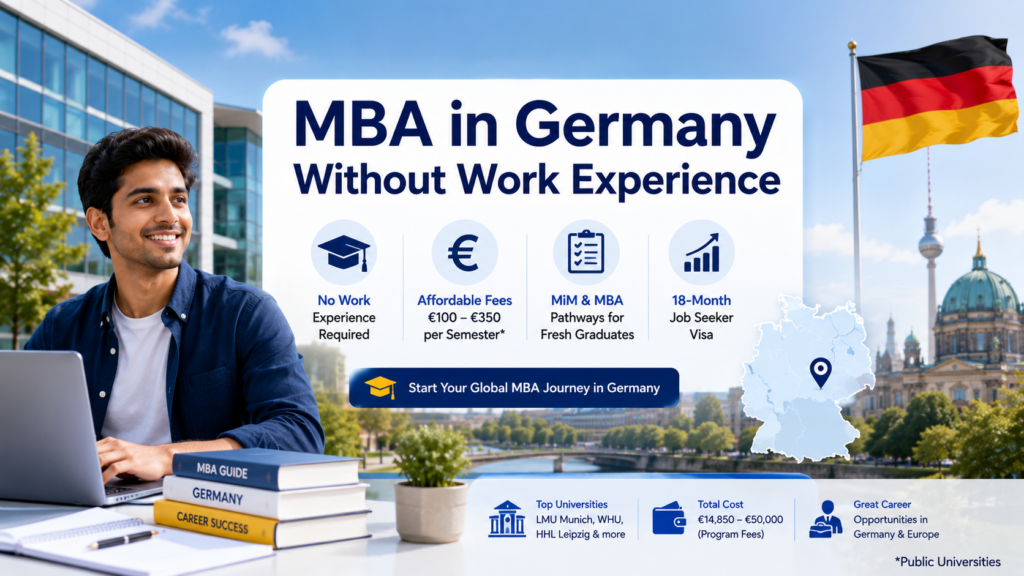
- Public universities charge Rs.10,995–Rs.38,482 (€100–€350) per semester.
- Freshers usually qualify for MiM or MSc Management, not “MBA” by name.
- Business/Commerce/Engineering Master’s applicants need a dMAT from Summer 2027.
- Private MBAs open to freshers cost Rs.16–55 lakh (€14,850–€50,000) total.
Is an MBA in Germany Without Work Experience Really Possible?
Yes, but not in the way most lists present it. An MBA in Germany without work experience is possible only through a specific set of pathways.
Most “MBA colleges in Germany without work experience” lists blur one important line:

Choose your dream country
 UK
UK
 USA
USA
 Germany
 Australia
 Ireland
 Canada
 UAE
UAE
 France
 Sweden
 Italy
Italy
 Other
Other
When do you want to study abroad?
What's your highest level of education?
Have you completed Class 12th?
What was your Class 12 CGPA/percentage?
Are you a student or a parent/guardian?
What do you want to study?
Select your current city
How Leap will help you

Personalised University Shortlist

Express Applications with Quicker Admits

End-to-End Application Support
- A degree titled MBA and a degree titled MSc in Management or MiM (Master in Management) are not the same things.
- German universities are strict about which one they'll actually admit a fresher into.
- Public universities in Germany, such as LMU Munich, rarely title their fresher-friendly programs "MBA." They call them "MSc Management," "MSc Business Administration," or "MiM" in Germany, open to students straight out of a bachelor's degree, with no work experience required.
- The traditional "MBA" title, especially at schools like ESMT Berlin or Mannheim Business School, is usually reserved for candidates with several years of professional experience.
ESMT's own admissions data shows its full-time MBA class averages six years of work experience and an average age of 30. That makes it a poor fit for a student searching for an MBA in Germany without work experience, despite appearing on almost every list on this exact topic online.
Source: ESMT Berlin, Full-Time MBA admissions page
Counselor insight: Students searching for an MBA in Germany without work experience usually assume the "MBA" label is what matters. It isn't. What matters is whether the admissions committee evaluates you on academics and aptitude or on a resume of managerial achievements. Ask that question about any program before you shortlist it.
MBA vs MiM in Germany: Which Path Fits You?
Pick based on your actual profile, not the degree title you'd prefer to have. This is the single most searched confusion about MBAs and MIMs in Germany among Indian students.
- Final-year BBA or B.Com student graduating in 2027, with no internships beyond college requirements: Target public university MiM or MSc Management programs. Your application is judged on CGPA, relevant ECTS credits in quantitative subjects, and your entrance exam score, not your resume.
- BTech graduate from an engineering background: Expect to need bridging coursework or a stronger quantitative profile, since business schools scrutinize whether your undergraduate credits cover economics, statistics, or accounting. Your engineering background also puts you inside the dMAT-affected field list for Summer 2027 intake onward: check the eligibility section below.
- Average academics but 1-2 relevant internships: A private "Early Career" or "Global MBA" program such as BSBI Berlin's Global MBA is a realistic option. These schools evaluate internships, projects, and a clear statement of purpose instead of demanding full-time work history.
Source: BSBI Berlin, Global MBA program page
Counselor insight: The single biggest mistake we see is a student with a 6.5 CGPA and no internships applying to a public MiM at a highly competitive university and getting rejected, then assuming an MBA in Germany without work experience is a myth. It isn't a myth; it's a matching problem. Match your actual profile to the right pathway first.
If you're weighing an MBA/MiM route against a technical career path, our detailed breakdown of software engineer salaries in Germany, including EU Blue Card thresholds, is worth comparing your ROI against before you commit to either path.
Top Colleges for MBA in Germany Without Work Experience
Colleges genuinely worth shortlisting for an MBA in Germany without work experience, verified against each university's own admissions and fee pages:
| University | Program | Tuition (Euro) | Tuition (INR) | Work Experience Needed |
| LMU Munich | MSc Management/Business | €97/semester (no tuition) | Rs.10,665/semester | None |
| WHU Otto Beisheim | Master in Management (MiM), 2026 fees | €33,000 (90 ECTS) – €40,400 (120 ECTS) | Rs.36.28–44.42 lakh | None |
| HHL Leipzig | Full-Time Master in Management | €38,500 total | Rs.42.33 lakh | Minimal (3 months per HHL/DAAD listing) |
| BSBI Berlin | Global MBA (UCA partnership) | €14,850 total | Rs.16.33 lakh | None, if the academic criteria is met |
| Munich Business School | MBA | €32,000 total | Rs.35.18 lakh | Around 2 years typically expected |
Exchange rate used: 1 Euro = Rs.109.95 as of July 2026. Rates fluctuate; verify the current rate before finalizing your budget.
Note: ESMT Berlin, Munich Business School, and Mannheim Business School appear on almost every list of MBA colleges in Germany without work experience online. In reality:
- ESMT's Full-Time MBA averages 6 years of experience per class.
- Munich Business School's own fee page confirms its MBA takes around 2 years.
- Mannheim favors GMAT scores paired with professional achievement.
These three are the wrong target if your goal is genuinely zero experience.
A few other schools are worth checking directly with the university for current fees and experience policy:
- EU Business School Munich, ISM, and the University of Cologne commonly admit candidates without GMAT or prior work experience.
- Exact terms vary by intake, so confirm eligibility on each university's own admissions page before applying.
Counselor insight: The three schools on the wrong list, ESMT, Munich Business School, and Mannheim, are not bad choices. They're wrong-timing choices. Every student we've counseled who got rejected from these programs had the right eventual profile; they were just two to three years too early. If you're a fresher now, target WHU MiM or LMU MSc Management, build your profile, and revisit ESMT after two years of work experience. The admission committee's evaluation will be completely different.
Eligibility Criteria and the New dMAT Rule for 2027-28
German admissions are rules-based: academics, entrance scores, and documented eligibility carry the weight that a resume would carry elsewhere in an MBA in Germany for Indian students' applications.
Quick-glance eligibility for MBA in Germany without work experience:
| Criteria | Requirement |
| Academic background | Recognized 3- or 4-year bachelor's degree, with ECTS credits in math/stats/economics for MiM routes |
| GMAT | 600+ preferred at competitive private schools; waived at several schools offering MBA in Germany without GMAT |
| GRE | 300–320 widely accepted as an alternative |
| English proficiency | IELTS 6.5+ or TOEFL 90+ |
| APS Certificate | Mandatory for all Indian applicants: Rs.18,000, non-refundable |
| dMAT (new, Summer 2027+) | Mandatory only for Engineering, Commerce/Finance/Economics, or Business/Management undergraduates |
dMAT Requirement (New for Summer 2027)
APS India confirmed on 29 June 2026 that Master's applicants whose undergraduate degrees are in Engineering, Commerce/Accounting/Finance/Economics, or Business/Management must submit a Digital Master Test (dMAT) certificate as part of their APS documentation from the Summer Semester 2027 onward. That covers most students reading this, since a BBA, B.Com, or BTech background falls inside the affected list.
- 3.5-hour computer-based test, €150 (Rs.16,492), run by g.a.s.t., not APS India.
- Exempt if you registered or shipped your APS documents before 29 June 2026 or already hold an APS certificate.
- A low score doesn't block your APS certificate; it's one data point, not a pass/fail gate.
Sources: APS India official portal; d-mat.de, official dMAT administrator
Counselor insight: Students often confuse dMAT with a new entrance exam for universities. It isn't. It sits inside your APS paperwork, not your university application. German universities decide independently how much weight to give it, if any, and a good score does not guarantee admission on its own.
Documents and Application Timeline for 2027-28
Every applicant needs the same core paperwork for an MBA in Germany without work experience, plus one new addition for the 2027-28 cycle.
| Document | India-Specific Detail |
| Bachelor's degree certificate and transcripts | Consolidated marksheet with registrar letter if semester-wise sheets aren't issued |
| APS Certificate | Apply at least 5 months before your visa appointment; Rs.18,000 fee, non-refundable |
| dMAT certificate (if affected field, Summer 2027+) | Only required if your undergraduate degree is Engineering, Commerce/Finance/Economics or Business/Management |
| IELTS/TOEFL score | 6.5+ IELTS or 90+ TOEFL for most English-taught programmes |
| GMAT/GRE (where required) | Check per university; several private schools waive this |
| Statement of Purpose | Must explain why an MBA now, without work experience, and how the programme fits your background |
| Blocked account confirmation | Rs.13,08,845 (€11,904) annual deposit for the student visa |
Sources: Make it in Germany, Prospects after graduation
Planning Calendar for Summer Semester 2027 Intake (Starts April 2027), the First Intake Affected by dMAT
- Now (July 2026): Confirm whether your undergraduate field falls under dMAT-affected categories and register with g.a.s.t. immediately if it does.
- August–September 2026: Complete your dMAT registration and sit the test on the 26 September 2026 sitting.
- October 2026: Collect your dMAT certificate.
- October–November 2026: Submit your APS registration and supporting documents.
- December 2026–January 2027: Receive your APS certificate and submit university applications by the 15 January 2027 deadline.
- February–March 2027: Attend your visa appointment.
- April 2027: Arrive in Germany and attend orientation.
Planning Calendar for Winter Semester 2027-28 Intake (Starts October 2027)
- December 2026 – February 2027: Shortlist universities, confirm which pathway (MiM vs MBA) fits your profile, and check if your degree falls under dMAT-affected fields.
- March – May 2027: Take IELTS/TOEFL and GMAT/GRE if required. Register for APS and, if affected, register for the relevant dMAT cycle.
- June – July 2027: Submit university applications via Uni-Assist or directly, including SOP, LORs, transcripts, and APS documentation.
- August 2027: Receive admission offers, open your blocked account, and book your visa appointment.
- September 2027: Visa processing (allow a 4-12 week buffer where possible), book flights, and arrange accommodation.
- October 2027: Arrive in Germany, complete Anmeldung (address registration), attend orientation.
Counselor insight: Students consistently under-budget time for the APS-plus-dMAT combination. If your field is affected, build the dMAT cycle on top of the normal APS 3-4 week window, not instead of it.
Cost of an MBA in Germany Without Work Experience
Budgeting for an MBA in Germany without work experience means separating tuition from living costs, since both vary independently.
Tuition and University Fees
Tuition is the biggest variable in an MBA in Germany without work experience, since public universities and private business schools sit at entirely different price points.
| Cost Item | Euro | INR | Notes |
| Public university semester fee (LMU, etc.) | €100–€350/semester | Rs.10,995–Rs.38,482/semester | MSc Management and MiM programmes here are effectively tuition-free |
| BSBI Berlin, Global MBA | €14,850 total | Rs.16.33 lakh | Genuine no-experience route |
| WHU, Master in Management | €40,400 total | Rs.44.42 lakh | Genuine no-experience route |
Sources for these figures: LMU Munich, WHU, and BSBI Berlin official fee pages, cited above.
Blocked Account (Student Visa Financial Proof)
This figure applies regardless of which pathway you pick for your MBA in Germany without work experience: every Indian student visa applicant needs this deposit confirmed before the German mission approves the visa.
| Item | Euro | INR |
| Annual deposit | €11,904 | Rs.13,08,845 |
| Monthly release | €992 | Rs.1,09,070 |
This is tied to the BAföG rate that the German government uses to set the annual minimum.
Monthly Living Costs
These are the recurring expenses you'll cover from your blocked account once you land, on top of tuition, and they vary noticeably by city.
| Expense | Euro | INR |
| Accommodation | €300–€700 | Rs.32,985–Rs.76,965 |
| Food | €150–€250 | Rs.16,492–Rs.27,488 |
| Health insurance | €80–€160 | Rs.8,796–Rs.17,592 |
| Transport | €60–€150 | Rs.6,597–Rs.16,492 |
Other One-Time Costs
Budget for these application and test fees separately, since most of them are due before you even receive an admission offer for your MBA in Germany without work experience.
| Cost | Euro | INR |
| Visa fee | €75 | Rs.8,246 |
| dMAT fee (if applicable) | €150 | Rs.16,492 |
| APS fee | N/A (charged in INR only) | Rs.18,000 |
Source: Make it in Germany, official government portal (cited above)
Exchange rate used: 1 Euro = Rs.109.95 as of July 2026. Rates fluctuate; verify the current rate before finalizing your budget.
Counselor insight: The blocked account figure is the one that surprises families most. Rs.13.09 lakh sounds like a tuition fee, but it's entirely your own money; you draw it down monthly at Rs.1,09,070 once you land. The real financial risk for a fresher MBA path isn't the blocked account; it's choosing a private school at Rs.44 lakh total cost and not budgeting for the 18 months of job searching after graduation. Plan the blocked account and the post-graduation runway together, not separately.
Scholarships to Cut the Cost of Your MBA in Germany
High tuition at private schools doesn't rule out an MBA in Germany without work experience. Government and university-specific scholarships can cut your net cost significantly if you apply early.
| Scholarship | Provider | Amount | Notes |
| DAAD Scholarships | German government | €992/month (Rs.1,09,070 ) | Government-funded postgraduate study support, plus health insurance and travel support |
| Deutschlandstipendium | German government + universities | €300/month (Rs.32,985) | 12 months, merit plus social engagement |
| WHU scholarships | WHU Otto Beisheim | Up to 75% of tuition | The standard award covers 25%; special award for outstanding MiM candidates covers 75% |
| HHL early-bird reduction | HHL Leipzig | Up to €6,000 (Rs.6.60 lakh) | Fee reduction for early, complete applications |
| ESMT early-application award | ESMT Berlin | Toward tuition | Separate from ESMT's main MBA scholarships |
Official source: DAAD, Scholarships Overview; WHU and HHL fee/financing pages cited above
Career Outcomes and Post-Study Work Visa
Whether an MBA in Germany without work experience is financially worthwhile depends on two factors: the pathway you choose and how you use the post-study visa window. It's also worth comparing against salaries in related fields like software engineering roles in Germany that many MiM graduates move into.
Entry-Level Roles
- Fresh MiM/MBA graduates typically start as Junior Consultant, Business Analyst, or Management Trainee.
- The German market still treats a full MBA as a post-experience qualification.
- A genuine fresher should expect a lower band than the headline MBA-graduate averages quoted for experienced hires.
Post-Study Work Visa
- Graduates get an 18-month job seeker permit (§20 AufenthG), confirmed on Germany's official "Make it in Germany" portal.
- You can work any job during this period.
- The clock starts from your graduation date, not your permit issue date.
- If your qualifying job offer clears the EU Blue Card salary threshold, you can convert directly to the EU Blue Card and start the fast-track route to permanent residency.
Source: Make it in Germany, official government portal (cited above)
What to Do When It Goes Wrong
- Missed the dMAT registration deadline: There's no confirmed makeup sitting for a missed cycle. Register the moment your affected-field status is confirmed; don't wait until the deadline week.
- APS delayed past your university deadline: Email APS India directly and ask your target university about a provisional deadline extension. German universities are used to this specific delay.
- Visa appointment pushed past intake start: Universities generally allow late arrival within the first two to four weeks if you can show a confirmed visa appointment date; contact the international office immediately. Don't wait for the semester to start.
- Low dMAT score: It does not automatically disqualify your APS certificate. Submit on schedule regardless of the number.
3 Takeaways on MBA in Germany Without Work Experience
The degree title matters less than the pathway. Three things to act on for the 2027-28 cycle, if you're planning an MBA in Germany without work experience:
- Target MiM or MSc Management, not a program branded "MBA," unless you've confirmed that specific MBA genuinely admits freshers. ESMT, Munich Business School, and Mannheim generally don't, despite showing up on most lists.
- Check whether your undergraduate degree falls under the dMAT-affected fields (Engineering, Commerce/Finance/Economics, Business/Management) now, and register for the test cycle immediately if it applies to your Summer 2027 or later intake.
- Budget in euros first: Rs.16-44 lakh in tuition depending on route, plus a Rs.13.09 lakh blocked account deposit, before you commit to an application.
Verified by: LeapScholar's Germany counseling team, with hands-on experience guiding Indian students through APS documentation and university applications.
Have questions about an MBA in Germany without work experience? Book a free session with a LeapScholar counselor.
Frequently Asked Questions About MBA in Germany Without Work Experience
-
Is it possible to do an MBA in Germany without work experience?
Yes, primarily through MSc Management or MiM programmes at public universities, or through a small number of private "Global MBA" programs such as BSBI Berlin that admit freshers on academic merit. Traditional "MBA"-titled programs at schools like ESMT or Mannheim typically expect several years of experience despite frequently appearing on generic lists.
-
Does Germany offer a free MBA for Indian students?
Public universities charge only a semester contribution of €100–€350 (Rs.10,995–Rs.38,482), but these tuition-free programs are almost always titled MSc Management or Business Administration, not "MBA." A degree formally called MBA at a public university is usually a fee-charging continuing-education program.
-
Are there MBA colleges in Germany without GMAT and work experience?
Yes. Several private institutions waive the GMAT for candidates with a strong academic record, though highly ranked schools like Mannheim or WHU still recommend it for admission and scholarships.
-
Does the new dMAT requirement affect MBA applicants without work experience?
It affects your APS documentation, not your MBA application, if your undergraduate degree is in engineering/commerce/accounting/finance/economics or business/management. This applies from Summer Semester 2027 onward, confirmed on APS India's official dMAT page.
-
What happens if my undergraduate degree isn't in a dMAT-affected field?
You're not required to take the dMAT. It applies only to engineering, commerce/accounting/finance/economics, and business/management backgrounds for Summer 2027 and later.
-
Can I get a job in Germany without work experience after my MBA?
Yes. The German market absorbs fresh MiM/MBA graduates into roles like Junior Consultant or Business Analyst, and the 18-month post-study job seeker visa gives you time to search without a ticking clock on your student visa.
-
Is an MBA in Germany without work experience a good financial investment?
For the MiM/MSc route, tuition of Rs.36-44 lakh against a full course of living costs is considerably lower than comparable UK or US programs, and public-university MiM tuition alone runs under Rs.1 lakh across the entire degree.
-
What if my APS or dMAT certificate gets delayed past my application deadline?
You can submit your APS application documents before your dMAT certificate is available; APS India will begin document verification in advance but cannot issue the final APS certificate until the dMAT result is checked. Contact your target university about a provisional extension if the delay risks their deadline.
-
Do I need to learn German if I have no work experience to rely on?
Coursework for most MBA and MiM programs is in English, but German at the B1/B2 level materially improves job prospects after graduation, particularly outside international teams in consulting or tech.







Have Questions? Get Guidance to reach your Dream University
Connect with India's finest counsellors and biggest study abroad community.
Get Guidance