
Quick Read
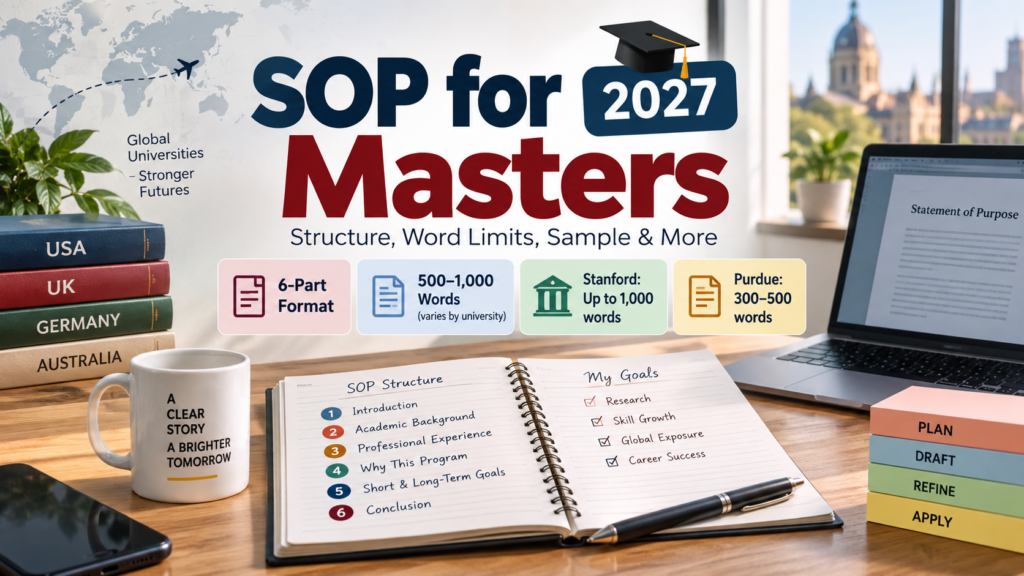
- An SOP for masters runs 500–1,000 words for most programs, though limits vary by university.
- Stanford allows up to 1,000 words; Purdue’s Industrial Engineering program caps it at 300–500.
- Six sections make up a strong SOP: hook, academics, experience, program fit, goals, and conclusion.
- Generic, non-personalized SOPs are the single most common reason Indian applicants get rejected.
What Is an SOP for Masters, and How Is It Different From a Personal Statement
An SOP for masters is a formal essay that explains your academic background, professional experience, and reasons for choosing a specific program and university. It is not the same as a personal statement, which leans more introspective and personal rather than goal-oriented.
| Criteria | Statement of Purpose (SOP) | Personal Statement |
| Focus | Academic and professional journey | Personal growth and motivations |
| Tone | Formal, goal-oriented | Slightly informal, introspective |
| Key elements | Career goals, program fit, relevant experience | Life experiences, values, personal challenges |
| Common in | US, UK, Australia, Germany | Mostly UK undergraduate applications |

Choose your dream country
 UK
UK
 USA
USA
 Germany
 Australia
 Ireland
 Canada
 UAE
UAE
 France
 Sweden
 Italy
Italy
 Other
Other
When do you want to study abroad?
What's your highest level of education?
Have you completed Class 12th?
What was your Class 12 CGPA/percentage?
Are you a student or a parent/guardian?
What do you want to study?
Select your current city
How Leap will help you

Personalised University Shortlist

Express Applications with Quicker Admits

End-to-End Application Support
If you want a straightforward answer to what a Statement of Purpose (SOP) is, LeapScholar's counselors have covered the basics directly.
SOP for Masters Word Count: What Universities Actually Require
Most guides quote a flat "500–1,000 words" rule for an SOP for masters sample. That's a reasonable starting range, but the real, official requirements vary far more than that:
| University/Program | Official Word Limit |
| Stanford University (graduate admissions) | Maximum recommended 1,000 words |
| Purdue University, School of Industrial Engineering | 300–500 words |
| Purdue University, Computer Science | No word limit stated, but conciseness advised |
| University of Arizona (Systems and Industrial Engineering) | 750–1,000 words, one to two pages |
Counselor insight: I tell every student the same thing: the word count you find in a generic "how to write an SOP for masters" guide is a starting assumption, not a rule. Always check your specific program's application portal for the exact prompt and limit before you finalize a draft, since submitting 1,200 words to a program capped at 500 signals you didn't read the instructions carefully.
SOP Format for Masters: The 6-Part Structure
A clear SOP format for masters breaks into six parts, each with a rough word share of the total, whether you're building it from scratch or checking it against a statement of purpose for masters sample PDF you've been given by a mentor:
| Section | Purpose | Word Allocation |
| Introduction | Hook the reader, and state your primary objective | 10–15% |
| Academic Background | Relevant coursework, projects, achievements | 20–25% |
| Professional Experience | Internships, jobs, research that built relevant skills | 15–20% |
| Why This Program and University | Specific faculty, courses, and resources that fit your goals | 20–25% |
| Short-Term and Long-Term Goals | Immediate objectives and career trajectory | 15–20% |
| Conclusion | Summarize intent, reinforce enthusiasm | 5–10% |
Counselor insight: The "Why This Program" section is where most Indian applicants lose the most points, not because they skip it, but because they write it last and rush it. I recommend drafting this section second, right after your hook, since it forces you to research the program properly before you write about your fit for it.
SOP for Masters Sample: A Real Opening and Structure Walkthrough
Looking for an SOP for masters example that you can actually learn from rather than copy? Here's an original sample SOP for masters example, written to illustrate structure rather than to be copied. This statement of purpose for masters sample and every sentence in it are original to this guide. Never reuse someone else's SOP text, including this one; universities run plagiarism checks, and a matched sample is an instant red flag.
Sample opening (Introduction, ~120 words):
"During my final year of a mechanical engineering degree, I spent four months building a low-cost water filtration prototype for a rural community outside Pune. Watching the design fail twice before it finally worked taught me more about iterative engineering than any textbook had. That project is the reason I am applying to the MS in Environmental Engineering at [University], where I want to move from small-scale prototypes to systems capable of serving entire districts."
Sample academic-background sentence:
"My undergraduate thesis on greywater recycling systems, supervised by [faculty name], gave me hands-on experience with the hydraulic modeling software that [University]'s Environmental Engineering Lab uses in its current municipal water projects."
Sample program-fit sentence:
"I am specifically drawn to Professor [Name]'s ongoing research on decentralized water treatment for the same reason my thesis mattered to me: it treats access to clean water as an engineering problem with a deadline, not an abstract policy goal."
This SOP for masters example illustrates the format most SOP for masters templates follow, but the specific details, project names, and faculty references have to be yours. A statement of purpose for masters example only works as a learning tool if you extract the structure and discard the wording entirely, the same way a statement of purpose for masters degree example from a friend or senior should never be copied line for line.
SOP for Masters by Country: US, UK, Germany, and Australia
- USA: strong focus on research goals and long-term career vision; faculty-specific references carry real weight.
- UK: emphasis on direct academic achievement and course relevance over broader career narrative.
- Germany: academic precision, clear motivation, and demonstrated fit with technical or research-heavy programs.
- Australia: practical goals, industry applications, and alignment with the local job market.
Counselor insight: Students preparing a single SOP for masters template and reusing it across four countries almost always get caught out by this variance. A UK-bound SOP that reads like a US one, heavy on personal narrative and light on direct course relevance, reads as unfocused to a UK admissions tutor.
Common SOP Mistakes Indian Students Make (and How to Fix Them)
| Mistake | Fix |
| Overemphasis on the past, no future vision | Balance past experience with a clear, specific future goal |
| Generic, vague, or over-formal language | Use specific examples; write in a natural, direct voice |
| Not customizing for each university | Tailor the "Why this program?" section for every single application |
| Misuse of AI tools or plagiarized samples | Use AI for grammar and structure checks only, never for generating your core narrative |
| Repeating your resume in paragraph form | An SOP explains motivation and reasoning; a resume lists facts. Don't duplicate one as the other |
Which SOP for Masters Template Fits Your Profile?
- If you're a fresh graduate with no work experience: Lean harder on academic projects, thesis work, and specific coursework in your "academic background" section, since you won't have a professional-experience section to carry equal weight.
- If you're a career switcher moving into a new field: Your introduction needs to directly address the gap between your degree and your target program, framed as a deliberate pivot backed by specific evidence (a certification, a side project, a relevant volunteer role), not an apology for changing direction.
- If your academic record has a weak semester or gap year: Address it briefly and factually in one sentence within your academic-background section, then move on. Don't dedicate a full paragraph to explaining it, and never lead your SOP with it.
What to Do If Your SOP Gets Rejected or Feels Too Generic
- If you've already submitted a generic SOP: most universities don't allow resubmission mid-cycle, so focus your energy on your remaining applications rather than trying to fix a submitted one.
- If you realize your SOP is too generic before submitting: rewrite the "Why This Program" section first; it's usually the fastest fix, and the section admissions committees scan for first.
- If you're rejected and reapplying next cycle: request feedback from your university's international office if available, and rebuild your SOP's hook around what's changed in your profile since the last attempt, not a reworded version of the same essay.
3 Takeaways on SOP for Masters
- Confirm your specific program's official word limit before finalizing your draft; don't rely on the generic 500-1,000 word rule alone.
- Use a sample only to learn structure, never wording. Rewrite the "why this program" section for every single university you apply to.
- If your SOP already feels generic, fix the program-fit section first since it's the fastest, highest-impact edit you can make.
Verified by: LeapScholar's admissions counseling team, with hands-on experience reviewing SOPs for Indian students applying to master's programs abroad.
Have questions about your SOP for masters? Book a free session with a LeapScholar counselor to get your draft reviewed before you submit.
Frequently Asked Questions About SOP for Masters
-
What is the ideal SOP for masters sample word count?
Most programs land somewhere between 500 and 1,000 words, but don't treat that as gospel. Stanford allows up to 1,000 words, while some Purdue programs cap submissions at just 300–500. Check the exact limit on your program's application page first.
-
How to write an SOP for masters that stands out?
If you're wondering how to write an SOP for masters that stands out, start with a specific, personal anecdote tied to your field, not a broad line about your passion for the subject. Back it up with real academic and professional evidence, name specific faculty or courses in your program-fit section, then close with clear short and long-term goals.
-
What is the best SOP format for masters?
Most admissions committees expect the same six-part SOP format for masters: introduction, academic background, professional experience, why this program and university, career goals, and conclusion. Follow the weighting in the structure table above and you're on solid ground.
-
Where can I find a statement of purpose for masters sample PDF?
A PDF doesn't matter to admissions committees; your content does. Hunting down a statement of purpose for masters sample PDF to copy from is also a plagiarism risk, since matched text against a widely circulated file is easy for admissions software to catch. Skip the download and write your own draft using this guide's structure and word-allocation breakdown.
-
Can I reuse one SOP for masters template across multiple universities?
Your core structure and personal story can stay the same, but the "why this program and university" section needs a rewrite for every single application. Admissions committees spot a generic, copy-pasted paragraph almost instantly.
-
How is a statement of purpose for masters example different from a personal statement example?
A statement of purpose for masters example zeroes in on academic and professional goals and program fit, written in a formal tone. A personal statement leans introspective, covering personal growth or life experience instead. Most programs in the US, UK, Australia, and Germany specifically ask for an SOP, not a personal statement.
-
What are the most common SOP mistakes Indian students make?
The same handful of issues show up again and again: generic, non-personalized "why this university" sections, language that's overly formal or vague, an SOP that reads like a restated resume, and no clear future goal after all that talk about past achievements.
-
Can I use AI tools to write my SOP for masters?
AI tools are fine for grammar checks, structure suggestions, and editing, but the core narrative and specific details need to be genuinely yours. Lean on AI too heavily and you'll end up with a generic statement that reads exactly like everyone else's.
-
Is a statement of purpose for masters degree example the same for MS and MBA applications?
A statement of purpose for masters degree example built for an MS program won't transfer directly to an MBA application. The core structure holds up, but an MBA-focused SOP leans harder on leadership experience and quantifiable professional impact, while an MS-focused SOP leans harder on academic and research background.








Have Questions? Get Guidance to reach your Dream University
Connect with India's finest counsellors and biggest study abroad community.
Get Guidance