Blogs
Blogs  Leap Digest
  Events
  About Us


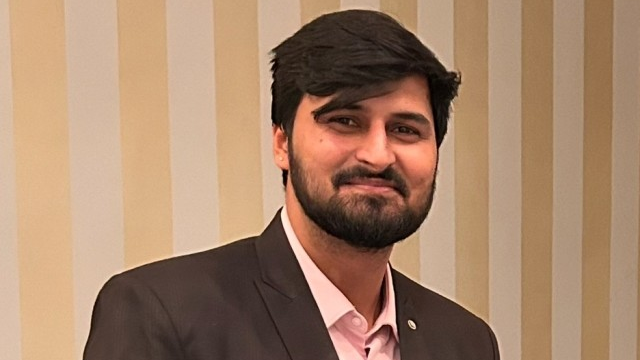
Naman Dubey
Dehradun

Join FREE expert session and get:
University Shortlist
Admit Eligibility
Financial Guidance
Book free counselling session
1/3Choose your dream country
When do you want to study abroad?
What's your highest level of education?
Have you completed Class 12th?
What was your Class 12 CGPA/percentage?
Are you a student or a parent/guardian?
Select your current city
How Leap will help you
 Personalised University Shortlist
  Express Applications with Quicker Admits
  End-to-End Application Support
 Walk into our Dehradun office for a face-to-face consultation with our regional experts.
Address
Hathibarkala Salwala, Dehradun, Uttarakhand, 1st floor, Max Plaza,Rajpur Rd, Ravindrapuri, Hathibarkala Salwala, Dehradun, Uttarakhand 248001


2M+
Students Assisted
50,000+
Courses Offered
1,500+
Partner Universities
98%
Admit Chances
Over 20,000+ success stories from students just like you.

Rakesh Kukreti
S Ahmed
Tsering Palmo
Q1. Is there a LeapScholar office in Dehradun?
A. Leap Scholar's Dehradun office is at the 1st floor, Max Plaza, Rajpur Road, Ravindrapuri, Hathibarkala Salwala, Dehradun, Uttarakhand 248001. The office is on Rajpur Road, one of the main arterial roads in the city, making it accessible from central Dehradun, Clock Tower, Rajpur, and Vasant Vihar by auto or cab in 10 to 20 minutes. You can call (+91) 90083 78585 to confirm walk-in timings or to schedule a session. Online counselling is also available for students based in Haridwar, Roorkee, Mussoorie, or elsewhere in Uttarakhand who cannot visit in person.
Q2. Which is the best study abroad consultant in Dehradun?
A. The most useful question to ask any consultant is, "Who will actually handle your case, and what is their specific destination expertise?" At LeapScholar's Dehradun office, Naman Dubey (7+ years, UK/Ireland/Germany) and Porshya Singh (4+ years, Australia/New Zealand) handle cases in their destination lanes rather than generalizing across every country. When choosing an overseas education consultant in Dehradun, look for a counselor who reviews your actual profile before recommending universities, states honestly when a target program is out of reach, and has verifiable experience with the specific country you're targeting, not just general study abroad knowledge.
Q3. Should I study in Canada or the UK from Dehradun?
A. This depends significantly on your field of study, your IELTS score, and what you want after graduation. Here is a factual comparison:
Q4. How much does it cost to study abroad from Dehradun?
A. Costs vary significantly by destination. As a general reference for 2026–27:
Education loans through Leap Finance can cover tuition and living expenses for eligible profiles. Exchange rate used: Rs.96 per USD. Verify the current rate before finalizing your budget.
Q5. What documents do I need for a UK student visa from Dehradun?
A. The UK Student Route visa application typically requires:
Document requirements can change; verify the current list at UKVI's official page before submitting.
Q6. What IELTS score do I need to study in the UK or Germany?
A. For the UK, the minimum for a Student Route visa is IELTS 5.5 per band, but most taught master's programs require 6.5 overall with no band below 6.0. Competitive programs at Russell Group universities commonly require 7.0 overall. Check the specific language requirement on your program page, not just the university's general entry page.
For Germany, public university Masters programs taught in English require an IELTS Academic of 6.0 to 6.5 overall depending on the institution. Programs taught in German require TestDaF or DSH language certification a separate preparation track. Students from Dehradun targeting German-taught programs should build at least 12 months of German language study into their preparation timeline.
Q7. Can LeapScholar in Dehradun help with education loans for studying abroad?
A. Yes. The Dehradun team connects students with LeapFinance, which offers education loan products for study abroad. Eligibility depends on your profile, the institution, and the loan amount required. The pre-approval process typically takes 6 to 8 weeks from document submission to sanction, so loan discussions should begin at the shortlisting stage rather than after an offer is received. Key documents for a loan application include: admission offer letter, fee structure from the university, academic transcripts, co-applicant income proof (usually a parent or guardian), and property documents if a secured loan is being considered.
Q8. How far in advance should I start study abroad counseling in Dehradun?
A. The minimum lead time depends on your destination and target intake:
If you're also sitting IELTS or GRE, add 8 to 12 weeks before the application deadline to allow for prep and a retest if needed.
Q9. Does LeapScholar in Dehradun provide online counselling for students outside the city?
A. Yes. Students from Haridwar, Roorkee, Haldwani, Rishikesh, and other parts of Uttarakhand who cannot visit the Rajpur Road office can access the same counseling services online through LeapScholar's platform. Sessions are conducted via video call, and all document reviews, SOP feedback, and visa preparation work can be handled remotely. Students who want an in-person session for the initial profile evaluation and then continue online for subsequent stages can also request that hybrid format.
Q10. Which is the best consultancy in Dehradun for abroad studies?
A. LeapScholar's Dehradun office offers free counseling across profile evaluation, university shortlisting, SOP and LOR guidance, student visa preparation, and education loan support. If you are comparing consultancies in Dehradun for abroad studies, the relevant checks are whether counselling is charged, whether counsellors specialize by destination, and whether the office has a verifiable admit track record for your target country.
Q11. Who are the best study abroad consultants in Dehradun?
A. LeapScholar's Dehradun office team offers free counseling for UK, USA, Canada, Germany, Australia, and Ireland. Counsellors hold 6 to 8 years of experience and are matched to your target destination. Book a session at leapscholar.com/study-abroad-consultant/dehradun.
Leap Scholar's Dehradun office on Rajpur Road provides in-person study abroad counseling for engineering graduates, commerce students, and working professionals from across Uttarakhand. Counselors Naman Dubey and Porshya Singh specialize in specific destinations: the UK, Germany, and Ireland on one side; Australia and New Zealand on the other, so the guidance you receive is based on real program knowledge, not a generic checklist. Online sessions are available for students outside the city. Book a free counseling session to start with a profile evaluation.
LeapScholar's Dehradun office is a free resource for students and working professionals planning studies overseas. As one of Dehradun's trusted abroad education consultants, the team covers every stage from initial profile assessment to student visa filing across UK, USA, Germany, Canada, Australia, and Ireland. Whether you are looking for study abroad consultants in Dehradun for a September or January intake, counseling is free, and the first session can be booked any day of the week.
Book a Free Counseling Session
The six services below are what the Dehradun counseling team works through with students, from the first profile call to the visa stage. Each one is different depending on your destination and program. What follows is how the process actually works at this branch.
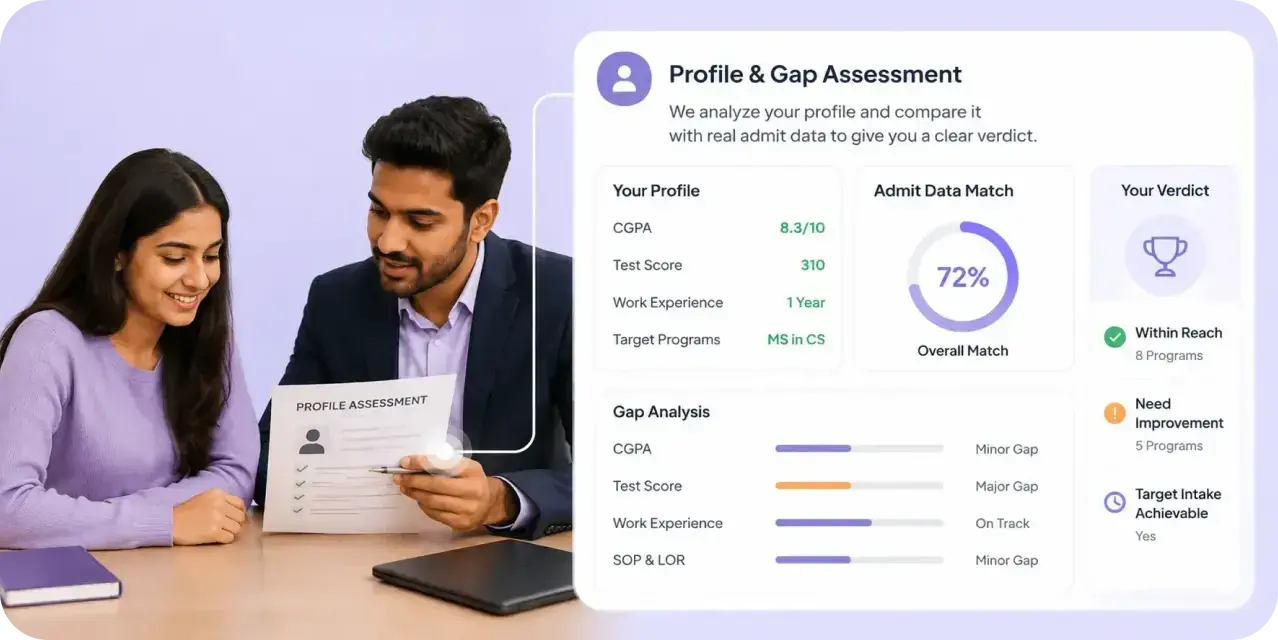
What this involves: The counselor reviews your academic transcripts, CGPA, backlogs (if any), test scores, and work experience against the typical admit profile for your target program and destination. This is done at the first substantive session before any shortlisting begins, because shortlisting without a realistic profile assessment wastes everyone's time.
Where Dehradun students struggle: Students from Graphic Era University, DIT University, Uttaranchal University, and other Dehradun-area colleges often arrive with a university list in mind but haven't verified whether their CGPA and GRE or IELTS score match the actual admit cohort for those programs. A 7.2 CGPA that feels strong at a local college may sit below the median admit for the target program, and the counselor needs to surface that clearly before the application process begins. This is one of the most common gaps our overseas education consultants in Dehradun flag in a first session: students arrive with a target that does not match their current profile data.
What the counselor does: The counselor maps your profile against admission data for programs that are realistically within reach, identifies the two or three gaps that most affect your competitiveness, and flags whether those gaps can be addressed before the target intake window. This is overseas education counseling at the point where it matters most.
Honest limit: The counselor can identify your gaps and tell you what would improve your position. Whether you address those gaps retaking IELTS, building a stronger work portfolio, or resolving backlogs before the target intake is your decision.
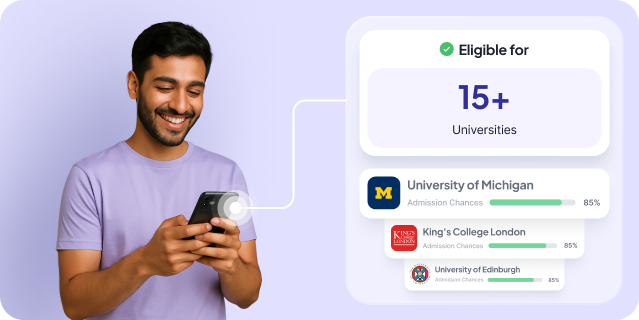
What this involves: Profile-based university shortlisting means building an application list across three tiers: programs where your profile is competitive (match), programs where you're a stronger candidate (safe), and programs where admission is possible but less certain (reach). The balance between these tiers depends on your risk appetite, budget, and timeline. For Dehradun students, Naman Dubey covers study in the UK, Ireland, and Germany; Porshya Singh handles Australia and New Zealand.
Where Dehradun students struggle: The most common shortlisting error is building a list dominated by QS-ranked brand names without checking program-specific admit data. A university ranked 50th globally may have a Computer Science department whose median admit GRE is 320 and CGPA is 8.5, information that isn't in the ranking table but is readily available and directly relevant to whether you apply there.
What the counselor does: Naman or Porshya shortlists based on actual cohort data for the specific program, not just the destination country. They also cross-check each shortlisted program's tuition against your education loan eligibility so there are no late surprises when the offer arrives and the fee has to be paid.
Honest limit: The counselor can build the strongest possible shortlist based on your profile and your target programs. You make the final decision on how many schools to apply to, which tier to prioritize, and what budget range to aim for.
What this involves: Statement of Purpose work at this branch means either building an SOP from scratch with the counselor or reviewing a draft the student has already written. LOR guidance covers which recommenders to approach, how to brief them, and what a strong recommendation actually needs to say, which often differs from students' assumptions.
Where Dehradun students struggle: SOPs from engineering students at Dehradun colleges often read as academic resumes in paragraph form. They list the CGPA, name the final-year project, mention a coding language, and then state that the student "wishes to pursue an MS." None of this tells the admissions committee why this student, this program, and this moment connect into a coherent narrative and the absence of that thread is what makes an SOP forgettable.
What the counselor does: The counselor works through your academic history, any research or internship experience, and your stated program goal to identify the two or three narrative threads that are genuinely distinctive. They also flag LOR requestors whose letters tend to be generic. A supervisor who writes the same letter for every student they recommend is a risk to the application, and the counselor will tell you that directly. Students who have worked with the best study abroad consultants in Dehradun consistently cite SOP support as the service most responsible for their admission outcomes, particularly for UK and German programs.
Honest limit: The counselor shapes the structure and reviews the content. The voice, the experiences described, and the accuracy of every claim in the SOP are your responsibility. No one else can substitute for the genuine specificity that makes a strong statement.
What this involves: Student visa guidance covers the full document preparation process for your destination: the UK Student Route, the Canadian study permit, the German student visa, or the Australian student visa each has different requirements, different financial documentation standards, and different lead times. The counselor works through the applicable document checklist with you and conducts mock visa interview sessions with feedback.
Where Dehradun students struggle: Two consistent problems appear at this stage. First, students underestimate the financial documentation requirements, particularly for the UK Student Route, where the CAS letter and the specific bank balance requirements need to be met in a defined sequence. Second, students applying for the UK Graduate Route or Canadian study permit often start document collection too late, leaving the counselor trying to compress an 8-week process into 3 weeks.
What the counselor does: The counselor runs a pre-visa document audit 6 to 8 weeks before your intended visa application window. For UK applicants, this includes verifying the CAS details, financial evidence, and ATAS clearance if required by your subject. Mock visa interviews cover the most common questioning areas for your destination so you're not encountering them for the first time at the embassy.
Honest limit: The counselor prepares the strongest possible application and the strongest possible candidate for the interview. The visa decision rests entirely with the relevant embassy or immigration authority. No ethical consultant can guarantee a visa outcome.
What this involves: Scholarship identification at the Dehradun branch means identifying merit-based and need-based scholarships that are genuinely applicable to your profile at your shortlisted universities, not a list of every scholarship that exists for international students. Education loan assistance means connecting you with LeapFinance, which offers education loan products for students who need cost coverage beyond their family's capacity.
Where Dehradun students struggle: The most damaging timing error at this stage is applying for scholarships after admission acceptance rather than incorporating scholarship potential into the application strategy from the start. Some scholarships have deadlines that fall before the general admission deadline; missing them cannot be undone. Students from Uttarakhand also frequently underestimate how much lead time an education loan sanction requires, particularly when it needs to be presented before an offer deadline.
What the counselor does: The counselor identifies 3 to 5 scholarships relevant to your profile at the shortlisting stage, not after you've received an offer. For education loans, the team coordinates with Leap Finance to give you a realistic picture of what you'd qualify for and on what timeline so the financial picture is clear before you commit to an application strategy.
Honest limit: Scholarship awards are competitive and entirely controlled by the awarding institution. The counselor can identify opportunities and position your application to be scholarship-eligible. No one can guarantee an award.
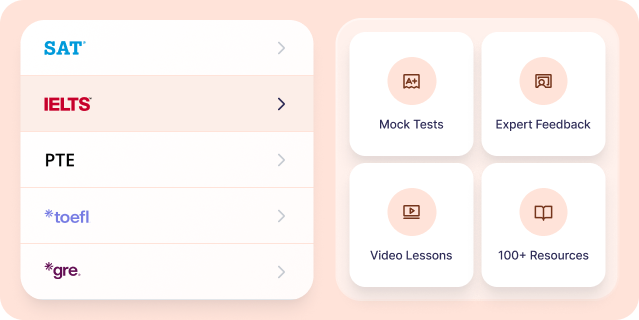
What this involves: At the profile evaluation stage, the counselor checks whether your current test score meets the requirements not just for your destination country but also for each specific program on your shortlist. Where it doesn't, they refer you to Leap Scholar's IELTS preparation programs or GRE preparation resources with a clear target score and a realistic timeline.
Where Dehradun students struggle: Two patterns come up consistently. Engineering students applying to US or German MS programs often skip the GRE entirely because it isn't mandatory at every institution, but for competitive programs at target universities, a strong GRE score strengthens the application significantly, and the counselor will flag this. The second issue is students applying with an IELTS 6.0 to programs that require 6.5 overall with no band below 6.0, a gap that seems small but results in rejection at the application stage.
What the counselor does: The counselor cross-checks the test score requirement for every shortlisted program individually, then gives you a clear verdict: your current score is sufficient, or you need to retest before applying. If a retest is needed, they advise on what timeline is realistic given your application deadlines. If you have 10 weeks before a deadline and need a 1.5-band improvement, the counselor will tell you whether that's achievable or whether the intake should shift.
Honest limit: Test score improvement depends on preparation effort and starting proficiency. The counselor gives you an honest assessment of what's achievable in the available time. The actual score is yours to earn.
Starting point: You're in your third or final year of a B.Tech in computer science, electronics, or mechanical engineering at a Dehradun college: Graphic Era University, DIT University, or Uttaranchal University. Your CGPA sits between 7.0 and 8.0. You haven't taken the GRE yet, and your IELTS is either pending or you scored a 6.5 on a previous attempt.
Target: MS in Computer Science, Electrical Engineering, or a related field. Germany appeals because public university tuition is minimal. Most Dehradun students looking at TU Munich, RWTH Aachen, or the University of Stuttgart are paying tuition in the range of Rs.0 to Rs.1.25 lakh ($0–$1,500) per semester, though living costs run approximately Rs.75,000–1,00,000 ($900–$1,200) per month. The UK appeals because the one-year program structure shortens the study timeline, and the Graduate Route visa allows two years of post-study work.
The timing problem: German university application deadlines for a September intake vary by department, but many technical programs close applications between January and April. If you want to start in September 2026, the preparation work SOP drafting, GRE sitting, and IELTS improvement, if needed needs to be underway by October or November 2025. Students who arrive in May or June asking about a September start are often looking at a year's delay, not a quick fix.
If you come in too late: A June walk-in wanting to start in Germany by September will almost certainly need to target the following year. The SOP alone requires multiple drafts and review cycles; adding a GRE sit and an IELTS retest into a 6-week window is not realistic. The counselor will tell you this directly rather than take your case and deliver a weak application.
What the counselor does: Naman Dubey maps your CGPA and test scores against admission data for specific German university departments and UK programs with realistic admit probability for your profile. He identifies the gaps — typically GRE score, IELTS band, or a thin research or project narrative in the SOP — and builds a preparation timeline that sequences test prep, SOP work, and application submission in the right order. For MS in Computer Science abroad from a Dehradun engineering background, the process works when it starts early.
Starting point: You've completed a BBA, B.Com, or BA from a Dehradun degree college, or you're 1 to 2 years into your first job. You're looking at a Master of Business Administration, Master of Accounting, or Master of Marketing. Australia and New Zealand appeal because of their post-study work rights: the Temporary Graduate visa (subclass 485) in Australia allows 2 to 4 years of work after graduation depending on the location of study; New Zealand's Post-Study Work visa allows up to 3 years.
Target: September intake in Australia or February intake in New Zealand; programs at universities in Melbourne, Brisbane, or Auckland. Total tuition for a two-year master's in Australia runs approximately Rs.20–30 lakh ($24,000–$36,000) depending on the university and program. Living costs add roughly Rs.1,20,000–1,50,000 ($1,440–$1,800) per month. An education loan from Leap Finance covers many of these costs, but the sanction process has its own timeline.
The timing problem: Australia's September intake has many business programs closing applications in April or May. Students who need an education loan and most Dehradun students do often don't account for the 6 to 8 weeks it takes to gather the financial documents, get the loan sanctioned, and have the funds available in the form the university requires. Starting the process in March for a September intake is risky; starting in January gives the loan process more time.
If you come in too late: An education loan that isn't sanctioned before an offer deadline means the offer lapses. Universities in Australia do not hold places indefinitely while loan paperwork catches up. The next intake is typically 6 months away, which is a real and costly delay.
What the counselor does: Porshya Singh identifies programs where the post-study work rights are strongest for your specific field of study (not every program in every city qualifies for the full 485 visa duration) and checks that your IELTS score and CGPA meet the specific entry requirement for each institution, not just the country minimum. She coordinates the application timeline with the education loan pre-approval process so both move in parallel rather than sequentially.
Review 1: "Session was good, counsellor naman, sir, cleared my all doubts, he explained me everything"
Review 2: "Prachi mam was excellent in assisting, whole team was good in assisting and resolve all queries."
Review 3: "The counsellor were very polite n sweet, they attended to all my queries, n I was able to get much needed insight on my study abroad journey."
Connect with India's best counsellors and the largest study abroad community.
Connect with India's finest counsellors and biggest study abroad community.