Blogs
Blogs  Leap Digest
  Events
  About Us
 Expert Insights
Public vs. Private Tech Universities in Germany: The Zero-Tuition Reality Check
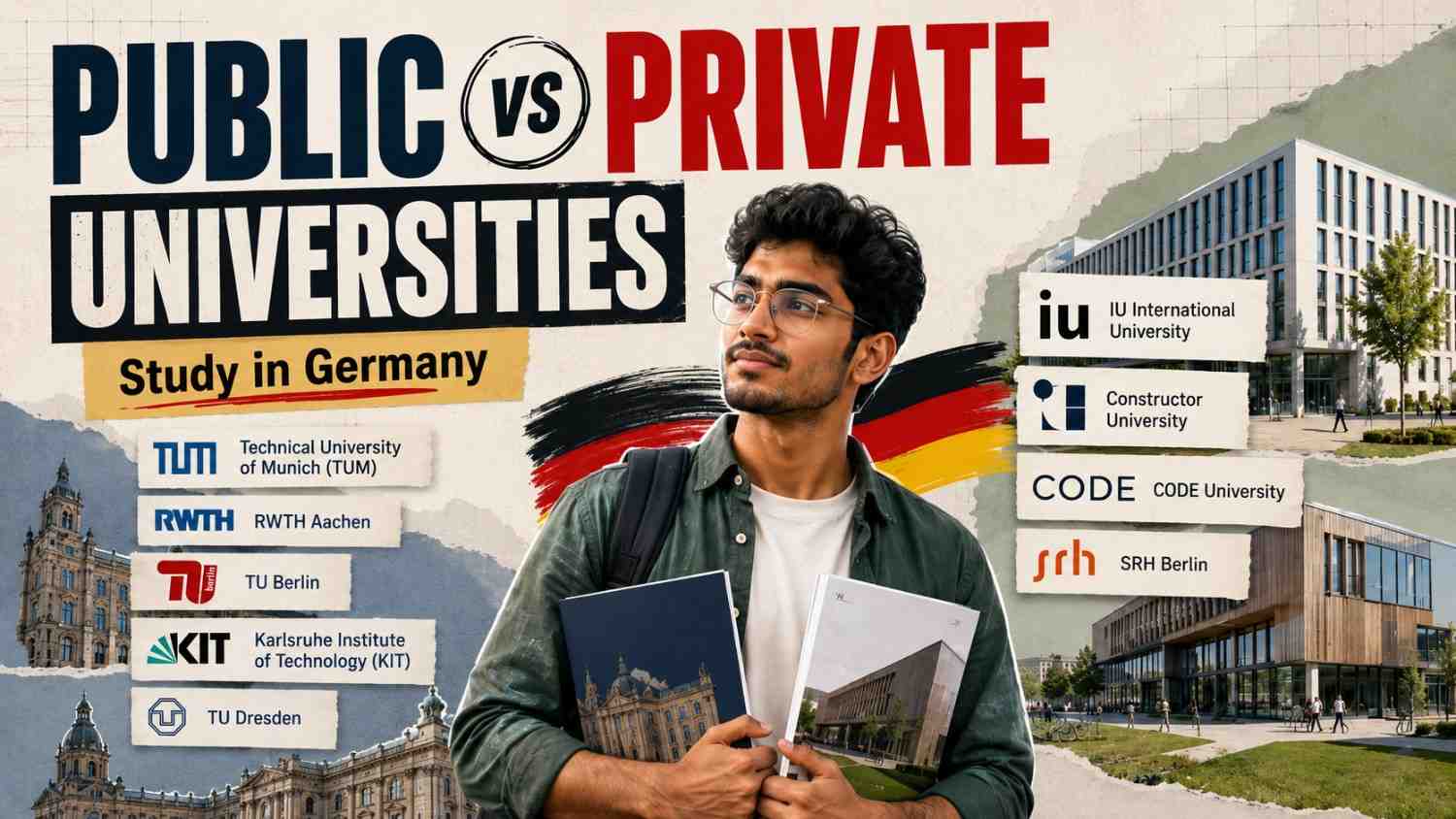
"Germany is free." That is the sentence most Indian students remember after their first search. It is mostly true; public universities in Germany charge zero tuition in 14 of 16 states. But "mostly true" hides details that change the financial picture significantly.
Currency note: 1 EUR = Rs. 109.10 as of July 9, 2026 (BookMyForex/Wise mid-market rate). Always verify current rates before financial planning.
The Zero-Tuition Reality: What It Actually Means
Germany's public universities charge zero tuition in 14 of 16 states, applying equally to Indian and domestic students. Three things complicate the "free" headline.
Semester contributions are mandatory: Every public university charges EUR 150 to EUR 430 per semester (approximately Rs. 16,365 to Rs. 46,913). This covers student union membership, administrative services, and usually a public transport pass. Over a 4-semester master's: EUR 600 to EUR 1,720 (Rs. 65,460 to Rs. 1,87,772). Not tuition. Not optional.
Two states charge extra for non-EU students:
- Baden-Württemberg: EUR 1,500 per semester (approximately Rs. 1,63,650) for non-EU students, including Indians, at Heidelberg, Stuttgart, and all BW institutions. Over 4 semesters: EUR 6,000 extra (Rs. 6,54,600).
- TUM in Bavaria: The Technical University of Munich charges EUR 2,000 to EUR 6,000 per semester for most international master's programs. Software engineering and bioinformatics remain free. Check your specific program before assuming.
The blocked account is mandatory: Every Indian student must deposit EUR 11,904 into a blocked Sperrkonto account before visa issuance. This is your own money, returned at EUR 992 per month after arrival. Setup at Expatrio or Fintiba costs EUR 70 to EUR 150 (Rs. 7,637 to Rs. 16,365).
Public Tech Universities: The TU9 Alliance
Germany's most prestigious tech universities sit within the TU9 alliance, nine institutions that educate the majority of Germany's engineering and CS graduates.
The TU9 universities:
- Technical University of Munich (TUM): QS #25 globally, 2027.
- RWTH Aachen: QS #104 globally, Germany's largest technical university.
- TU Berlin: QS #145 globally, AI, computer science, smart systems.
- Karlsruhe Institute of Technology (KIT): QS #116 globally, top-ranked for informatics.
- TU Dresden: microelectronics and embedded systems.
- TU Darmstadt: cybersecurity and distributed systems.
- TU Braunschweig: automotive software and robotics.
- Leibniz University Hannover: applied computer science.
- University of Stuttgart: aerospace and robotics software.
What TU9 offers:
- Zero tuition in most states, with access to EUR 3+ billion in annual research funding and strong employer pipelines. SAP, BMW, Bosch, Siemens, and the Mittelstand all recruit actively from TU9 campuses.
- The Werkstudent (working student) program: up to 20 hours per week during the semester inside a German company. This is the single biggest accelerant toward a first job; German practical experience secured during studies converts faster than any application sent from India.
The challenges:
- Admissions are competitive. Rejected applications at TUM and RWTH are common.
- Most bachelor's programs are German-medium. English-medium options concentrate at the master's level.
- The APS certificate (mandatory since November 2022, non-refundable, EUR 175, approximately Rs. 19,089) takes 3 to 4 weeks standard and 8 to 10 weeks at peak season. Factor this in.
Private Tech Universities: What You Pay and What You Get
As of 2026, approximately 70% of English-taught bachelor's programs in Germany are at private institutions. For master's, the gap is smaller. Private universities charge EUR 8,000 to EUR 40,500 per year (Rs. 8.73 lakh to Rs. 44.19 lakh).
The four notable private tech institutions:
University | Tuition/year | Specialisation | Intakes |
| IU International University | EUR 10,000–20,000 | CS, AI, Data Science, Cybersecurity | Multiple per year, rolling |
| Constructor University (Bremen) | EUR 20,000 | Data Science, Computer Science | Annual |
| CODE University (Berlin) | EUR 10,000–12,000 | Software Engineering, UX, Product | Rolling |
| SRH Berlin | EUR 8,000–15,000 | Tech and Business | Multiple per year |
Before applying to any private university: Verify state recognition using the HRK Compass (hrk.de/en/higher-education-compass/). Indian banks, including SBI, Bank of Baroda, and HDFC Credila, reject education loans for unrecognized institutions, and your APS certificate and visa also require state recognition.
What private universities give you:
- English-medium bachelor's programs, very rare at public universities.
- Rolling admissions with multiple start dates. Missing one window does not cost you six months.
- Smaller cohorts (20 to 40 students), structured career services, and faster admissions decisions.
What they do not give you:
- The research depth and employer brand of TU Munich, RWTH, or KIT.
- The same Werkstudent pipeline access at major German corporates.
- DAAD scholarships, which generally favor public university enrollment.
Scholarships at private universities: The Deutschlandstipendium (EUR 300/month, approximately Rs. 32,730/month) is available at both public and private universities; it is the one major German scholarship that does not favor either route. Many private universities also run their own merit scholarships covering 25 to 100% of tuition. IU, Constructor University, and Frankfurt School all have scholarship programs for international students. Check each institution's scholarship page before assuming "private means fully self-funded."
The dMAT exam, mandatory from Summer Semester 2027: Indian students applying for master's programs in engineering and computer science at German universities must now sit the Digital Master Test (dMAT) as part of the APS verification process. This applies to both public and private universities. Registration opened June 29, 2026. Registration deadline: September 15, 2026. First exam: September 26, 2026. Fee: EUR 150 (approximately Rs. 16,365). Students applying for Summer Semester 2027 and beyond are affected. Factor this into your application timeline.
The Full Cost Comparison: 2-Year Master's in Tech
Cost item | Public (14 states) | Public (BW or TUM) | Private (mid-tier) |
| Tuition | EUR 0 | EUR 3,000–12,000 | EUR 16,000–40,000 |
| Semester contributions | EUR 600–1,720 | EUR 600–1,720 | EUR 0–800 |
| Living costs (2 years) | EUR 18,000–26,000 | EUR 18,000–26,000 | EUR 18,000–26,000 |
| APS certificate | EUR 175 | EUR 175 | EUR 175 |
| Total outlay | Rs. 20.49–30.44 lakh | Rs. 23.76–43.53 lakh | Rs. 37.30–74.07 lakh |
The blocked account (EUR 11,904) is not included; it is your own money returned monthly, not a cost.
Which Route Fits Your Profile?
Choose public if:
- You can secure admission (GPA above 8.5 on a 10-point scale for most programs).
- You are applying for a master's degree, where English options are widely available.
- Budget is your primary constraint, and you want the strongest employer brand for your first German job.
Choose private if:
- You need an English-medium bachelor's and cannot manage German language instruction.
- You missed a public intake and cannot wait six months for the next cycle.
- You want smaller cohorts, direct faculty access, and structured career support.
- You can manage higher tuition through loans or scholarships and are targeting startup or Berlin tech roles.
The LeapScholar Software Engineer Germany Guide covers salary ranges, the EU Blue Card and 21-month PR pathway, the Werkstudent strategy, city-by-city living costs, and a month-by-month planning timeline.
Talk to a Leap Scholar counselor to decide whether public or private is right for your profile, how to approach APS, and what your admissions timeline looks like for 2026 or 2027 entry.
Sources: MS in Germany, Public vs Private Universities 2026 | Studying-in-Germany.org, Cost to Study in Germany 2026 | Study.eu, Germany Private vs Public Universities | BookMyForex, EUR to INR July 8, 2026 | TopUniversities, Technical University of Munich QS 2027 Official Profile | TopUniversities, RWTH Aachen QS 2027 Official Profile

Kirti Singhal
Kirti is an experienced content writer with 4 years in the study abroad industry, dedicated to helping students navigate their journey to international education. With a deep understanding of global education systems and the application process, Kirti creates informative and inspiring content that empowers students to achieve their dreams of studying abroad.
Users also read

Top 10 Industries That Create the Most Billionaires in 2026: Guide for Indian Students

Stanford MBA Career Diversity: Industries, Salaries and What Indian Students Need to Know

Anthropic Academy: 16 Free AI Courses With Certificates in 2026 That Indian Students Cannot Afford to Ignore