Blogs
Blogs  Leap Digest
  Events
  About Us
 Expert Insights
Best Countries for Post-Study Work Permits in 2026: Ranked for Indian Students
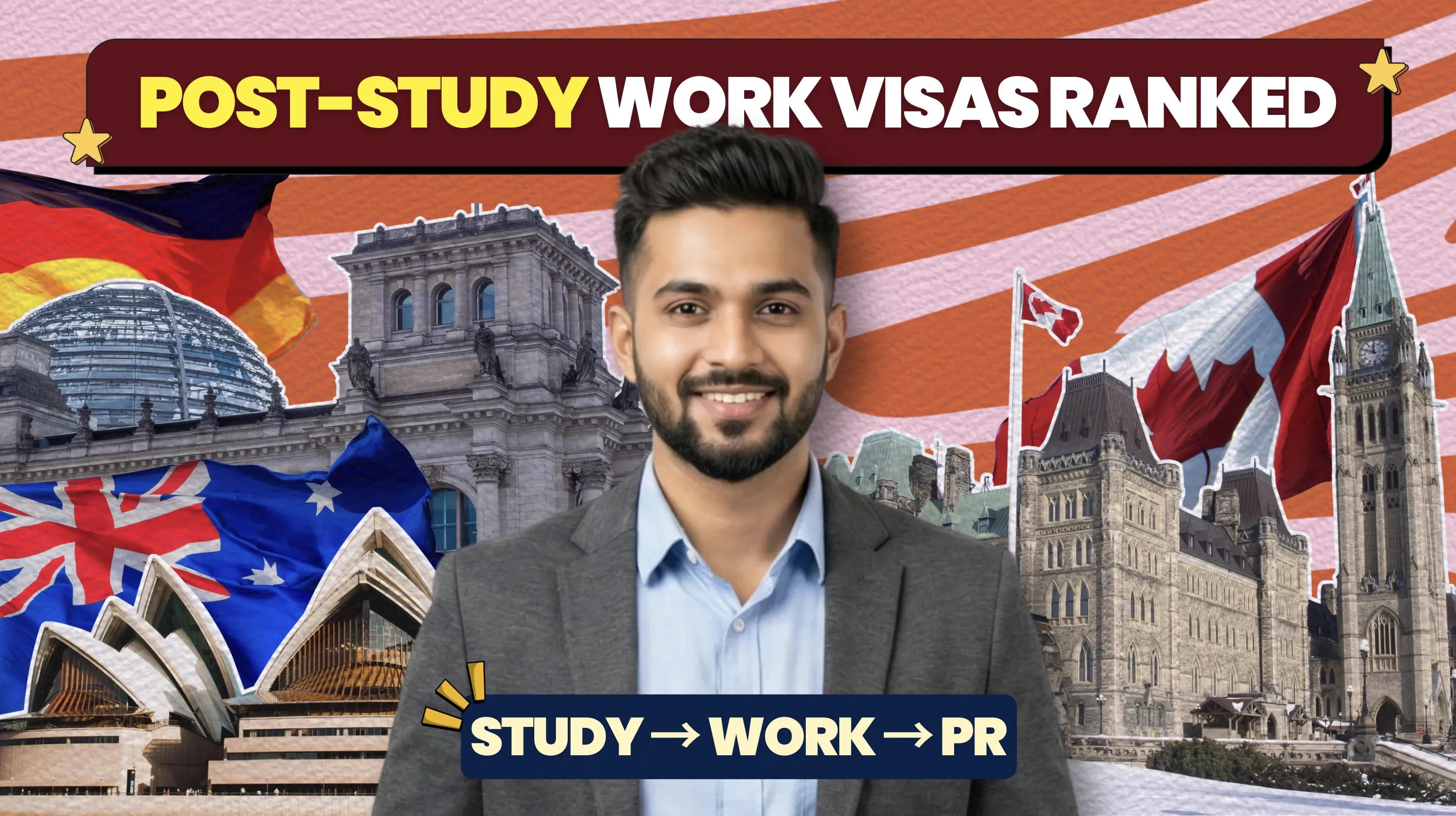
Picking a country to study in is not just about tuition fees or rankings. For most Indian students, the real question is, what happens after graduation? Can I stay, work, and build something there, or am I on a flight home the moment my student visa expires?
Here is how 15 of the most popular study destinations stack up, ranked honestly, for Indian students planning their next move in 2026.
The Top Tier: Where the System Actually Works for You
Canada: 10/10
- Permit: Post-Graduation Work Permit (PGWP) of up to 3 years
- Work rights: Open permit, any employer, any field
- What makes it special: The PGWP feeds directly into Express Entry and Provincial Nominee Programs, meaning graduation in Canada is often the first real step toward permanent residency
- Bottom line: If long-term settlement is your goal, no country offers a more structured path from student to resident.
Important 2026 update: PGWP rules changed significantly from late 2024. Degree graduates (bachelor's, master's, and PhD) must now submit a valid language test result (CLB 7) with their application. College and diploma graduates face field-of-study restrictions; many programs, including business administration and hospitality, are no longer PGWP-eligible. The PGWP is also a one-time permit per lifetime. Verify your program's eligibility at canada.ca before applying.
Australia: 9/10
Permit: Post-Study Work Visa (Subclass 485):
- Bachelor's (including honours): 2 years
- Master's by coursework: 2 years
- Master's by research: 3 years
- PhD/Doctoral: 3 years
- Indian nationals under AI-ECTA: +1 year (Master's = 3 years, PhD = 4 years)
- Regional study bonus: additional 1–2 years may apply
Note: The previous 4–6 year extensions for skill shortage graduates were discontinued in mid-2024 and no longer apply.
- Age limit: Most applicants must be under 35. PhD and Master's by research graduates may apply up to age 50.
- Work rights: Work for any employer, any role
- Sectors in demand: Healthcare, engineering, education, technology
- Bottom line: Strong duration, smooth process, and a skilled migration route that Indian graduates have successfully navigated for years
Germany: 9/10
- Permit: 18-month job-seeking visa after graduation
- Work rights: Part-time work allowed while job hunting; full rights once employed
- What comes next: Employment at a qualifying salary moves you into the EU Blue Card, long-term residency with a clear PR route
- Sectors in demand: Engineering, IT, healthcare, business
- Bottom line: 18 months of real breathing room, and the EU Blue Card makes Germany a destination, not just a stopover
The Strong Middle: Good Systems with Real Conditions
Ireland: 8/10
- Permit: 2-year third-level graduate scheme for postgraduates
- Work rights: No job offer needed to activate the permit
- What makes it special: Google, Apple, Meta, Pfizer, IBM, and over 1,000 multinationals run European operations from Ireland. The path from graduate permit to employment permit is well-worn.
- One honest caveat: Dublin's cost of living has risen sharply. Budget for it
- Bottom line: If tech, pharma, or finance is your field, Ireland's company base is hard to match anywhere in Europe
Denmark: 7/10
- Permit: Up to 3 years job-seeking residence permit after bachelor's, master's, or PhD
- Work rights: Limited hours during job search, full rights once employed
- Sectors in demand: IT, engineering, healthcare
- Note: From January 2026, Denmark tightened rules for dependents during the post-study period. Check current rules if you plan to bring family
- Bottom line: Generous permit length and a strong PR pathway for graduates who land qualifying roles
Netherlands: 7/10
- Permit: 1-year Orientation Year (Zoekjaar) permit
- Work rights: Work for any employer, freelance, or start a business; no separate work permit needed
- What comes next: Direct pathway to the Highly Skilled Migrant visa once employed.
- Bottom line: One year is shorter than competitors, but the freedom within that year is real. Have your job search plan ready before you graduate
United Kingdom: 7/10
The UK’s Graduate Route is flexible at the start. The complexity comes later.
- Permit: 2 years after graduation, 3 years for Ph.D. holders (for applications submitted by December 31, 2026)
- Work rights: No job offer required, no restriction on role type
- What makes it work: London is genuinely one of the best cities in the world for finance, tech, consulting, and media careers
- The honest catch: Moving into long-term UK work requires Skilled Worker visa sponsorship, and not every employer is a licensed sponsor. Outcomes vary significantly by sector
- Bottom line: Strong for students targeting London-based industries. Less predictable for everyone else
Critical 2026/2027 update: The UK government has confirmed that from January 1, 2027, the Graduate Route will be reduced from 2 years to 18 months for bachelor's and master's graduates. PhD graduates continue to receive 3 years of support. Applications submitted by December 31, 2026, will still receive the full 2 years. Plan your graduation and application timeline accordingly.
France: 7/10
France's graduate pathway is solid. Whether it works for you depends largely on one variable: language.
- Permit: Up to 2 years to find work after graduation
- Sectors in demand: Engineering, luxury goods, finance, technology
- The real factor: Paris has a meaningful English-speaking corporate sector, but knowing French substantially improves your job prospects and daily life everywhere outside the office
- Bottom line: If you are willing to learn the language, France becomes a significantly stronger proposition than most Indian students realize.
The Conditional Tier: Possible, but Depends on Your Situation
United States: 5/10
- Permit: OPT gives 12 months for non-STEM and up to 36 months for STEM graduates
- The problem: After OPT, long-term work requires the H-1B visa, which is lottery-based with historically under 30 percent acceptance rates
- For Indian students specifically: The green card backlog adds years, sometimes decades, of uncertainty on top of the H-1B lottery
- Bottom line: You can do everything right and still lose. The US rewards those who get through, but the pathway is genuinely unpredictable
New Zealand: 6/10
- Permit: Up to 3 years depending on degree and study location
- Sectors in demand: Healthcare, agriculture, engineering, IT
- The honest constraint: New Zealand is a small economy. If your field aligns with demand, the pathway works well. If it does not, options narrow quickly
- Bottom line: A good option for the right profile. Less suitable for graduates in fields without clear local demand
Sweden: 6/10
- Permit: 12 months to seek employment after graduation
- Work rights: Full work rights during the permit period
- Sectors in demand: Technology, engineering, renewable energy, life sciences
- The challenge: 12 months is a short window, and English, while widely used in Swedish workplaces, is not universal outside major cities
- Bottom line: Strong for STEM graduates, tighter for everyone else
Singapore: 6/10
- Permit: Short-term work passes available after graduation
- Long-term reality: Permanent residency is discretionary and competitive. Staying long-term depends almost entirely on employer sponsorship
- Best suited for: Finance, technology, and trade roles at MNCs or financial institutions
- Bottom line: A strong short-term career launchpad. Not the most predictable long-term settlement option
Japan: 6/10
- Permit: Work visa pathways available after graduation
- Sectors in demand: Technology, engineering, manufacturing
- The honest truth: Most career progression in Japan requires functional Japanese. International company roles in English exist, but they are not the norm
- Bottom line: Investing in the language unlocks a job market actively seeking international talent
South Korea: 6/10
- Permit: D-10-1 job-seeker visa for graduates of recognised Korean universities
- Sectors in demand: Technology, semiconductors, automotive, shipbuilding
- The language factor: English-medium roles at Korean conglomerates and international firms are more available than a decade ago, but deep career progression still benefits from Korean
- Bottom line: A growing option, particularly for STEM graduates willing to engage with the language
Finland: 6/10
- Permit: 1-year extended residence permit to seek employment
- Sectors in demand: Technology, engineering, design, life sciences
- Well-known employers: Nokia, KONE, Wärtsilä, and a growing startup ecosystem in Helsinki
- The honest barrier: Finnish is one of the harder languages to learn. Helsinki's corporate sector is increasingly English-friendly, but full integration requires effort on the language front
- Bottom line: Worth a serious look for STEM and design graduates, especially those interested in Scandinavia's quality of life
Conclusion
If long-term settlement matters to you, Canada and Australia remain the clearest, most accessible routes for Indian students. Germany and Ireland are the best European options if you prepare for what each requires.
If flexibility is the priority, the UK, Netherlands, and Denmark all deliver with the right profile. The US has the biggest professional upside but the least predictable path.
Not Sure Which Country Fits Where You Are Right Now?
The right destination depends on your degree, your field, your budget, and what you actually want your life to look like in five years. A ranking can point you in a direction. A counselor can tell you specifically which path makes sense for your profile.
Book a free session with a Leap Scholar counselor and get an honest picture of which countries and pathways match where you are today.
Sources: IRCC : Post-Graduation Work Permit Canada | Australian Department of Home Affairs, Subclass 485 | German Federal Foreign Office, Job Seeker Visa | IND Netherlands: Orientation Year Permit | UKVI : Graduate Route Visa | UK Home Office, Graduate Route Reduction Confirmation | Irish Naturalisation and Immigration Service | Swedish Migration Agency | Study in Denmark: Official Portal

Kirti Singhal
Kirti is an experienced content writer with 4 years in the study abroad industry, dedicated to helping students navigate their journey to international education. With a deep understanding of global education systems and the application process, Kirti creates informative and inspiring content that empowers students to achieve their dreams of studying abroad.
Users also read

Top 10 Industries That Create the Most Billionaires in 2026: Guide for Indian Students

Stanford MBA Career Diversity: Industries, Salaries and What Indian Students Need to Know

Anthropic Academy: 16 Free AI Courses With Certificates in 2026 That Indian Students Cannot Afford to Ignore