
Quick Read
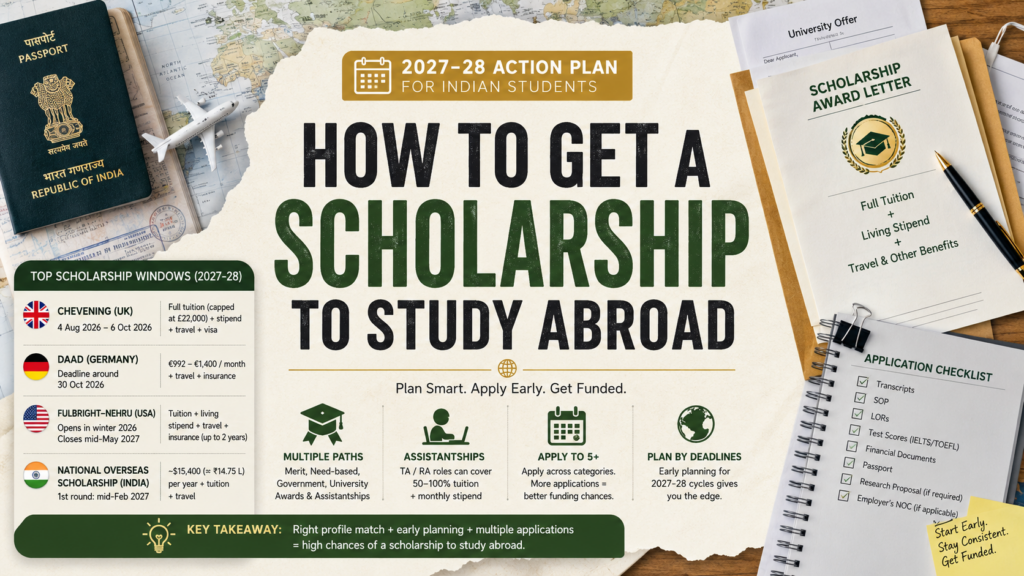
- To get a scholarship to study abroad comes down to profile fit, timing, and applying to more than one source of funding.
- Chevening’s 2027-28 window is open right now: applications close 6 October 2026.
- Merit, need-based, government, and university awards each judge a different part of your profile.
- Graduate assistantships (TA/RA roles), not just scholarships, fund a large share of US Master’s students.
How to Get a Scholarship to Study Abroad?
The first step is matching your profile to the right funding category, since merit awards, need-based grants, and government scholarships each evaluate entirely different things.
A merit scholarship looks at your grades and test scores. A need-based grant looks at your family’s income. A government scholarship, like Chevening or Fulbright, looks at leadership and a plan to return home and contribute. Applying to the wrong category wastes your strongest material on committees who were never going to weigh it. That category match is the real answer to how I can get a scholarship to study abroad.
Counselor insight: The students who get funded aren’t always the ones with the highest CGPA. They’re the ones who matched their actual strengths, leadership, financial need, or a niche research fit to the scholarship type built to reward exactly that.
Types of Scholarships for Indian Students to Study Abroad
How to get a scholarship to study abroad starts with knowing which type you’re actually eligible for.
| Scholarship Type | What It Rewards | Examples |
| Merit-based | Strong academic transcripts and test scores | University of Toronto International Scholar Award, Imperial College Global Excellence |
| Need-based | Demonstrated financial need, usually verified through FAFSA (US) or income documents | Harvard Financial Aid, need-based grants at ETH Zurich |
| Government | Leadership potential, professional experience, or a national development priority | Chevening (UK), Fulbright-Nehru (US), DAAD (Germany), National Overseas Scholarship (India) |
| University-specific | Fit with a particular university’s priorities | UCL Global Undergraduate Award, University of Sydney Vice-Chancellor’s Award |
| Graduate assistantships | Research or teaching capacity, mainly at Master’s and PhD level | Teaching Assistant (TA) and Research Assistant (RA) roles at US and Canadian universities |
| Private or trust-funded | Merit plus a specific eligibility criterion set by the trust | Inlaks Scholarship, JN Tata Endowment, KC Mahindra Scholarships |
Counselor insight: Graduate assistantships are the most under-used route we see among Indian applicants. A TA or RA position can cover 50 to 100 percent of tuition plus a monthly stipend, and unlike most scholarships, you apply for it after admission, directly with your department, not through a separate portal.
Scholarship to Study Abroad After 10th or After 12th: What’s Realistic
Most of the routes above, Chevening, Fulbright-Nehru, and DAAD assistantships, require a completed bachelor’s degree or years of work experience. If you’re looking for a scholarship to study abroad after 12th or even after 10th, the realistic options look different.
| Stage | Most Credible Route | Typical Coverage |
| After Class 10 | United World Colleges (UWC) | Need-based support is available, ranging from partial assistance to full coverage. Total fees for the two-year diploma range roughly from $25,000 to $75,000 a year (₹23.95 lakh to ₹71.85 lakh a year), depending on the campus. Selection is competitive, based on an interview and essay process, not board exam scores alone. |
| After Class 12 | University-specific merit scholarships | The University of Toronto’s Lester B. Pearson Scholarship offers full tuition, books, fees, and residence for four years (around 37 awarded each year globally), or you can receive up to NZD 10,000 (₹5.51 lakh) through the University of Auckland’s International Excellence Award. Most flagship government scholarships (Chevening and Fulbright-Nehru) are Master’s-level only, so this is the more realistic route at this stage. |
Exchange rate used: USD 1 = ₹95.8, NZD 1 = ₹55.1 (rates as of August 2026). Verify the current rate before finalizing your budget, since it moves daily.
Counselor insight: Parents often ask how to get a scholarship to study abroad for a child straight out of school. The honest answer is that undergraduate funding is thinner and more university-specific than postgraduate funding, so shortlisting universities with strong merit-award histories matters more than searching for a single flagship scholarship.
Study Abroad Scholarship Windows Currently Open or Opening Soon
A few major routes have live or upcoming 2027-28 deadlines worth acting on now.
| Scholarship | Coverage | Status |
| Chevening (UK) | Full tuition (capped at £22,000 / ₹28.16 lakh for MBA programs), a monthly living stipend, return airfare, and visa costs, for a one-year Master’s | Open now: 4 August 2026 to 6 October 2026, 11:00 UTC |
| DAAD (Germany) | Monthly stipend of EUR 992 to EUR 1,400 (₹1.08 lakh to ₹1.53 lakh), depending on degree level, plus travel and insurance | Most programs close around 30 October each year; exact dates vary by course |
| Fulbright-Nehru Master’s (USA) | Tuition, living stipend, travel, and insurance for up to two years | Typically opens in the preceding winter and closes in mid-May; requires 3 years of work experience |
| National Overseas Scholarship (India) | Tuition, travel, and an annual maintenance allowance of approximately $15,400 (₹14.75 lakh) for SC, DNT, landless agricultural laborer, and Traditional Artisan candidates | The first round usually opens in February or March for 40 days (though the 2026-27 cycle opened in April); a second round opens around September–October if seats remain |
Exchange rate used: GBP 1 = ₹128, EUR 1 = ₹109, USD 1 = ₹95.8 (rates as of August 2026). Verify the current rate before finalizing your budget, since it moves daily.
Official sources: Chevening, Application Timeline, DAAD India, Scholarship Database, USIEF, Fulbright-Nehru Master’s Fellowships, Department of Social Justice and Empowerment, National Overseas Scholarship.
Counselor insight: Chevening being open right now is not a minor detail. It closes on 6 October 2026, and reading committees weigh your leadership essays as heavily as your academics, so a rushed application written in the final week rarely competes with one drafted over 6 to 8 weeks.
Documents You Need for a Study Abroad Scholarship
Every route to apply for a scholarship abroad asks for a similar core document set.
| Document | India-Specific Detail |
| Academic transcripts and mark sheets | CBSE, ICSE, or state board originals, attested where the scholarship requires it |
| Degree or provisional certificate | Required to confirm completion of your current level of study |
| Valid passport | Needed for identity verification on nearly every scholarship portal |
| English test score | IELTS, TOEFL, or PTE, depending on what the specific scholarship or university accepts |
| Statement of Purpose (SOP) | Should name the scholarship’s actual selection criteria, not just your general study-abroad goals |
| Letters of Recommendation (LORs) | At least one academic and one professional referee, briefed early on what the scholarship rewards |
| Resume or CV | Highlighting leadership, research, or community work relevant to the scholarship type |
| Financial documents | Bank statements, income certificate, or ITRs are required for need-based and government awards |
| Research proposal | Mandatory for MS by Research, PhD, and most assistantship applications |
| Employer’s NOC or endorsement | Required for government awards like Fulbright-Nehru and National Overseas Scholarship if you are currently employed |
Counselor insight: The employer’s NOC is the document students forget until the last week. If you are working and applying for a Fulbright-Nehru or National Overseas Scholarship, request it the same month you start your application, not after you’re shortlisted.
How to Apply for a Scholarship to Study Abroad: Step by Step
Here is how to apply for scholarship to study abroad once you know your category and have your documents ready.
- Match your profile to a category. Use the table above to identify whether you fit merit, need-based, government, or assistantship funding before you start researching specific names.
- Build a shortlist of 5 to 8 scholarships. Include at least one government award, one university-specific award, and one backup private or trust scholarship.
- Start documents 3 to 6 months out. Academic transcripts, LORs, and financial documents take longer to arrange than most students expect.
- Write a scholarship-specific SOP for each application. A generic SOP recycled across five scholarships comes across as generic to every reading committee.
- Apply to your target university first, where relevant. Many government scholarships, including Chevening, require an existing or conditional university offer before they will consider your application. That is the core of how to apply for universities abroad with scholarship funding attached: the offer and the scholarship application move in parallel.
- Submit early, not on the deadline day. Portals for high-volume scholarships like Chevening and DAAD slow down or fail in the final 48 hours.
Counselor insight: Students who stack 5 or more applications, rather than pinning everything on one flagship scholarship, consistently secure some level of funding. Full funding is rare. Partial funding, stacked from two or three sources, is realistic.
Scholarship Application Calendar for Indian Students, 2027-28
Timing is a bigger factor in how to get a scholarship to study abroad than most students expect.
| Month | What to Do |
| Aug to Sep 2026 | Shortlist scholarships and universities; Chevening’s window is open through 6 October |
| Oct 2026 | Submit Chevening and any DAAD applications with October deadlines |
| Nov to Dec 2026 | Prepare documents for Fulbright-Nehru and university-specific scholarships opening in early 2027 |
| Jan to Feb 2027 | Fulbright-Nehru applications typically open; National Overseas Scholarship’s first round usually opens mid-February |
| Mar to May 2027 | Fulbright-Nehru closes around mid-May; follow up on interview invitations for earlier applications |
| Jun to Aug 2027 | Confirm university admission and assistantship offers for a September 2027 intake |
Counselor insight: Build this calendar around the earliest deadline you’re targeting, not the latest. Students who plan around Chevening’s October close often miss DAAD’s own October deadlines because they assumed they had more runway.
How to Get Scholarship Abroad: A Decision Framework by Profile
The fastest way to work out how to get scholarship abroad for you is to match your profile against these three common cases.
- If you are a final-year undergraduate with strong grades but no work experience, focus on merit-based and university-specific scholarships rather than Chevening or Fulbright-Nehru, since both require 2 and 3 years of professional experience respectively.
- If you have 2 or more years of work experience and a clear leadership track record, Chevening or a Commonwealth-linked award is worth prioritizing, since your essays can lean on real professional impact rather than only academic results.
- If you are applying for a research-heavy Master’s or PhD in the US or Canada, approach departments directly about TA or RA assistantships alongside any scholarship applications, since assistantships are awarded separately from most external scholarships and can be combined with them.
Counselor insight: Most students only ask, “Which scholarship should I apply to?” The more useful question is “which of these three routes actually matches where I am right now,” since applying confidently to the right one beats spreading thin effort across all of them.
What to Do When Your Study Abroad Scholarship Application Doesn’t Go Your Way
- Rejected from your top scholarship: Apply to your backup list immediately rather than waiting for the next cycle; most scholarship types run annually, but university-specific and assistantship funding decisions continue through the admissions cycle.
- Offered partial funding only: Combine it with a second scholarship or an education loan rather than assuming partial funding means the plan has failed; most funded students abroad stack two or more sources.
- Missed a deadline: Note the exact reopening pattern (Chevening and Fulbright-Nehru both run annual cycles) and use the gap year productively: strengthen your English test score, gain more work experience, or start a research project.
- No assistantship offered despite admission: Contact the department directly in your first semester; many TA and RA positions are allocated after enrollment based on faculty funding cycles, not only at the admission stage.
Counselor insight: A rejection from one scholarship says nothing about your chances at the next. We’ve seen students turned down by Chevening secure a fully funded DAAD place the same year because the two committees are evaluating entirely different things.
3 Takeaways on How to Get a Scholarship to Study Abroad
- How to get a scholarship to study abroad starts with matching your profile to the right category (merit, need-based, government, or assistantship), not with a list of scholarship names, whether you plan to study overseas with scholarship funding at the undergraduate or postgraduate level.
- Apply to 5 or more sources across categories, and treat graduate assistantships as a separate, often overlooked, funding route alongside traditional scholarships.
- Time-sensitive windows matter: Chevening’s 2027-28 cycle closes 6 October 2026, and DAAD, Fulbright-Nehru, and the National Overseas Scholarship each follow their own annual cycle worth planning around now.
Verified by: LeapScholar’s Study Abroad Counseling team, with hands-on experience guiding Indian students through scholarship and assistantship applications across the UK, USA, Germany, Canada, and Australia.
Have questions about how to get a scholarship to study abroad that fits your profile? A LeapScholar counselor can walk through it with you, free of charge.
Frequently Asked Questions About How to Get a Scholarship to Study Abroad
-
How can I get a 100 percent scholarship to study abroad?
Full funding usually comes through government programs like Chevening, Fulbright-Nehru, or DAAD, or through highly competitive university awards. Strong academics alone rarely secure it; leadership evidence, a clear return-and-contribute plan, and an SOP matched to the scholarship’s actual criteria matter just as much. That combination is the real answer to how to get a scholarship to study abroad at full value.
-
How do I get a scholarship to study abroad for Indian students specifically?
Start with India-specific routes: the National Overseas Scholarship for eligible categories, DAAD’s India-focused funding lines, and Fulbright-Nehru, which is administered separately for Indian citizens. These are built around Indian eligibility documents (caste certificates, income certificates, Indian degree equivalence) that generic international scholarship lists don’t cover.
-
Is there a scholarship to study abroad after 12th grade, or only for postgraduate students?
Undergraduate funding exists but is more university-specific than postgraduate funding. Look at merit awards tied to individual universities, such as the University of Toronto’s Lester B. Pearson Scholarship or the University of Auckland’s International Excellence award, rather than searching for a single flagship undergraduate scholarship. This is generally how to study abroad with scholarship support straight after school.
-
What is the National Overseas Scholarship, and who is it for?
The National Overseas Scholarship is a Government of India scheme for Scheduled Caste, Denotified Nomadic and Semi-Nomadic Tribe, Landless Agricultural Laborer, and Traditional Artisan candidates. It funds Master’s and PhD studies abroad, with around 125 slots awarded each year.
-
Is it possible to get a free scholarship to study abroad without work experience?
Yes, for undergraduate and some Master’s-level merit or need-based scholarships. Government scholarships like Chevening and Fulbright-Nehru specifically require 2 and 3 years of work experience respectively, so those routes only open up after you’ve built that experience.
-
Can I apply for multiple study abroad scholarships at the same time?
Yes, and it’s the strategy most funded students actually use. Applying to 5 or more scholarships across different categories, merit, need-based, and government, significantly improves your odds of securing at least partial funding.
-
How do teaching or research assistantships work for a Master’s abroad?
A TA or RA position is awarded by a university department, usually after you’re admitted, and can cover 50 to 100 percent of tuition plus a monthly stipend. You typically need to contact the department directly or check its funding page, since these aren’t listed on general scholarship portals.
-
Is 20 lakhs enough to study abroad?
It depends on the country. In Germany or parts of Europe, Rs.20 lakh can cover most costs. In the UK, USA, Canada, or Australia, it typically covers only part of the tuition, so most students combine it with a scholarship, assistantship, or education loan.
-
Which country gives scholarships most easily to Indian students?
Germany offers accessible options through DAAD and its low-tuition public universities, along with government-backed routes in the UK and USA (Chevening and Fulbright-Nehru), though all remain competitive and require early preparation.
-
What happens if my scholarship application gets rejected?
Apply to your backup shortlist immediately, since most flagship scholarships only run once a year. Use the time before the next cycle to strengthen the specific weak point in your application, whether that’s your English score, your SOP, or your work experience. This stage is often where students finally work out how to get a scholarship to study abroad on their second attempt.
-
How many recommendation letters do I need for a study abroad scholarship?
Most scholarships ask for two, ideally one academic and one professional referee who can speak to different strengths in your profile. Brief each referee early on the scholarship’s specific selection criteria.





Have Questions? Get Guidance to reach your Dream University
Connect with India's finest counsellors and biggest study abroad community.
Get Guidance