Highlight Incorrect Words PTE: Template, Tips & Ticks, Example & How to Improve

updated at

Updated on Apr 02, 2025, 06:43

The PTE exam has been taken by over a million test-takers worldwide, making it a popular choice for language proficiency assessment. One of its key challenges is the Listening section, which includes a task called Highlight Incorrect Words. Many candidates find this section tricky, but you can improve your accuracy with the right strategies and consistent practice.


In this article, you'll learn an effective approach to mastering the Highlight Incorrect Words PTE task, along with valuable tips to help you spot errors quickly and efficiently.

On This Page

Arrow right
Slider image

1. What is the PTE Highlight Incorrect Words Task?

The Highlight Incorrect Words PTE task is part of the listening section.

Slider image

2. How to Approach the Highlight Incorrect Words Task?

You need a strategy that balances speed and accuracy to do well in the Highlight Incorrect Words PTE task.

Slider image

3. Practice Exercises for PTE Highlight Incorrect Words

The summarize spoken text PTE template provides a structured approach to tackling the summarize spoken text task in the PTE exam.

Slider image

4. Effective Strategies to Master PTE Highlight Incorrect Words

You need sharp focus, quick thinking, and smart practice to do well in the Highlight Incorrect Words PTE task.

Slider image

5. Common Mistakes for PTE Highlight Incorrect Words & How to Avoid Them

Many test-takers lose valuable points in the Highlight Incorrect Words PTE task due to avoidable mistakes.

1.

What is the PTE Highlight Incorrect Words Task?

The Highlight Incorrect Words PTE task is part of the listening section. It tests your ability to find mistakes in a passage. In this task, you will see a text where some words are wrong or do not fit the context. Your job is to find and highlight these incorrect words.


To do this, read the passage carefully and look for words that seem out of place, have grammar mistakes, or do not match the sentence's meaning. This task checks your understanding of grammar, vocabulary, and sentence structure.


Success in the Highlight Incorrect Words PTE task isn't just about spotting differences—it's also about understanding how your performance is measured.

How is Highlight Incorrect Words task Scored in PTE Listening?

You get 1 point for every wrong word you highlight correctly in the Highlight Incorrect Words PTE task. But you lose one point if you highlight a correct word by mistake.


In addition, if you miss a wrong word and don't highlight it, you won't get any points. However, if you find some mistakes but miss others, you still get partial points for the ones you highlighted correctly.


Below is a quick overview of the Highlight Incorrect Words PTE task format:
 

Component Key Details
Audio Type Lecture, conversation, or discussion
Number of Incorrect Words 5 incorrect words in each transcript
Recording Duration 15 to 50 seconds
Input Required Highlight the word that doesn't match the audio as accurately as possible
Scoring Criteria Accuracy of identifying the incorrect word and correct spelling


To score well, focus on grammar, vocabulary, and context—every mistake in highlighting affects your score. But beyond just scoring, the Highlight Incorrect Words PTE task significantly affects your overall PTE Listening results.


Read Next: PTE Listening Practice Test 2025 with Sample Answers

Why is Highlight Incorrect Words task Important for Your Overall Score?

The Highlight Incorrect Words PTE task is important because it affects your listening and reading scores. It tests your ability to spot differences between spoken and written text, helping you improve both skills. 


Below are the reasons why the Highlight Incorrect Words PTE task matters:
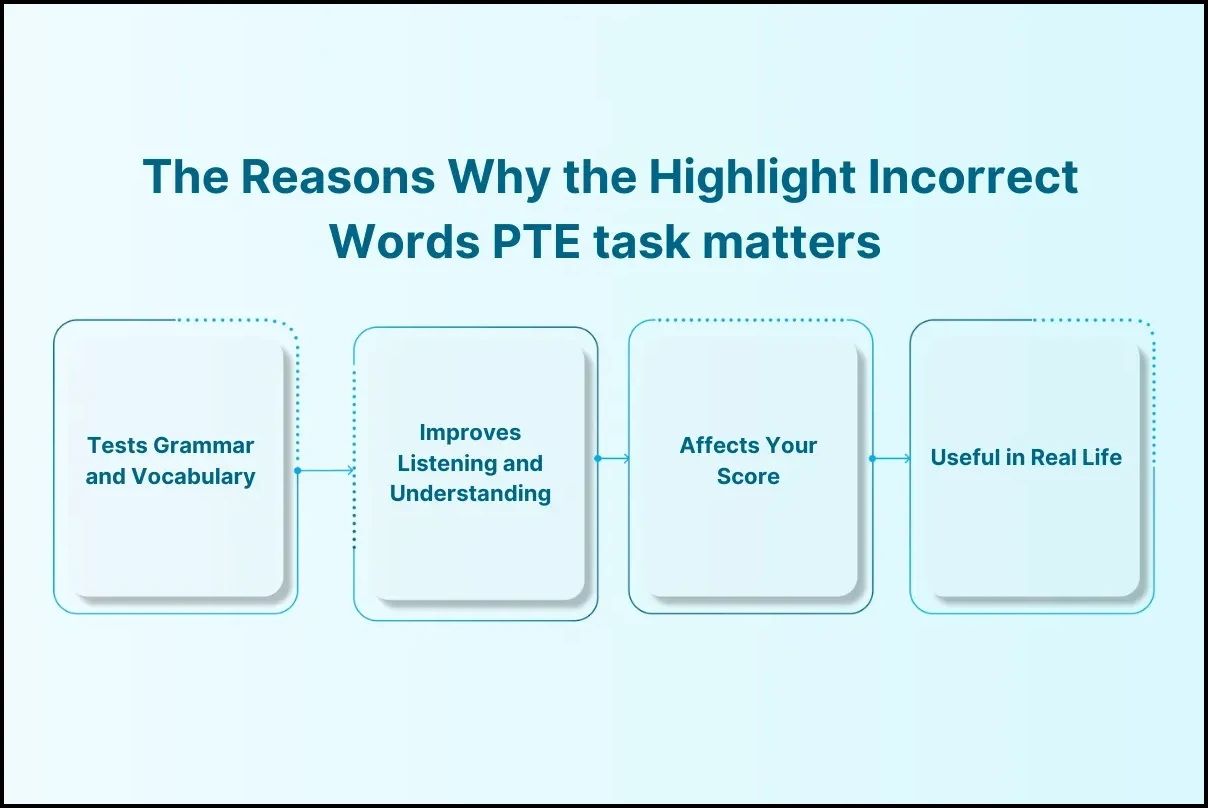
 

Why is Highlight Incorrect Words task Important for Your Overall Score?


  • Tests Grammar and Vocabulary: This task checks how well you understand grammar and vocabulary. You need to find words that are incorrect or don't fit the sentence. This skill helps spot mistakes in written English, which is important for clear communication.
  • Improves Listening and Understanding: Since this is part of the Listening section, it tests how well you can hear and understand a passage. You need to recognise words that don't match the meaning or disrupt the flow.
  • Affects Your Score: Your performance in this task directly impacts your Listening score and, in turn, your total PTE score. Identifying incorrect words correctly can help you score higher.
  • Useful in Real Life: In everyday communication, spotting mistakes in speech and writing is important. Doing well in this task shows that you can recognise errors and ensure clear and accurate messages.


Since the Highlight Incorrect Words PTE task contributes to your overall PTE Listening score, adopting the right approach is key to increasing your points.


Also Read: PTE Score in Bands 2025

2.

How to Approach the Highlight Incorrect Words Task?
How to Approach the Highlight Incorrect Words Task?


You need a strategy that balances speed and accuracy to do well in the Highlight Incorrect Words PTE task. Keep your cursor ready and listen carefully for pronunciation differences. This will help you quickly spot mistakes.


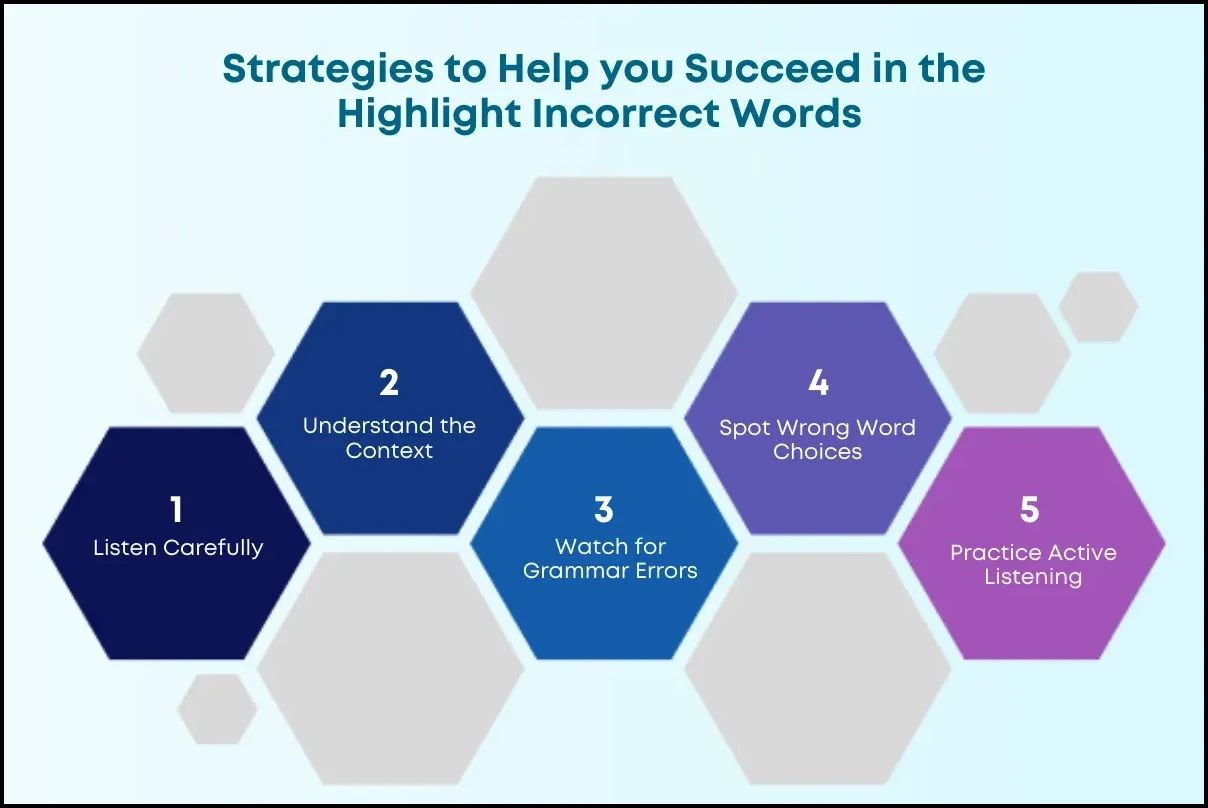
Below are some of the strategies to help you succeed in the Highlight Incorrect Words PTE task:


  • Listen Carefully: You'll hear an audio passage while reading a transcript. Pay close attention to the audio so you can spot the wrong words. The better you understand the passage, the easier it will be to find errors.
  • Understand the Context: Before you start marking incorrect words, make sure you grasp the overall meaning of the passage. If a word doesn't fit logically or grammatically, it's likely a mistake.
  • Watch for Grammar Errors: Common mistakes in writing include errors in subject-verb agreement, tense, and prepositions. Always check if verbs, articles, and prepositions are used correctly to maintain clarity and accuracy.
  • Spot Wrong Word Choices: Some words may not match the sentence's tone or meaning, leading to errors in word choice. Similarly, a formal passage shouldn't include casual words that may feel out of place.
  • Practice Active Listening: Make a habit of paying close attention to spoken English daily. The more you practice listening, the better you'll notice mistakes.


Using these strategies will improve your accuracy in spotting incorrect words and help you score higher in the Highlight Incorrect Words PTE task. However, you need a combination of PTE Listening Highlight Incorrect Words tips to excel.


Read Next: PTE Reading Practice Test 2025

3.

Practice Exercises for PTE Highlight Incorrect Words

The best way to improve the Highlight Incorrect Words PTE task is through regular practice with audio recordings and transcripts. Try to simulate real test conditions by listening only once and marking the differences.


Here are 5 sample Highlight Incorrect Words PTE questions:


You will hear a recording along with its transcription below. Some words in the transcription do not match what the speaker says. Please click on the words that are incorrect.
 

Audio Transcript Text On Screen
Obesity Adult obesity is worsening, and more than one in eight members in the world is obese. The problem is most significant in North America, but Africa and Asia are also experiencing an upward trend, the material shows. Undernutrition and obesity coexist in many cities, and can even be seen side by side in the same household. Poor access to nutritious food due to its higher cost, the stress of working with food insecurity, and physiological adaptations to food deprivation help explain why food-insecure families may have a small risk of overweight and obesity.
Baking Baking as a business or profession has never been confined to the making of butter alone—that is to say, bread in everyday use. A baker we take to mean a person who bakes and prepares any starchy substance intended for animal food. Therefore baking not only includes loaf-bread baking, biscuit baking, fancy-bread baking, but also pastry-making and confectionery. Two of the most essential things in bread-baking, in order to make a full-flavoured, showy, and sweet loaf, are good yeast and good flour. A good oven is also necessary. An oven which is either too hot or too cold will spoil what would otherwise be a good batch of bread: so great care should be used in order to have the stove of the proper heat. Pan bread, or bread baked in tins, need a greater heat than batch bread, as pan-bread dough is of a faster nature than batch-bread dough, and consequently requires more heat to keep it up. There are so many different kinds, and each chef, as a rule, seems to fancy what he has been most used to.
Scenery The effect of scenery upon the brain of man has often been noticed and much has been written about it. Illustrations of this are generally drawn from the historic lands and from the ancient people of the East. The civilized races, such as the Greeks, Romans and other nations who formerly dwelt on the hills of the Mediterranean, are taken as examples. The Greeks are said to have owed their peculiar character and their taste for art to the varied and beautiful scenery which surrounded them. Their mythology and poetry are full of allusions to the views of nature. Mountains and springs, rivers and seas all come in as the background of the picture which represents their character and history. The same is true of the Romans, Egyptians, Phenicians, Syrians, Hebrews, the ancient Trojans and Carthaginians. Each one of these cities seems to have been affected by the scenery.
Public Park Those who make public parks are apt to try too much and to injure not only the beauty, but the practical value of their creations by loading them with unnecessary and expensive details. From the time when landscape gardening was first practiced as a fine art to the present day, park makers have been ambitious to move the face of nature—to dig lakes where lakes did not exist and to fill up lakes where they did present, to cut down natural hills and to raise artificial ones, to plant in one place and to clear in another, and generally to spend money in construction entirely out of proportion to the price of the results obtained.
BSc The Bsc in Animal Health Degree enables you to write your pre-veterinary requirements. Research areas include the morphology and behaviour of domestic animals, the relationship between workers and animals and the safety and quality of feed supply.You will have the opportunity to apply your knowledge and skills through real assignments, case studies and practical skills development.You’ll work closely with agricultural animals and have many chances for industry interaction.


Regular Highlight Incorrect Words PTE practice with targeted exercises builds confidence, but making listening drills a part of your daily routine can take your accuracy to the next level.


Daily Drills to Improve Listening and Error-Spotting Skills


If you want to get better at spotting incorrect words in the Highlight Incorrect Words PTE task, regular practice is important. Start with short audio clips and transcripts, then slowly move on to faster speech and different accents to boost your accuracy and confidence.


Here’s a simple routine to help you strengthen your listening skills and improve your accuracy in the Highlight Incorrect Words PTE task:

Active Listening Practice

Active Listening Practice (15-20 minutes): Focus on audio content and identify errors in transcripts. Key steps include the following:


  • Choose a PTE listening test or an academic podcast.
  • Listen without looking at the transcript.
  • Pause and try to recall key points.
  • Listen again, this time reading the transcript.
  • Spot any words that sound different from what you heard (e.g., incorrect synonyms, mispronunciation).
  • Highlight the errors and write the correct words.
Pronunciation Practice

Pronunciation Practice (10-15 minutes): Recognise words that sound different due to pronunciation or accents. Key steps include the following:


  • Choose a TED Talk or academic lecture with a transcript.
  • Listen carefully to pronunciation.
  • Write down words that sound different from how they are spelt.
  • Listen again and compare your notes with the transcript.
Synonym and Word Choice Drill

Synonym and Word Choice Drill (15 minutes): Identify when synonyms are misused in transcripts. Key steps include the following:


  • Listen to an academic passage without the transcript.
  • Scan the transcript for synonyms that don't fit the context.
  • Spot incorrect words and replace them with the right ones.
Context Clue Practice

Context Clue Practice (15-20 minutes): Use context to find incorrect words in transcripts. Key steps include the following:


  • Choose a short lecture or interview recording.
  • Listen to the first 1-2 minutes and predict what comes next.
  • Listen again while reading the transcript.
  • Spot words that don't match the meaning of the passage.
Shadowing Technique

Shadowing Technique (15-20 minutes): Improve pronunciation and accuracy by repeating speech. Key steps include the following:


  • Pick a podcast or TED Talk and play a short clip (1-2 minutes).
  • Repeat exactly what the speaker says.
  • Compare your speech with the transcript and spot differences.
Speed Listening Practice

Speed Listening Practice (15 minutes): Catch words in fast speech and identify errors. Key steps include the following:


  • Choose a fast-paced news report or podcast.
  • Listen at normal or increased speed.
  • Scan the transcript and spot mismatched words.
Review Incorrect

Review Incorrect Words Daily (10-15 minutes): Reinforce learning by reviewing past mistakes. Key steps include the following:


  • Make a list of incorrect words from past practice.
  • Listen again and try to spot the errors.
  • Compare your answers and focus on problem areas.
Group Practice

Group Practice (Optional – 30 minutes): Work with others to improve listening and error-spotting skills. Key steps include the following:


  • Join a study group or find a partner.
  • Play a listening passage together.
  • Pause and discuss errors in the transcript.
  • Correct mistakes and compare notes.


Regular ‘Highlight Incorrect Words’ PTE practice helps sharpen your listening and error-spotting skills, but it's also important to be aware of common mistakes that affect your accuracy.


Read Next: PTE Practice Test 2025

4.

Effective Strategies to Master PTE Highlight Incorrect Words

You need sharp focus, quick thinking, and smart practice to do well in the Highlight Incorrect Words PTE task. Regular training with different accents and timed exercises will increase your speed and accuracy. 


Below are some PTE Listening Highlight Incorrect Words tips to help you out with the task:
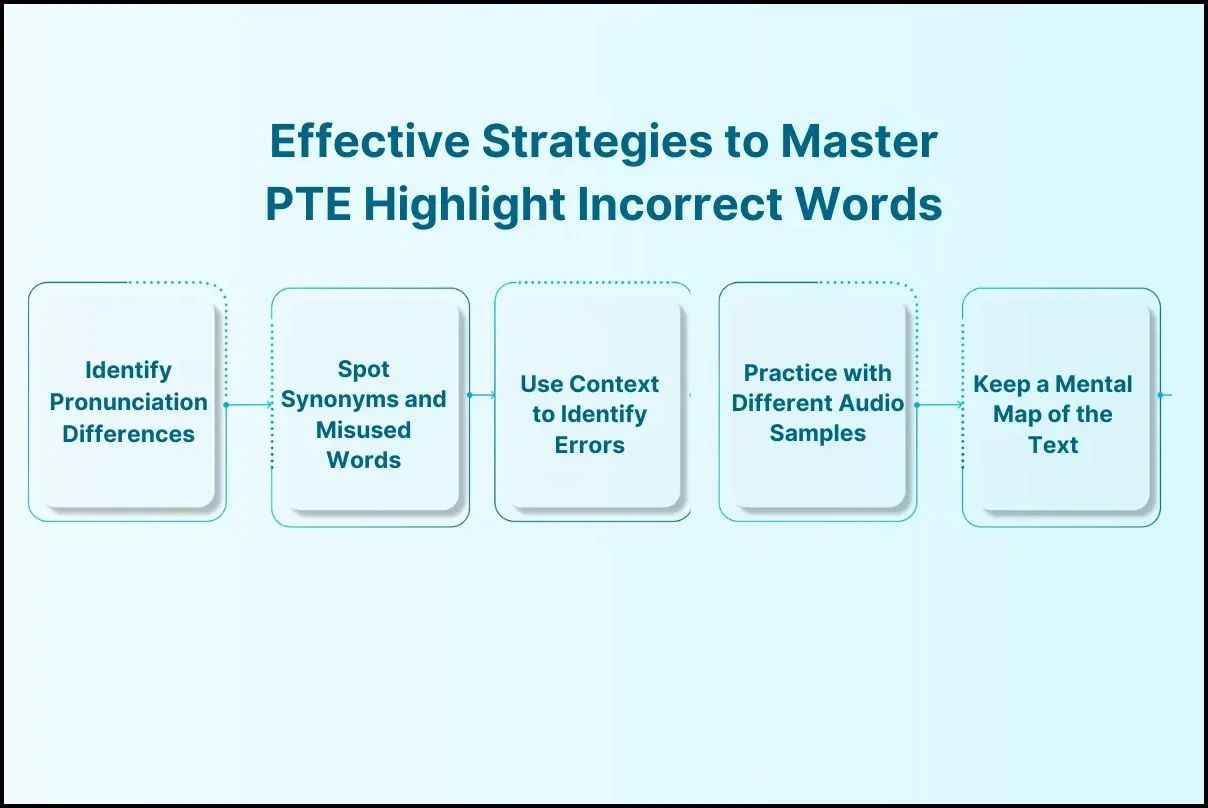
 

Effective Strategies to Master PTE Highlight Incorrect Words


  • Identify Pronunciation Differences: Accents, speech patterns, and speed can change how words sound, making them harder to recognise. Focus on vowel and consonant sounds to improve accuracy.
  • Spot Synonyms and Misused Words: If the audio says "increase," but the transcript says "decrease," the contrast is clear. Similarly, if the intended word is "prevent," but the transcript says "help," it's incorrect.
  • Use Context to Identify Errors: Listen for contradictions or words that don't fit. If the audio uses a noun but the transcript has a verb, it's likely incorrect. Numbers, dates, and technical terms are common sources of errors.
  • Focus on Keywords: Pay attention to specific details like names, dates, and numbers rather than just the overall meaning. Listen carefully for words that don't match the text, and if you hear something different, make a mental note and compare it with the transcript.
  • Scan the Text While Listening: Quickly move through the transcript as you listen to spot mismatched words. Track the words in the text while listening, and if something sounds different, pause briefly and highlight it.
  • Handle Difficult Words: Unfamiliar terms, accents, or technical jargon can be tricky. Use context clues from surrounding words to determine the correct term, and if unsure, rely on common prefixes or suffixes.
  • Manage Fast Speech: Focus on stressed syllables and the first few words of each phrase, as these often carry key meanings. Pauses and intonation changes can also signal important words.
  • Practice with Different Audio Samples: Regular practice sharpens recognition of pronunciation, synonyms, and context. Listen to podcasts, news, and lectures to build familiarity with accents and speaking styles.
  • Keep a Mental Map of the Text: Track the text's structure while listening, which helps catch discrepancies. Note key points or transition highlights where errors may appear. If a sudden topic shift occurs, the incorrect word might relate to that change.


Learning the right strategies is important for doing well in the PTE Highlight Incorrect Words task. But to get even better, regular practice is a must.


Read Next: PTE Reading Tips and Tricks 2025

5.

Common Mistakes for PTE Highlight Incorrect Words & How to Avoid Them

Many test-takers lose valuable points in the Highlight Incorrect Words PTE task due to avoidable mistakes. A common error is selecting words based on assumptions rather than actively listening, leading to unnecessary negative marking. 


Below are some of the common mistakes in the Highlight Incorrect Words PTE task with effective tips to avoid them:


  • Clicking the Wrong Words Due to Distractions: Avoid multitasking or checking your phone. If unsure about a word, pause, listen again, and double-check before clicking.
  • Not Noticing Pronunciation Differences: Listen to TED Talks, podcasts, and international news. Pay attention to vowel and consonant pronunciation—words like "schedule" sound different in British and American English.
  • Selecting Too Many Words, Leading to Penalties: Highlight only the incorrect word, as over-selection leads to penalties. Trust your first instinct—if a word sounds off, it's likely wrong. Take a moment to listen to the full sentence before making a selection.
  • Not Listening to the Whole Audio: Always listen to the entire clip before selecting a word. A word might seem incorrect in isolation but makes sense within the full sentence, so wait for context before deciding.
  • Ignoring Synonyms and Word Substitutions: Some words sound similar but don't fit the sentence's meaning. If a word feels out of place, it's likely incorrect. For example, "increase" and "decrease" are opposites and easy to confuse.


If all this feels overwhelming, you're not alone. LeapScholar's PTE Score 80 Course provides expert guidance, PTE practice tests, and personalised feedback to help you confidently navigate the Retell Lecture PTE task and work towards your target score.


Score 80+ in PTE with Leap's Self-Prep Course

student enroll count

Students Enrolled

review count

2,411 Reviews

app download banner image
See Course Details

IELTS Important Information

PTE Important Information

PTE Sample Test Free

FAQs

Q. What is highlight incorrect words in PTE?

Ans. In the PTE Listening test, Highlight Incorrect Words is a task where you listen to an audio and see a transcript. Some words in the text are different from what is spoken. Your job is to click on the incorrect words. This task checks your listening and reading skills.

Q. Does highlight incorrect word have negative marking?

Ans. Yes, the Highlight Incorrect Words PTE task has a negative marking. Clicking on the wrong word will result in a loss of points. But you cannot get a score below zero for the task. This means guessing incorrectly can lower your score, so it is important to choose words carefully.

Q. How many highlight incorrect words in PTE?

Ans. The number of incorrect words in the Highlight Incorrect Words PTE task varies. Usually, there are about 3 to 6 incorrect words in each question. You need to listen carefully and select only the words that do not match the audio to score well.

Q. What is highlight incorrect words marking criteria in PTE?

Ans. In the Highlight Incorrect Words task, you get one point for each correct answer. If you select a wrong word, you lose one point. However, your total score for this task cannot be negative. This means accuracy is important to get a good score in this section.

Q. How to improve highlight incorrect words in PTE?

Ans. To improve this PTE task, practice active listening by focusing on pronunciation and similar-sounding words with different meanings. Read along with audiobooks or news while listening, and take PTE mock tests to get familiar with the format and boost accuracy.

Q. How do you highlight the incorrect words on PTE listening task?

Ans. In the PTE Listening Highlight Incorrect Words test, you'll see a transcript while an audio plays. Listen carefully and click on the words that don't match. The incorrect words will be highlighted when selected, but choose carefully, as wrong selections can lower your score.

Q. How is 'highlight incorrect word' scored on the PTE exam?

Ans. This task is scored based on the number of correct and incorrect selections. Each correct answer gets one point, while each wrong selection loses one point. However, the lowest possible score is zero, so you cannot get a negative total score for this task. Accuracy is important for a good score.

Q. Why is the Highlight Incorrect Words task important in PTE?

Ans. This task is important because it tests both listening and reading skills. It helps check how well you can recognise spoken words and match them with written text. Doing well in this section can improve your overall listening score and help in real-life situations where listening accuracy is needed.

Q. How much time do you get for the Highlight Incorrect Words PTE task?

Ans. The time for the Highlight Incorrect Words PTE task depends on the length of the audio, which is usually 15 to 50 seconds. You must listen carefully and click on incorrect words while the audio plays. There is no extra time after the recording, so staying focused and reacting quickly is important.

Q. What strategies can help in the Highlight Incorrect Words PTE task?

Ans. First, skim the transcript before the audio starts, then follow the text closely while listening. Pay attention to pronunciation differences and tricky words. If you're unsure, it's better to skip than guess, as wrong answers lose points. Regular practice with audio scripts will help improve accuracy.

Q. What types of words are usually incorrect in the PTE Listening Highlight Incorrect Words task?

Ans. Incorrect words often have similar meanings or sounds but differ in pronunciation. These may include verb changes (like "running" instead of "ran"), synonyms (like "big" instead of "large"), or small grammar changes (like "is" instead of "was"). Paying attention to these details makes it easier to spot mistakes.