Blogs
Blogs  Leap Digest
  Events
  About Us
 Expert Insights
The Next Frontier: Japan and South Korea Emerge as Strategic Study Destinations for Indians
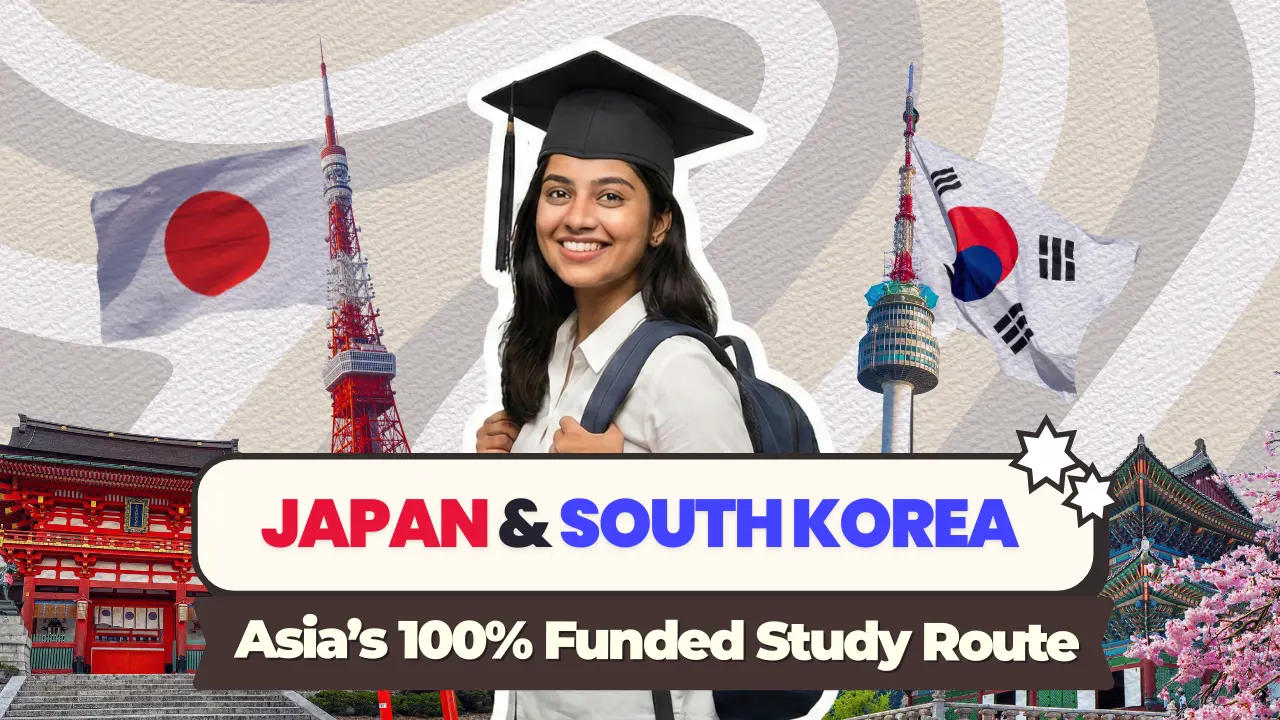
While most Indian students are still fixated on the US, UK, Canada, and Australia, something interesting is happening quietly in East Asia. Japan and South Korea are rapidly becoming strategic study destinations that offer something the traditional choices increasingly don't: generous full scholarships, high-demand job markets desperate for skilled workers, and genuinely affordable living costs.
While the West tightens its borders, Japan and South Korea have opened a strategic corridor for Indian STEM talent. This is the "Zero-Debt" route:
- Fully Funded: MEXT (Japan) and GKS (South Korea) offer 100% tuition waivers and monthly stipends up to ₹95,000.
- Job Ready: Tap into Japan’s 800,000 IT professional shortage or Korea's $450B semiconductor belt.
- Fast-Track PR: Secure permanent-style residency in as little as 2–3 years after graduation.
The shift eastward is driven by increasing global education outreach from these nations, growing availability of English-taught programs, and crucially, scholarship programs so generous they make studying in the West look financially reckless by comparison.
Japan: Engineering Excellence & The "Zero-Debt" MEXT Route
The MEXT (Monbukagakusho) Scholarship is arguably the most comprehensive scholarship on the planet. For Indian students in 2026, it is the ultimate "Golden Ticket."
The MEXT 2026 Financial Package
| Benefit | Details for 2026 Intake |
| Tuition & Fees | 100% Exemption (Entrance, Admission, & Tuition) |
| Monthly Stipend | ¥143,000 – ¥148,000 (Approx. ₹83,000 – ₹86,000) |
| Airfare | Round-trip economy-class tickets included |
| Language Prep | 6 months of free Japanese training (if needed) |
The Two Pathways to Success
- Embassy Recommendation: The most common route. Applications typically open in April/May of the year before you travel. It involves a written test and an embassy interview in India.
- University Recommendation: You apply directly to a Japanese university during their admission cycle. If the university selects you, they recommend you to MEXT. This is often faster for students with strong research proposals.
Career Opportunities: Filling the 2026 Skills Gap
Japan’s "Super-Aged" economy has created an insatiable demand for international talent. If you graduate from a Japanese university in 2026/27, you are stepping into a seller's market.
High-Priority Sectors for Indian Graduates
- The AI & Tech Surge: Japan is investing billions into "Society 5.0." Demand is at an all-time high for AI Researchers, Machine Learning Engineers, and Cybersecurity Experts.
- Robotics & Automation: With companies like Fanuc and Yaskawa, Japan is the world capital of robotics. They need Automation Engineers to help transition their manufacturing sectors.
- The Semiconductor Belt: A new 2026 priority. Japan is reviving its domestic chip manufacturing and needs Semiconductor Physicists and VLSI Designers.
- Healthcare Tech (Gerontechnology): Designing technology for elderly care is a booming sector where IT meets healthcare.
The Language Reality: English-Taught Hubs
You do not need to be a Japanese expert to start your journey. Top-tier 2026 programs are increasingly English-Medium.
- Top Universities in Japan: The University of Tokyo, Kyoto University, and Tokyo Institute of Technology (Tokyo Tech) offer robust Global 30 (G30) programs where the entire Master's or PhD is in English.
- The "Dual-Language" Strategy: While you study in English, most universities offer free Japanese courses. Reaching JLPT N3 or N2 by graduation is the "Career Accelerator" that allows you to negotiate salaries of ¥6M – ¥8M (₹35L – ₹46L) at firms like Sony, SoftBank, or Rakuten.
South Korea: K-Tech & The "Golden Ticket" Career Path
In 2026, South Korea is prioritizing Indian STEM talent to fuel its "National Strategic Technologies" initiative. While K-Culture is the hook, the Industry-Academic integration is the real ROI.
The 2026 "Silicon Belt" Advantage
Unlike the West, where internships are competitive, Korean universities like KAIST and Seoul National University (SNU) have "Contract Departments" funded by industry giants.
- Direct Pipeline: Your Master's thesis could be co-supervised by engineers from Samsung Electronics or SK Hynix.
- $20B AI Infusion: In 2026 alone, South Korea is investing $20.4 billion specifically into AI and Chip R&D.
- The "Domestic Fast-Track": Graduates from Korean universities are exempt from certain work experience requirements for the E-7 Professional Visa, making you hireable the day you graduate.
The 2026 Global Korea Scholarship (GKS) Update
The GKS remains the "Full-Ride" standard for 2026. However, the benefits have been recalibrated to match the rising cost of living in Seoul.
| Benefit | 2026 Master's/PhD Package |
| Full Tuition | 100% Covered (Up to KRW 5M per semester; excess covered by University) |
| Monthly Stipend | KRW 1,000,000 – 1,100,000 (Approx. ₹63,000 – ₹70,000) |
| One-Year Language | Fully Funded (Mandatory training to reach TOPIK Level 3) |
| Arrival Grant | KRW 200,000 (Settlement Allowance) |
| Bonus Points | +5% Bonus for Science & Engineering applicants |
The "Working Professional" Roadmap (2026/27)
The biggest update for 2026 is the Point-Based E-7 Visa system, which has been eased for international graduates of Korean universities.
- E-7-1 Professional Visa: Designed for managers and specialists in 67 occupations. If you graduate from a Korean university, the "1-year work experience" rule is waived.
- Semiconductor Fast-Track: If your Master's is in high-tech (Semiconductors, Display, Bio), you can qualify for the E-7-S Special Professional Visa if your salary is at least 1.5x the GNI per capita.
- Permanent Residency (PR): Years spent on a D-2 Student Visa can now count toward certain long-term residency tracks, significantly shortening your path to citizenship or an F-5 (PR) visa.
Japan Vs. South Korea: What Should You Choose?
Let me lay out why Japan and South Korea represent genuine strategic value compared to Western destinations:
- Academic strength: Japan excels in robotics, engineering, computer science, and materials science. Korea dominates in AI, IT, electronics, biotechnology, and increasingly media production and creative technologies.
- Scholarship generosity: Both MEXT and GKS provide full funding that covers everything. Compare this to partial scholarships in the West that still leave you with massive debt.
- In-demand jobs: Japan needs IT engineers, AI specialists, and mechanical engineers. Korea needs software developers, data analysts, and semiconductor engineers. Both countries face acute shortages and actively recruit international talent.
- Cultural experience: Japan offers tradition, precision, and Zen aesthetics. Korea offers hyper-modernity, K-Culture immersion, and technological innovation. Both provide genuinely unique experiences you can't replicate elsewhere.
- Post-study work: Both countries are gradually opening post-study work pathways for international graduates, though they're not yet as established as Canada or Australia. This is evolving rapidly as labor shortages intensify.
The Bottom Line
By securing a competitive MEXT or GKS scholarship, Indian students can achieve a completely debt-free, world-class education in economies that desperately need technical expertise. You're not just getting an education, you're positioning yourself in Asia's most advanced economies during a period of acute skills shortage.
These aren't backup options. They're strategic choices for career-focused students who recognize that the future of global technology and innovation is increasingly being written in Asia, not just Silicon Valley.
The application processes are rigorous and require early preparation, strong academic records, and compelling research proposals. But for students willing to look beyond the traditional destinations, Japan and South Korea offer opportunities that are financially smarter and potentially more career-rewarding than the increasingly expensive and competitive Western options.

Kirti Singhal
Kirti is an experienced content writer with 4 years in the study abroad industry, dedicated to helping students navigate their journey to international education. With a deep understanding of global education systems and the application process, Kirti creates informative and inspiring content that empowers students to achieve their dreams of studying abroad.
Users also read

Top 10 Industries That Create the Most Billionaires in 2026: Guide for Indian Students

Stanford MBA Career Diversity: Industries, Salaries and What Indian Students Need to Know

Anthropic Academy: 16 Free AI Courses With Certificates in 2026 That Indian Students Cannot Afford to Ignore