
Quick Read
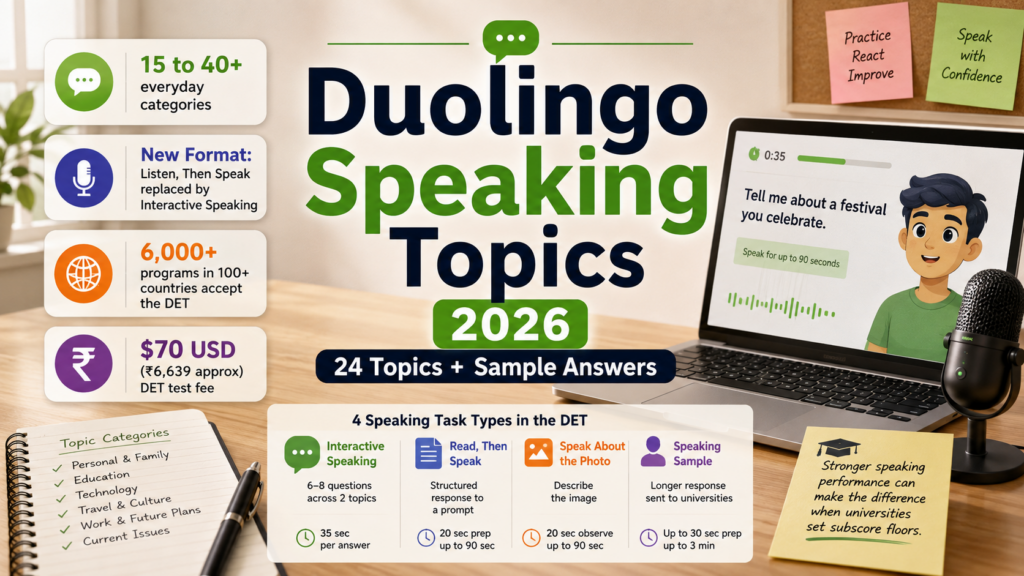
- Duolingo speaking topics span 15 to 40+ everyday categories.
- The current DET format replaced Listen, Then Speak with Interactive Speaking.
- Indian test-takers face frequent topics like festivals, family, and academics.
- The DET costs $70 USD (₹6,639) and covers 6,000+ accepting programs.
Duolingo Speaking Topics and the Current DET Format
This guide to Duolingo speaking topics with answers covers the current format. Duolingo’s own 2026 scoring guide confirms exactly four speaking task types, all graded on the same six speaking criteria (content, discourse coherence, fluency, grammar, lexis, and pronunciation):
- Interactive Speaking: a live, reactive back-and-forth with an animated character, 6-8 questions across 2 topics
- Read, Then Speak: a structured response to a written prompt
- Speak About the Photo: a descriptive response to an image
- Speaking Sample: a longer, interview-style response that is scored on the same criteria and additionally shared directly with the universities you apply to

Choose your dream country
 UK
UK
 USA
USA
 Germany
 Australia
 Ireland
 Canada
 UAE
UAE
 France
 Sweden
 Italy
Italy
 Other
Other
When do you want to study abroad?
What's your highest level of education?
Have you completed Class 12th?
What was your Class 12 CGPA/percentage?
Are you a student or a parent/guardian?
What do you want to study?
Select your current city
How Leap will help you

Personalised University Shortlist

Express Applications with Quicker Admits

End-to-End Application Support
Two things worth confirming before you prep: Listen, Then Speak has been removed and replaced by Interactive Speaking. Read Aloud is still part of the test, but it's a short vocabulary/pronunciation task in the comprehension section, not one of the four speaking-response task types this guide covers. If your prep material groups it in with Interactive Speaking or the Speaking Sample, that's the outdated part. Duolingo does not publish an official list of speaking topics, but the same categories (family, education, technology, travel, work, and current issues) recur consistently across real test attempts. Duolingo's own guide also confirms that over 6,000 programs in more than 100 countries accept the test.
Sources: Duolingo's official DET Scoring Guide for Teachers, 2026; see sections 2.5, 2.6, and 4.1-4.8 for the complete, exhaustive task inventory; and Duolingo's Featured Accepting Institutions guide, August 2025, the most recent official acceptance figure Duolingo has published (no newer official count exists yet, so treat 6,000+ as the current confirmed baseline through 2027).
If you've read that Duolingo speaking is "easier" than IELTS and are tempted to under-prepare, LeapScholar's common Duolingo myths guide covers why that's not quite right.
Counselor insight: Students who prepare using a single memorized script often struggle to respond in the moment. Interactive Speaking pivots topics midway through. Practicing to react, not recite, matters more than covering every possible topic.
Why Duolingo Speaking Topics and Scores Actually Matter for Admission
Score requirements are set by individual universities, not by Duolingo, and they don't reset on a fixed annual cycle, so the same official figures generally carry into the 2027-28 admissions cycle unless a university publishes a change. Two verified examples:
- Imperial College London requires a DET score of 115 overall (no subscore below 105) for its Standard level, or 125 overall (no subscore below 115) for Higher-level programs.
- University of Toronto requires an overall score of 120, with a Production subscore (which includes speaking) also at 120, for tests taken on or after July 1, 2024.
Sources: Imperial College London's official English language requirements page; University of Toronto's official English Language Ability page.
Notice that both universities call out a subscore floor, not just an overall number. A strong speaking performance is often what separates a borderline overall score from an admit-ready one.
If you're applying to the UK specifically, read Leap Scholar's counsellor answer on whether Duolingo is accepted for UK universities and visas before you assume a university's DET acceptance also covers your student visa; it usually doesn't.
If your target score maps better to an IELTS band you already understand, LeapScholar's Duolingo score to IELTS conversion guide has the current chart.
For destination-specific lists, see Duolingo-accepted universities in the UK and Duolingo-accepted universities in the USA.
Duolingo Speaking Task Types, Time Limits, and What to Have Ready
| Task | Time | What It Tests | What to Have Ready (India-specific note) |
| Interactive Speaking | 35 sec per answer, 6-8 questions across 2 topics | Spontaneous reaction, fluency | A quiet room and a headset mic; background noise from shared study spaces is a common Indian test-day issue |
| Read, Then Speak | 20 sec prep, up to 90 sec speak | Organized extended response | Practice using Indian examples (your city, your college) so answers come without translation lag |
| Speak About the Photo | 20 sec observe, up to 90 sec speak | Descriptive vocabulary | Build a vocabulary bank now; don't try to invent adjectives mid-answer |
| Speaking Sample | Up to 30 sec prep, up to 3 min speak | Sustained response, scored and sent to universities | This recording goes to admissions offices; dress and speak as you would in an interview |
LeapScholar's dedicated Duolingo picture description guide provides worked photo examples and a scoring breakdown specifically for Duolingo speaking topics, if you want to delve deeper into that one task alone.
Counselor insight: Most Indian applicants under-prepare for the Speaking Sample specifically, because it feels less "gradable." It is the one task an admissions officer actually watches, so a flat or under-length answer here does real damage even with a strong overall score.
24 Duolingo Speaking Topics for Indian Students, by Category
Duolingo does not release a fixed topics list, but these 24 Duolingo speaking test topics, grouped into 6 categories, cover what recurs most often for Indian test-takers across Read, Then Speak, Interactive Speaking, and the Speaking Sample. Treat these topics as a working Duolingo speaking topics list to rehearse against, not a guaranteed question bank.
- Personal & Family: a family tradition you follow, your favorite childhood memory, someone who influenced you, a festival you celebrate.
Useful vocabulary: upbringing, close-knit, cherished, bond
- Education & Student Life: your favorite subject and why, online versus offline classes, a challenge you faced in college, and your career goals after graduation.
Useful vocabulary: curriculum, hands-on, setback, aspiration
- Technology & Society: a gadget you use daily, social media's effect on students, AI in everyday life, and online versus in-person communication.
Useful vocabulary: indispensable, distraction, streamline, connectivity
- Travel & Culture: a place you want to visit, your favorite city in India, a memorable trip, a cultural custom worth explaining to a foreigner.
Useful vocabulary: itinerary, heritage, picturesque, hospitality
- Work & Future Plans: a skill you want to learn, your ideal job, a business you admire, and balancing work and study.
Useful vocabulary: upskill, work-life balance, entrepreneurial, long-term goal
- Current Issues & Opinions: an environmental issue you care about, public transport in your city, a recent news story, and your view on remote work.
Useful vocabulary: sustainable, congestion, headline, flexibility
Below are two Duolingo speaking samples with answers, one for Read, Then Speak and one for an Interactive Speaking follow-up, so you can see how a full response should sound rather than just a topic label.
1. Sample answer, Read Then Speak (Festival): Prompt: "Talk about a tradition or festival in your country."
"In my country, India, Diwali is known as the Festival of Lights and usually falls in October or November. Families decorate their homes with diyas, share sweets, and visit relatives. It is important to me because it represents renewal and community, and it is a time I always make sure to be home with my family."
2. Sample answer, Interactive Speaking follow-up (Technology): Prompt: "What's your favorite piece of technology and why?"
"That's a good question. My phone's translation app is genuinely indispensable for me. I use it when I'm reading English research papers I don't fully understand yet. It has made my studying far more efficient, and I don't think I could keep up with my coursework without it."
Counselor insight: Indian test-takers often over-rehearse "Family" and under-rehearse "Current Issues." Interactive Speaking specifically pivots into opinion-based follow-ups, so having one or two ready views on transport, the environment, or remote work matters as much as the personal topics.
Duolingo Speaking Topics for the Speaking Sample: Your Video Introduction to Universities
The Speaking Sample is scored on the same six speaking criteria as your other tasks, and it's also the one response a human at your target university actually watches directly, alongside your Writing Sample. You get up to 30 seconds to prepare and up to 3 minutes to speak, and aiming for the fuller end of that range matters more here than anywhere else in the test.
Sample answer, Speaking Sample (Cultural custom): Prompt: "Discuss a cultural custom or tradition from your country and explain why it matters to you." "A tradition that matters deeply to me is Diwali, the Festival of Lights. It typically falls in October or November, and families spend the days before cleaning and decorating their homes. On a personal level, it is a time when my extended family gathers, regardless of how busy everyone's year has been. On a broader level, it reflects values of renewal and generosity that shape how I try to live the rest of the year."
Counselor insight: Keep your Speaking Sample topic distinct from your Read, Then Speak answer if the two land on similar ground. Admissions readers see both responses, and when the content across tasks is nearly identical, it can come across as a rehearsed script rather than genuine fluency.
Which Duolingo Speaking Topics to Prioritize: A Decision Framework
Not every student needs to prepare the same way. Your prep should match where you actually are:
- If you are a Class 12 student taking the DET for the first time: Prioritize Personal & Family and Education & Student Life topics first. These are the categories you can speak about with the least translation lag, and building fluency here first makes the harder categories easier later.
- If you are a final-year graduate applying under time pressure: Skip broad topic memorization and instead drill Interactive Speaking specifically. It carries the heaviest weight on your Conversation subscore, and with limited weeks left, reacting well under pressure matters more than topic breadth.
- If you are retaking the test after a low Production or Conversation subscore: Go back to Speak About the Photo and Read, Then Speak before anything else, since pronunciation and lexis are graded across every speaking task now, not a single isolated task. A low subscore here usually points to pronunciation clarity or vocabulary range, not topic knowledge, and no amount of extra topic practice fixes that gap.
6-Week Duolingo Speaking Topics Prep Plan for Indian Students
| Weeks | Focus | What to Do |
| 1-2 | Format familiarity | Learn the 4 current speaking task types, and confirm your prep source isn't still referencing Listen, Then Speak or Read Aloud |
| 3-4 | Topic breadth | Work through all 6 categories above, and record yourself for at least 3 topics per category |
| 5 | Interactive Speaking drills | Practice reacting to an unplanned topic pivot within 35 seconds, out loud, daily |
| 6 | Full mock attempts | Take a complete timed mock, and review your own recordings for filler words and pace |
If your first attempt is not enough, the Duolingo English Test fee waiver guide explains who qualifies for reduced-cost retakes, since a second $70 (₹6,639) try is a significant expense for most Indian applicants.
If you're also weighing whether counselling support is worth the cost at this stage, this counsellor answer on LeapScholar's counselling fees breaks down what's free versus paid.
Note: The Duolingo English Test costs $70 USD (approximately ₹6,639) based on an exchange rate of ₹94.84 per USD. The final INR amount may vary depending on the exchange rate, bank charges, and taxes. Check the current fee at checkout before budgeting.
What to Do When You Get a Duolingo Speaking Topic You Didn’t Prepare For
This scenario happens to most test-takers at least once. A few concrete responses:
- Unfamiliar topic: Don't freeze or restate the question. Choose the personal experience that is closest to the question, even if it is not a perfect fit, and speak in a structured way instead of trying to find the "correct" topic-specific answer.
- Microphone or technical issue mid-task: Stay in your seat and keep the camera in frame.
Review the full Duolingo English Test rules for 2026 before test day so you know what counts as a reportable issue versus normal glitches.
- Risk of invalidation from looking away: Keep your eyes on the screen even while thinking. Prolonged gaze aversion is one of the most common and most avoidable reasons Indian test-takers get flagged.
- Low speaking subscore on your first attempt: This is a prep gap, not a proficiency ceiling for most students.
See this counselor answer on what to do when your English test score isn't good enough for a retake framework that applies just as well to Duolingo.
Counselor insight: Students rarely get invalidated for a genuinely unfamiliar topic. They get invalidated for how they react to one, mainly by breaking eye contact or going silent for too long.
3 Takeaways on Duolingo Speaking Topics
- Duolingo speaking topics are unpredictable by design, so prepare across categories rather than memorizing fixed answers, and drill Interactive Speaking specifically since it now replaces the old Listen, Then Speak format.
- Your Speaking Sample is watched directly by admissions staff, and university subscore floors (like Imperial's 105/115 and Toronto's 120 in Production) often decide admission more than your overall score does.
- A low speaking subscore is almost always a prep gap, not a ceiling. A focused 6-week plan, honest mock recordings, and reacting calmly to unfamiliar topics fix it faster than repeated blind retakes.
Verified by: LeapScholar's Exams counseling team, with hands-on experience guiding Indian students through DET preparation.
Have questions about Duolingo speaking topics? Book a free session with a LeapScholar counselor.
Frequently Asked Questions About Duolingo Speaking Topics
-
What are the most common Duolingo speaking topics?
The most common categories are personal and family life, education and student life, technology, travel, work and future plans, and current issues. Duolingo does not publish official Duolingo English test speaking topics with answer lists, but these categories recur consistently across Read, Then Speak, Interactive Speaking, and the Speaking Sample.
-
Are Duolingo speaking topics for 2026 different from earlier years?
The topics themselves haven't changed much, but the task format has. The 2026 speaking section runs on four tasks (Interactive Speaking, Read, Then Speak, Speak About the Photo, and Speaking Sample), with Listen, Then Speak and Read Aloud both removed. If your source still lists five or more speaking tasks, it's describing an older format.
-
Is there an official Duolingo speaking topics PDF?
No. Duolingo does not publish a downloadable topics PDF, and any site offering one as "official" isn't sourcing it from Duolingo directly. Build your own practice sheet from a verified category list, like the one above, instead.
-
Where can I get a Duolingo speaking topics PDF free download?
There isn't a genuine free download from Duolingo itself, so treat "free PDF download" offers from third-party sites with caution, since several turn out to be lead-capture forms rather than real files. Copying the category list and sample answers above into your notes achieves the same result.
-
How many speaking questions are on the Duolingo test?
Per Duolingo's own current test structure, you'll get one Interactive Speaking set of 6 to 8 questions, one Read, Then Speak, one Speak About the Photo, and one Speaking Sample. There is no separate "Read Aloud" task in the current format.
-
Is 'Listen, Then Speak' still part of the Duolingo test?
No. It has been replaced by Interactive Speaking, a live conversational format with an animated character. Any prep material that only mentions Listen, Then Speak is outdated and should be set aside.
-
Is it hard to get a 125 on Duolingo speaking?
A 125 is achievable with consistent, focused practice, generally over 6 to 8 weeks. Students who record themselves, build topic-specific vocabulary, and drill Interactive Speaking reaction times tend to reach this range faster than those who only memorize sample answers.
-
How do I answer Duolingo speaking questions?
Structure your response with a brief introduction, one or two supporting details or a personal example, and a short closing line. Speak at a natural pace, avoid long pauses, and use the full time available rather than stopping early.
-
Does Duolingo release an official list of speaking topics?
No. Duolingo has never published a fixed topic list, and its question bank is designed to vary between attempts. Preparing across a wide range of categories is more reliable than trying to guess a fixed set.
-
What happens if I get a Duolingo speaking topic I never prepared for?
Pick the closest real experience you have and answer with a clear structure, even if the fit isn't exact. Test-takers are far more likely to lose points for freezing or going silent than for an imperfect topic match.
-
Can the Duolingo app itself help me prepare for speaking?
Yes, daily practice on the Duolingo app builds pronunciation and vocabulary. It should be combined with official DET-format practice, since the app's exercises don't replicate the exact timing and task structure of Interactive Speaking or the Speaking Sample.
-
What's the difference between the Speaking Sample and Interactive Speaking topics?
Both are scored on the same six speaking criteria by Duolingo's AI. The difference is what happens afterward: the Speaking Sample is a single, longer response (up to 3 minutes) that is also sent directly to the universities you apply to, while Interactive Speaking is a fast, reactive back-and-forth with no single prompt lasting more than 35 seconds, used only for your DET score.





Have Questions? Get Guidance to reach your Dream University
Connect with India's finest counsellors and biggest study abroad community.
Get Guidance