
Quick Read
- UK First Class Honours requires 70% or above, not 90% like in India.
- A 2:1 (60–69%) is the standard minimum for most UK Masters admissions.
- An Indian CGPA of 7.0/10 on the UGC CBCS scale typically maps to a UK Upper Second Class (2:1).
- Indian students need Rs. 1.85 lakh ($1,529) per month in London shown in bank for 28 days.
- UK postgraduate degrees use Pass, Merit, and Distinction instead of Honours classes.
- Chevening and most UK university merit scholarships require a 2:1 equivalent from Indian applicants.
How the UK Grading System Works for Indian Students in 2026
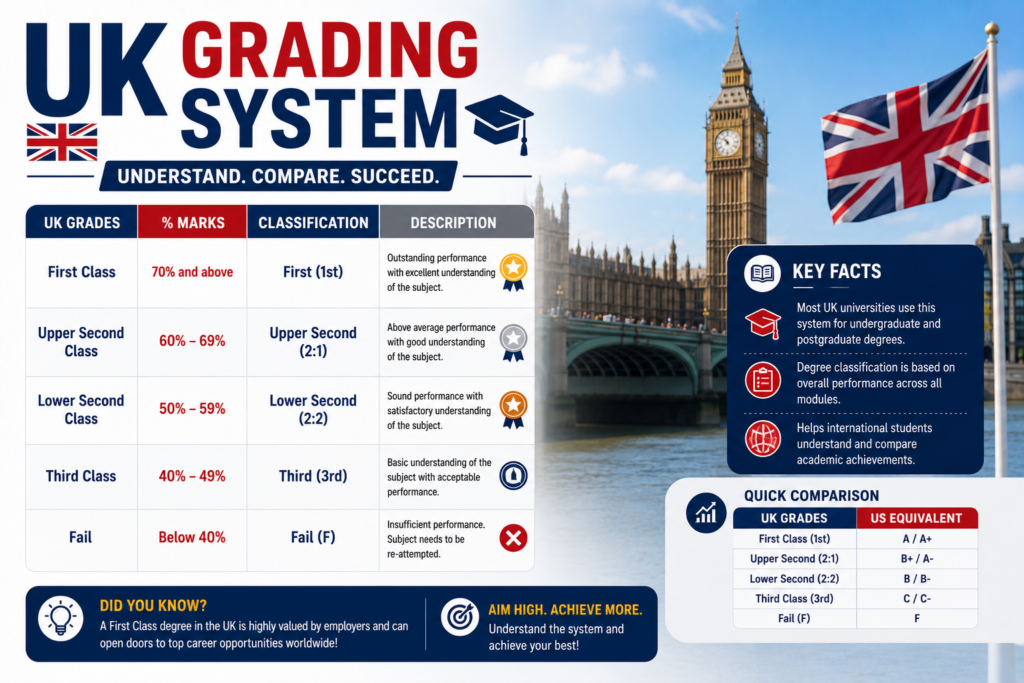
The UK grading system classifies undergraduate degrees into four bands rather than assigning a single percentage or CGPA. If your offer letter says “minimum 2:1 equivalent required,” that is a band, not a raw number. Understanding your band and how to stay in it is the first step before shortlisting UK programs.
Here is how the four undergraduate bands work:

Choose your dream country
 UK
UK
 USA
USA
 Germany
 Australia
 Ireland
 Canada
 UAE
UAE
 France
 Sweden
 Italy
Italy
 Other
Other
When do you want to study abroad?
What's your highest level of education?
Have you completed Class 12th?
What was your Class 12 CGPA/percentage?
Are you a student or a parent/guardian?
What do you want to study?
Select your current city
How Leap will help you

Personalised University Shortlist

Express Applications with Quicker Admits

End-to-End Application Support
| Classification | Common Name | Percentage Range | What It Signals |
|---|---|---|---|
| First Class Honours | "First" or "1st" | 70% and above | Exceptional academic performance; rare at most institutions |
| Upper Second Class Honours | "2:1" (two-one) | 60–69% | The standard graduate-employability benchmark |
| Lower Second Class Honours | "2:2" (two-two) | 50–59% | A pass with honours; limits some postgraduate and employer routes |
| Third Class Honours | "Third" | 40–49% | Minimum qualifying honours degree |
| Ordinary/Pass Degree | N/A | Below 40% | No honours classification |
One thing that disorients almost every Indian student when they first see UK results: a 70% in the UK is not the same as a 70% in India. In the UK, getting above 70%, especially in a Masters course, is a big challenge. UK markers deliberately reserve the top of the percentage scale for truly exceptional work. According to HESA's 2024/25 data (published January 2026), 30% of undergraduates who obtained their degree received First Class Honours the highest possible grade for UK graduates. Approximately half of all students achieved a 2:1, and around 20% obtained a 2:2 (HESA 2022/23, the most recent year with full classification breakdown available).
This is relevant for Indian students in a very specific way: if you scored 75% in your Indian BTech, you are not automatically equivalent to a UK First. The number is coincidental. The two systems are measuring performance on fundamentally different scales.
Counselor insight: Most Indian students we speak to assume they are a 2:2 or lower because they are comparing raw percentages. A student with 62% from a reputable Indian college who applies with confidence often meets a 2:1 requirement. The problem is not their grades; they undersell themselves in the application by misunderstanding the requirement.
UK Grading System vs. Indian Grading System: The Conversion Table
This is the table that actually matters when you are checking whether your profile meets a UK university's stated requirement. No direct mathematical conversion exists. UK universities assess Indian transcripts individually, but the equivalencies below reflect the thresholds used by the majority of UK admissions teams for Indian applicants.
| UK Classification | UK Percentage | Indian Percentage (typical) | Indian CGPA (UGC CBCS 10-pt) | Indian Division |
|---|---|---|---|---|
| First Class Honours (1st) | 70%+ | 75% and above | 8.0/10 and above | Distinction / First Class with Distinction |
| Upper Second Class (2:1) | 60–69% | 60–74% | 6.5–7.9/10 | First Class |
| Lower Second Class (2:2) | 50–59% | 50–59% | 5.5–6.4/10 | Second Class |
| Third Class | 40–49% | 45–49% | 4.5–5.4/10 | Pass |
Note on the 70–74% Indian range: The 70–74% Indian percentage band sits at the boundary between 2:1 and First Class equivalency. Russell Group programs often read 72%+ from non-Tier 1 Indian institutions as a 2:1; applicants from Tier 1 institutions (IIT/NIT) at the same percentage are frequently assessed as First Class by admissions tutors. If your score falls within this range, contact the admissions office directly or request a formal UK ENIC equivalency assessment before making programme decisions.
Two important caveats that every Indian student must understand.
First, Russell Group universities (the 24 research-intensive universities that include UCL, Manchester, Edinburgh, and Warwick) routinely set higher bars for Indian applicants than their published minimum. A program that officially asks for a 2:1 equivalent may in practice expect 65–70%+ from an Indian state-affiliating university applicant because the admissions team factors in institutional variation across Indian colleges.
Second, the prestige of your Indian institution changes the equation. A CGPA of 6.8/10 from an IIT or NIT is read differently from a 6.8/10 from a private affiliating college. UK universities do not have a published formula for these scores; it is a judgment call made by the admissions tutor.
Counselor insight: Indian transcripts show a semester-by-semester breakdown, which UK admissions teams read carefully. A student with a low first-year score but strong final-year results can sometimes make the case for a 2:1 equivalency in their SOP by addressing the trajectory directly. Never submit transcripts without context if there is an obvious dip.
Postgraduate UK Grading System: Pass, Merit, and Distinction Explained
Once you are studying inside a UK university at the postgraduate level (MSc, MA, MBA, or LLM), the degree classification language changes completely. You will not hear "2:1" or "first" in a Masters program. Instead, the postgraduate UK grading system uses three bands:
| PG Classification | Percentage Range | What It Means |
|---|---|---|
| Distinction | 70% and above | Outstanding performance across taught modules and dissertation |
| Merit | 60–69% | Very good performance; acceptable for most PhD applications |
| Pass | 50–59% | Qualified; may limit PhD and competitive graduate employer access |
| Fail | Below 50% | Does not meet passing standard; resit or alternative award applies |
The pass mark for postgraduate taught modules at UK universities is 50%, not 40% as it is for undergraduate modules. You will be required to resit or resubmit an assessment task if you fail to reach the minimum pass mark of 40% (undergraduate) or 50% (postgraduate).
The dissertation is an important part of your final classification. Depending on your program, it typically accounts for 30–50% of your total postgraduate grade. This area is the component where Indian students most commonly drop a classification. Students who score Merit across all taught modules but submit a weak dissertation regularly end up with an overall pass.
Counselor insight: The dissertation is not just an extended essay. UK markers assess research design, methodology, originality, and argument structure, not just content volume. Students who start dissertation planning in month two of a one-year Masters consistently outperform those who begin in month nine. If your taught module average is sitting at 65–68%, a strong dissertation is the difference between Merit and Distinction.
What Your UK Grade Classification Means for Scholarships and Visas in 2026
Your degree classification has direct financial consequences. Most of the major scholarships available to Indian students for UK study have a minimum grade equivalency requirement, and nearly all of them set that minimum at 2:1 or above.
| Scholarship | Minimum Indian Grade Equivalent | Notes |
|---|---|---|
| Chevening | 2:1 (approx. 60–65% or CGPA 6.5+) | Plus 2,800 hours of work experience |
| Commonwealth Masters | 2:1 equivalent | Focus on development-related fields |
| GREAT Scholarships | 2:1 equivalent | Minimum £10,000 (Rs.12,98,700) tuition reduction per award |
| Gates Cambridge | First Class equivalent (70%+) | Extremely competitive; research fit paramount |
| Clarendon (Oxford) | First Class equivalent | Full fees + living grant; all nationalities eligible |
| Felix Scholarship | First Class equivalent | Indian students only; financial need criteria also apply |
| University merit bursaries | 2:1 (automatic at many universities) | Not widely advertised; applied at point of admission |
One point of confusion worth clearing up: Your UK student visa itself does not have a minimum grade requirement. Visa eligibility rests on your Confirmation of Acceptance for Studies (CAS), financial documentation, and English language test scores, not on your degree classification from your Indian institution. However, your degree classification affects whether you receive a conditional or unconditional offer, and conditional offers require you to meet grade thresholds before the university issues your CAS.
For more on how your profile affects scholarship access, see scholarships for Masters in UK for Indian students and fully funded scholarships in UK.
Counselor insight: The GREAT Scholarship is the most accessible major award for Indian students with a solid 2:1 profile; it does not require work experience, it is available across multiple universities, and the application process is tied to your university application rather than a separate competitive round. Most students who qualify for it never apply because they don't know it exists until after they've already enrolled.
Decision Framework: Which UK Classification Applies to Your Indian Profile?
Scenario 1: You are a final-year B.Tech. student from a state-affiliated university, graduating in May 2026, with a 65% aggregate across all semesters.
Your profile most likely maps to a UK 2:1 equivalent, but only just. Many Russell Group programs will ask for 65%+ from Indian state-board-affiliated colleges as their practical 2:1 threshold (even when the published minimum says 60%). You should apply to your target universities with your current grade and a clear SOP for UK universities that addresses any semester dips directly. Do not wait until your final results are declared to apply. Submit your most recent available transcript and include your expected graduation date.
Scenario 2: You are a Commerce graduate with a CGPA of 7.8/10 on the UGC CBCS 10-point scale from a mid-tier private college.
A CGPA of 7.8/10 on the UGC CBCS system squarely maps to the 2:1 band and, often, depending on your institution, is read as borderline First Class. If your target university is outside the Russell Group, you likely meet a First Class equivalent threshold. Typically, this profile qualifies as a strong 2:1 for Russell Group programs. Your transcript will show the letter grades (A+, A, B+) alongside the CGPA. Make sure the university's admissions office receives the full grade sheet, not just the CGPA summary.
Scenario 3: You are a graduate with Distinction (78%) from a Tier 2 college applying to a Russell Group MSc in the UK.
A 78% aggregate from a Tier 2 college clearly places you in the First Class band based on raw percentage. The question for a Russell Group MSc application is whether the admissions tutor weighs your institutional context. Most Russell Group universities use UK ENIC (formerly NARIC) equivalency assessments for borderline Indian applications. At 78%, you are unlikely to be borderline; this profile is strong. Your risk area is not the grade; it is likely the IELTS score for UK universities (most Russell Group MSc programs require 6.5–7.0 overall) and the quality of your research statement.
Documents Indian Students Need to Apply with UK Grading in Mind
UK universities do not ask you to convert your grades before applying. They assess Indian transcripts directly. What they do require is that the right documents reach them in a readable format, at the right stage of the application.
| Document | What It Is | India-Specific Detail | When Required |
|---|---|---|---|
| Academic transcripts (semester-wise) | Official record of all semester results | Must show individual subject marks and CGPA/percentage, not just final year | At application, updated copy required post-graduation |
| Provisional certificate | Issued by university after exams and before degree certificate | Many Indian state universities take 4–8 weeks post-exam to issue this | Required for CAS and visa if degree certificate not yet issued |
| Consolidated marksheet | Single-page summary across all years | Some Indian universities call this document the "final transcript." | Often required separately from semester-wise sheets |
| Degree certificate | Formal conferral document | Not available until convocation, which may be months after graduation | Required before enrollment begins; conditional offer accepted without it |
| Medium of Instruction (MOI) letter | Confirms your Indian degree was taught in English | Must be on official letterhead with registrar's seal; states English was used for all lectures, exams, and assessments | Some universities accept this in place of IELTS |
| NARIC/ENIC credential evaluation | UK credential evaluation report | Required by some universities when Indian grade equivalency is unclear, ECCTIS (formerly NARIC) is the UK authority | Requested by individual universities not required universally |
| IELTS/PTE/TOEFL scorecard | English language proficiency proof | It must be IELTS for UKVI Academic version for visa purposes | Required for both admission and student visa |
A note on the provisional certificate: Indian universities sometimes issue it 4–8 weeks after your last exam. If your UK application deadline falls within this window, contact the admissions office before the deadline, submit a letter from your registrar confirming your expected graduation date, and note the delay in your SOP. Most UK universities issue conditional offers on this basis routinely; they manage Indian graduation timelines every cycle.
Counselor insight: The document we see delayed most often is the Medium of Instruction letter. Many Indian universities issue it only on request and take 2–3 weeks. If your target university accepts an MOI letter in place of IELTS, apply for it the day you decide to apply, not the week before your deadline.
If your target university accepts a Medium of Instruction letter in place of an IELTS score, see study in UK without IELTS for the full list of universities and requirements. Apply for the MOI letter the day you decide to apply many Indian universities take 2–3 weeks to issue it.
What to Do When UK Grading System Goes Wrong: Borderline Grades, Fails, and Result Delays
If your Indian grades are borderline for a UK program's stated requirement:
Do not self-reject before applying. Apply with a strong SOP that contextualizes your academic record, explaining an upward grade trajectory, research projects, or relevant work experience. Many UK universities issue conditional offers to borderline applicants pending final results. If your target is a Russell Group program and you genuinely fall short of their practical threshold, consider applying to a pre-masters or foundation route offered by that university's international office. This is a legitimate pathway, not a fallback option.
If you fail a module during your UK undergraduate degree:
If you fail a module, most UK universities allow one resit attempt. You sit the same assessment again, with no extra classes, and if you pass, the mark is capped at the minimum pass mark (40% for undergraduate programs, 50% for postgraduate programs). A capped pass still counts toward your degree; it just cannot raise your overall classification. If you fail the resit, your university's Board of Examiners will determine whether you receive a lower-class degree, an ordinary degree (no honours), or, in serious cases for Masters students, a Postgraduate Diploma rather than your full Masters.
If you fail a module during your UK Masters degree:
The consequences are more direct than at the undergraduate level. Students who fail their dissertation module may resit it on two occasions, with a maximum mark of 50%. If you fail your dissertation resit, you will be awarded a Postgraduate Diploma (PGDip) rather than your full Masters degree. A PGDip is a recognized qualification and is not worthless, but it is not a Masters, and it affects your eligibility for the post study work visa UK Graduate Route, which requires completion of an eligible full degree.
If your Indian results are delayed and you cannot meet a document deadline:
Apply with your most recent available transcript, even if it only covers your penultimate semester. Include a brief cover email to the admissions office with your expected result declaration date. Most UK universities issue conditional offers on this basis. Once your provisional certificate or consolidated marksheet is available, upload it to your applicant portal immediately. Do not wait until the formal degree certificate is issued; the provisional certificate is sufficient for both the conditional offer and the CAS process.
If your UK student visa is refused due to grade documentation:
The most common document-related refusals for Indian applicants involve financial evidence errors (the 28-day rule) rather than academic transcripts, but if your refusal references your CAS or academic conditions, read the refusal letter in full before reapplying. A correctable documentary issue does not require a waiting period; you can reapply immediately with corrected documents. For visa-specific guidance, see UK student visa requirements.
Counselor insight: The scenario we see most often among Indian students is a missed 2:1 threshold by a minimal margin, say, a 59.4% final aggregate. In this situation, the first step is to contact the admissions office directly. Some universities have the discretion to admit a student who narrowly misses the stated minimum if the rest of the application is strong. Such an outcome does not guarantee itself and is more common at non-Russell Group institutions, but it is worth the email before you withdraw your application.
3 Things to Do Before You Apply
- Before you begin shortlisting, please map your CGPA or percentage to a UK classification. A 2:1 requirement at a Russell Group program typically means 65%+ in practice for applicants from non-IIT Indian institutions. Knowing where you stand helps you avoid over-applying to programs you cannot access and under-applying to those you are qualified for.
- Check your target scholarship's grade requirement directly. A First-Class profile opens Chevening (alongside work experience), Gates Cambridge, and Clarendon. A 2:1 profile opens GREAT Scholarships, Commonwealth Masters awards, and most university automatic merit bursaries. Scholarship eligibility should be part of your university shortlisting process, not an afterthought.
- If your Indian results are delayed, you should apply anyway. Submit your most recent transcript with an expected result declaration date in your cover email. Most UK universities deal with Indian graduation timelines every single cycle and will issue a conditional offer. Do not let provisional certificate timing stop you from hitting UK application deadlines.
Verified by: LeapScholar's UK counseling team, with hands-on experience guiding Indian students through UK university applications, grade equivalency assessment, and visa documentation.
Have questions about the UK grading system or your admission eligibility? Book a free session with a LeapScholar counselor.
Frequently Asked Questions About the UK Grading System
-
Is a UK 2:1 equivalent to First Class in India?
Not exactly. A UK 2:1 (60–69%) maps broadly to a First Class in India (60–74% or CGPA 6.5–7.9/10). In India, First Class simply means you passed with honours. In the UK, a 2:1 is the standard benchmark for postgraduate admissions and graduate employment; it carries more weight than the label suggests. A UK First Class (70%+) is closer to an Indian Distinction or a First Class with Distinction.
-
My Indian results are delayed. Can I still apply to a UK university?
Yes. Apply with your most recent available transcript and include a brief note or cover email to the admissions office stating your expected result declaration date. Most UK universities issue conditional offers to Indian applicants on this basis, requiring them to submit final marksheets before enrollment. The provisional certificate from your Indian university (issued shortly after exams, before the formal degree certificate) is sufficient for both the conditional offer stage and the CAS process.
-
What happens if I fail a module in the UK?
Most UK universities allow one resit attempt per failed module. For postgraduate programs, the resit mark is capped at the pass mark (50%), which means the resit can push you to a pass but cannot contribute to a Merit or Distinction. If you fail the resit, your Board of Examiners decides the outcome, which may mean a lower classification, an ordinary degree (for UG), or a Postgraduate Diploma (for PG) rather than your intended Masters. Contact your personal tutor immediately after receiving a fail grade; early conversations with the university often open options that are not visible from the regulations alone.
-
How are UK university grades calculated?
UK undergraduate grades are calculated as a weighted average across your years of study, with the final year carrying the most weight, often 60–100% of the total classification depending on the university. First-year results frequently carry 0% weighting and function as a transition year. Postgraduate grades are typically calculated as a weighted average of taught module marks and the dissertation mark, with the dissertation contributing 30–50% of the final classification. Each module is weighted by its credit value.
-
What is a Distinction in the UK university system?
A Distinction is the highest classification in the postgraduate (Masters) UK grading system, awarded for an overall average of 70% and above across taught modules and dissertation. It is the postgraduate equivalent of a First Class Honours at the undergraduate level. A Masters with Distinction is particularly valued for PhD applications and competitive graduate roles in finance, consulting, and research.
-
Is 60% a good grade in the UK?
A 60% in the UK places a student in the 2:1 (Upper Second Class) band, which is the benchmark grade for graduate employment and postgraduate study. Most UK employers and universities treat a 2:1 as the standard baseline. So yes, 60% is a good grade in the UK; it is not average or mediocre, as it might appear to an Indian student accustomed to scoring 75–85% in their board exams.
-
What is First Class Honours equivalent to in India?
UK First Class Honours (70%+) is equivalent to an Indian percentage of 75% and above or a CGPA of 8.0/10 and above. Students from IITs and NITs with a CGPA above 8.0 typically qualify comfortably. Students from non-Tier 1 institutions may need 78–80% for some universities to view the profile as a genuine First Class equivalent, given the variation in marking standards across Indian colleges.
-
What is a 2:2 degree equivalent to in India?
A UK 2:2 (Lower Second Class Honours, 50–59%) maps approximately to an Indian percentage of 50–59% or a CGPA of 5.5–6.4/10. A 2:2 is a qualifying honours degree. Some UK employers and a number of postgraduate programs accept it, but competitive graduate schemes and most PhD positions expect a 2:1 or First Class. If your Indian profile places you in this band, a strong SOP and relevant work experience can still get you admitted to many solid UK universities.
-
What is a 2:1 degree equivalent to in India?
A UK 2:1 (Upper Second Class Honours, 60–69%) is broadly equivalent to an Indian percentage of 60–74% or a CGPA of 6.5–7.9/10 on the UGC CBCS scale. The exact equivalency depends on your institution; a CGPA of 6.8 from an IIT is typically read as a stronger 2:1 profile than the same CGPA from a state-affiliated college. Most UK Masters programs set a 2:1 as their minimum admission requirement.
-
What is 70% in the UK grading system?
In the UK grading system, 70% or above is classified as First Class Honours at the undergraduate level, or a Distinction at the postgraduate level. This is the highest classification awarded. It does not mean 70 out of 100 in the Indian sense; UK markers deliberately reserve the top of the scale for truly exceptional work, and scores above 80% are rare even for strong students.










Have Questions? Get Guidance to reach your Dream University
Connect with India's finest counsellors and biggest study abroad community.
Get Guidance