


 Blogs
Blogs  Leap Digest
  Events
  About Us






GMAT Sample Paper: Quantitative Section
Most students find the Quantitative section of the GMAT a tad bit challenging. However, with enough preparation, it can be cracked easily!
The Quantitative section is designed to assess your mathematical skills and your ability to reason quantitatively. Most of the questions related to problem-solving and data sufficiency. Below are some GMAT math sample questions.
x is 1 ⁄ 5 less than 9 ⁄ 10
x is between 2 ⁄ 5 and 4 ⁄ 5
A. Statement (1) ALONE is sufficient, but statement (2) alone is not sufficient.
B. Statement (2) ALONE is sufficient, but statement (1) alone is not sufficient.
C. BOTH statements TOGETHER are sufficient, but NEITHER statement ALONE is sufficient.
D. EACH Statement ALONE is sufficient.
E. Statements (1) and (2) TOGETHER are NOT sufficient to answer the question asked, and additional data are needed.
Answer: (A)
A. $15,000
B. $25,000
C. $60,000
D. $75,000
E. $90,000
Answer: (A)
A. 12
B. 15
C. 20
D. 25
E. 30
Answer: (C)
GMAT Sample Paper: Verbal Reasoning
The Verbal Reasoning section of the GMAT exam is probably the simplest of all sections, yet thorough preparation is required to increase your chances of getting a good score.
The verbal reasoning portion evaluates your ability to comprehend various kinds of text material, analyse arguments, and construct correct sentences (as per standard English). Scoring well in this section is a great opportunity to prove your communication and analytical skills.
Directions:
The questions in this group are based on the content of a passage. After reading the passage, choose the best answer to each question. Answer all questions following the passage on the basis of what is stated or implied in the passage.
Question:
Schools expect textbooks to be a valuable source of information for students. My research suggests, however, that textbooks that address the place of Native Americans within the history of the United States distort history to suit a particular cultural value system. In some textbooks, for example, settlers are pictured as more humane, complex, skilful, and wise than Native Americans. In essence, textbooks stereotype and depreciate the numerous Native American cultures while reinforcing the attitude that the European conquest of the New World denotes the superiority of European cultures. Although textbooks evaluate Native American architecture, political systems, and homemaking, I contend that they do it from an ethnocentric European perspective without recognising that other perspectives are possible.
One argument against my contention asserts that, by nature, textbooks are culturally biased and that I am simply underestimating children's ability to see through these biases. Some researchers even claim that students know they cannot take textbooks literally by the time they are in high school. Yet substantial evidence exists to the contrary. Two researchers, for example, have conducted studies that suggest that children's attitudes about particular cultures are strongly influenced by the textbooks used in schools. Given this, an ongoing, careful review of how school textbooks depict Native Americans is certainly warranted.
Which of the following is most likely the topic of the paragraph immediately following the passage?
(A) Specific ways to evaluate the biases of United States history textbooks
(B) The centrality of the teacher's role in United States history courses
(C) Nontraditional methods of teaching United States history
(D) The contributions of European immigrants to the development of the United States
(E) Ways in which parents influence children's political attitudes
Answer: (A)
Critical Reasoning Question
Directions:
For this question, select the best of the answer choices given.
Question:
Mall Owner: Our mall’s occupancy rate is so low that we are barely making a profit. We cannot raise rents because of an unacceptably high risk of losing established tenants. On the other hand, a mall that is fully occupied costs about as much to run as one in which a rental space here and a rental space there stands empty. Clearly, therefore, to increase profits we must sign up new tenants.
Which of the following, if true, most seriously weakens the argument?
(A) The mall’s operating costs could be cut by consolidating currently rented spaces so that an entire mall wing could be closed up.
(B) The mall is located in a geographic area in which costs incurred for air-conditioning in the hot summers exceed those incurred for heating in the mild winters by a wider margin.
(C) The mall’s occupancy rate, though relatively low, has been relatively stable for several years.
(D) The mall lost tenants due to each of the two major rent increases that have occurred there.
(E) None of the mall’s established tenants will likely need additional floor space there in the foreseeable future.
Answer: (A)
GMAT Sample Paper: Data Insights
Data Insights is designed to test your ability to interpret data. This portion of the test will require you to analyse data tables, graphs, and charts. Business schools regard data analysis as an important skill.
A good score in this section indicates that you may be exceptionally good at decision making, and other valuable leadership skills.
Question:
What is the monthly rent for a certain apartment?
(1) The monthly rent per person for 4 people to share the rent for the apartment is $375.
(2) The monthly rent per person for 4 people to share the rent of the apartment is $125 less than the monthly rent per person for 3 people to share the rent.
(A) Statement (1) ALONE is sufficient, but statement (2) alone is not sufficient.
(B) Statement (2) ALONE is sufficient, but statement (1) alone is not sufficient.
(C) BOTH statements TOGETHER are sufficient, but NEITHER statement ALONE is sufficient.
(D) EACH statement ALONE is sufficient.
(E) Statements (1) and (2) TOGETHER are NOT sufficient.
Answer: (D)
As the digital age advances, the number of visitors to traditional libraries across various cities in India has seen a shift. The chart provided highlights the visitor counts in four distinct cities for 4 different years in a span of 14 years.
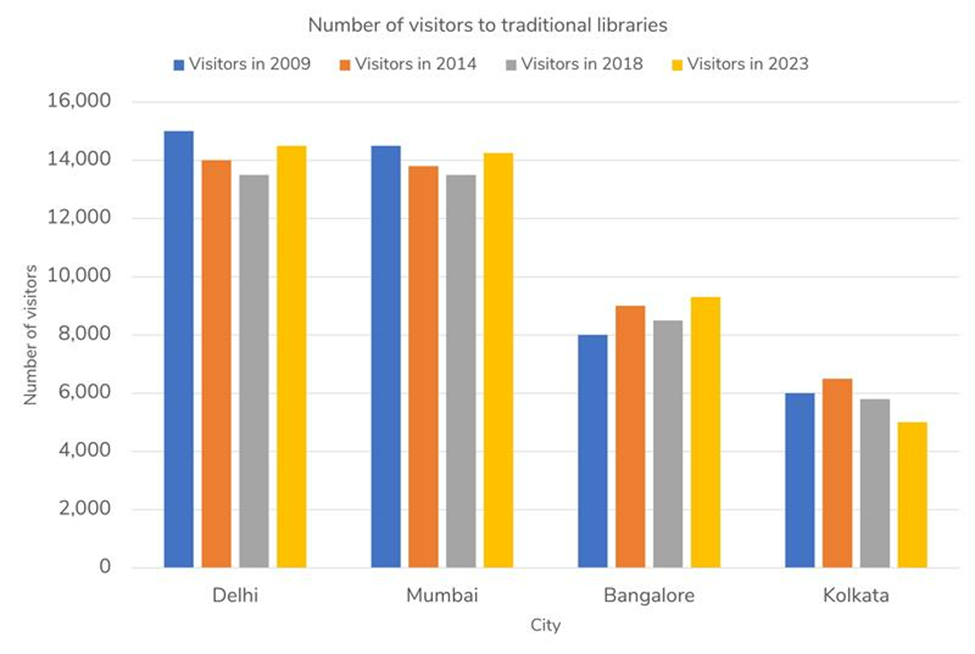
Complete the statement that most accurately reflects the information provided.
Between 2009 and 2023, the visitor count to traditional libraries in ______saw an increase of approximately ______ percent, rounded to the nearest 10 percent.
Answer:
Blank 1: Bangalore
Blank 2: 20 percent

