Blogs
Blogs  Leap Digest
  Events
  About Us
 Trending News
Germany Is Building a Deeper Academic Partnership with India in 2026: What It Means Beyond a Student Visa
For years, the India-Germany education story has run on a single track: Indian students fly to Germany, study at a public university for free or near-free, get an 18-month job-seeking visa after graduation, and build a career in Europe. That track is still very much open. But in 2026, they are building a second, broader track alongside it.
Germany is now working to build a long-term knowledge partnership with India that goes well beyond student recruitment. The government is formalizing joint research programs, bilateral funding mechanisms, startup exchanges, and institutional partnerships between Indian and German universities. For Indian students and researchers, the initiative means more pathways into Germany than most of them currently know exist.
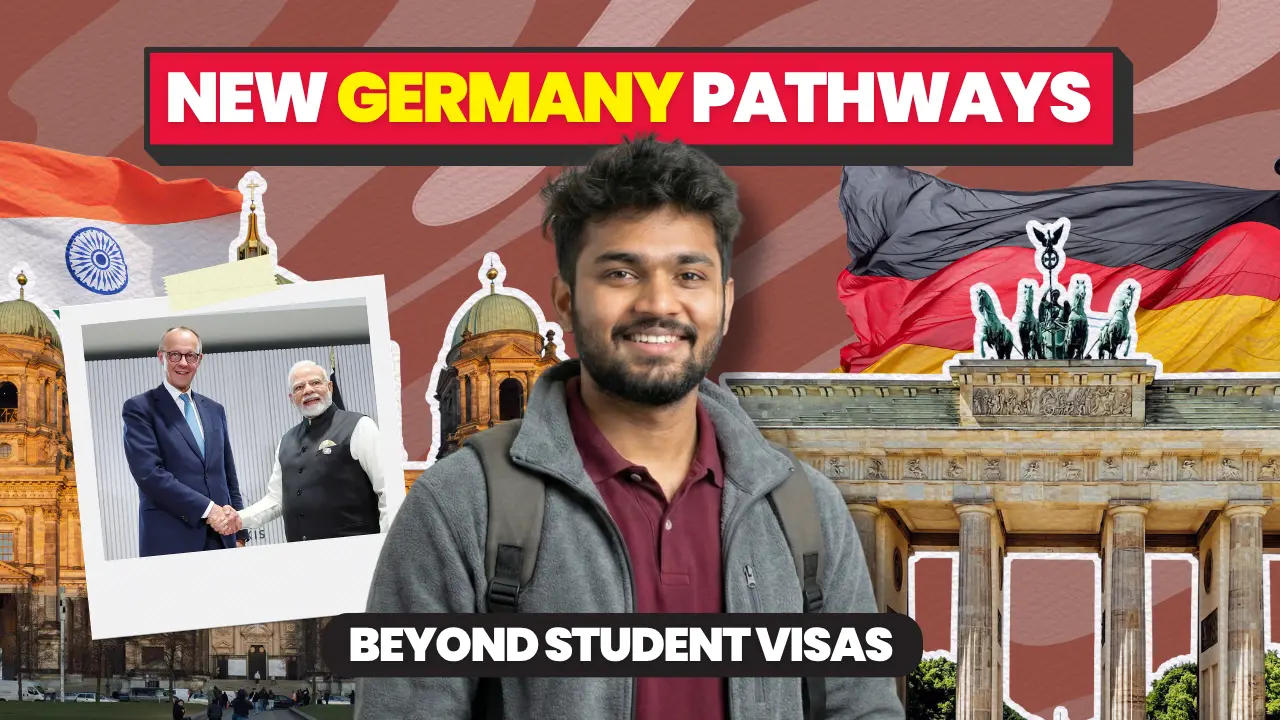
What set these developments in motion was the Indo-German higher education roadmap discussed during talks between Prime Minister Narendra Modi and German Chancellor Friedrich Merz at their bilateral meeting in Ahmedabad on January 12–13, 2026. For the first time, the bilateral strategic partnership placed higher education at the center, alongside trade, technology, and green energy. Both governments are treating academic collaboration as part of economic and geopolitical strategy, not just cultural exchange.
Why Germany Has Shifted Its Thinking on India
Nearly 60,000 Indian students are currently studying in Germany, making Indians the largest international student group in the country. Germany already has the Indian student numbers. What it wants now is something more durable.
The question Germany is asking is not how to attract more Indian students but how to build a knowledge relationship with India that keeps producing value over decades. India, from its side, wants access to European research infrastructure, German industrial networks, and bilateral funding. Both sides see more in this relationship than student visas.
For Indian students, the practical consequence is that studying in Germany is now one route among several. Research fellowships, joint PhD programs, innovation exchange grants, and collaborative research projects are becoming funded, accessible options that do not require relocating to Germany permanently or even applying to a degree program.
Programmes Open to Indian Students and Researchers Right Now
DFG-ICSSR Joint Research Grants
Germany's primary research funding body, the Deutsche Forschungsgemeinschaft (DFG), runs a joint grant program with India's Council of Social Science Research (ICSSR). The 2026 call has opened. Both organizations independently review proposals, and they fund projects that both sides recommend for support. This program is for researchers and PhD students in social sciences and humanities. Projects run two to three years, with costs shared between DFG and ICSSR.
SPARC-GIANT Programme
Twelve Indo-German research projects have already been selected under SPARC GIANT, a co-funded initiative by the governments of India and Germany, jointly run by DAAD and IIT Kharagpur. The program pairs Indian IITs and central research institutions with German university partners for collaborative STEM research. If you are a PhD student or postdoctoral researcher at an IIT or central university, watch the DAAD India website for the next call for proposals.
IGSTC Research Partnerships
The Indo-German Science and Technology Centre, set up jointly by India's Department of Science and Technology and Germany's Federal Ministry of Education and Research, runs four active schemes worth knowing:
- 2+2 Research Projects: Joint R&D projects with one academic institution and one industry partner from each country, built for researchers working at the intersection of applied science and industry
- PhD and Postdoc Industrial Fellowships: Funded exposure to a German industrial setup for PhD students and postdocs, focused on applied research and technology development
- Two-Way Research Exchange: Paired fellowships for young researchers from both countries, giving each side firsthand experience of the other's research environment
- Women in STEM: A dedicated scheme supporting women researchers from India and Germany in building scientific careers across both countries
DAAD Delegation and Partnership Programmes
DAAD runs a program that funds German university delegations to travel to India specifically to build academic partnerships. Applications open every October to November. Separately, Indian research groups can host German undergraduate research assistants in summer 2026. Both programs seed the kind of institutional relationships that turn into longer-term research agreements.
DWIH New Delhi Innovation Programmes
The German Centre for Research and Innovation in New Delhi runs two programs aimed at Indian students and researchers with entrepreneurial ambitions:
- InnoXchange: A bilateral program connecting Indian and German deep-tech startup ecosystems, implemented with SINE at IIT Bombay on the Indian side. It is designed for startup founders, incubator managers, and researchers looking to build cross-border innovation partnerships
- India-Upper Rhine Softlanding Program: Places selected Indian life science startups inside the innovation ecosystem where Germany, France, and Switzerland meet. Built for research-driven teams wanting to test their technology and business model in the European market
Three More Programmes Most Indian Researchers Do Not Know About
Max Planck Partner Groups
Since 2004, the Max Planck Society and India's Department of Science and Technology have supported 88 Partner Groups, 22 of which are currently active. The program works like this: an Indian researcher completes a stay at a Max Planck Institute in Germany, returns to their home institution in India, and then receives five years of funding to run a research group that stays connected to their Max Planck host lab. It is one of the most sustained and well-resourced early-career research programs available to Indian scientists, and it barely features in the standard conversation about studying or researching in Germany. In February 2026, TIFR Mumbai hosted the most recent Partner Group meeting, which 40 current and former Indian group heads attended.
INSA-DFG Researcher Visits
Under the MoU between the Indian National Science Academy (INSA) and the Deutsche Forschungsgemeinschaft (DFG), approximately 25 to 30 Indian researchers are nominated by INSA every year to visit Germany specifically to initiate collaborative projects. This is not a student program. It is for researchers who want to build a joint project with a German counterpart and need the institutional backing to make the first contact. If you are at a research institution and want to explore German partnerships, INSA is your starting point.
DAAD Research Ambassadors
DAAD maintains a network of research ambassadors spread across India, Bangladesh, Bhutan, Nepal, and Sri Lanka. These are researchers who have completed advanced work in Germany and are now based in India, actively helping students and peers connect with German research opportunities. If you are at a university or institution where Germany feels distant and unreachable, your nearest DAAD Research Ambassador is often the most practical first contact you can make.
What Modi and Merz Actually Signed
The India-Germany Joint Statement from 2026 contains specific commitments that will generate funded research activity over the next several years. The ones most relevant to Indian students and researchers are:
- A Joint Declaration of Intent on Semiconductor Ecosystem Partnership, building institutional dialogue across the semiconductor value chain between Indian and German institutions
- An MoU between the All-India Institute of Ayurveda and Charité University of Germany, for cooperation in traditional medicine and health sciences
- A Joint Declaration of Intent on Critical Minerals cooperation, with R&D and value addition as explicit focus areas
- Reaffirmation of the Green and Sustainable Development Partnership, with EUR 10 billion committed by Germany until 2030, creating sustained research demand in climate technology and renewable energy
How to Read This Depending on Where You Are
1. Currently studying in Germany: The growing institutional framework means more funded research opportunities are coming your way, both during and after your degree. IGSTC joint industry research projects are open to students at German universities with an Indian partner institution.
2. PhD student or postdoc based in India: IGSTC fellowships, SPARC GIANT, and DFG-ICSSR grants are funded routes into Germany that do not require a new degree application. Many have no application fee and are open across disciplines.
3. Early-career researcher or startup founder: InnoXchange and the Soft Landing Program are built for your stage. Neither requires existing German connections to apply.
4. Planning to study in Germany: The bilateral partnership context changes how you think about your degree. German universities are deepening ties with Indian institutions, which means your alumni network and institutional pipelines back to India are going to be stronger five years from now than they are today.
German Universities Are Not Opening Campuses in India
Worth saying clearly: German universities are not pursuing physical expansion into India. Funding constraints and operational challenges make the campus model unattractive. The investment is going into collaboration, joint research, and bilateral exchange programs, not buildings. If you are waiting for a German university to open near you, that is not the plan.
Figuring Out Which Pathway Fits You
Germany in 2026 offers more routes for Indian students and researchers than most people are aware of. The right one depends on your stage, your field, and what you want to build.
Book a free session with a Leap Scholar counselor to get a clear picture of which Germany pathway matches where you are right now and what your next step actually looks like.
Sources: India-Germany Joint Statement, Prime Minister's Office | DFG-ICSSR Joint Research Grants 2026 | DAAD India, Cooperation Programmes | DWIH New Delhi, InnoXchange and Innovation Programmes | Indo-German Science and Technology Centre | Embassy of India, Berlin, Science and Technology Cooperation

Kirti Singhal
Kirti is an experienced content writer with 4 years in the study abroad industry, dedicated to helping students navigate their journey to international education. With a deep understanding of global education systems and the application process, Kirti creates informative and inspiring content that empowers students to achieve their dreams of studying abroad.
Users also read
University of Sheffield Opens BEng (Hons) CSE Admissions: Scholarships Up to £7,500 for Indian Students

Australia Has Moved Indian Students to EL3, the Highest Visa Scrutiny Tier. Here’s What That Means.

The Summer Internship Conversion Strategy for UK Freshers in Software Engineering