Blogs
Blogs  Leap Digest
  Events
  About Us
 Trending News
DGIST Ranks 4th in the World for Research Quality: What Indian Students Need to Know About South Korea's Most Underrated University
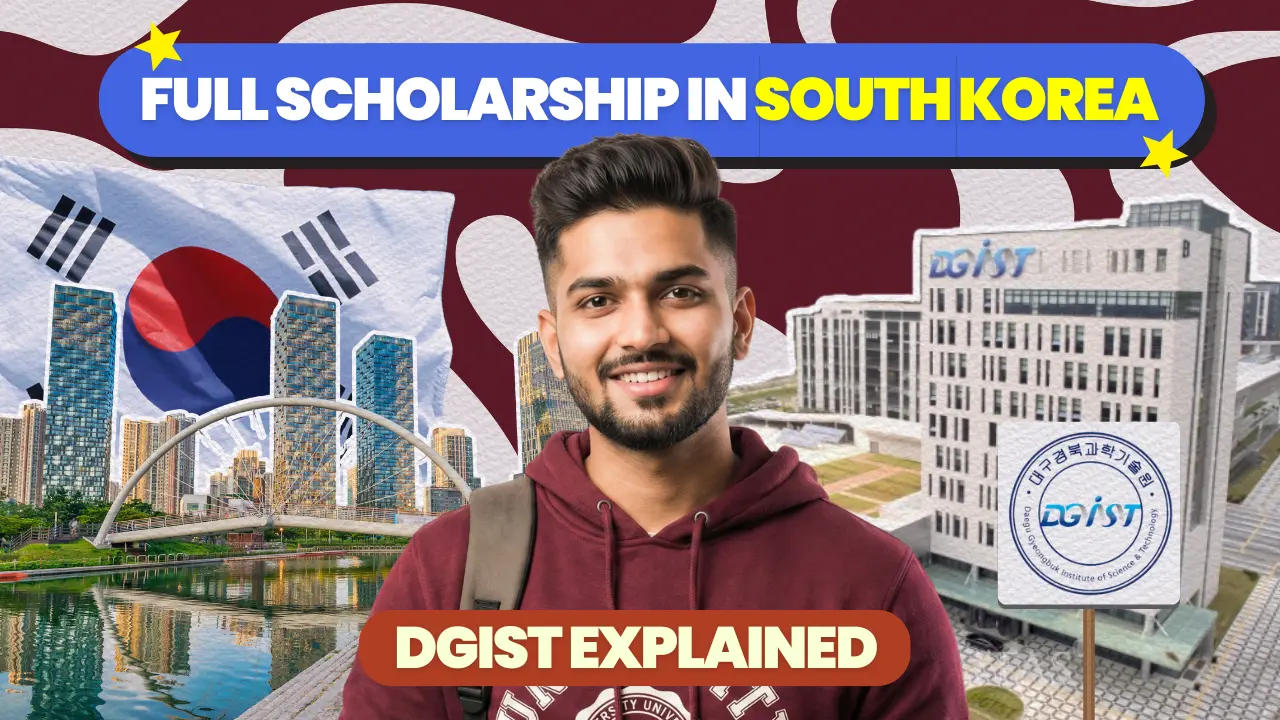
Most Indian students planning to study in South Korea have heard of KAIST. Some have heard of POSTECH. Very few have heard of DGIST. That is about to change.
Daegu Gyeongbuk Institute of Science and Technology, or DGIST, ranked 4th in the world by citations per faculty in the QS World University Rankings 2026, behind only Harvard, City University of Hong Kong, and Caltech. In South Korea, it ranked first. Not second. First, ahead of KAIST, SNU, and every other Korean institution.
For a university that only opened its undergraduate school 11 years ago, that is a number that deserves more than a passing glance.
A Small University Doing Something Very Different
DGIST is one of four government-funded science and technology universities in South Korea, alongside KAIST, GIST, and UNIST. It was established in 2004 as a national research institute, launched its graduate programs in 2011, and opened its undergraduate school in 2014.
It is small by design. Approximately 945 students total across undergraduate and graduate programs. What makes it genuinely different from every other Korean university is its undergraduate structure: there are no departments. Every student enters the same College of Transdisciplinary Studies and designs their own academic track, drawing from AI, semiconductor engineering, robotics, brain science, energy systems, and new biology.
Most universities sort you into a department on day one and let the walls between disciplines do the rest. DGIST deliberately keeps those walls low, because its research philosophy is built on a simple idea: the most interesting problems do not belong to one field.
Where it stands in 2026:
- 4th globally by citations per faculty, QS World University Rankings 2026
- 1st in South Korea, ahead of KAIST and SNU
- 431.7 citations per faculty over five years, more than eight times the global average of 52.0
- 27.85 applicants per undergraduate seat in the 2026 early admissions cycle
The Scholarship That Comes With Admission
Every admitted international undergraduate at DGIST receives the following, automatically, without a separate application:
- Full tuition waiver: Zero tuition for the entire duration of the program. No essay, no income test, no conditions. You get in, tuition is waived
- Monthly living stipend: Paid every month directly to the student to cover living costs
- Subsidised on-campus housing: Dormitory accommodation at well below market rates
- Korean language training: Built into the international student support program
- National health insurance: DGIST pays 100 percent of the monthly insurance contribution for international students
At the graduate level, master's and PhD students get full tuition coverage plus monthly stipends tied to their research involvement. PhD packages at DGIST are competitive with what leading research universities offer globally.
Currency note: 1 KRW = Rs. 0.0646 as of May 11, 2026. Always verify the current rate before making financial decisions.
The Three Fields DGIST Is Building Its Next Decade Around
In July 2025, DGIST formally committed to three strategic research areas. Understanding them matters if you are thinking about applying, because these are the fields where faculty hiring, lab investment, and PhD funding will be concentrated for the foreseeable future.
1. Physical AI is about AI systems that work in the real world, not just on screens. Robots that can sense, decide, and act. Real-time systems that respond to physical environments. It sits at the intersection of machine learning, robotics, and engineering, and it is where global industrial demand is growing fastest right now.
2. Human digital twins are digital replicas of human biological systems used for personalized medicine, healthcare simulation, and biomedical research. DGIST already has deep strength in brain science and new biology, which makes this area a natural next step rather than a new direction.
3. Quantum sensing applies quantum mechanics to build sensors of extraordinary precision for use in healthcare, navigation, defense, and environmental monitoring. Early days globally, but DGIST is positioning itself at the frontier deliberately.
If you are in engineering, computer science, biomedical research, or applied physics, these three areas are where funded PhD positions and global hiring will be concentrated over the next decade. DGIST is not a university moving toward these fields. It is already there.
Try It for Six Weeks First
If committing to a full degree at DGIST feels premature, the Summer Research Internship gives you a way in without the full commitment.
It is a six-week funded program for international undergraduate students in their third or fourth year. Selected interns work in DGIST research labs across seven areas: physics and chemistry, electrical engineering and computer sciences, robotics and mechatronics, energy sciences, brain sciences, new biology, and interdisciplinary studies.
What the 2026 program covered:
- Financial support covering scholarship, dormitory fees, and a daily allowance, totalling approximately KRW 1,560,000, around Rs. 1,00,776 for the full six weeks
- On-campus accommodation, two interns per room
- Korean cultural sessions and a one-day industrial tour
- A certificate of completion from DGIST on finishing the program
Who can apply:
- Non-Korean undergraduate students in their 3rd or 4th year
- Minimum GPA of 3.0 on a 4.0 scale, or equivalent
- Strong English proficiency, assessed through your academic advisor's recommendation letter; no formal IELTS or TOEFL score needed
The 2026 internship ran from June 29 to August 7. The 2027 application window is expected to open in February 2027, following the same pattern as every previous cycle. Check the DGIST International Affairs page at dgist.ac.kr when February arrives.
Applying for Undergraduate Admission
DGIST takes international undergraduate applications once a year, opening in December for entry the following academic year.
The 2027 intake timeline:
- Applications open: December 2026
- Applications close: Early February 2027
- Results announced: By May 2027
What you need to apply:
- High school transcripts from all years, in English or with certified translation
- Certificate of graduation or expected graduation
- A personal statement covering your academic background, research interests, and why DGIST specifically
- One or two recommendation letters from teachers or school authorities
- No SAT, ACT, or TOEFL minimum score required
Who cannot apply:
- Korean nationals, including dual citizenship holders
- Transfer applicants. DGIST only takes freshmen
- Students from homeschooling programs, GED, or online-only qualifications
The personal statement is where applicants win or lose their applications. In 2026, there were nearly 28 applicants for each available seat. A statement that connects your academic interests specifically to DGIST's transdisciplinary research model will do more than any test score could.
What Life in Daegu Actually Looks Like
DGIST sits on the Daegu Technopolis campus in South Korea's fourth-largest city. It is not Seoul, and that is genuinely useful for students watching their budget.
Living costs in Daegu run significantly lower than in Seoul or Busan. DGIST's on-campus dormitories are subsidized, modern, and well-maintained. The campus is self-contained with dining halls, sports facilities, a library, and research centers, so students can meet most daily needs without leaving. You can reach Central Daegu by public transport for everything else.
Studying at DGIST does not require Korean. The university teaches the undergraduate program and most graduate courses for international students in English. That said, picking up conversational Korean makes daily life considerably easier and post-graduation job hunting in South Korea significantly more realistic.
The Indian student community in Daegu is small but growing. DGIST's Korean Language Centre and International Student Association actively support international students with settling in, visa paperwork, and the quieter adjustments that nobody warns you about before you arrive.
Is DGIST Right for You?
DGIST is built for students who want to do research, not just complete a degree. If your goal is a conventional engineering or business program with a clear corporate campus recruitment path, this is not the place.
It makes strong sense if:
- Research is genuinely what you want to do, not a box to tick
- AI, robotics, brain science, energy systems, semiconductor engineering, or biomedical fields is where you are headed
- Full financial support without a separate scholarship application matters to you
- You want to design your own academic path rather than follow a fixed department
- A PhD abroad or a research-facing career in South Korea is the next step after your degree
If you are finishing your undergraduate degree, you might also want to explore how to apply for a direct Ph.D. after B.Tech. to fast-track your research career.
December 2026 Is Closer Than It Sounds
The undergraduate application window opens in December 2026. The summer research internship opens around February 2027. Both are preparation-dependent: the personal statement for DGIST takes time to get right, and the internship recommendation letter needs your academic advisor's buy-in well in advance.
Book a free session with a Leap Scholar counselor to get a clear read on whether DGIST fits your academic profile, how to write a personal statement for a research university with no departments, and how it compares to other Korean and Asian institutions for your specific goals.
Sources: Asia Research News, DGIST QS 2026 Rankings | DGIST Official Website | DGIST 2026 Undergraduate Admissions Guide for International Students | DGIST Summer Research Internship 2026 | Asia Research News, DGIST Future Strategic Areas

Kirti Singhal
Kirti is an experienced content writer with 4 years in the study abroad industry, dedicated to helping students navigate their journey to international education. With a deep understanding of global education systems and the application process, Kirti creates informative and inspiring content that empowers students to achieve their dreams of studying abroad.
Users also read

US Ends "Duration of Status" for F-1 Students: What Every Indian Student Must Do Before September 15, 2026
QS 2026 Reveals World's Top 20 Medical Schools

Top Global Internships with August 2026 Deadlines: Finance, Tech, Research, and Policy