
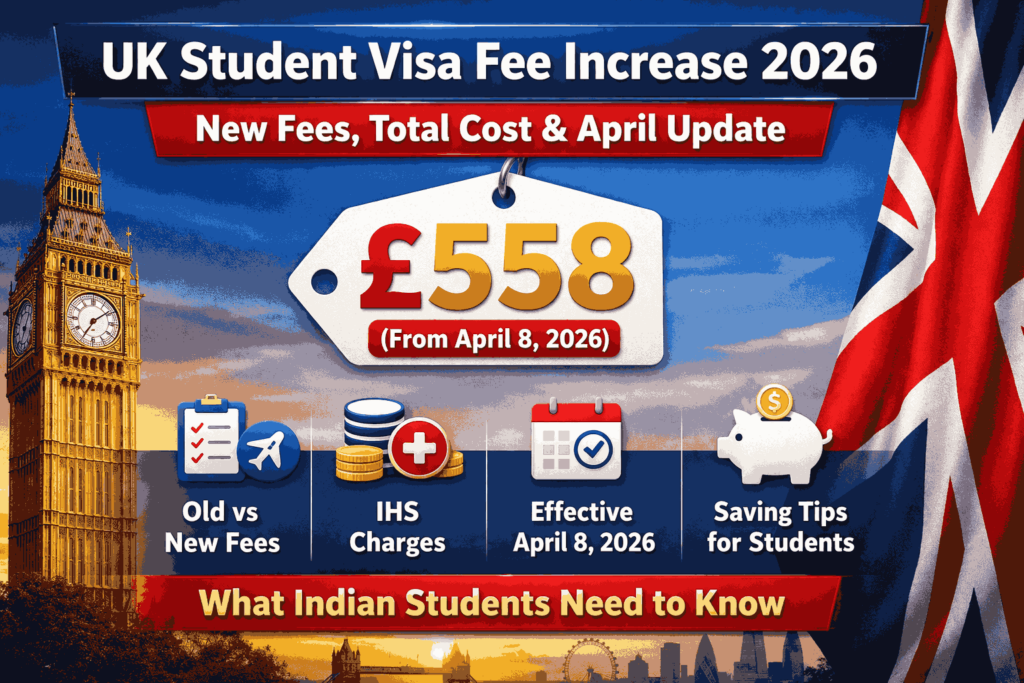
The UK Home Office has confirmed a UK visa fee hike in 2026 across all major immigration routes, effective April 8, 2026. For Indian students, the student visa application fee rises from £524 to £558, an increase of £34. For an Indian family planning a September 2026 departure, this article covers the exact rupee impact, the full total cost of a UK student visa (not just the application fee), whether rushing your application before April 8 is actually worth it, and what to do if things go wrong. By the end, you will have a clear number to put in your budget spreadsheet and a three-step action plan.
UK Visa Fee Increase April 2026: What Has Changed? (Official Update)
The UK Home Office published its revised immigration and nationality fee schedule on March 18, 2026, with the new rates applying to any application submitted on or after April 8. As confirmed by immigration firm Fragomen, most visa fees across work, study, and visit routes are rising by around 6 to 7 percent. The Home Office describes the increases as moderate and inflation-linked, aiming to transition towards a “user-funded” immigration system.
Here is what has changed for the fees that matter most to Indian students:
| Fee Category | Current Fee (before April 8) | New Fee (from April 8, 2026) | Change in GBP | Change in INR (approx.) |
|---|---|---|---|---|
| Student Visa (outside UK) | £524 (Rs.56,080) | £558 (Rs.59,730) | +£34 | +Rs.3,640 |
| Student Visa (inside UK, extension) | £524 (Rs.56,080) | £558 (Rs.59,730) | +£34 | +Rs.3,640 |
| Graduate Route Visa (in-UK application) | £880 (Rs.94,160) | £937 (Rs.100,260) | +£57 | +Rs.6,100 |
| Standard Visitor Visa (6 months) | £127 (Rs.13,590) | £135 (Rs.14,450) | +£8 | +Rs.860 |
| Indefinite Leave to Remain (in UK) | £3,029 (Rs.3,24,100) | £3,226 (Rs.3,45,180) | +£197 | +Rs.21,080 |
| Immigration Health Surcharge (student rate) | £776/year | £776/year | No change | No change |

Choose your dream country
 UK
UK
 USA
USA
 Germany
 Australia
 Ireland
 Canada
 UAE
UAE
 France
 Sweden
 Italy
Italy
 Other
Other
When do you want to study abroad?
What's your highest level of education?
What do you want to study?
Select your current city
How Leap will help you

Personalised University Shortlist

Express Applications with Quicker Admits

End-to-End Application Support
Important: The Immigration Health Surcharge (IHS) is NOT increasing in this round, as confirmed by Cambridge University’s International Students page and Fragomen. The IHS remains at £776 per year for students. Several online sources are conflating fee increases with the IHS. Your IHS cost depends solely on the length of your visa, not on April 8.
The Graduate Route visa fee increase is relevant if you are already studying in the UK and are planning to apply for your post-study work visa. If your Graduate Route application is ready, submitting before April 8 saves Rs.6,100.
Exchange rate used: Rs.107 per £1 (approximate market rate, March 2026). The Home Office sets its own quarterly conversion rate, which may differ from this figure. Verify the actual rate at your VFS Global appointment. All INR figures in this article are estimates for planning purposes only.
Total Cost of UK Student Visa in 2026 for Indian Students (Full Breakdown)
The student visa application fee of Rs.59,730 (£558 from April 8) is not what you actually pay. Most Indian families see only this number in headlines and underestimate the total outlay by two to three lakhs. Here is the complete picture for a student applying for a September 2026 start.
The IHS is the largest additional cost. It is calculated on the full length of your visa, not your course. A 1-year Master’s typically receives a visa of around 16 months (course duration plus 4 months). Because the IHS is charged in 6-month blocks rounded up, this calculation means you pay for 2 full years of IHS. A 2-year integrated Master’s or a course with a placement year receives a visa of around 28 months, pushing the IHS to 3 years.
| Cost Item | 1-Year Master’s | 2-Year Course | India-Specific Note |
|---|---|---|---|
| Student Visa Application Fee | Rs.59,730 (£558) | Rs.59,730 (£558) | Paid via VFS in INR; rate varies |
| Immigration Health Surcharge | Rs.1,66,320 (£1,552 = 2 yrs x £776) | Rs.2,49,480 (£2,328 = 3 yrs x £776) | Paid in GBP online via UKVI portal; your bank converts |
| TB Test (mandatory for India) | Rs.2,500-3,500 | Rs.2,500-3,500 | Must use UKVI-approved clinic; result valid for 6 months |
| IELTS Exam Fee | Rs.17,000 (approx.) | Rs.17,000 (approx.) | Required unless your university accepts MOI or alternative |
| VFS Service Charges | Rs.1,500-4,500 | Rs.1,500-4,500 | Depends on centre and optional services chosen |
| Priority Visa Service (optional) | Rs.88,300 (£825) | Rs.88,300 (£825) | 5-working-day decision; not available in all cities |
| Total (standard service) | ~Rs.2,47,000-2,51,000 | ~Rs.3,30,000-3,34,000 | Excluding tuition and living costs |
UK Student Visa Application Fee From Outside UK in 2026
For Indian students applying from India (outside the UK), the student visa application fee from April 8, 2026 is £558, equivalent to approximately Rs.59,730. This is the same rate as for students applying from within the UK. The Home Office charges an identical fee regardless of whether you are applying from India or from inside Britain. The fee is paid in Indian rupees through VFS Global centres in India. The exact INR amount you pay at VFS may differ slightly from the figure above because the Home Office applies its own quarterly exchange rate, which is typically set a few rupees above the prevailing market rate.
For students already in the UK who need to extend their visa or switch to a Student visa, the in-country application fee is also £558 from April 8.
UK Student Visa Priority Service Fee 2026: Is It Worth It for Indian Students?
The priority service fee for a UK student visa in 2026 is £825 (approximately Rs.88,300), giving you a decision within 5 working days of your biometric appointment. The super priority service costs £1,000 (approximately Rs.1,07,000) and targets a next-working-day decision. Both fees are paid during the online visa application before you attend your VFS appointment.
A few things Indian applicants need to know before choosing priority:
Priority processing is not available at all VFS centres in India. As of 2026, it is typically available in Delhi, Mumbai, Bangalore, Chennai, Hyderabad, and Kolkata but availability changes. Check the VFS Global India website on the day you book, as slots fill fast during peak season (June to August).
Choosing priority does not improve your chance of approval. It only speeds up the decision. If your documents have an issue, a priority application will be refused faster, not more favourably. Most students applying for a September 2026 start who submit in July 2026 do not need priority; standard processing of 3 weeks is sufficient. Priority is genuinely useful only if you receive your CAS after mid-July or your course induction starts before mid-September.
Counselor insight: The IHS is almost always the number that surprises families. A student applying for a 1-year Master’s starting September 2026 needs to budget around Rs.1,66,000 just for the health surcharge, paid upfront during the visa application before they leave India. This is not a discretionary expense. It cannot be waived, even if you intend to use private healthcare in the UK.
For guidance on the full application process, read our UK student visa application guide.
Should You Apply Before April 8, 2026? (Real Cost vs Risk Analysis)
The short answer for most students reading this on March 24, 2026: no. The saving on the student visa application fee alone is Rs.3,640. If your application is fully ready and you were going to apply this week anyway, then yes, apply before April 8. Submitting an incomplete application to save Rs.3,640 is not a good financial decision, considering the total cost ranges from Rs.2.5 lakh to Rs.3.5 lakh. A rejected or withdrawn application means you lose the entire fee and pay it again under the new rate.
Counselor insight: The most common reason Indian students lose their visa fee entirely is not a refusal on merit, it is a financial documentation error that makes their application invalid. The 28-day rule (your bank balance must not drop below the required threshold for even one day during a 28-consecutive-day window, with the final statement dated within 31 days of application) catches students who rush without checking their bank records carefully.
Here are three India-specific scenarios to help you decide
Scenario 1: You are a final-year student graduating in May 2026, waiting for your CAS.
If you are finishing a BTech, BCom, or BA in May 2026 and have received a conditional offer from a UK university, your Confirmation of Acceptance for Studies (CAS) will not arrive until June or July 2026 at the earliest, after your final results are confirmed. You cannot submit a student visa application without a valid CAS. The April 8 deadline is irrelevant to you. Your application will happen entirely under the new fee structure. Budget Rs.59,730 for the application fee.
Scenario 2: You already have your CAS, your university offer is unconditional, and your documents are in order.
If you are a January 2026 intake student extending a visa or a student who deferred from 2025 with everything ready, and your 28-day bank balance window has already been satisfied, submit before April 8. You save Rs.3,640 on the application fee. More importantly, if you are inside the UK and your Graduate Route application is ready, submitting before April 8 saves Rs.6,100 on that fee.
Scenario 3: You are still shortlisting universities and have not taken IELTS yet.
The April 8 deadline has no bearing on your situation. You likely will not apply for a student visa until August or September 2026 at the earliest. Focus your energy on your IELTS preparation and your university applications.
Other UK Student Visa Changes in 2026 You Must Know
The April 8 fee increase is the most recent update, but it sits inside a broader set of policy changes that Indian students planning for 2026-27 need to understand.
Proof-of-funds requirements (updated January 2025, still in force for all 2026 applications): According to UK Home Office student visa guidance, you must show funds covering your outstanding first-year tuition plus living costs for up to nine months. The maintenance requirement for 2026 applications stands at £1,529 per month (Rs.1,63,600) for London-based study, totalling £13,761 (Rs.14,72,400) for nine months. For study outside London, the requirement is £1,136 per month (Rs.1,21,550), totalling £10,224 (Rs.10,93,900) for nine months. These figures must be held in your account for a continuous 28-day period.
Graduate Route shortening (effective January 1, 2027): As confirmed by the Cambridge University International Students page, applications submitted on or after January 1, 2027, will receive only 18 months of post-study work permission for Bachelor’s and Master’s graduates, reduced from 2 years. PhD graduates continue to receive 3 years. If you are starting a 1-year Master’s in September 2026 and graduating in September 2027, you will apply for the Graduate Route after this cutoff and receive only 18 months. This materially affects your post-study career planning. Read more in our UK post-study work visa (Graduate Route) guide.
Dependent restrictions: Since January 2024, only students on PhD and postgraduate research programs may bring dependents. Students on taught postgraduate and undergraduate courses cannot bring spouses or children under the student visa route.
Digital eVisa: Physical Biometric Residence Permits have been replaced by a digital eVisa. You must create a UKVI online account to access your immigration status. The fee is not an extra cost, but it requires action before travel.
UK Student Visa Documents Checklist 2026
Use this table when preparing your application. The India-specific column addresses requirements that particularly trip up applicants from India.
| Document | Core Requirement | India-Specific Detail |
|---|---|---|
| Valid Passport | Must be valid for duration of visa | Carry original to VFS appointment; scans uploaded online |
| Confirmation of Acceptance for Studies (CAS) | 14-digit reference from your university | Valid for 6 months from date of issue; cannot apply more than 6 months before course start |
| Proof of Funds (Bank Statements) | Must show tuition balance + maintenance funds for 9 months | 28-consecutive-day rule; final statement within 31 days of application; no single-day dip below threshold |
| English Language Test Score | Minimum IELTS 5.5 in all 4 sections for visa; university may require higher | See IELTS score required for UK universities; PTe and Duolingo accepted at some universities |
| TB Test Certificate | Mandatory for Indian applicants | Must use UKVI-approved clinic in India; valid for 6 months; cost Rs.2,500-3,500 |
| Academic Transcripts and Degree Certificates | Required for all completed qualifications | Originals required at VFS; certified translations if not in English |
| Passport-size Photographs | Per UKVI specifications | Check current photo specs on GOV.UK before printing |
| IHS Payment Receipt | Paid online during application | Paid in GBP; your bank converts; keep payment confirmation |
| UKVI Account Credentials | Required to submit application and access eVisa | Create at UKVI.homeoffice.gov.uk before starting |
For the complete list of requirements, see our UK student visa requirements guide.
UK Student Visa Timeline 2026: Month-by-Month Application Plan
This timeline maps to the Indian academic calendar. Key pressure points for Indian students are the board exam season (March-April), Class 12 and undergraduate results (May-June), and peak UK visa processing delays (June-August).
| Month | What to Do | India-Specific Note |
|---|---|---|
| March 2026 (now) | Finalise university shortlist; confirm IELTS score is ready | Board exam season: Class 12 students should not delay IELTS further |
| April 2026 | Accept university offer; pay tuition deposit to trigger CAS; begin 28-day bank balance window | New visa fees apply from April 8; budget Rs.59,730 for application fee |
| May 2026 | Class 12 / UG final results released; universities update conditional offers | University turnaround to unconditional offer: typically 2-4 weeks after results |
| June 2026 | Receive CAS from university (usually within 2-4 weeks of deposit confirmation); book TB test | TB test result valid 6 months; plan to get it done before June ends |
| July 2026 | Submit visa application; pay IHS; book VFS biometrics appointment | Peak season begins: VFS slots in major cities (Bangalore, Delhi, Mumbai) fill fast |
| August 2026 | Standard processing: 3 weeks from biometrics; receive eVisa | June-August: Home Office processing can take 4-6 weeks; apply priority if you have a firm travel date |
| September 2026 | Travel to UK; arrive 1 week before course start minimum | UK induction weeks typically start mid-to-late September |
For university shortlisting and course selection, see our UK university list and fees.
Conclusion
First, budget using the total cost, not the headline fee. The student visa application fee rising from Rs.56,080 to Rs.59,730 is real but small relative to your total visa outlay. For a 1-year Master’s, the mandatory IHS of Rs.1,66,320 is the number that shapes your financial plan. Please consider building your budget around the comprehensive table in this article, rather than solely focusing on the headline figure.
Second, if your CAS and documents are ready, submit before April 8. For all other students ,especially those graduating in May 2026 or still waiting for IELTS scores, the April 8 deadline is not actionable. Rushing an incomplete application costs far more than the fee saving.
Third, start your 28-day bank balance window at least five weeks before you plan to apply. This is the one preparation step that cannot be improvised. Once you know your application date, count back 28 days and make sure the required funds are in a single account and stay there.
Verified by: LeapScholar’s UK counselling team, with hands-on experience guiding Indian students through the UK student visa process, including financial documentation, VFS appointments, and credibility interviews.
Have questions about your UK visa budget or the April 2026 fee changes? Book a free session with a LeapScholar counsellor.
Frequently Asked Questions About the UK Visa Fee Increase 2026
Q. What is the new UK student visa fee from April 8, 2026?
Ans. The student visa application fee increases from £524 to £558 for applications made both from outside and within the UK, effective April 8, 2026. This increase was confirmed by the UK Home Office in its revised fee schedule published March 18, 2026. The old rate of £524 applies to applications submitted before April 8.
Q. How much does a UK student visa cost in Indian rupees in 2026?
Ans. From April 8, 2026, the fee for a student visa application Rs.59,730 (£558 at a rate of Rs.107/£). However, this is only the application fee. For a 1-year Master’s program, the total visa-related outlay, including the mandatory Immigration Health Surcharge of around Rs.1,66,320, TB test, and VFS service charges, is approximately Rs.2,47,000 to Rs.2,51,000. Always verify the exact INR figure at VFS on application day, as the Home Office applies its exchange rate.
Q. Is the Immigration Health Surcharge increasing in April 2026?
Ans. No. The IHS is not changing in this round of fee increases. The student rate remains £776 per year, as confirmed by Fragomen’s April 2026 briefing. The IHS is calculated based on the full length of your visa. A 1-year Master’s visa typically covers around 16 months, meaning you pay approximately £1,552 (2 years x £776) upfront.
Q. Should I apply for my UK student visa before April 8, 2026, to save money?
Ans. Only if your application is completely ready. The savings on the student visa application fee is Rs.3,640. If your CAS is in hand, your 28-day bank balance window is satisfied, and your documents are complete, submit before April 8. If any one of these conditions is not met, do not rush. A refusal or an invalid application costs you the full fee plus the new fee on reapplication. Students already in the UK on a Student Visa who are Those ready to apply for the Graduate Route should do so before April 8, when the savings amount to Rs.6,100.
Q. My UK student visa was refused. Do I pay the new fee to reapply?
Ans. Yes. The visa fee is non-refundable on refusal, and a reapplication is treated as a new application with the fee applicable on the day you submit. If your original application was refused before April 8 and you reapply after April 8, you pay the new fee of £558 (Rs.59,730). Read the refusal letter carefully before reapplying. Reapplying with the same documentation that caused the original refusal will very likely result in a second refusal.
Q. What happens if I pay the wrong UK visa fee amount?
Ans. Paying even slightly less than the correct amount, whether due to using an outdated fee table, a currency conversion error, or a calculation mistake on the IHS, can result in your application being voided or delayed. The fee is non-refundable in this scenario. Always use the official GOV.UK fee page and verify the INR conversion at your VFS appointment on the day you pay.
Q. How much bank balance do I need to show for a UK student visa in 2026?
Ans. For a September 2026 application, you must show your outstanding first-year tuition fees plus living costs for nine months. Living costs are £1,529 per month (Rs.1,63,600) for London, totalling £13,761 (Rs.14,72,400), or £1,136 per month (Rs.1,21,550) outside London, totalling £10,224 (Rs.10,93,900). These amounts, plus any outstanding tuition ,must sit continuously in your account for 28 consecutive days, with your final bank statement dated within 31 days of your visa application.












Have Questions? Get Guidance to reach your Dream University
Connect with India's finest counsellors and biggest study abroad community.
Get Guidance