
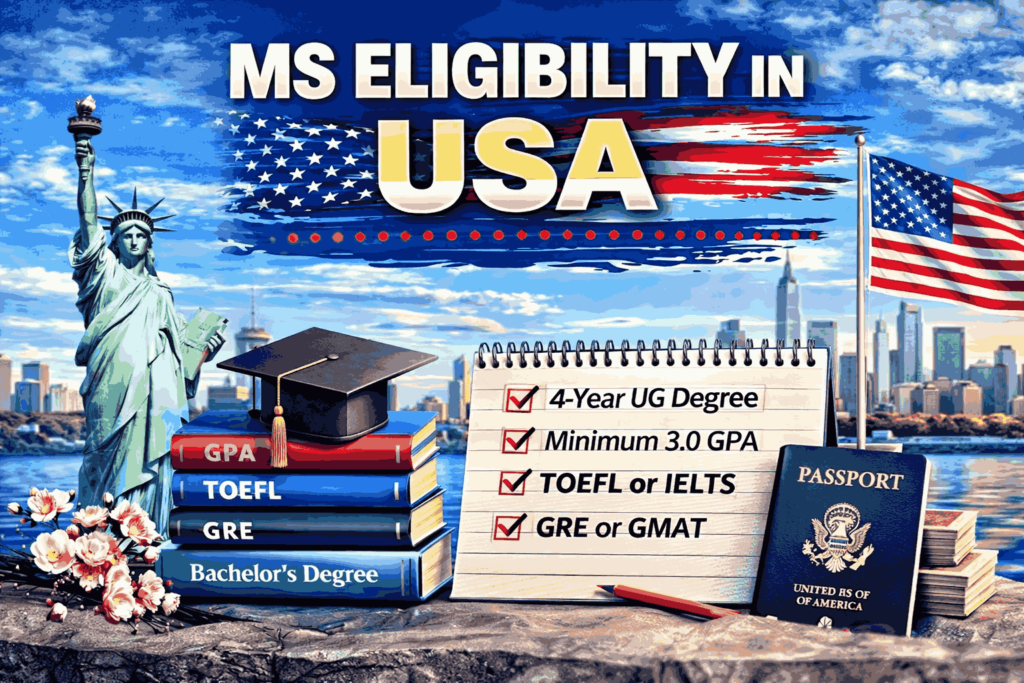
Everything you need to qualify for an MS in the USA in 2026 is covered here: academic requirements, test scores, documents, intake timing, and the F-1 visa, all mapped to the Indian academic calendar.
The Open Doors 2025 Report recorded 363,019 Indian students in the USA in 2024-25, making India the largest source of international students for the second year running. New enrollments declined significantly in Fall 2025, per IIE’s Open Doors 2025 data, partly driven by F-1 processing concerns.
What MS Eligibility in USA Actually Means for Indian Applicants
Admission isn’t decided by cutoffs alone. Your CGPA, GRE, SOP, recommendations, research, and work experience all get weighed together. A 7.5 CGPA with solid project work and a focused SOP regularly beats an 8.5 CGPA with a generic application.
Some things are non-negotiable, though: a recognised bachelor’s degree, proof of English proficiency, and an F-1 visa. GRE, work experience, and portfolios depend on the specific program and tier you’re targeting.

Choose your dream country
 UK
UK
 USA
USA
 Germany
 Australia
 Ireland
 Canada
 UAE
UAE
 France
 Sweden
 Italy
Italy
 Other
Other
When do you want to study abroad?
What's your highest level of education?
Have you completed Class 12th?
What was your Class 12 CGPA/percentage?
Are you a student or a parent/guardian?
What do you want to study?
Select your current city
How Leap will help you

Personalised University Shortlist

Express Applications with Quicker Admits

End-to-End Application Support
For context on what you are stepping into: MS courses in the USA span Computer Science, Data Science, Engineering, Finance, Public Policy, and more. The eligibility specifics below apply broadly across these disciplines, with STEM and non-STEM differences noted where they matter.
Academic Eligibility: CGPA, GPA, and Bachelor’s Degree Requirements
Your bachelor's degree: 4-year vs 3-year
A 4-year BTech, BE, or BSc (Hons) meets this requirement directly. A 3-year BSc, BCom, or BA is accepted at some universities as-is; others ask for a WES (World Education Services) credential evaluation to confirm equivalency. Check each target program's admissions page before applying.
CGPA Conversion: Where You Actually Stand
| Indian CGPA (10-pt) | Percentage Equiv. | US GPA (4.0) | University Tier Realistic |
|---|---|---|---|
| 9.0 and above | 90%+ | 3.8–4.0 | Top-tier (MIT, Stanford, CMU) |
| 8.0–8.9 | 80–89% | 3.5–3.8 | Top and mid-tier |
| 7.0–7.9 | 70–79% | 3.0–3.4 | Mid-tier; targeted approach needed |
| 6.0–6.9 | 60–69% | 2.5–3.0 | Accessible programs; strong SOP critical |
| Below 6.0 | Below 60% | Below 2.5 | Very limited; strengthen other profile elements |
Backlogs and Academic Gaps
One or two backlogs, cleared on the first attempt and followed by improving grades, won't kill your application at mid-tier programs. Multiple uncleared backlogs are harder to recover from, though strong work or research experience can help.
Counselor insight: A cleared backlog with an upward grade trend is not the liability most students think it is at mid-tier programs. What matters is the trajectory. If your 6th and 7th semester grades are your best, say so in your SOP; admissions reviewers notice improvement curves, and a brief honest explanation is far better than hoping they won't look.
STEM vs Non-STEM Differences
STEM programs place a heavy weight on how well your undergrad subjects map to the program. If you're switching fields, certifications and project work can fill that gap. Non-STEM programs (Finance, Public Policy) lean more on work experience and written components.
Counsellor insight: US admissions teams look at individual subject grades, not just your final CGPA. A 7.8 built on strong core technical papers will carry more weight than a 7.8 padded with electives. Check your detailed marksheets before you start applying.
GRE, GMAT, and the GRE Waiver Reality in 2026
Is GRE Required?
Around 60-65% of MS programs now offer a GRE optional or waived status, but the two aren't the same:
• GRE waived / test-blind: A score is not considered even if you send it.
• GRE optional: You decide whether to submit. A strong score helps; a weak score you chose to send can work against you.
• GRE required: Still the case at several top programs. Georgia Tech's MS in CS, for instance, requires GRE scores with minimum section benchmarks, no exceptions.
Source: https://www.in.ets.org/gre.html
Northwestern’s CS department does not require GRE for its 2025–26 master’s applications. CMU’s MSCS program strongly recommends GRE for applicants who cannot otherwise demonstrate strong mathematical proficiency.
Score Benchmarks by Program Tier
| Program Tier | Competitive GRE (Quant + Verbal) | GRE Quant Focus |
|---|---|---|
| Top-tier (MIT, Stanford, CMU) | 325-340 | 165-170 |
| Mid-tier (Purdue, ASU, UT Dallas) | 315-324 | 160-165 |
| Accessible programs | 300-314 | 155-160 |
Business-adjacent MS programs typically expect GMAT scores in the 600-700 range. Some programs take either the GRE or the GMAT; visit the admissions page before you register.
For a curated list of programs by score tier, see GRE accepted universities in the USA. If you are seriously considering a GRE-free application, read the detailed guide on MS in USA without GRE.
English Proficiency: TOEFL, IELTS, and Duolingo Requirements for MS in USA 2026
English proficiency is required unless your bachelor's was at an English-medium institution that the university explicitly recognises as exempt. For most Indian students, that means taking TOEFL, IELTS, or Duolingo.
| Test | Minimum for Most Programs | Competitive Score |
|---|---|---|
| TOEFL iBT | 80–90 | 100–110 |
| IELTS Academic | 6.5 overall | 7.0–7.5 |
| Duolingo English Test (DET) | 105–115 | 120–130 |
TOEFL has the broadest acceptance. IELTS works at most US programs now and is easier to schedule from Tier 2/3 cities. Duolingo is growing, but a few competitive programs still won't take it; confirm before relying on it.
Both TOEFL and IELTS scores expire after two years. A 2023 score may not be valid by Fall 2026 enrollment; check against your intended program start date, not just the application deadline.
Counsellor insight: A common mistake is to take the English test too late in the application cycle. University application portals often require official scores, sent directly by ETS or IDP, which can take two to three weeks after the test. If you are applying to Fall 2026, your TOEFL or IELTS score should be registered and submitted by October 2025 at the latest for December application deadlines. For IELTS preparation, see the guide on IELTS exam: preparation, pattern and fees. For TOEFL, see TOEFL exam: dates, fees and preparation.
Fall 2026 vs Spring 2027: How Intake Affects Your Options
Which intake you target affects scholarships, CPT timing, program availability, and how competitive the pool is. It's a strategic decision, not just a calendar one.
| Factor | Fall 2026 (Aug-Sep 2026) | Spring 2027 (Jan 2027) |
|---|---|---|
| Application window | Sep 2025 - Jan 2026 | Aug-Oct 2026 |
| Program availability | Almost all MS programs | ~40-50%; CS/Engineering often limited |
| Scholarship / TA/RA access | Highest -- budgets reset in Fall | Very limited -- most positions already allocated |
| Competition level | The highest volume of Indian applicants | Lower volume; acceptance rates slightly higher |
| CPT eligibility | Summer 2027 | Summer 2028 (6 months later) |
| Best suited for | Final-year students graduating May-June 2026 | Missed Fall; gap-year applicants; GRE/IELTS retakers |
For a detailed guide on Spring-specific strategy, deadlines, and university lists, see Spring intake in USA: universities and deadlines. For scholarship-specific planning across both intakes, see scholarships for MS in USA.
Documents Required for MS Application and F-1 Visa
MS Application Documents
| Document | What Is Required | India-Specific Note |
|---|---|---|
| Bachelor's degree certificate | Original or attested copy | 3-year degrees may need a WES evaluation |
| Official transcripts | Sealed, issued by the university | Apply 4–6 weeks in advance; Indian universities are slow |
| SOP | 500–1,000 words, program-specific | Generic SOPs are the most common reason for rejection |
| LORs (2–3 letters) | Academic preferred; professional acceptable | At least one from a professor in a core technical subject |
| Resume/CV | 1–2 pages | Include projects, publications, internships, and certifications |
| GRE/GMAT scores | Official scores via ETS or GMAC | Don't self-report weak scores if a waiver is available |
| TOEFL/IELTS/DET scores | Official scores from the testing body | Verify score validity window against program start date |
| Passport copy | Valid 6+ months beyond intended stay | Begin renewal if expiry is before December 2026 |
| Application fee | Rs.4,500–Rs.12,500 per university | Budget for 8–12 applications across tiers |
F-1 Visa Documents
| Document | What Is Required | India-Specific Note |
|---|---|---|
| Form I-20 | Issued by the university after financial proof is verified | Must be signed by you and the DSO before the interview |
| DS-160 | Completed via travel.state.gov | Submit before scheduling an appointment; print confirmation |
| SEVIS fee receipt | Rs.29,050 ($350), paid via fmjfee.com | Pay only after receiving the I-20; SEVIS ID must match |
| MRV visa fee | Rs.15,355 ($185) | Non-refundable; pay via US Embassy authorised channels |
| Financial proof | Bank statements: Rs.16,60,000–Rs.41,50,000 ($20k–$50k) | Sudden large deposits (within 30–60 days) raise red flags |
| Education loan letter | If applicable | Must show the full sanctioned amount; partial letters weaken your case |
| Academic records | Transcripts, degree certificate, test score cards | Bring originals; officer may verify against DS-160 |
| Proof of ties to India | Property docs, employment letter, family responsibilities | Required to demonstrate intent to return post-study |
| Passport | Valid 6+ months beyond US stay | Include all past Indian passports |
Full preparation for the visa interview, including what consular officers typically ask and how to answer honestly, is covered in the US student visa interview preparation guide for Indian students.
Counselor insight: The single document that causes the most last-minute panic is the official transcript. Indian universities, VTU, Mumbai University, and JNTU, routinely take 6-8 weeks to process sealed transcript requests, and some charge per copy. Please request at least three sealed sets as soon as you decide to apply, rather than waiting until you start shortlisting universities. You will need them earlier than you expect
Month-by-Month Planning Calendar
Fall 2026 (For Students Graduating May–June 2026)
| Month | Action Required | India-Specific Note |
|---|---|---|
| Mar–Apr 2025 | Begin GRE and TOEFL/IELTS preparation | VTU/Anna University exams run Feb–May; plan around them |
| May–Jun 2025 | Take the GRE (aim for 2 attempts before October) | First attempt by June; retake by September if needed |
| Jul–Aug 2025 | Research universities; build a target list | Check GRE waiver status per program; policies change every cycle |
| Aug–Sep 2025 | Take TOEFL or IELTS | Score must be valid through August 2026 enrollment |
| Sep–Oct 2025 | Draft SOPs; request LORs | Give professors 6-8 weeks; brief them on target programs |
| Oct–Nov 2025 | Submit applications (early deadlines: Dec 1-15) | Budget Rs.4,500-Rs.12,500 per university |
| Jan–Mar 2026 | Final-year exams | Don't neglect final year grades -- US universities request final transcripts |
| Mar–May 2026 | Receive decisions; compare offers | Negotiate TA/RA before accepting -- offers can sometimes be improved |
| May–Jun 2026 | Graduation; collect documents; request transcripts | VTU/Anna University degree certificates can take 2-4 months -- apply early |
| Jun 2026 | Receive I-20; pay SEVIS fee | I-20 is issued only after the financial documents are verified by DSO |
| Jun–Jul 2026 | Book F-1 visa interview; complete DS-160 | Peak season: visa slots fill fast. Book as early as possible |
| Jul–Aug 2026 | Attend F-1 interview; receive visa decision | Approval ~3–5 working days; allow time for stamping |
| Aug 2026 | Travel to USA | Earliest entry: 30 days before program start date |
Spring 2027 (Condensed)
| Month | Action Required |
|---|---|
| Jan–Apr 2026 | GRE/IELTS preparation during the final semester |
| May–Jun 2026 | Graduation: Collect original documents |
| Jul 2026 | Begin SOP drafting; request LORs |
| Aug–Sep 2026 | Submit Spring 2027 applications |
| Oct–Nov 2026 | Receive decisions; pay SEVIS fee; apply for F-1 visa |
| Dec 2026 | Attend F-1 visa interview |
| Jan 2027 | Travel to USA; Spring semester begins |
Decision Framework: Which Path Is Right for You?
Scenario 1: Final-year BTech student, CGPA 7.8, GRE 315, no backlogs
Suitable position for Fall 2026 if you start by March 2026. A 7.8 CGPA (~3.1 on a 4.0 scale) is realistic for mid-tier programs. A GRE score of 315 works well there but won't get you far at top-5 CS programs. Target 10-12 universities: 2-3 ambitious, 5-6 match, 3-4 safe. If you have research interests, email professors at target schools in July–August 2025.
Scenario 2: Graduate with 6.5 CGPA, cleared backlogs, 1 year work experience, no GRE yet
Top-tier programs aren't realistic here; applying to them wastes application fees. Stick to mid-tier and accessible options: Purdue, ASU, UT Dallas, and USC. Your work experience is real value; the SOP needs to show what you built and where the MS takes you next. Take the GRE; aim for 310+. Spring 2027 is worth considering; it gives you time for a second attempt, and the applicant pool is smaller.
Scenario 3: Student with a 3-year BSc and strong research background
Before shortlisting anything, confirm that the university accepts 3-year degrees. Don't assume. Programs that often need a WES evaluation, which takes 7–10 weeks, should get started early. Your research output (publications, conference work, substantial projects) is what makes the case; lean hard on it.
Counsellor insight: Most students spend 90% of their prep time on the GRE and TOEFL and barely any on the SOP. At mid-tier programs, the SOP is often what separates two applicants with the same CGPA and scores. A good SOP isn't a career summary; it names a specific problem you want to tackle, explains why your background qualifies you, and connects that to what this particular program offers.
What to Do When Things Go Wrong
Missed the Fall 2026 deadline
Spring 2027 works for roughly 40-50% of MS programs, including solid CS and Engineering options at ASU, Northeastern, and Stevens. Applications typically open in August-October 2026. Use the extra time to retake the GRE, sharpen your SOP, and contact professors.
CGPA below 6.5 / 3.0 GPA equivalent
Either strengthen your profile with a strong GRE Quant score (160+), a relevant portfolio, or certifications or get realistic about which tier of programs you're targeting.
The marksheet or degree certificate is delayed
Delays from VTU, Mumbai University, and JNTU are common and well-known to US offices. Get a formal delay letter from your university, attach it to your application, and apply anyway. Most programs issue conditional admits and ask for final documents once they arrive.
F-1 visa refusal under INA Section 214(b)
A refusal doesn't block future applications. The reasons for refusal typically include inadequate financial proof, vague study plans, or insufficient ties to India. Before reapplying, fix the specific problem, ensure consistent bank statements, and provide tighter answers on why you're returning post-MS. The US student visa interview guide for Indian students covers common refusal reasons and how to address them in a second application.
GRE or TOEFL score below the program benchmark
Don't send a weak score to a GRE-optional program. For required programs, please consider retaking the exam before the deadline. TOEFL can be retaken every 3 days; IELTS every 5. If there's no time left, switch to GRE-optional programs or move to Spring 2027.
Conclusion
Before you shortlist a single university, do three things:
• Convert your CGPA properly. Use the table above to figure out which tier is realistic and build your list from there, not from rankings or brand names. One of the most costly mistakes Indian MS applicants make is applying to ten reach programs without any matches or safeties.
• Check each program's GRE policy individually. GRE-optional for admission doesn't always mean GRE-irrelevant for TA/RA positions. Know exactly what the waiver covers at each school before you decide whether to test.
• Start your SOP and LOR requests at least three months before your first deadline. Your scores get you shortlisted. Your SOP and recommendations decide where you actually get in.
Frequently Asked Questions
-
1. What is the minimum CGPA for MS in USA in 2026?
Most programs set a floor of 3.0 on a 4.0 scale, which is roughly a 7.0 CGPA / 65-70%. For mid-tier programs, 7.5-8.0 (3.2-3.5 on 4.0) is where you become genuinely competitive. MIT, Stanford, and similar schools typically admit students at 3.5 and above.
-
2. Can I do an MS in the USA without GRE in 2026?
Around 60–65% of programs now offer GRE optional or waived status, including Northwestern CS, UCSD, and Northeastern Engineering. Several top programs still require it, though. And even at optional-GRE schools, a strong score can improve your shot at assistantships.
-
3. Is a 3-year degree accepted for MS in the USA?
Depends on the university. Some take it as-is; others need a WES evaluation. A 3-year degree from a well-known institution with a strong academic record has a better chance. Always verify on the specific program's admissions page before applying.
-
4. How much bank balance is required for the F-1 visa?
You need to show enough to cover at least one full year of tuition plus living costs, typically Rs.16,60,000 to Rs.41,50,000 ($20,000-$50,000). Funds should be liquid, and the statements should show a stable balance over at least six months. An approved education loan letter from a recognized lender also counts.
-
5. What is the difference between Fall and Spring intake for MS eligibility?
The eligibility requirements are the same. What differs is what's on offer. Fall has more programs, more scholarships, and better CPT timing. Spring has a smaller pool of programs, almost no institutional funding, and CPT eligibility pushed back by around six months.
-
6. Can I gain admission into a US MS program with backlogs?
Cleared backlogs, especially just one or two cleared on the first attempt, aren't disqualifying at mid-tier programs. Uncleared backlogs are trickier. Please address them candidly in your SOP and apply to programs where your overall profile aligns with their requirements.
-
7. My TOEFL or IELTS score is expiring before enrollment. Can I still use it?
Scores are valid for two years from the test date. If yours was from before August 2024, it could expire before Fall 2026 enrollment. Most universities verify validity at enrollment, not just at application. If it's expired, you'll need to retake.
-
8. I received an F-1 visa refusal. Can I apply for the next intake?
Yes, a Section 214(b) refusal doesn't close the door permanently. Figure out exactly what the officer wasn't satisfied with: finances, study motivation, or ties to India, fix that specifically and reapply. After addressing the real issue, many students who initially face refusal eventually secure their visa.
Explore More
- MS in USA without GRE: universities and requirements
- Minimum CGPA required for MS in USA
- Scholarships for MS in USA: full guide for Indian students
- Spring intake in USA: universities and application deadlines
- US student visa interview: preparation guide for Indian students
- GRE accepted universities in USA: scores, tiers and fees
- IELTS exam: preparation, pattern and fees
- Study in USA: universities, cost and visa guide
About the Author
Verified by: LeapScholar’s USA counselling team, with hands-on experience guiding Indian students through MS applications, F-1 visa processes, and post-admission planning across hundreds of successful admits.
Have questions about your MS eligibility or application strategy? Book a free session with a LeapScholar counsellor and get a personalised assessment of your profile.









Have Questions? Get Guidance to reach your Dream University
Connect with India's finest counsellors and biggest study abroad community.
Get Guidance