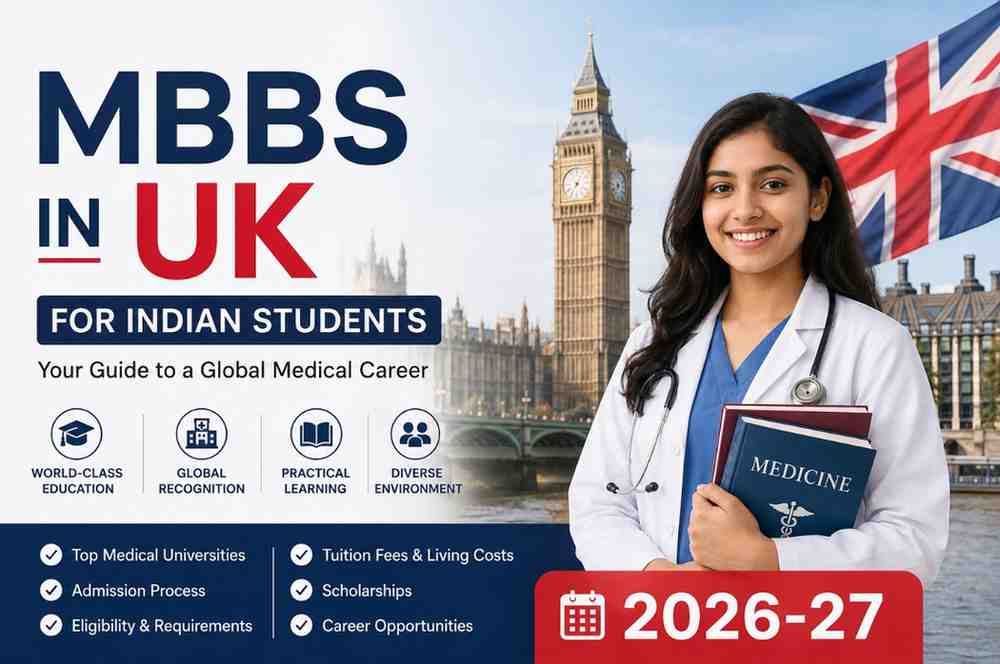
To pursue an MBBS in UK, Indian students must complete Class 12 with Physics, Chemistry, and Biology with at least 50-70% marks, clear medical entrance tests like UCAT, BMAT, or GAMSAT, and demonstrate English proficiency through IELTS or TOEFL. The MBBS degree in the UK usually takes 5-6 years, including pre-clinical and clinical training, followed by a 1-year internship. Admission is highly competitive, as top universities such as the University of Oxford, University of Cambridge, Imperial College London, University of Edinburgh, and King’s College London offer a limited number of international seats. Applicants need a strong academic record, high test scores, and an early UCAS application to secure admission
For Indian students aiming to earn a globally recognised medical degree, the UK stands out as one of the most promising destinations with an average starting salary of £32,398 (₹37.7L) and the highest employment rate of over 94% (HESA 2024). With GMC-accredited degrees, early NHS clinical exposure, and evolving global standards. If you’re aiming to earn a globally recognised medical degree, the UK remains one of the best options for Indian students. With GMC-accredited MBBS, structured NHS clinical exposure, and synchronised licensing standards like UKMLA and India’s NExT, the UK is now more relevant and future-proof for Indian applicants than ever before.
2026 Highlights sneak peek for studying MBBS in UK for Indian Students
- UKMLA replacing PLAB for licensing from 2024
- NEET remains mandatory for Indian applicants
- UKVI visa updates: tighter financial documentation rules
- NExT becomes compulsory from 2026 for returnees aiming to practice in India
GMC(General Medical Council): The GMC is the official UK body that registers medical practitioners to ensure they meet the standards required for safe practice, NHS(National Health Service): The NHS is the publicly funded healthcare system in the United Kingdom, providing a wide range of health services to residents, UKMLA(United Kingdom Medical Licensing Assessment): The UKMLA is a standardized test that all doctors must pass to demonstrate their knowledge and skills before they can be licensed to practice medicine in the UK, NExT(National Exit Test): The NExT is a proposed single national examination in India for final year MBBS students to obtain a license to practice medicine and for admission to postgraduate medical courses.
Choose your dream country
When do you want to study abroad?
What's your highest level of education?
Select you current city
How Leap will help you
Personalised University Shortlist
Express Applications with Quicker Admits
End-to-End Application Support
Key Highlights for MBBS in UK for Indian Students
| Aspect | Details |
|---|---|
| Types of MBBS Courses Offered in the UK | BS (Bachelor of Science), ChB, BCh |
| Eligibility Criteria | - 85% in Physics, Chemistry, Biology, and English in Class 12 - Applicants must be at least 18 years old - Minimum 6.5 overall for IELTS, 100+ is required for TOEFL |
| Documents Required | - Academic transcripts, NEET scorecard, UCAT/BMAT results - Passport, Personal Statement, Letters of Recommendation - English proficiency proof or MOI - Financial documentation showing adequate funds (approx. £35,000–40,000/year to cover tuition and living costs) |
| Acceptable Tests for Indian Students | NEET |
| Available Scholarships | Global Health Future Leaders Scholarship, Chevening Scholarship, Hull York Medical School International Scholarship, Rhodes Scholarship, Imperial College Faculty of Medicine Scholarship |
| Course Duration | 4-6 years |
| Approx Average Tuition Fee for Indian Students | £22,800 - £52,000 (₹26.7L - ₹61L) |
| Estimated Average Annual Salary of MBBS Graduates in the UK | £76,300 (₹89.3L) |
Top MBBS Colleges in UK for Indian students in 2026-2027
Top universities such as the University of Oxford, the University of Cambridge, Imperial College London, University College London, King’s College London, and the University of Edinburgh offer the MBBS in UK for Indian students. These universities consistently rank among the best for medicine. These institutions provide strong graduate outcomes with an around 90% employment rate and enable graduates to stand out in India’s NExT examination as well as internationally.
Here are the top 10 universities in the UK for Medicine based on the QS World University Rankings 2025 (Medicine), along with their graduate employability rates and Course duration:
| University Name | QS Global Rank (Medicine) 2025 | Average Tuition Fee (per year) | Course Duration | Employability Rate |
|---|---|---|---|---|
| Imperial College London | 7 | £52,900 (₹62.2L) | 6 years | 92.6% |
| University of Oxford | 2 | £39,010 (₹45.9L) | 6 years | 91.3% |
| University of Cambridge | 5 | £61,434 (₹72.2L) | 6 years | 90.2% |
| University College London (UCL) | 8 | £47,000 (₹55.3L) | 6 years | 88.9% |
| King’s College London | 15 | £47,700 (₹55.3L) | 6 years | 87.2% |
| University of Edinburgh | 20 | £38,500 (₹45.3L) | 6 years | 89.0% |
| University of Glasgow | 44 | £47,000 (₹55.3L) | 5 years | 90.5% |
| University of Manchester | 33 | £38,000 (₹44.7L) | 5 years | 87.6% |
| University of Bristol | 59 | £38,700 (₹45.5L) | 5 years | 88.4% |
| University of Birmingham | 67 | £46,320 (₹54.5L) | 5 years | 89.8% |
High-ranked universities will have a low acceptance rate for international students, ranging between 10-24% which is very low. So you can for the strong alternatives likethe University of Glasgow, University of Manchester, University of Bristol, andUniversity of Birmingham. These universities are ranked in QS, but are less competitive than the top 20. For Indian students, they are attractive because they combine academics with slightly more accessible entry requirements compared to Oxford or Cambridge. All the listed universities for MBBS in UK for Indian students are recognised by the GMC and NMC, which means that the MBBS degree will be valid for licensing exams in India (like NExT) and allow practice post-registration. It is always better to choose a university recognised by both regulatory bodies to ensure a smooth path in both countries. It will help to get admission for specialisation in both countries in the future.
To boost your admission chances for MBBS in UK, prepare early for competitive exams like UCAT or BMAT, maintain top grades in Physics, Chemistry, and Biology, and submit a strong UCAS application before the October 15 deadline. Whether you aim for Oxford or a strong option like Glasgow, Birmingham, Bristol, or Manchester, pursuing an MBBS in the UK is an investment that leads to global recognition and rewarding medical careers.
Why These 10 UK MBBS Colleges Stand Out for Indian Students in 2026?
- High Graduate Employability: Most graduates enter the NHS Foundation Programme directly, with >87% employment within 6 months of graduation.
- Global Recognition: All listed universities are GMC-recognised, and their degrees are valid for NMC (India) registration with NExT clearance.
- Integrated Clinical Exposure: Students receive early hands-on experience through clinical placements in major teaching hospitals.
- International Alumni Network: These universities produce globally respected doctors and medical researchers working across the UK, India, the US, and the Middle East, including Sir Alexander Fleming from Imperial College London.
- Work & PR Pathways: A Tier 2 work visa is available for 2–5 years post-study through NHS job placements, with high PR conversion for medical professionals.
Cheapest MBBS in UK for Indian Students in 2026-2027
All the top universities for MBBS in the UK will cost a fortune, not just for fees, but also the living expenses will be high in cities like London and Manchester. So here are some affordable MBBS courses for which Indian students seek value within quality medical education. You can choose one from this selection of reputable UK universities offering lower tuition without compromising on GMC accreditation or superior NHS-integrated training.
Top Affordable Universities for Studying MBBS in UK for Indian Students
| University Name | Annual Tuition Fee (GBP/INR) | Course Duration | Graduate Employment Rate |
|---|---|---|---|
| University of Aberdeen | £34,000 (₹40L) | 5 years | 88% |
| University of Dundee | £38,000 (₹44.7L) | 5 years | 88% |
| University of Bristol | £42,600 (₹50.1L) | 5 years | 88% |
| University of Birmingham | £44,100 (₹51.9L) | 5 years | 89% |
| Cardiff University | £38,500 (₹45.3L) | 5 years | 88% |
(Time Out Worldwide, Wikipedia, THE, Tuition data drawn from various university profiles, HESA Graduate Outcomes)
Even though these universities look like a good option, the chances of getting accepted by these universities are as low as 8-15%, and the competition will be even harder for these because of the affordability factor. There are even cheaper universities like Edge Hill University with tuition fees around ₹30L. But cheaper doesn’t always mean better, as they launched MBBS recently, so they don’t have much industry tie-up or recognition, even though they got GMC recognition when they launched MBBS in 2020.
| What students on Reddit are saying… Reddit User @medixUK23: “I’m in my second year at King’s College London. I picked it because it’s GMC-approved and NMC-recognised. My plan is to complete foundation training in the UK and then decide whether to return to India or continue with specialisation here. Having both options gives me peace of mind.” Reddit User @futuredocIN: “After hours of research, I realised that not all foreign MBBS universities are accepted by NMC. But the UK’s top schools, like Edinburgh and Manchester, are on the list. If you're spending ₹2 Cr+ on education, better make sure it's recognised in both countries.” |
What are the Popular Specialisations in MBBS for Indian Students with high ROI in 2026?
If you're planning to pursue an MBBS in the UK, it's crucial to align your future with specialisations that offer strong returns on investment because MBBS in the UK doesn't come cheaper. The following medical fields not only offer excellent earning potential in the NHS but also open doors for Postgraduate Medicine in India (via NExT) or global medical careers. Here's a breakdown of the most rewarding specialisations based on salary, NHS demand, and compatibility with Indian healthcare.
Top Specialisations After MBBS in the UK (2026)
| Specialisation | Avg Salary in UK (GBP/INR) | Top NHS Employers | India Relevance |
|---|---|---|---|
| Surgery (Neurosurgery, Orthopaedics) | £90,000 - £130,000 (₹1.05 Cr - 1.52 Cr) | NHS England, NHS Scotland, Private Clinics | High PG competition, excellent salary scope |
| Internal Medicine | £60,000 - £85,000 (₹70.6L - 1 Cr) | Royal Free London NHS, Guy’s & St Thomas’ NHS Trust | Balanced practice; NExT-aligned and PG-ready |
| Paediatrics & Emergency Medicine | £55,000 - £80,000 (₹64.7L - 94.1L) | Great Ormond Street Hospital, NHS Wales | Shortage in Indian govt hospitals |
| Public Health & Global Health | £45,000 - £65,000 (₹52.9L - 76.4L) | Public Health England, WHO, NGOs | Opportunities in the Indian government, NGOs, and policy |
| Psychiatry | £50,000 - £80,000 (₹58.8L - 94.1L) | NHS Mental Health Services, University Hospitals | Rising demand due to mental health awareness in India |
| General Practice (GP) | £60,000 - £100,000 (₹70.6L - 1.17 Cr) | GP Partnerships, NHS Local Trusts | Flexible for India/UK practice; suitable for independent clinics |
Why These Specialisations Matter for Indian Students?
- NExT-Friendly: These specialisations align well with India’s NExT PG structure, making transition easier post-MBBS.
- NHS Shortage Areas: Roles in Emergency Medicine, Psychiatry, and GP are currently under-staffed in the UK, making Indian graduates more employable.
- Dual Benefit: Students can gain NHS experience and return to India for high-impact roles in public and private healthcare sectors.
For a better ROI, a specialisation or a Master's Degree will help MBBS graduates. Their salary will increase along with the MD and experience level. While choosing it, make sure to opt for something that will have relevance and demand in both the UK and India which align with your interests for a good ROI potential. Dual benefits can be useful in unexpected situations. Make your CV and records strong to create an unbeatable application.
Sources: NHS Careers, BMJ Salary Reports, BMA
What are the Eligibility Criteria for Indian Students to get admission to MBBS programs in the UK in 2026?
Applying for MBBS in the UK requires meeting strict academic qualifications, standardised test scores, and documentation. Here's what Indian students should aim for in 2026, including typical average scores that competitive applicants achieve:
Academic Qualification
- 12th Grade:
You must have passed your 12th-grade with Physics, Chemistry, and Biology, securing a minimum of 50% marks. - Typical Accepted Score: 90-95% in PCB to stay competitive at leading medical schools
Age
- Applicants must be at least 18 years old by the start of the course (usually September of the intake year).
UCAT (UK)
- Required by many UK medical schools
- Average Score (2024): Around 2,523 (total), placing applicants in the 50th percentile
- Competitive Threshold: Scores of 2,600+ (80th percentile and above) are generally seen among shortlisted applicants.
Source: MedifyUniAdmissions, Medic Mind
BMAT (UK)
- Now phased out from many universities, but still used in some cases
- Average Score: Around 5.0, while top applicants often score 6.0 or higher
- For Cambridge, interviewees averaged 6.0 in Sections 1 and 2, and 3.3A in Section 3.
Source: rostrumedu.com, The Medic Portaloxbridgemind.co.uk.
English Langauge
A good score on English proficiency tests such as IELTS or TOEFL is generally required.
- IELTS: Minimum 6.5 overall, with 6.0 in each band; however, scoring 7.0+ is recommended for top universities
- TOEFL iBT: Typically, 100+ is required
- MOI (Medium of Instruction): Accepted by some universities as an alternative to English tests, provided official documentation is submitted.
Documents Required
- Academic transcripts, NEET scorecard, UCAT/BMAT results
- Passport, Personal Statement, Letters of Recommendation
- English proficiency proof or MOI
- Financial documentation showing adequate funds (approx. £35,000–40,000/year to cover tuition and living costs)
How to Apply for MBBS in the UK for Indian Students in 2026-2027?
For Indian students aspiring to pursue a Bachelor of Medicine, Bachelor of Surgery (MBBS) degree in the United Kingdom, the application process for the 2026-2027 academic year is a meticulous and competitive endeavour. This comprehensive guide outlines the essential steps to help you realize your ambition of studying medicine in the UK.
Phase 1: Foundational Research and Preparation (April 2025 - August 2025)
This initial phase is crucial for laying a strong groundwork for your application.
Step 1: In-Depth Research and University Selection
Begin by researching UK medical schools that accept international students. Pay close attention to their specific entry requirements, tuition fees, curriculum, and the university's reputation. Resources such as the General Medical Council (GMC) website and university prospectuses are invaluable. Shortlist a maximum of four medical schools to apply to through the Universities and Colleges Admissions Service (UCAS).
Step 2: Understanding Academic and English Language Requirements:
- Academic Qualifications: Most UK medical schools require excellent academic standing. For Indian students, this typically translates to:
- Class 12 (or equivalent): A high percentage, generally above 85-90%, with Chemistry and Biology being mandatory subjects. Some universities may also require Mathematics or Physics. It is essential to check the specific subject and grade requirements of your chosen universities.
- English Language Proficiency: You will need to demonstrate your proficiency in English by taking a recognized test like the International English Language Testing System (IELTS) or Pearson Test of English (PTE) Academic. Aim for an overall IELTS score of 7.0 or above, with no less than 6.5 in each component, or the equivalent in other accepted tests.
Step 3: Preparing for University Clinical Aptitude Test (UCAT): The UCAT is a mandatory admissions test for most UK medical schools. It assesses cognitive abilities, attitudes, and professional behaviors.
- Registration: UCAT registration typically opens in May and closes in September 2025 for the 2026 entry.
- Preparation: Dedicate significant time to practicing for the UCAT's five sections: Verbal Reasoning, Decision Making, Quantitative Reasoning, Abstract Reasoning, and Situational Judgement. Utilize official UCAT preparation materials and consider joining a coaching program if necessary.
Phase 2: The Application Process (September 2025 - January 2026)
This phase involves the formal submission of your application and subsequent steps.
Step 4: The UCAS Application
All applications for full-time undergraduate courses in the UK, including medicine, are submitted through UCAS.
- Application Opens: The UCAS application portal for 2026 entry will open in early September 2025.
- Key Deadline: The deadline for submitting applications to medical schools is October 15, 2025. This is a strict deadline, and late applications will not be considered.
- Personal Statement: This is a critical component of your application. Craft a compelling personal statement (up to 4,000 characters) that highlights your motivation for studying medicine, relevant work experience or volunteering, and your understanding of the qualities required to be a good doctor.
- References: You will need a strong academic reference from a teacher or counselor who knows you well.
Step 5: Taking the UCAT
The UCAT testing window usually runs from July to September 2025. You must take the test within this period for your application to be considered for the 2026 intake.
Step 6: Interviews
If your application is shortlisted, you will be invited for an interview. Interviews are typically held between December 2025 and March 2026. They can be in the form of a traditional panel interview or a Multiple Mini Interview (MMI) circuit, which involves a series of short, structured interviews.
Step 7: Receiving Offers
Universities will start sending out offers from late 2025 to early 2026. Offers can be unconditional (if you have already met all the requirements) or conditional (contingent on you achieving certain grades in your final exams).
Phase 3: Post-Offer and Visa Application (March 2026 - August 2026)
Once you receive an offer, the focus shifts to securing your place and obtaining your student visa.
Step 8: Accepting Your Offer
You will need to accept your chosen offer through the UCAS portal by the specified deadline.
Step 9: Applying for a Student Visa
Indian nationals require a Student Visa to study in the UK. The application process typically involves:
- Confirmation of Acceptance for Studies (CAS): Your university will provide you with a CAS number once you have an unconditional offer and have paid your deposit.
- Financial Requirements: You must demonstrate that you have sufficient funds to cover your tuition fees for the first year and living expenses for up to nine months. The required amount will be specified in the visa guidelines.
- Tuberculosis (TB) Test: You will need to get a TB test from a UK Home Office-approved clinic in India.
- Online Application and Biometrics: You will need to complete the online visa application form, pay the visa fee, and the Immigration Health Surcharge (IHS). You will then need to book an appointment at a visa application center to have your biometrics (fingerprints and photograph) taken.
Step 10: Pre-Departure Preparations
Once your visa is approved, you can start making your travel arrangements, booking accommodation, and preparing for your move to the UK.
When Should You Start the Application Process for MBBS in the UK: Application Timeline (2026–27 Intake)
| Stage | Timeline |
|---|---|
| Test preparation | Jan - May 2025 |
| Tests and shortlisting | Jun - Sep 2025 |
| UCAS submission deadline | 15 October 2025 |
| Interviews & offers | Dec 2025 - Mar 2026 |
| Acceptance & finance | Apr - Jul 2026 |
| Visa application & travel | Aug - Sep 2026 |
What are the Common Mistakes to avoid while applying for MBBS in the UK?
With the increased competition, you should be very careful while applying for MBBS in the UK. Avoiding these common errors can significantly improve your chances of securing admission and visa approval for MBBS in the UK.
Top Mistakes Indian Students Make:
- Missing the UCAS Deadline: MBBS deadlines are earlier than most UK courses (usually 15 October). Late applications are not considered, so make sure to set reminders for the deadlines.
- Neglecting UCAT/BMAT Preparation: These entrance exams are critical for admission. Many students underestimate the preparation time or use outdated study resources.
- Writing Generic Personal Statements: Admission tutors seek passion, reflection, and personal experiences in your SOP. Generic essays reduce your chances drastically; instead, find your USP and prepare it.
- Weak Interview Preparation (MMI): UK medical schools often use MMI (Multiple Mini Interviews). Lack of structured practice results in poor performance.
- Poor CV: MBBS is highly competitive. Scoring below 85% in PCB (Physics, Chemistry, Biology) or poor English skills can weaken your application. So, your priority should always be to create a strong CV.
- Under-budgeting for Living Costs: Many students only plan for tuition. Forgetting the UK's high living expenses (£12,000/year) causes financial strain or visa rejection. With inflammation in the scene, try to be prepared.
- Applying Without Understanding Course Structure: UK MBBS courses are 6 years long, include clinical placements, and have early patient exposure. Not researching this leads to a dropout or mismatch. You should have a thorough idea of what you should expect in the course.
- Ignoring University-Specific Entry Criteria: Each university may have different score cutoffs, test preferences (UCAT or BMAT), and interview formats. Going generic and not doing university-specific research can lead to misinterpretation.
- Weak LORs (Letters of Recommendation): Submitting vague or non-academic LORs doesn’t help. Strong LORs from science teachers or mentors make a real difference.
- Not Applying for Scholarships or Financial Aid: Several MBBS universities offer partial scholarships. Ignoring these means missing out on lakhs in savings.
What is the Total Cost of studying MBBS in the UK for Indian students?
Pursuing an MBBS in the UK can be a significant financial investment, especially for Indian students. The total cost includes pre-admission expenses, tuition over 5-6 years, and ongoing living costs. Here's a detailed cost breakdown for 2026 admissions:
| Category | Total Estimated Cost (GBP/INR) | Includes |
|---|---|---|
| Pre-admission | £4K (~₹4.7L) | NEET, UCAT/BMAT, IELTS/TOEFL, UCAS application, visa, NHS surcharge |
| Tuition Fees | £200K - £250K (~₹2.35 Cr - ₹2.94 Cr) | Annual university fee (5-6 years) depends on the institution and the course length |
| Living Costs | £50K - £72K (~₹58.8L-₹84.7L) | Accommodation, food, travel, insurance, utilities, entertainment (5-6 years) |
| Total (All-Inclusive) | £254K - £326K (~₹2.98 Cr - ₹3.83 Cr) | Full MBBS journey - from application to graduation |
Most people only think about the fees when they think about the cost of studying MBBS in the UK, which altogether will come around₹2.98 Cr - ₹3.83 Cr. Living expenses are way higher than in India, so while calculating the expenses, make sure to consider the cost of living in the city of your choice. Also, try to check and apply for the available scholarships, which will help you save Lakhs.
While the costs for an MBBS degree are specific, understanding the broader financial landscape is key to planning your education in the UK. For a comprehensive breakdown of expenses beyond just medicine, including accommodation, lifestyle, and costs for other popular courses, be sure to visit our detailed Cost of Studying in the UK page.
Pre Arrival Costs for Studying MBBS in UK for Indian Students in 2026
Here is a detailed breakdown of the pre-arrival costs for Indian students looking to study MBBS in the UK in 2026.
| Category | Expense | Estimated Cost Range (£/₹) |
|---|---|---|
| Application & Exams | UCAS Application Fee | £22.50 - £70 (₹2,635 - ₹8,200) |
| IELTS Exam | £154 (₹18,000) | |
| Visa & Immigration | Student Visa Fee | £524 (₹61,386) |
| Immigration Health Surcharge | £776/year of study (e.g., £3,880 for a 5-year course) | |
| TB Test | Varies | |
| Travel | One-way Flight Ticket | £400 - £900 (₹46,859 - ₹1,05,434) |
| Total (excluding tuition fees & maintenance funds) | £1,900 - £5,600+ (₹2,22,583 - ₹6,56,035) |
1. Application and Entrance Exam Fees
- UCAS Application Fee: You will apply through the Universities and Colleges Admissions Service (UCAS). The application fee is approximately £22.50 to £70 (~₹2,635 to ~₹8,200), depending on the number of universities you apply to.
- English Language Proficiency Test (IELTS): The IELTS exam for UK Visas and Immigration (UKVI) is a mandatory requirement. The fee for this test in India is around INR 18,250.
- Medical Entrance Exams (UCAT/BMAT): Most UK medical schools require applicants to take either the University Clinical Aptitude Test (UCAT) or the BioMedical Admissions Test (BMAT). The fees for these exams vary, but you should budget for this cost.
2. Visa and Immigration Costs
- Student Visa Application Fee: The UK student visa application fee for a student applying from outside the UK is approximately £524 (~₹61,386).
- Immigration Health Surcharge (IHS): This is a mandatory fee that gives you access to the UK's National Health Service (NHS). The IHS fee for a student visa is approximately £776 (~₹90,908) per year of your course. For a typical 5-6 year MBBS program, this can add up to a significant pre-arrival cost that must be paid upfront.
- Tuberculosis (TB) Test: Indian students are required to get a TB test from a UKVI-approved clinic as part of their visa application. The cost for this test is a few thousand Indian Rupees.
3. Financial Proof for Visa Application
You must show that you have enough funds to cover your first year's tuition fees and living expenses. This is a crucial pre-arrival requirement, even if you don't spend it all before you arrive.
- Proof of Tuition Fees: You must show you have the funds to cover your first year's tuition. MBBS tuition fees for international students can range from £22,800 to £52,000 (~₹26,71,002 to ~₹60,91,758) per year, depending on the university.
- Proof of Living Costs (Maintenance Funds): You must demonstrate you have enough money to cover your living expenses for up to nine months. The required amount varies by location:
- London: You must show £1,483 (~₹1,73,732) per month, totaling £13,347 (~₹15,63,590) for 9 months.
- Outside London: You must show £1,136 (~₹1,33,081) per month, totaling £10,224 (~₹11,97,733) for 9 months.
Note: This money must be held in your bank account for a consecutive period of at least 28 days before you apply for the visa.
4. Travel Costs
- Flight Tickets: The cost of a flight ticket from India to the UK can vary significantly depending on the airline, booking time, and time of year. You should budget anywhere from ~₹40,000 to ~₹90,000 or more for a one-way flight.
- Travel Insurance: Although the IHS covers your healthcare, you may want to consider additional travel insurance for your journey and initial days in the UK.
Cost of Living in the UK for Indian Doctors After MBBS
After completing your MBBS in the UK, as an Indian graduate, you will typically transition from a student visa to a work visa, such as the Graduate Route visa. This allows you to work in the UK for two years. Your status will change from a student to a junior doctor, likely starting in the NHS Foundation Programme as a Foundation Year 1 (FY1) doctor. This shift significantly changes your financial landscape, from paying tuition fees to earning a salary.
Estimated Income for a Junior Doctor
Your cost of living will be relative to your income. As a newly qualified doctor in the UK, you can expect the following salary:
- Foundation Year 1 (FY1) Doctor: The basic salary is approximately £32,398 (₹37.9L) per year.
- Foundation Year 2 (FY2) Doctor: The basic salary increases to around £37,303 (₹43.7L) per year.
Your take-home pay (after tax and National Insurance contributions) for an FY1 doctor will be roughly £2,100 - £2,400 (₹2.4L - ₹2.8L) per month. Additional pay for unsocial hours (nights and weekends) can increase this amount.
Here is a detailed breakdown of the estimated monthly cost of living for a single person in London versus other parts of the UK.
Living Costs in London vs Outside London for Indians in 2026
London is significantly more expensive than any other city in the UK. While salaries are often slightly higher due to a "London weighting" allowance, this often does not fully compensate for the steep increase in living expenses.
The cost of living in other major cities like Manchester, Birmingham, Leeds, Glasgow, or Bristol is considerably lower than in the capital, offering a better work-life balance from a financial perspective.
| Expense Category | Estimated Monthly Cost in London (£/₹) | Estimated Monthly Cost in Outside London (£/₹) |
|---|---|---|
| Accommodation (Rent) | £900 - £1,800+ (₹1.05L - ₹2.10L) | £600 - £1,100 (₹70k - ₹1.28L) |
| Council Tax | £90 - £150+ (₹10k - ₹18k) | £80 - £130 (₹9k - ₹15k) |
| Utilities (Gas, Electricity, Water) | £100 - £200 (₹12k - ₹24k) | £90 - £180 (₹10k - ₹21k) |
| Transport (Public Transport) | £150 - £200 (₹18k - ₹24k) | £60 - £150 (₹7k - ₹18k) |
| Groceries & Food | £250 - £400 (₹29k - ₹47k) | £200 - £350 (₹23k - ₹41k) |
| Communication (Phone & Internet) | £40 - £60 (₹5k - ₹7k) | £30 - £50 (₹4k - ₹6k) |
| Professional Expenses | £50 - £100 (₹6k - ₹12k) | £50 - £100 (₹6k - ₹12k) |
| Leisure & Socialising | £200 - £400+ (₹24k - ₹47k) | £150 - £350+ (₹18k - ₹41k) |
| Total Estimated Monthly Cost | £1,780 - £3,310+ (₹2.08L - ₹3.87L) | £1,260 - £2,410+ (₹1.47L - ₹2.82L) |
On an FY1 salary, living in London can be challenging. A significant portion of your income will be dedicated to rent and essential bills, leaving a modest amount for savings and discretionary spending. Many junior doctors opt for flatshares to manage costs. The junior doctor's salary will stretch much further outside of London. The lower cost of rent, in particular, frees up a larger portion of your income. This allows for a more comfortable lifestyle, with greater potential for savings, travel, and pursuing hobbies.
Scholarships for MBBS in the UK for Indian Students in 2026-2027
For Indian students, pursuing an MBBS in the UK is a financial commitment. Although fully-funded grants for medicine are uncommon, many UK universities provide overseas scholarships to help cover these fees for the 2026–2027 intake. A solid application profile and outstanding academic merit are the main criteria used to award these extremely competitive opportunities.
| Scholarship | Type | Eligibility Criteria | Amount/Benefit |
|---|---|---|---|
| Chevening Scholarship | UK Government (Merit-based) | High academic merit, leadership, UG degree, 2 yrs. work exp. (For PG Med Only) | Full tuition + living expenses |
| Commonwealth Shared Scholarship | UK Govt (Developing Nations) | Indian nationals for PG healthcare/public health (Not direct MBBS) | Full tuition, airfare, stipend |
| Global Health Future Leaders Scholarship | Liverpool School of Tropical Medicine | For public health/MBBS-related MSc | Full funding + living costs |
| UCL Global Undergraduate Scholarship | University-Specific | Academic merit, low-income international students | Up to full tuition fee coverage |
| Imperial Bursary | University (Need-based) | Household income < £60,000/year | £5,000 - £7,000/year |
| King’s College International Hardship Fund | University Emergency Fund | Existing students in financial distress | £100 – £3,000 one-time |
| University of Dundee Global Excellence | Merit-based UG Scholarship | Excellent academic profile for MBBS | £6,000/year |
| Bristol Think Big Undergraduate Award | University (Merit-based) | All UG applicants incl. Medicine | £5,000–£10,000/year |
| University of Birmingham India Outstanding Achievement | Country-specific | Indian students with exceptional grades | £2,500–£5,000 one-time |
| International Scholarships by NHS | Post-graduation Pathway | The NHS offers tuition reimbursement for students who work in the UK post-study | Variable, covers part of tuition or debt relief |
Note: Most direct MBBS scholarships are limited, but students often combine bursaries, fee waivers, and NHS work-back schemes post-graduation for financial relief.
Loans, Fee Waivers, and NHS Support (2026)
- UK NHS Bursaries: Available after the 5th year of study for students pursuing MBBS at UK universities; includes a tuition fee waiver + a maintenance grant.
- Indian Banks (Education Loans): Major banks like SBI, HDFC Credila, Axis offer loans up to ₹75L - ₹1.5Cr with 9%-11% interest for UK MBBS.
- Prodigy Finance: For PG (Postgraduate Medical Degrees), but not directly for MBBS.
- University Fee Waivers: Offered based on academic merit and financial need – varies by university.
UK Student Visa Requirements (2026 Update)
With tightening immigration policies and increasing global student competition, UK student visa rules have seen key changes in 2026. For Indian MBBS aspirants, it’s critical to understand the latest guidelines under the Student Route visa (formerly Tier 4).
| Recent 2026 Updates Post-Study Work (PSW) rights remain under review (as of Aug 2025) Spouse and dependent visas are no longer allowed for most taught students Proof of financial support is stricter, with higher maintenance fund thresholds TB tests and biometric appointments are delayed in some Indian regions due to demand |
Student Visa Requirements for Indian Students studying MBBS in the UK (2026)
To secure a UK student visa for MBBS, Indian students must meet the following:
- Confirmation of Acceptance for Studies (CAS)
Issued by your UK university after unconditional offer acceptance. - Valid Passport
- Proof of English Proficiency
- IELTS: 6.5 overall, 6.0+
- TOEFL iBT: 100+
- NEET Qualification Certificate
- Required by NMC India + university admission
- Proof of Funds (for 9 months)
- Tuition: 1st year fees
- Living: £1,334/month (London), £1,023/month (outside London)
- Tuberculosis Test Report: Mandatory from a UKVI-approved clinic in India
- Immigration Health Surcharge (IHS): £776/year (₹91K) × 6 years = ₹5.47L
- Visa Application Fee: £490 (₹57,655) as of 2025
- Biometric Appointment at VFS
- Visa Interview (if required): Conducted randomly for some applicants
Source: UK Government Visa Guidelines, UKCISA Visa Advice
What are the problems faced while applying for a student visa in the UK?
Despite clear procedures, Indian students often face several issues:
Common Visa Challenges (2025-2026)
- Delayed CAS from universities: Especially for competitive MBBS courses with conditional offers
- Biometric appointment backlog: VFS centres in India (Delhi, Mumbai, Chennai) are often fully booked in peak season
- Financial Proof Errors: Incorrect bank statements or a lack of 28-day minimum fund maintenance
- Visa Refusals Due to Low GTE Justification: Students are unable to prove genuine intent for studies in visa interviews
- Confusion Over Dependent Rules: Many MBBS students are still unaware that a dependent/spouse visa isn't allowed now
- TB Test Centre Overload: Shortage of slots or test certificate delays affecting application timelines
- Document Upload Issues on UKVI Portal: File rejections, system errors, and confusion in sequencing documents
- Changes in Policies Mid-Cycle: Some students apply under old guidelines but are assessed under new rules. So be up to date.
Tip: Always prepare your visa application at least 3-4 months before your course start date, and use UKVI-accredited consultants or university support if possible. You will start spending on the degree before admission, so be very careful with the dates
What are the Career Opportunities After Completing MBBS in the UK for Indian Graduates?
Graduating with an MBBS from a UK university opens up a wide array of global career paths for Indian Students. Whether you choose to work in the NHS, return to India, or apply your medical training in other countries, the global recognition and clinical exposure make it a high-ROI option even in India.
Career Opportunities After MBBS in the UK
After completing MBBS in the UK, Indian graduates have multiple career pathways, each with its own salary potential, recruiters, and growth prospects:
NHS Foundation Training (FY1 & FY2)
- Major Recruiters: NHS England, Trust Hospitals
- Average Salary: ₹38.1L – ₹43.8L
- Overview: This is the first step for graduates entering the UK healthcare system. Foundation Training offers hands-on experience across different specialties and prepares doctors for specialist training or GP roles.
Specialist Training (ST1-ST8)
- Major Recruiters: NHS, UK Health Boards, Royal Colleges
- Average Salary: ₹47.3L – ₹99.4L
- Overview: After foundation years, doctors can pursue specialty training in fields like cardiology, surgery, or pediatrics. Training duration varies, but it equips you with in-depth expertise and higher earning potential.
General Practitioner (GP)
- Major Recruiters: NHS, Private Clinics
- Average Salary: ₹76.4L – ₹1.11 Cr per year
- Overview: GPs play a vital role in primary healthcare. This role offers stable income and opportunities for private practice or consultancy alongside NHS work.
Clinical Research & PhD Opportunities
- Major Recruiters: WHO, UKRI, Universities (UCL, Oxford, Cambridge)
- Average Salary: ₹47L – ₹64.7L per year
- Overview: UK medical universities and research institutions offer extensive research opportunities, allowing MBBS graduates to contribute to global healthcare advancements.
Returning to India via NExT
- Major Recruiters: AIIMS, Max, Apollo, Manipal Hospitals
- Average Salary: ₹10L – ₹25L per year
- Overview: Indian students can return to India and clear the NExT exam to practice locally. UK MBBS graduates are highly sought after in India’s private and public healthcare sectors.
Medical Officer (Non-specialist)
- Major Recruiters: WHO, Médecins Sans Frontières, NGOs, PSU Hospitals
- Average Salary: ₹12L – ₹30L per year
- Overview: For those inclined toward humanitarian work or global healthcare, positions with NGOs or international organizations offer both meaningful work and competitive pay.
Postgraduate Studies (MD/MS, MSc)
- Major Recruiters: NHS, Private Hospitals, Global Health NGOs
- Average Salary: Varies: ₹20L – ₹50L+ per year
- Overview: Pursuing higher studies in medicine or public health can significantly increase earning potential and open doors to global leadership roles in healthcare.
Note: Salaries may vary depending on the role, location, and currency exchange rates.
Completing your MBBS is an achievement, but what comes next? For many Indian graduates in UK, the journey doesn't end at graduation. The UK offers a clear pathway to transition from student to practising doctor, allowing you to gain invaluable experience in the world-renowned NHS. To understand how you can extend your stay and launch your medical career, explore our detailed guide on the UK's Post-Study Work Visa for graduates.
Can I practice medicine in India after graduating from a UK medical school in 2026?
Yes, you can practice medicine in India after completing your MBBS from a UK university, but there are key conditions to meet as per the National Medical Commission (NMC) and the FMGL (Foreign Medical Graduate Licensing) Regulations, 2021.
Key Conditions for UK MBBS to be Valid in India:
- NMC Recognition:
- Your UK medical university must be listed and approved by the NMC.
- It must offer a primary medical qualification equivalent to India’s MBBS.
- Course Duration:
- You must complete at least 54 months (4.5 years) of academic coursework.
- UK courses typically meet this, with 5-6 years total duration, including clinical rotations.
- Mandatory Internship:
- The UK Foundation Year (FY1) or supervised internship must be completed abroad.
- From 2024, India will no longer allow completing internships within India if you studied abroad.
- Pass NExT (National Exit Test):
- After returning to India, you must clear NExT to get permanent registration and begin practice.
- NExT replaces FMGE and serves as both a licensing and PG entrance exam.
- English Language Proficiency (if required):
- You may also need to show English proficiency (IELTS/TOEFL) in some NMC cases..
MBBS in the UK is valid in India if your university is NMC-listed, you complete the full course and internship abroad, and clear the NExT exam. Plan your academic journey keeping these regulations in mind to ensure seamless career progression in India.
Work Permit and PR Pathways After MBBS in the UK for Indian Graduates
After completing MBBS in the UK, Indian students have structured and well-recognised pathways to stay back, work, and even apply for permanent residency (PR). Here's a breakdown of how you can transition from a student to a full-time NHS doctor and eventually secure a settlement in the UK.
| Visa Type | Who’s It For? | Duration | Post-study Use |
|---|---|---|---|
| Graduate Route Visa | MBBS graduates who want to work in the UK | 2 years | Apply for jobs, clinical placements, and NHS posts |
| Skilled Worker Visa (Tier 2) | For full-time NHS jobs post FY1/FY2 or after PLAB | 5 years (renewable) | Sponsored by the NHS or Trusts |
| Health and Care Worker Visa | Healthcare professionals, including doctors | Up to 5 years | Fast-track PR, reduced visa fees, family included |
After completing an MBBS in the UK, Indian graduates have clear and structured options to work and settle in the country. Most start with the Graduate Route Visa, which allows two years to find NHS roles or clinical placements. From there, transitioning to a Skilled Worker or Health and Care Worker Visa enables long-term employment and a path to PR (Indefinite Leave to Remain). With consistent NHS employment, students can apply for PR in as little as 5 years, eventually becoming eligible for UK citizenship.
| What students on Reddit are saying “After graduation, the Graduate Visa lets you explore job options before settling into the NHS track.” - IndianMedicalUK |
UK vs India- Which is Better to Study MBBS in 2026?
Choosing between the UK and India for studying MBBS is one of the most crucial decisions for Indian medical aspirants. It is expensive in both countries. Let’s break it down by key factors:
| Factor | MBBS in UK | MBBS in India (Private Colleges) |
|---|---|---|
| Duration | 5-6 years | 5.5 years |
| Recognition | Globally recognised (GMC + NMC) | India only (NMC) |
| Clinical Training | Early, structured, within NHS hospitals | Varies by college, often delayed |
| Total Cost | ₹2 Cr+ (including tuition & living) | ₹70L-₹1.2 Cr |
| Avg. Starting Salary | ₹40L-₹50L/year (NHS or UK roles) | ₹6L-₹12L/year (India; varies widely) |
| Return on Investment | High: Global jobs, NHS salary, PG abroad | Moderate: Depends on NEET-PG and location |
| Entrance Process | NEET + UCAT/BMAT + UCAS + Interviews | NEET only |
| Postgraduate Pathways | Easier access to PG in the UK, the US, and Australia | Highly competitive NEET-PG; limited PG seats |
| Work Permit & Stay | 2-year post-study visa + NHS career options | No post-study work visa |
| Licensing Exam | UKMLA (mandatory from 2025 for UK practice) | NEXT (mandatory from 2026 for Indian practice & PG) |
| Global Career Mobility | Highly eligible for jobs/PG in the UK, Canada, Australia, etc. | Low-Requires separate exams for every country |
Is Studying in the UK a Better Option than Studying MBBS in Countries like Russia, China, Bangladesh?
Is studying MBBS in the UK a better option than studying MBBS in countries like Russia, China, or Bangladesh? Well, the UK offers better infrastructure, recognition, and future opportunities-making it a wise long-term investment compared with other common MBBS destinations. However, choosing the right country for your MBBS can shape your medical career for life. While Russia, China, and Bangladesh are popular among Indian students for their affordability, the UK offers a globally recognised degree, high-quality clinical training, and direct GMC recognition, critical for practising medicine worldwide. Let’s break down the key differences in student life, recognition, ROI, and long-term career value.
Country Comparison Overview
| Factor | UK | Russia | China | Bangladesh |
|---|---|---|---|---|
| Recognition in India (NMC) | Mostly recognised | Some universities delisted | Limited recognition | Most are NMC-approved |
| Medium of Instruction | English | English (some Russian mixed) | English (Chinese mixed) | English |
| Clinical Exposure | Early NHS integration | Limited hands-on training | Varies by university | Decent, mostly in later years |
| Cost of Education (5-6 yrs) | £150,000 - £200,000 (₹1.76Cr - ₹2.35Cr) | ₹25-45 lakhs | ₹30-50 lakhs | ₹25-35 lakhs |
| Global Degree Acceptance | High (GMC recognised) | Low to moderate | Low to moderate | Low to moderate |
| Internship Opportunities | NHS paid internships available | Must return to India | Must return to India | Must return to India |
| Language Barriers | None | Possible | Possible | None |
| Post-MBBS Work Visa/PR Path | Graduate Route + NHS shortage roles | Rare | Rare | Rare |
Key Takeaways and Explanation
- UK vs Russia: While Russia offers affordability, many medical degrees are no longer recognised by NMC (India) as of 2024. Also, language barriers and limited clinical exposure reduce career scope.
- UK vs China: China's infrastructure has improved, but many programs mix Chinese and English instruction, which may affect comprehension during clinical years. Also, a lower acceptance rate by Indian regulators adds uncertainty.
- UK vs Bangladesh: Bangladesh provides affordable and English-medium education with NMC approval, but lacks global mobility and access to healthcare systems like the NHS.
Student Life Comparison: UK vs Others
- UK: High-quality student life, multicultural cities, international student support, part-time work options, and access to NHS training hospitals.
- Russia/China: Cultural adjustment and extreme climates can be challenging. Many students report limited interaction with patients during training.
- Bangladesh: Cultural familiarity but limited international exposure or resources compared to the UK.
Conclusion: Why MBBS in the UK Could Be the Best Choice for You in 2026?
Well, choosing to pursue MBBS in the UK isn’t just about earning a degree-it’s about stepping into one of the world’s most respected healthcare systems. What many don’t realise is that UK-trained doctors are among the most mobile globally, with over 200+ countries accepting GMC-accredited qualifications. Indian students also benefit from early hands-on NHS placements, access to cutting-edge research, and growing scholarship support via Commonwealth, Chevening, and university-specific grants.
While alternative destinations may offer cheaper tuition, few provide the combination of international recognition, structured clinical training, and long-term PR opportunities that the UK does. You might not know this, but if PR is your goal, MBBS increases the chance of getting PR in the UK for Indian students. Suppose you’re thinking long-term, be it global practice, medical research, or entrepreneurship in healthcare. In that case, the UK remains one of the smartest investments for Indian medical aspirants in 2026 and beyond, as it is one of the top industries that’s not threatened by AI today.
How LeapScholar Can Help You?
We offer:
- One-on-one UCAS and SOP counselling
- UCAT/BMAT prep
- English Language test prep
- Loans and scholarship support
- Visa filing assistance
- Free webinars and mock interviews
Are You Eligible for MBBS in the UK? Book a free counselling session with Leap Scholar Today!
Completing an MBBS is a monumental achievement, but it marks the beginning of your journey toward specialisation. To understand the full career trajectory, it is crucial to explore the next steps, making our detailed guide on PG in UK after MBBS the perfect resource for planning your advanced medical training and future in the UK's healthcare system.
Frequently Asked Questions (FAQs)
-
Is NEET required for MBBS in the UK?
Yes, the NEET would be mandatory to all Indian students desiring to pursue MBBS in the UK. Whereas the UK universities do not assess NEET scores during their admissions process, it is mandatory at the National Medical Commission (NMC) in India. That way, the graduates can go back and work in India as medical practitioners.
-
What is the cost of MBBS in the UK?
The expenses of pursuing MBBS in the UK will be as much as £2,00,000- 3,00,000 (2.35 - 3.52 crore). This encompasses boarding fees, living, accommodation, application fees, and costs associated with visa fees. Prices may differ greatly between the universities and the city one can live in.
-
Is NEET valid in the UK?
No, UK universities do not consider NEET scores for admission. However, Indian students must still clear NEET to comply with NMC regulations if they wish to practice in India later.
-
Is MBBS in the UK valid in India?
An MBBS degree of a UK-based medical school recognised by GMC is valid in India, yes. To obtain the license of the NMC Indian students have to pass NExT (National Exit Test). There is also a need to make sure that the university appears in the list of approved foreign institutions by the NMC.
-
What is MBBS called in London?
In London and across the UK, MBBS is referred to as MBBS or MBChB. At Oxford, it’s called BM BCh. Despite the different names, the qualification is equivalent to an MBBS in India.
-
What is the salary of MBBS in the UK?
The average salary of a medical graduate in the UK in their Foundation Year 1 (FY1) is between 32-34,000 GBP (37-39 lakhs). This can increase to 50,000-100,000 as they get experience, particularly senior doctors and NHS consultants. These salaries are also associated with the location of the hospital and speciality.
-
What is the NEET rate in the UK?
In the UK, there is no selection procedure that is based on NEET, nor do universities take NEET scores into account. NEET is just applicable to the Indian students planning to be back in India after MBBS. Technically, there is no cut-off and no acceptance rate to NEET in the UK system.
-
What are the fees of Oxford University for MBBS?
Oxford’s medical program (BM BCh) costs around £39,010 per year (₹45.9 lakhs), totaling approximately £234,000 (₹2.75 crore) for the full 6-year course.
-
What is the NExT exam for MBBS?
National Exit Test (NExT) is a compulsory licensing examination that is implemented by the NMC to all Indian and foreign medical graduates. It is used instead of the older NEET-PG and FMGE exams beginning in 2024. Graduates of UK universities have to complete NExT in order to qualify to practice in India.
-
How long is PG in the UK after MBBS?
Postgraduate training in the UK generally takes 5-8 years, including 2 years of Foundation Training and 3-6 years of Specialty Training depending on the chosen field.
-
Can I study MBBS in the UK for free?
It is not without cost to study for MBBS in the UK, and the cost is high, particularly to foreigners. Nevertheless, a number of scholarships such as Chevening, Commonwealth, and university scholarships may alleviate much financial pressure thereof. Indian students with a powerful academic profile are able to find both partial and even full funding.
-
How much does it cost to become a medical doctor in the UK?
Training to be a full-fledged medical doctor in the UK, such as MBBS, living expenses and fees to take licensing exams and speciality training, can set you back over 300,000 lbs just to become a doctor (in 3.5 crores). This takes up to 5-6 years of education plus some years of postgraduate training. A long and costly course will mean financial planning has to be done.
-
How long is an MBBS in the UK?
In the UK, MBBS normally lasts 5 years. Most universities, however, present courses that take 6 years, especially where the program involves an intercalated BSc degree or an extra foundation year on the part of international students. In most of the programmes, clinical exposure begins at an early stage, providing students with practical exposure on top of academic studies.
-
How much percentage is required for MBBS in the UK?
Most Indian students require at least an 85% mark or higher in their Class 12 CBSE, ISC or state board, meaning in Biology, Chemistry and Physics of the curriculum. For the very elite universities such as Oxford, Cambridge, or Imperial, higher scores of 90-95% are possible because of their strong academic record. Besides, there are requirements for entrance tests and interviews to be used by students to gain admission.


Have Questions? Get Guidance to reach your Dream University
Connect with India's finest counsellors and biggest study abroad community.
Get Guidance