Blogs
Blogs  Leap Digest
  Events
  About Us
 Trending News
Where Indian Students Are Actually Going in 2025 And What It Means for Your 2026 Plans
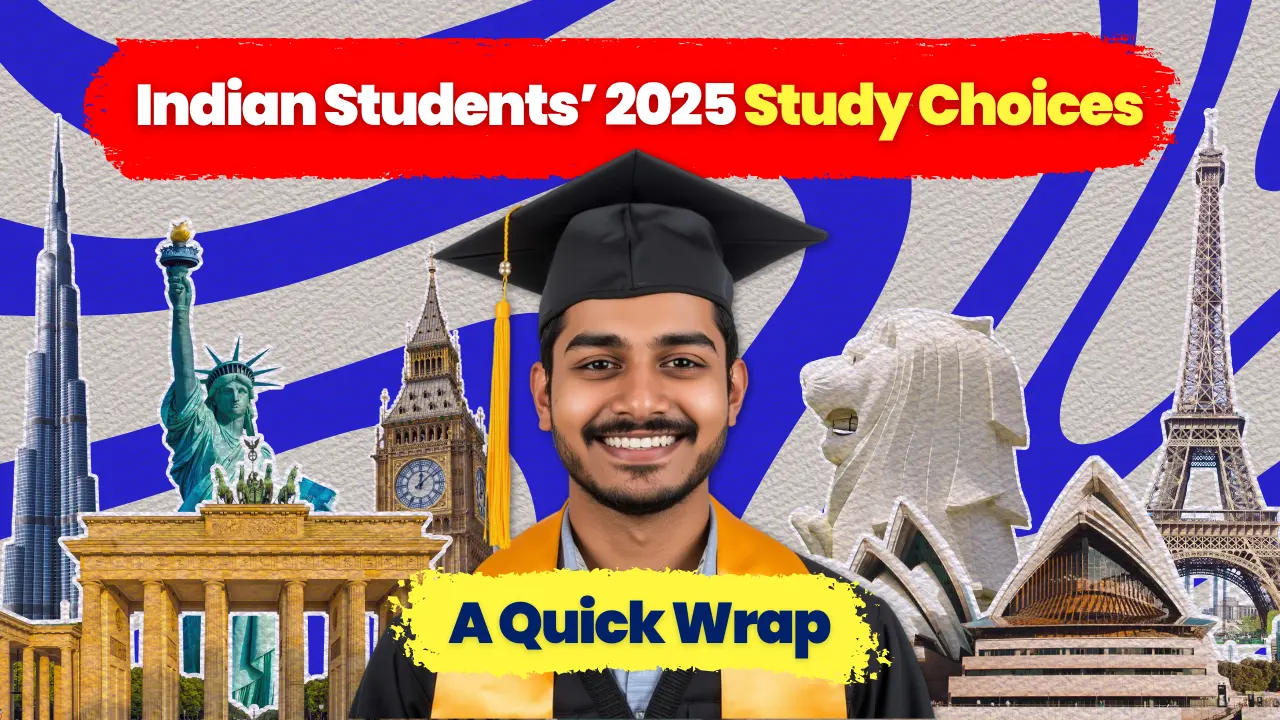
Remember when studying abroad meant basically choosing between the US, UK, Canada, or Australia? Those days are pretty much over.
In 2025, Indian students didn't just follow the crowd; they got strategic. Yes, the traditional favorites still topped the charts, but there's a fascinating shift happening. Students are asking smarter questions: "Where will I get the best value?" "Which country actually wants international graduates to stay?" "Can I afford this without drowning in debt?"
If you're planning to study abroad in 2026, understanding these trends isn't just interesting; it's essential. Let's break down where your peers went this year and what you can learn from their choices.
The Big Picture: What Changed in 2025
Think of 2025 as the year Indian students became practical romantics. Everyone still dreams of international campuses and global careers, but now they're running the numbers first. Tuition costs, post-study work rights, quality of life, and realistic PR pathways - these aren't boring details anymore. They're deal-breakers.
The result? Germany jumped ahead as the value champion. Ireland became the tech lover's paradise. France started looking seriously attractive with those 5-year work visas. And the UAE? It's no longer just a transit stop; it's a legitimate study destination.
The Top 10
1. Canada: Still Number One, But Getting Pickier
With over 427,000 Indian students, Canada remains the heavyweight champion. But here's the thing: it's getting harder to get in, especially for undergrad programs. The Post-Graduation Work Permit is still golden, but you'll need to be more strategic about which province and which program you choose.
If you're targeting Canada for 2026, think Master's programs. They're facing less scrutiny, and the pathway to PR is clearer for graduate students.
Canada: The "Master’s or Bust" Strategy
Canada remains a top choice, but the "Golden Age" of easy undergraduate entry is over. In 2026, Canada is prioritizing quality over quantity.
- The 2026 Cap: A national limit of 408,000 permits means competition is fierce for colleges and undergrad programs.
- The Master’s Loophole: Master’s and PhD students at public universities are exempt from federal study caps and do not need a Provincial Attestation Letter (PAL).
- Strategic Tip: Aim for 16-month+ graduate programs. These face less scrutiny and provide a direct path to the Post-Graduation Work Permit (PGWP) and Permanent Residency (PR).
2. United States: The Dream That Still Works
The US continues to dominate for high-impact careers, especially in Tech and Research.
- STEM OPT Advantage: If you graduate in a STEM field, you are eligible for 3 years of Optional Practical Training (OPT). This is your most realistic bridge to an H-1B visa.
- Political Climate: While political rhetoric regarding OPT remains, the program continues to be the backbone of the US tech labor force.
- Strategic Tip: Look for "Public Ivies" or state universities (e.g., University of Texas, Purdue). They offer massive recruitment networks at a fraction of the cost of private institutions.
3. United Kingdom: Fast and Focused
The UK is your destination if you want a world-class degree and work experience without a 5-year commitment.
- Graduate Route Update: Most Master's graduates starting in 2026 will receive 2 years of post-study work rights (if they complete by end of 2026). However, a reduction to 18 months is confirmed for applications made from January 1, 2027.
- Cost Efficiency: A 1-year Master’s means one year of tuition and one year of living expenses period.
- Strategic Tip: Focus on Russell Group universities. Their reputation remains a "passport" in global finance and consulting hubs.
4. Australia: The PR Path That Actually Works
Australia’s new migration strategy is tough on "visa hopping" but incredibly rewarding for Indian graduates.
- Indian Advantage (AI-ECTA): Under the trade agreement, Indian Master’s graduates (coursework) get 3 years of work rights outperforming most other nationalities.
- The Age Cap: Most 485 visa streams now have an age limit of 35. However, Master’s (Research) and PhD graduates remain eligible until age 50.
- Strategic Tip: Study in Category 2 (Perth, Adelaide) or Category 3 (Regional) areas to unlock an extra 1–2 years of work rights and bonus PR points.
5. Germany: The Smart Money Choice
Germany has officially become the "Smart Money" choice for engineering and tech.
- Public University Fees: Most public universities charge €0 tuition. You only pay a "semester contribution" (approx. €300–€500) which covers your transport pass and admin.
- 18-Month Job Search: You get 18 months post-graduation to find a job. If you find a role paying above €45,934 (in IT shortage roles), you qualify for the EU Blue Card.
- Strategic Tip: Learn German to B1 level during your degree. It cuts your PR wait time to just 21 months.
6. UAE: Education Close to Home
The UAE is no longer just for business; it's a strategic academic stepping stone.
- Transnational Education: You can study at the Dubai campuses of University of Birmingham (UK) or Heriot-Watt and receive the exact same degree as the home campus for a lower cost.
- Golden Visa: High-achieving students (GPA 3.75+) can qualify for a 10-year Golden Visa, providing long-term stability in a tax-free economy.
7. Ireland: Where Tech Giants Actually Are
Ireland is the quiet giant of European tech and pharma.
- Stamp 1G Visa: Master’s graduates (Level 9) get a 2-year stay-back visa with full work rights.
- MNC Presence: Google, Meta, Apple, and Intel all have European HQs in Dublin, creating a high-demand market for Data Science and Fintech.
8. France: The Hidden Gem
France is aggressively targeting 30,000 Indian students by 2030 with unique visa perks.
- Master’s Perk: Master’s graduates get a 2-year post-study visa (APS/Job Search). Once they return to India, they are eligible for a 5-year multiple-entry Schengen visa.
- English Taught: Over 1,600 programs are now taught entirely in English, particularly in top-tier Business Schools (HEC, INSEAD).
9. New Zealand: The Peaceful Alternative
New Zealand is for those who value nature and safety as much as their career.
- 3-Year Open Visa: If you complete a Master’s (Level 9) or PhD (Level 10), you get a 3-year open work visa, one of the most generous in the world.
- Green List: Focus on Nursing, Teaching, or Construction Engineering to get a "Straight to Residence" pathway.
10. The Netherlands: Innovation Without the Hype
The Netherlands is the best non-native English-speaking country for international students.
- TU Excellence: Universities like Delft and Eindhoven are world leaders in Logistics and Renewable Energy.
- Orientation Year: You get a 1-year search year (Zoekjaar) to find a job. Once you land a role with a salary above the "Highly Skilled Migrant" threshold, your permit is easily extended.
What This Means
Look, choosing where to study abroad in 2026 isn't about picking the "best" country. It's about finding your fit. Here are the real questions to ask:
- Can you afford 3-4 years there, not just tuition but actually living?
- Does the country want you to stay after graduation, or is it just taking your money?
- Are companies in your field actually hiring in that location?
- Can you handle the weather, the culture, the distance from home?
The students who succeeded in 2025 weren't necessarily the ones with the highest budgets. They were the ones who did their homework, found their sweet spot, and went in with a plan.
Your Move
The good news? You have more real options today than any previous generation of Indian students. The challenge? You need to be strategic, not just optimistic.
Start researching early. Talk to current students, not just agents. Run the numbers honestly. And remember the right destination for your friend might be completely wrong for you.
The world is more open to Indian students than ever before, but the successful ones in 2026 will be those who choose with both their hearts and their heads.

Kirti Singhal
Kirti is an experienced content writer with 4 years in the study abroad industry, dedicated to helping students navigate their journey to international education. With a deep understanding of global education systems and the application process, Kirti creates informative and inspiring content that empowers students to achieve their dreams of studying abroad.
Users also read
Vietnam Steps Into the Global Academic Spotlight at APAIE 2026: And Indian Students Should Pay Attention
Vietnam Steps Into the Global Academic Spotlight at APAIE 2026: And Indian Students Should Pay Attention
Indian Passport Fees Rise From July 1, 2026. Here Is What It Means If You Plan to Study Abroad.