Blogs
Blogs  Leap Digest
  Events
  About Us
 Trending News
South Korea Eases Visa Rules for International Students in 16 Technical Majors: What Indian Students Need to Know
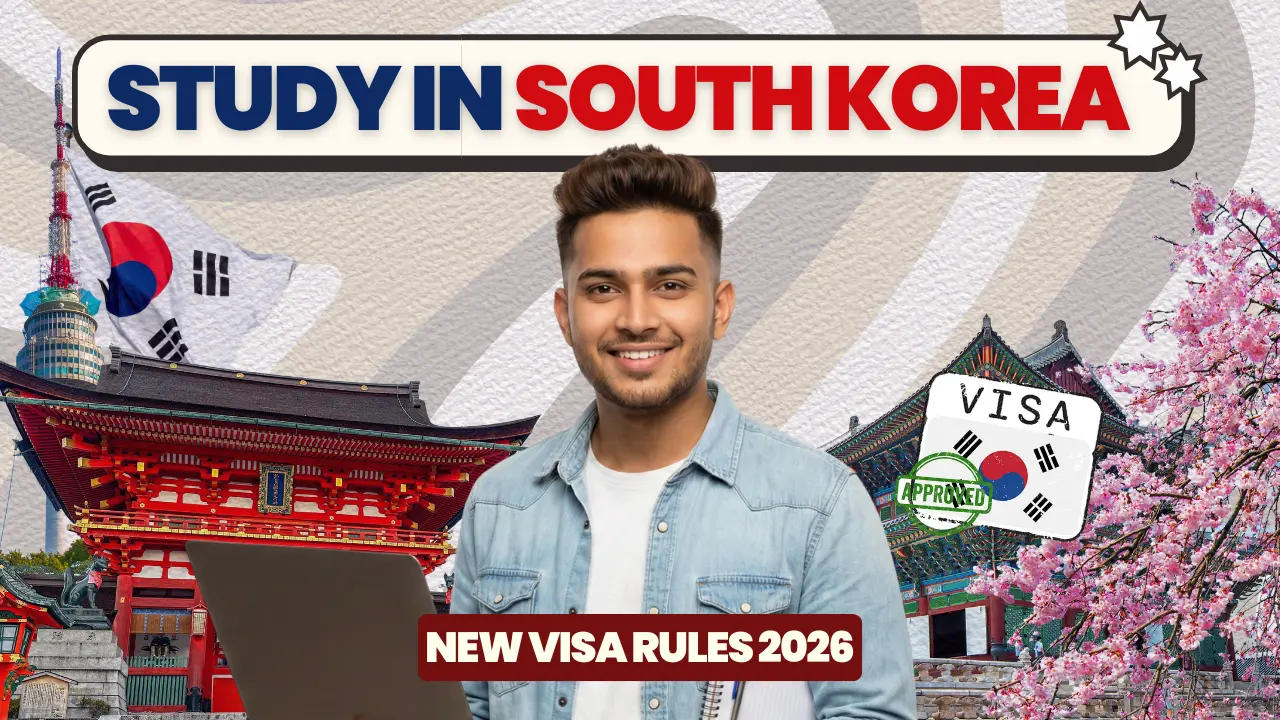
South Korea has announced eased visa regulations for international students enrolled in selected vocational university programs. The Ministry of Justice designated 16 vocational programs across the country as workforce-focused technical courses, making their students eligible for relaxed D-2 student visa requirements, expanded part-time working hours, and a pathway to a special work visa for graduates.
This is not a minor administrative update. It is a structural change to how international students in these programs can live, work, and build a career in South Korea, and the implications for Indian students are worth understanding properly.
(Currency note: 1 KRW = Rs. 0.0641 as of April 30, 2026. Always verify the current rate before making any financial decisions.)
What Has Actually Changed: The Three Key Reforms
On February 5, 2026, the Ministry of Justice designated 16 vocational programs as workforce-focused technical courses. Students in these programs are now eligible for eased D-2 student visa requirements, expanded part-time work hours, and a pathway to a special work visa after graduation.
Reform 1: No More Minimum Bank Balance Requirement for the D-2 Visa
- Students admitted to the 16 designated programs will no longer need to show proof of a minimum bank balance to secure a D-2 visa, provided they have achieved TOPIK level 3 or higher in Korean language proficiency
- Previously, students applying to universities in the Greater Seoul area had to show at least 20 million KRW (approximately Rs.12.82 lakh) in savings, and students outside Seoul needed 16 million KRW (approximately Rs.10.25 lakh)
- For Indian students with TOPIK Level 3 or above, this financial barrier is now completely removed for these 16 programs
Reform 2: Part-Time Work Hours Increased from 30 to 35 Hours Per Week
- The initiative increases allowable part-time work hours during the semester from 30 to 35 hours per week
- South Korea's minimum wage for 2026 is KRW 10,320 per hour, effective January 1, 2026 (up 2.9% from the 2025 rate of KRW 10,030), approximately Rs. 661.51 per hour at current rates
- At 35 hours per week, a student working maximum hours can earn approximately KRW ~₹1,563,444 per month, approximately ₹100,220 per month
- That additional income meaningfully reduces the financial burden of studying in South Korea, especially for students managing education loans
Reform 3: A Brand New Post-Graduation Work Visa
- The Justice Ministry plans to introduce the E-7-M work visa, also called the K-CORE (K-College to Regional Employment) visa, exclusively for graduates of the 16 programs. Eligible graduates must secure employment in their field of study with a minimum annual salary of 26 million KRW and have Korean language proficiency at KIIP level 4 or TOPIK level 5
- 26 million KRW annually is approximately 16.67 lakh per year at current rates
- This creates a named, structured pathway from graduation directly into employment, one of the most important factors Indian students weigh when choosing a study destination
The Path from Graduation to Long-Term Residency
The K-CORE visa does not just allow graduates to stay and work. It opens a clear route to long-term residency, significant for Indian students thinking beyond the degree itself.
Holders of the E-7-M visa who work for five years, or three years in regions projected to experience population decline, can apply for the F-2 resident visa, which provides long-term residency options for skilled international talent.
The pathway in simple terms:
- Complete one of the 16 designated technical programs
- Graduate and secure a job in your field at a minimum of KRW 26 million annually (approximately Rs. 16.67 lakh per year)
- Hold TOPIK Level 5 or KIIP Level 4 Korean proficiency
- Work on the E-7-M visa for 5 years (or 3 years in a designated population-decline region)
- Become eligible for the F-2 long-term resident visa
For Indian students planning beyond the degree itself, this process is a named, structured pathway, from study to employment to long-term residency, backed by formal visa categories at each stage.
The 16 Programs: Fields and Locations
The 16 programmes are spread across multiple provinces, including six in Gyeonggi, three in Busan, and others in North Jeolla, Daegu, North Gyeongsang, South Gyeongsang, Ulsan, and South Jeolla. Programs range from automotive engineering and mechanical engineering to textile design, renewable energy, and smart agri-food resources.
The deliberate spread across provinces is intentional. South Korea is directing international talent away from the already congested Greater Seoul area and into regions experiencing population decline and labor shortages. For students, the move means significantly lower living costs than Seoul-based programs, which, combined with the 35-hour work week, creates a genuinely more manageable financial picture.
Fields covered across the 16 designated programs:
- Automotive and mechanical engineering
- Renewable energy systems
- Smart agri-food resources and agricultural technology
- Textile design and manufacturing
- Information technology and computing
- Electronics and semiconductor-related disciplines
Why This Matters for Indian Students Specifically
South Korea has not historically featured prominently on Indian students' study abroad shortlists. The UK, USA, Canada, Australia, and Germany dominate those conversations. But the February 2026 reforms change the calculus in specific ways.
For Indian engineering and technical students:
The 16 designated programs sit in disciplines where Indian undergraduate engineering students build strong foundations: automotive, mechanical, electronics, IT, and energy. Students with BTech or BE backgrounds in these fields have directly relevant profiles for postgraduate technical programs in South Korea.
For students who want to work while studying:
The 35-hour work week is one of the most generous student work allowances in Asia. For Indian students managing education loans or trying to offset living costs, earning approximately Rs`.1,00,220 per month while studying is a meaningful financial lever that does not exist at this level in most other Asian study destinations.
For students thinking about a long-term Asian career:
South Korea's semiconductor, automotive, electronics, and renewable energy sectors are globally significant. Samsung, Hyundai, LG, SK Hynix, and POSCO all have their headquarters there. A technical degree in South Korea, combined with Korean language proficiency and the K-CORE visa, puts graduates directly inside the recruitment pipeline of some of the world's most significant engineering and technology employers.
What You Need to Prepare
If South Korea's 16 technical programs are of interest to you, these are the priorities to focus on now:
Korean language, TOPIK:
- TOPIK Level 3 removes the financial proof requirement for the D-2 visa
- TOPIK Level 5 is required for the K-CORE post-graduation work visa
- Start Korean language preparation early; TOPIK requires sustained preparation and cannot be rushed
Program verification:
- Not all technical programs in South Korea qualify under this pilot. Only the 16 specifically designated programs are covered
- Check the official Ministry of Justice list to confirm your target program and institution are included before you apply
The trial timeline: Act early.
The trial program will run until the end of 2027, after which the Justice Ministry will assess its effectiveness and determine whether to expand or make the visa benefits permanent.
This is a pilot. Students entering in 2026 and 2027 are studying under the most favorable conditions South Korea has ever extended to international technical students. Whether these conditions become permanent after 2027 depends on how the pilot performs. Early entrants benefit from the most generous version of the policy while it is active.
Want to Know If South Korea Is the Right Fit for Your Profile?
At Leap Scholar, our counselors can help you identify which of the 16 designated programs aligns with your academic background, plan your TOPIK preparation timeline, and map out the full study-to-work pathway in South Korea.
Book your free counseling session with Leap Scholar today for personalized guidance on whether South Korea's expanded visa and work rights make it the right study destination for your 2026 or 2027 application.
Sources: Nairametrics, South Korea Relaxes Visa Rules | TheRadar, South Korea Eases Visa Rules | Travel and Tour World, South Korea Visa Reforms | BookMyForex, KRW to INR April 30, 2026 | Official Ministry of Justice South Korea
Kirti Singhal
Kirti is an experienced content writer with 4 years in the study abroad industry, dedicated to helping students navigate their journey to international education. With a deep understanding of global education systems and the application process, Kirti creates informative and inspiring content that empowers students to achieve their dreams of studying abroad.
Users also read
Vietnam Steps Into the Global Academic Spotlight at APAIE 2026: And Indian Students Should Pay Attention
Vietnam Steps Into the Global Academic Spotlight at APAIE 2026: And Indian Students Should Pay Attention
Indian Passport Fees Rise From July 1, 2026. Here Is What It Means If You Plan to Study Abroad.