Blogs
Blogs  Leap Digest
  Events
  About Us
 Trending News
Harvard Just Made Tuition Free for Families Under $200,000. Here Is What Indian Students Need to Know About Ivy League Financial Aid
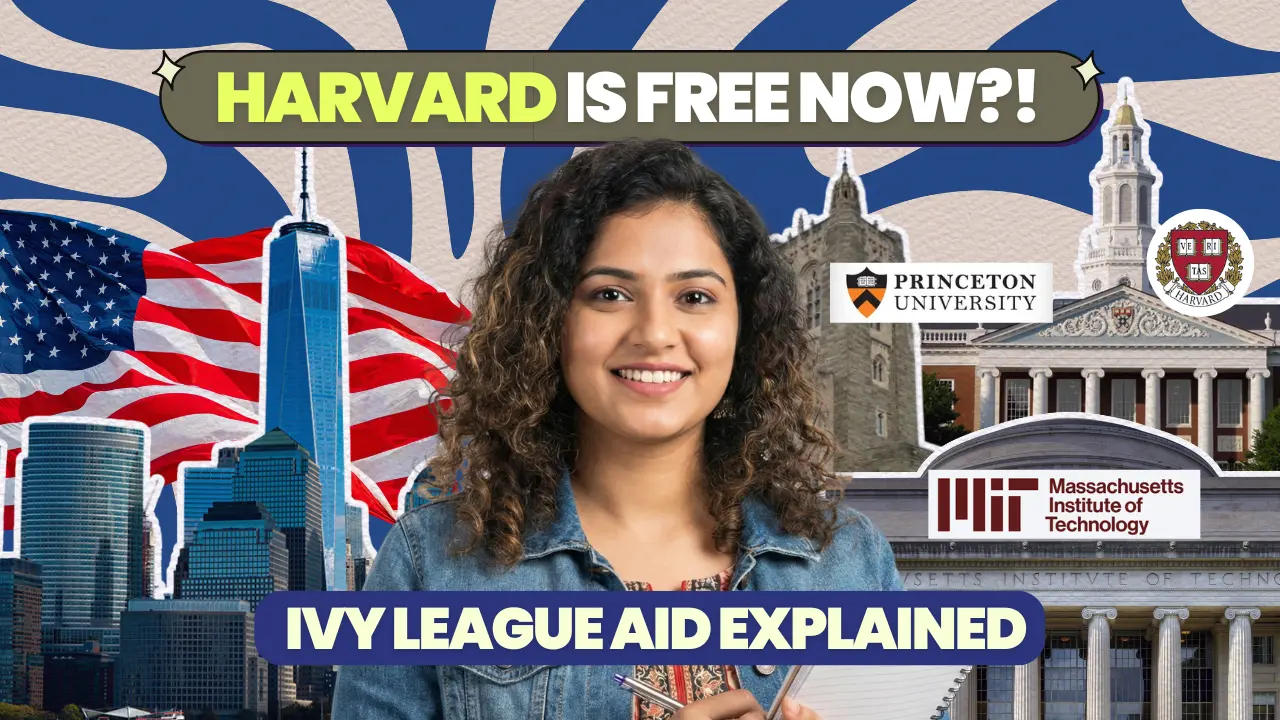
Harvard, MIT, and Princeton all expanded their financial aid programs this year in ways that explicitly include international students. Harvard now covers full tuition for families earning under $200,000. MIT made the same move from fall 2025. Princeton's average aid package crossed $80,000 per year. These are not small adjustments. They reflect a genuine shift in how some of America's most prestigious universities think about who should be able to attend. Understanding the benefits of studying in the USA can help you decide if the rigorous application process is worth the effort.
The honest caveat is that the money only exists for students who get in. And getting in is genuinely, brutally hard. This blog covers both sides: what the financial aid actually offers and what it realistically takes to be a competitive Indian applicant.
Two Terms That Change Everything
Before the numbers make sense, two terms need to be clear. Most of the confusion Indian students have about US financial aid comes from not knowing these.
Need-blind vs need-aware
A need-blind university does not look at your ability to pay when deciding whether to admit you. A need-aware one does. For Indian students, this matters more than almost anything else, because it tells you whether applying for financial aid could quietly hurt your chances.
Harvard, MIT, Princeton, Yale, and Dartmouth are all need-blind for international students. Brown became need-blind for international applicants from the Class of 2029. Applying for aid at these universities does not disadvantage your application in any way.
Need-based vs merit-based
Ivy League financial aid is almost entirely need-based. It is calculated on your family's income, assets, and circumstances, not your grades alone. A student with a perfect academic record from a wealthy family gets nothing. A student with strong academics from a middle-income family can receive a package that covers most or all of the cost.
Harvard, MIT, and Princeton all explicitly say they offer no merit scholarships. The aid is tied to what your family can actually afford to pay, not how impressive your application is.
What Harvard, MIT, and Princeton Are Offering in 2025-26
Harvard
Harvard's financial aid policy from 2025-26 works on a sliding income scale:
- Family income under $100,000: All costs covered, including tuition, room, board, and fees. Zero parent contribution
- Family income under $200,000: Full tuition covered (currently $59,320), with individual assessment for room, board, and fees on top
- Family income above $200,000: Tailored aid evaluated case by case
The total cost of attending Harvard in 2025-26 is approximately $86,926, around Rs.82.85 lakh. Harvard's financial aid budget this year is $275 million, up from $235 million in 2022. Indian students are included in exactly the same program as American students. There is no separate, smaller pool for international applicants.
MIT
From fall 2025, MIT made tuition free for students from families earning under $200,000. Total cost of attendance for 2025-26 is approximately $85,960, around Rs.81.80 lakh. The median price actually paid by a student who received an MIT scholarship in 2024-25 was $10,268, approximately Rs.9.77 lakh for the full year. 57 percent of MIT undergraduates received need-based aid in 2024-25. MIT is need-blind for international students and meets 100 percent of demonstrated financial need.
Princeton
Princeton's average aid package for 2025-26 crossed $80,000 per year, approximately Rs.76.14 lakh. Princeton meets 100 percent of demonstrated financial need for all admitted students and does it entirely through grants, never loans. 89 percent of recent Princeton seniors graduated with zero debt.
Currency note: 1 USD = Rs.95.18 as of May 12, 2026. Always verify the current rate before making financial decisions.
The Full Picture Across All Eight Ivy League Universities
Not all Ivy League schools treat international students the same way on financial aid. Here is where each one stands:
- Harvard: Need-blind for international students. Meets 100% of demonstrated need
- MIT (technically not Ivy League but academically in the same tier): Need-blind for international students. Meets 100% of demonstrated need
- Princeton: Need-blind for international students. Meets 100% of demonstrated need. No loans
- Yale: Need-blind for international students. Meets 100% of demonstrated need. No loans
- Dartmouth: Need-blind for international students since 2022. Meets 100% of demonstrated need
- Brown: Need-blind for international students from Class of 2029. Meets 100% of demonstrated need
- Columbia: Need-aware for international students. Still generous for those who receive aid, averaging nearly $89,000 in annual packages
- Cornell: Need-aware for international students
- Penn (UPenn): Launched the Quaker Commitment in 2025-26, raising income thresholds for full support, but remains need-aware for international students
How the Financial Aid Application Actually Works
You do not apply for aid after you are admitted. The two processes run simultaneously. When you submit your admissions application, you also submit your financial aid application. Both go in together.
What Indian students need to submit:
- CSS Profile: The College Board's detailed financial aid form. It asks for family income, assets, tax information, property holdings, and unusual expenses. This is the main document US universities use to assess your family's financial situation
- University financial aid form: Each school has its own supplementary form for international students, asking for income documentation specific to your country
- Supporting documents: Indian income tax returns (ITR filings), salary certificates, bank statements, and property valuations where applicable
The aid office takes all of this and calculates your Expected Family Contribution, the amount your family is assessed as able to pay. Your financial aid package covers the gap between that number and the total cost of attendance.
Something most Indian families do not realise until it is too late: The CSS Profile captures assets, not just income. A family with a modest annual income but significant property holdings or savings may be assessed as able to contribute more than they expected. Document all liabilities, outstanding loans, and genuine expenses carefully. The process rewards thoroughness and accuracy, not just low income.
What Getting In Actually Takes
The financial aid is real. The admission odds are not forgiving about it.
Harvard's acceptance rate for the Class of 2029 was approximately 3.6 percent. MIT's was 2.7 percent. Princeton's was 4.7 percent. Yale's was 3.7 percent. These are global numbers. You are competing against the strongest students from every country in the world.
What admitted Indian students tend to have in common:
- Near-perfect Class 12 scores (CBSE or ISC), with especially strong performance in their target field
- SAT scores of 1500 or above are common among admitted international students at the most selective Ivies, though many schools are now test-optional
- Depth in one or two extracurricular areas rather than a long list of surface-level involvement. Research work, national competition results, published writing, or genuine community projects carry real weight. Participation certificates do not
- Essays that are specific, honest, and reveal something true about how you think. Admissions readers go through tens of thousands of essays. The ones that land are the ones that sound like a person wrote them
- Recommendations from teachers who can speak to who you are in a classroom, not just confirm your grades
What does not work is worth saying directly: A strong academic record without anything else. Activities that exist to fill a resume slot but have no real story behind them. Essays about overcoming adversity that describe the difficulty without showing what it taught you. These are patterns admissions readers recognize immediately.
The Honest Version of This
A family earning Rs.50 lakh to Rs.1.5 crore a year could genuinely receive a Harvard or MIT education for a fraction of what they would pay at a private Indian engineering college. That is not an exaggeration. The financial aid at these institutions is unlike anything else in global higher education.
But spending 18 to 24 months preparing a serious Ivy League application, taking the SAT, building research experience, and writing and rewriting essays is a significant investment of time and energy. Most students who do all of this, including genuinely brilliant ones, still do not get in. The acceptance rates are what they are.
The smarter approach for most Indian students is to build the strongest possible version of your application, aim high, and also apply to a spread of US universities across selectivity levels. Several universities outside the Ivy League, like Vanderbilt, Rice, Johns Hopkins, and Notre Dame, also offer substantial financial aid to international students and have meaningfully higher acceptance rates.
The Numbers Only Tell You So Much
Understanding what your family's financial profile actually translates to in a real aid package and how your academic profile compares to what these universities are admitting requires more than reading a blog.
Book a free session with a Leap Scholar counselor to get a clear, honest read on where your profile stands for Ivy League admissions, what your realistic financial aid estimate looks like, and which US universities give Indian students the best combination of admission odds and financial support right now.
Sources: Harvard College, How Aid Works | MIT Student Financial Services, Making MIT Affordable | MIT, International Students Financial Aid | Princeton University, Financial Aid Enhancements 2025 | Harvard Magazine, Harvard Augments Financial Aid | Boston Globe, Top US Colleges Give $1 Billion in Aid to Foreign Undergrads

Kirti Singhal
Kirti is an experienced content writer with 4 years in the study abroad industry, dedicated to helping students navigate their journey to international education. With a deep understanding of global education systems and the application process, Kirti creates informative and inspiring content that empowers students to achieve their dreams of studying abroad.
Users also read

Vietnam Steps Into the Global Academic Spotlight at APAIE 2026: And Indian Students Should Pay Attention
Vietnam Steps Into the Global Academic Spotlight at APAIE 2026: And Indian Students Should Pay Attention

Indian Passport Fees Rise From July 1, 2026. Here Is What It Means If You Plan to Study Abroad.