Blogs
Blogs  Leap Digest
  Events
  About Us
 Trending News
Universities More Than Doubled AI Degree Programs. Here Is What Indian Students Actually Need to Know
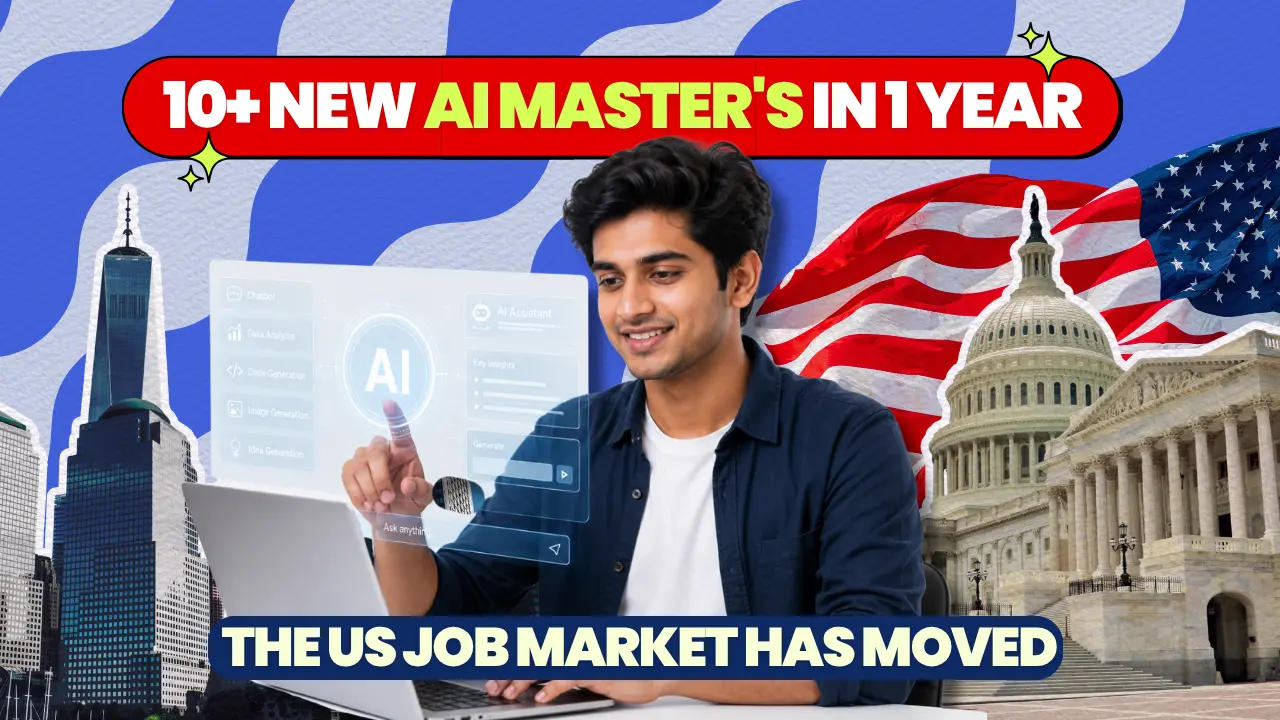
Bachelor's AI programs at US universities grew 114 percent between 2024 and 2025, jumping from 90 to 193 in a single year. Master's programs in AI grew 2.7x from 116 to 310, between 2022 and 2026. MBA programs with AI specializations have risen 1,260 percent since 2022. And online job postings requiring generative AI competence jumped 323 percent in the last year alone.
That is not a trend. That is a structural shift in how American universities are building degrees, and it is moving faster than most Indian students planning a 2026 US application realize.
The real question is not whether universities are adding AI to their programs. They clearly are. The question is whether the specific program you are looking at builds AI in meaningfully or just adds the word to the title to catch attention. That difference shows up in your career outcomes, and it is worth knowing how to tell them apart before you apply. High competence in these emerging fields often leads to some of the highest-paying jobs in the USA for international graduates.
The Numbers First
Before you start shortlisting programs, it helps to understand the scale of what has actually changed.
- 193 bachelor's AI programs are active in the US as of 2025, up from 90 a year earlier, more than doubled in 12 months
- 310 master's AI programs active as of 2026, up from 116 in 2022. If you are comparing North American options, you should also look at the specific curriculum for Masters in Computer Science in Canada to see how they integrate machine learning.
- 62 standalone AI majors identified by Northeastern University's Centre for Inclusive Computing as of April 2026, growing every semester
- MBA in AI programmes have seen a 1,260 percent increase since 2022; business schools are moving faster than any other faculty
- 323 percent rise in job postings requiring generative AI competence in the last year
- USD 110,000 to USD 140,000: starting salary range for AI-integrated roles in marketing, product, and business management in the US
The market is not just looking for people who can build AI models. It is looking for people who can use AI strategically inside a profession, whether that is marketing, product, design, or operations. US universities are now building degrees that reflect exactly that distinction.
For Indian students, the domestic picture makes this even more urgent. According to a June 2025 MeitY report, India will need over 1 million AI-literate professionals by 2026, with the sharpest shortage in mid-level roles that combine domain expertise with AI skills. A marketing graduate who genuinely understands AI-driven campaign optimization is not the same candidate as one who completed a weekend certification. US universities are now building degrees that produce the former.
Who Is Actually Moving Fast and Who Is Not
Faster at the middle tier. Slower at the top. That is the honest picture.
The Ivies and elite research universities are cautious. MIT, Stanford, and Harvard are adding AI concentrations into existing programs rather than building standalone AI degrees. Part of that is academic rigor. Part of it is protecting their brand from programs that have not been tested. Either way, if you are looking for a practical, career-focused AI-integrated degree, the most interesting programs right now are not at the top.
Mid-tier and regional universities are moving significantly faster. Schools like WVU, Cincinnati, Stevens, Duke, and NJIT have launched entirely new programs built specifically for employability rather than research.
The expansion is happening across four types of structural change:
- New standalone AI degrees built from the ground up, where AI is the central discipline
- Existing degrees restructured with mandatory AI components in Business, Marketing, and Engineering
- Hybrid professional degrees combining a domain like marketing or product management with applied AI
- Cross-disciplinary programmes built specifically for non-technical professionals entering AI roles
The programs are open right now.
This section covers what is actually enrolling. It is one part of the decision, not the whole thing.
Undergraduate: Four New Degree Types
Universities leading at UG level: Michigan Tech, University of Tulsa, San Diego State, University of North Texas, and NJIT
These are not electives inside a CS degree. They are standalone bachelor's programs with AI as the core.
- BS in Artificial Intelligence (CS-heavy): Build AI systems, train models, and work in technical roles. It is the most similar to a traditional CS degree. Best for students who want to go deep technically from day one.
- BS in Applied AI (Engineering and CS combined): Applied machine learning for robotics, manufacturing, and industrial AI. Best for students targeting engineering-adjacent roles rather than pure software.
- BS in Artificial Intelligence and Human Responsibility (Technology and Liberal Arts) AI ethics, governance, and policy alongside technical training. The most unusual program on this list and one of the most forward-looking. Built for students who want to work in AI regulation, product responsibility, or policy roles.
- BS in Business with AI: The most accessible entry point for non-CS students. Data analysis, AI tools, and business strategy together without requiring a deep programming background.
Graduate Level: By Field
1. Marketing with AI
If you are studying marketing in the US without AI in the curriculum, you are preparing for a job market that has already moved past you.
- WVU, MS in Artificial Intelligence Marketing: AACSB-accredited, fully online, 30 credit hours. No GRE or GMAT required. One of the first programs in the US to place AI at the center of a marketing degree rather than as an add-on. Covers consumer insights, campaign optimization, digital media automation, and personalization.
- Arizona State (W.P. Carey), MS in Marketing: AI is woven throughout the curriculum and not offered as an elective. Rolling admissions through July 2026 for Fall entry
- Harvard Extension, AI in Marketing Microcertificate: Two graduate-level courses combining AI strategy with practical marketing application. Not a full master's, but the fastest and lowest-cost route to verified AI marketing credentials before committing to a longer degree
2. Product Management with AI
Product management is one of the fastest-growing graduate career tracks for Indian students in the US, and universities are now building AI directly into PM training.
- Duke, AI Product Management MEng (AIPI): Students build deployable AI products from semester one. Over 95% placement within six months of graduation. Alumni at OpenAI, IBM, Autodesk, and Fidelity. Available as a 12-month accelerated, 16-month standard, or 2-year part-time programme
- Northwestern, MSAI+X: Built explicitly for non-STEM professionals entering AI. Uses a human-centered AI model combining technical training with design thinking and psychology. Two tracks: a 15-month technical track and a cross-functional track for marketing, finance, and operations professionals
3. Design with AI
Design is where AI integration is newest and most uneven. But the right programs are already there.
- Carnegie Mellon, MHCI (Master of Human-Computer Interaction): The deepest AI-design integration in the US. Housed in CMU's School of Computer Science, not a traditional design school, which gives it AI research depth that standalone design programmes cannot match
- NYU Tandon, MS in Integrated Design and Media: Computational design, data visualisation, and AI-driven creative tools inside an engineering school environment
- Northeastern, MS in Informatics (HCI track): AI, data science, and UX research for students who want to design AI-driven products rather than build the underlying models
4. Business and Management with AI
- University of Cincinnati, Master's in AI Management: One of the first dedicated AI management programs from a US business school. Trains students to lead AI teams and implement AI strategy, not just understand the technology
- NYU Stern, MSBAi: Cohort-based, in-person. Strong placement in finance, consulting, and technology
5. Engineering and CS with AI
- Kennesaw State, MS in Artificial Intelligence: Technical programme for AI engineering and data science roles
- Stevens Institute of Technology, MS Applied AI: Multiple concentrations, including healthcare AI, cybersecurity AI, financial AI, and general applied AI. One of the most flexible applied AI master's in the US
- University at Buffalo, MS Engineering Science (AI concentration): Engineering foundations with a machine learning track
Three Things That Will Decide Whether Any of This Works for You
1. STEM Designation Changes Everything on OPT
Indian students graduating from STEM-designated programs can work in the US for 36 months on optional practical training. Non-STEM graduates get 12 months. That gap is career-defining.
- Duke's AIPI: STEM designated ✓
- Stevens Applied AI: STEM designated ✓
- Buffalo Engineering Science: STEM designated ✓
- WVU AI Marketing: Not STEM-designated ✗
Before you apply, verify the STEM status of the specific program on the Department of Homeland Security's STEM Designated Degree Program list. Do not rely on the university's website alone, because STEM designations can change.
2. Your Background Determines Your Realistic Options
AI programs from CS and engineering departments typically require Python, math, and statistics foundations at the point of entry. Business school AI programs and cross-disciplinary programs like Northwestern MSAI+X are explicitly built for non-technical professionals.
Applying to the wrong category wastes a full application cycle and produces a weaker application. Know which one you are before you start.
3. The Word "AI" in the Title Means Nothing on Its Own
Some programs have genuinely restructured their entire curriculum around AI. Others have added one elective and updated the brochure. Three signals that separate real integration from rebranding:
- A mandatory capstone that deploys an actual AI product or system
- An embedded industry co-op or internship built into the programme structure
- Faculty who are actively publishing in applied AI, not just teaching it
Check all three before you commit to any program.
What This All Adds Up To
The Stanford HAI 2026 AI Index highlights something the program listings alone do not show: all the growth in AI academic programs has gone to academia, reversing a decade-long trend of AI PhD graduates flowing directly into industry. Universities are hiring AI faculty, building labs, and restructuring curriculum around research and practice simultaneously.
The gap between programs that genuinely deliver and those that do not is also wider. That gap is what you are navigating when you choose.
The right program starts with the right match.
The difference between a program that accelerates your career and one that leaves you with a degree and mismatched skills comes down to the alignment between your background, the program's actual curriculum, and the specific job market you are building toward.
Book a free session with a Leap Scholar counselor to understand which AI-integrated programs fit where you are academically, how to position your application for the programs seeing the highest Indian student interest right now, and which STEM-designated degrees give you the strongest OPT window after graduation.
Sources: CRA CERP, Tracking the Rise of AI Academic Programs, April 2026 | Pursuit.us, AI in Education News 2026 | MastersInAI.org, 2025 AI Degree Report | Programs.com, Universities Offering AI Programs 2026 | Stanford HAI , 2026 AI Index Report: Education | WVU, MS in AI Marketing | ASU W.P. Carey, MS Marketing | Harvard Extension, AI in Marketing Microcertificate | AIDegreePrograms.org, Best AI Masters 2026
Kirti Singhal
Kirti is an experienced content writer with 4 years in the study abroad industry, dedicated to helping students navigate their journey to international education. With a deep understanding of global education systems and the application process, Kirti creates informative and inspiring content that empowers students to achieve their dreams of studying abroad.
Users also read
US Ends "Duration of Status" for F-1 Students: What Every Indian Student Must Do Before September 15, 2026
QS 2026 Reveals World's Top 20 Medical Schools
Top Global Internships with August 2026 Deadlines: Finance, Tech, Research, and Policy