Blogs
Blogs  Leap Digest
  Events
  About Us
 Expert Insights
Career in German FinTech: Why India's Tech Talent is the Solution
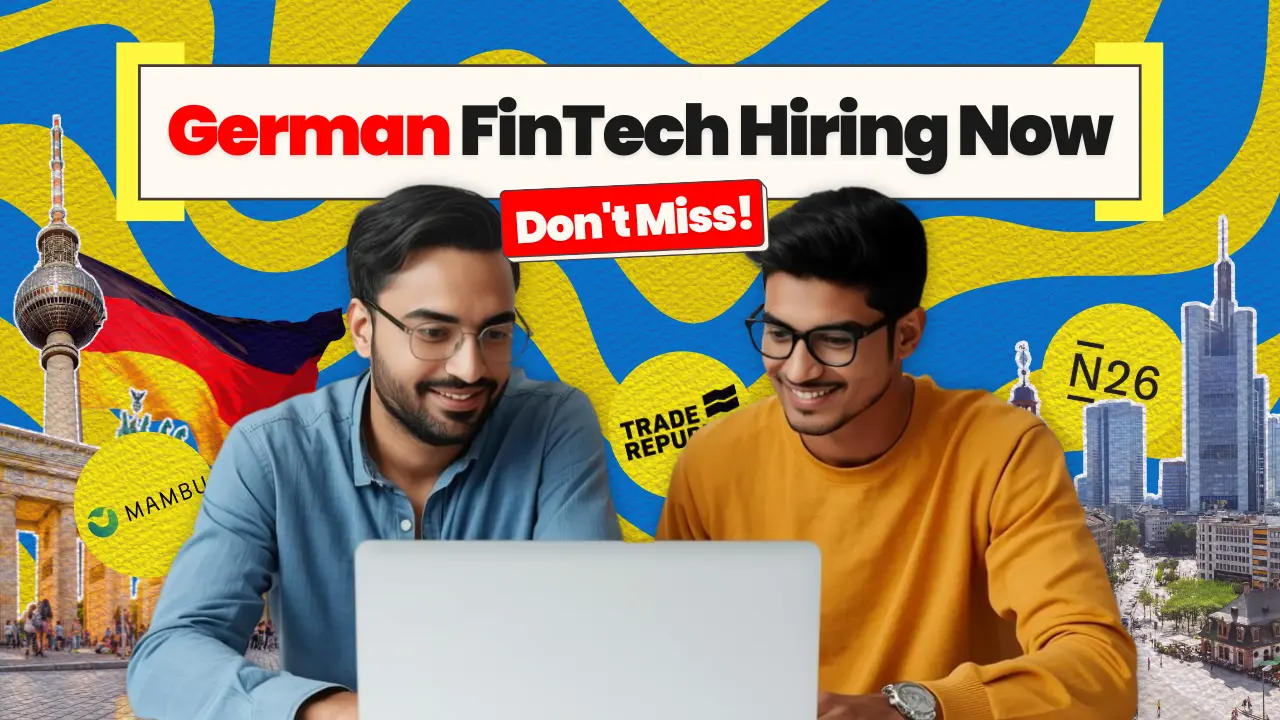
Germany, Europe’s economic powerhouse, is facing a digital bottleneck. While its FinTech industry is scaling at a CAGR of 15%, the country is grappling with a staggering 149,000+ unfilled IT positions. This isn't just a "skills gap"; it is a systemic challenge that has forced Germany to fundamentally rewrite its immigration laws to attract global experts.
For ambitious Indian graduates, this is the ultimate strategic window. Your experience with India’s world-leading digital payment infrastructure (UPI) and large-scale system architecture makes you more than just an applicant; you are the high-priority solution Germany needs to power its financial revolution.
What You Need to Know
- The Hubs: Berlin (the "Startup Capital") and Frankfurt (the "Financial Giant") are desperately hunting for talent. While Berlin leads in Crypto and Neobanks, Frankfurt is the go-to for RegTech and Blockchain.
- The Technical "Wheelhouse": Demand is highest for specialists in Cloud Computing (AWS/Azure), Python/Java development, AI/Machine Learning, and Cybersecurity.
- Salary Benchmarks: Entry-level positions for 2026 typically start between €45,000 and €60,000 annually. This offers a comfortable lifestyle with serious savings potential compared to similar roles in India.
- Simplified Visa Pathways: * EU Blue Card: The fast-track to Permanent Residency (PR) in as little as 21 months (with B1 German) or 33 months (with A1). For 2026, the salary threshold for IT shortage roles is approximately €45,934.
- Opportunity Card (Chancenkarte): A brand-new points-based visa that allows you to move to Germany for 12 months to find a job without an initial offer.
- The Language Advantage: Most FinTech offices operate in English, but learning basic German (A2/B1) is your "secret weapon" to double your job prospects and speed up your PR.
Why German FinTech Hubs are Recruiting Indians?
Germany is the economic engine of Europe, but as of late 2025, that engine is facing a critical bottleneck. Digital transformation has outpaced the domestic supply of tech specialists, leaving nearly 149,000 IT positions unfilled across the country.
For Indian graduates, this is more than an opportunity; it is a high-priority invitation. FinTech companies in Berlin and Frankfurt are specifically scouting for Indian talent because they offer the "Triple Advantage":
- Technical Depth: A foundation in high-concurrency systems (like UPI) that mirrors the complexity of German digital finance.
- English Proficiency: The primary language of German FinTech is English, allowing for seamless Day 1 integration.
- Global Resilience: Indian professionals are recognized for their adaptability in high-pressure, fast-scaling environments.
The Skills German FinTech Wants Right Now
By 2026, the German FinTech sector is no longer just looking for "generalist" developers. The market has become highly selective, focusing on specialists who can operationalize complex technologies within one of the world's most stringent regulatory frameworks.
Here is the strategic breakdown of the skills that will place you at the top of the hiring list in Berlin and Frankfurt for the 2025–2026 cycle.
1. Engineering: Beyond Basic Coding
While Java and Python remain the backbone of German FinTech, companies now prioritize Platform Engineering and Architecture over pure feature development.
- The Go & Rust Surge: For high-frequency trading platforms and decentralized finance (DeFi), Go (Golang) and Rust have moved from "niche" to "high-demand" due to their performance and memory safety.
- Microservices & Event-Driven Design: Recruiters are hunting for engineers who can manage Apache Kafka or RabbitMQ to handle real-time payment streams across distributed systems.
2. Cloud-Native & MLOps Maturity
In 2026, "knowing AWS" is no longer enough. FinTechs are shifting toward Operationalizing AI and Cloud-Native Scale.
- MLOps Engineers: Companies like Trade Republic and Scalable Capital need professionals who can take AI models out of a research "notebook" and put them into Production Pipelines. This requires mastery of tools like Kubernetes (K8s), Kubeflow, and Terraform (Infrastructure as Code).
- Cost Governance: FinTech startups are under pressure to be profitable. Experience in FinOps (optimizing cloud spend on AWS/Azure) is a rare but highly valued "hybrid" skill.
3. Cybersecurity & "RegTech" (The 2026 Multiplier)
Cybersecurity is the highest-paying skill bracket in Germany. With the EU's NIS2 Directive and the AI Act becoming fully enforceable in 2026, "Security" is now a legal mandate.
- Zero-Trust Security: Experience in building "Zero-Trust" architectures and IAM (Identity & Access Management) is critical.
- GDPR & AI Compliance: You become a "Super Candidate" if you can code while understanding EU Data Protection standards.
- Pro Tip: Mentioning your familiarity with DPIA (Data Protection Impact Assessments) on your CV will immediately trigger interest from Compliance and Risk managers.
4. AI-Powered "Hyper-Personalization"
The next battle for German neobanks (like N26) is using AI to predict customer needs before they arise.
- Predictive Insights: Skills in Behaviour Modelling and Real-time Anomaly Detection (for fraud prevention) are the current "hiring engines."
- Generative AI for Finance: Experience in integrating LLMs (Large Language Models) for automated customer service or internal "AI Auditors" is the newest high-demand niche for 2026.
Summary: The 2026 Skill Heatmap
| Skill Category | High-Demand Tools/Tech | "Hidden Secret" to Winning |
| Back-end | Java (Spring Boot), Go, Rust | Understanding Bank-grade API reliability. |
| Data & AI | Python, TensorFlow, PyTorch | Ability to build Audit-ready AI (Explainable AI). |
| DevOps | Kubernetes, Docker, Terraform | Expertise in Zero-downtime deployments. |
| Security | Penetration Testing, IAM, SOC | Mastery of EU's GDPR and AI Act rules. |
Navigating Germany’s 2026 Visa Pathways for IT Professionals
One of the most encouraging aspects of building a career in Germany is the clarity and favorability of their skilled immigration policies. For 2026, the German government has refined these pathways to ensure that technical talent, especially from India, can transition from applicant to resident faster than ever.
The Graduate Route: The 18-Month Advantage
For many Indian students, the most reliable route is pursuing a Master’s degree in Germany.
- Post-Study Work Rights: After graduation, you are eligible for an 18-month residence permit specifically for job hunting.
- Strategic Flexibility: During these 18 months, you can take up any kind of employment to support yourself while you hunt for a "qualified" role in FinTech or IT.
- Local Advantage: Being in the country allows you to attend networking events in hubs like Berlin and Frankfurt, giving you a massive edge over offshore applicants.
The Premium Pathway: EU Blue Card (2026 Updates)
If you already have a recognized technical degree and a job offer, the EU Blue Card is your fastest ticket to Europe.
| Feature | 2026 Requirements & Benefits |
| Minimum Salary (IT Shortage) | €45,934 per year (Approx. ₹41 Lakhs) |
| Standard Salary Threshold | €50,700 per year (Approx. ₹45 Lakhs) |
| IT Specialist Clause | You can qualify with 3 years of IT experience, even without a degree. |
| Family Benefits | Spouses receive immediate, unrestricted work rights. |
| Permanent Residency (PR) | Eligible in 21 months (with B1 German) or 27–33 months (with A1). |
The New Wildcard: The Opportunity Card (Chancenkarte)
Launched to combat the talent crunch, this is a points-based visa that allows you to move to Germany for up to 12 months to find a job without having an offer first.
- Eligibility: You need at least 6 points based on criteria like age, English/German skills, professional experience, and ties to Germany.
- Work Rights: Unlike the old Job Seeker Visa, the Opportunity Card allows you to work part-time (up to 20 hours per week) while you search for your full-time FinTech role.
Choosing Your Best Path
- Choose the Graduate Route if: You want to specialize further (e.g., a Master's in AI) and benefit from Germany’s low-cost public university system while building a local network.
- Choose the Blue Card if: You are an experienced developer or data scientist with a high-paying offer in hand from a German firm.
- Choose the Opportunity Card if: You have a strong profile but haven't secured an offer yet and want to "test the waters" in Berlin or Frankfurt while working part-time.
Stability, Savings, and Social Security in Germany
Choosing Germany means opting for a lifestyle defined by stability, high social security, and a radical respect for personal time. As you plan your 2026 relocation, here is the breakdown of the "German Dream" for tech professionals.
1. The "Feierabend" Culture: Work to Live
German work culture is built on the concept of Feierabend—the sacred boundary between the workday and evening leisure.
- 38 to 40-Hour Focus: In 2026, corporate Germany remains committed to the 40-hour week. Working late is often seen as a sign of poor time management, not dedication.
- Mobile Work Law: New legislation proposed for 2026 aims to formalize your right to hybrid or remote work, further protecting your personal time.
- Generous Vacation: While the legal minimum is 20 days, most FinTech and IT companies provide 28 to 30 days of paid vacation annually, plus roughly 10–12 public holidays.
2. Social Security: The 2026 Safety Net
Your salary contributions are investments into one of the world’s most robust social safety nets. For 2026, the German Federal Council has approved new social security thresholds:
- Public Healthcare (GKV): Contributions are split between you and your employer. In 2026, the mandatory insurance threshold rises to €77,400 annually. If you earn above this, you can choose Private Health Insurance (PKV), which can be cheaper for young, single professionals.
- Unemployment & Pension: If you lose your job, insurance typically covers 60% of your previous net salary. The contribution cap for 2026 for pension and unemployment rises to €101,400, ensuring high earners are fully protected.
- Taxes: The basic tax-free allowance will increase to €12,348 in 2026, meaning you keep slightly more of your income before taxes kick in.
Cost of Living vs. Salary ROI (2026 Snapshot)
While global inflation is a factor, German tech salaries have scaled to match. Even in major hubs, your purchasing power remains high. Here is a simplified cost of living in Germany vs. earnings comparison:
| Expense Category | Berlin (Tech Hub) | Frankfurt (Finance Hub) | Leipzig (Affordable Alternative) |
| Rent (1-BR City Center) | €1,220 | €1,301 | €721 |
| Monthly Living (Excl. Rent) | €1,000 | €1,082 | €989 |
| Deutschland-Ticket | €63 (Nationwide) | €63 (Nationwide) | €63 (Nationwide) |
| Avg. IT Net Salary | €3,500 – €4,500 | €3,800 – €5,000 | €3,200 – €4,200 |
Pro Tip: From January 1, 2026, the Deutschland-Ticket price will rise to €63 per month. This single ticket still offers the world's best value, allowing you unlimited travel on all regional trains and city transport across the entire country.
Your Next Move: Secure Your German Future
The talent shortage in Germany's FinTech sector isn't just a statistic; it's an open invitation. German companies are prioritizing international talent acquisition and investing in driven professionals from India. By sharpening your technical stack and navigating the right visa pathways, you can confidently step into Europe's financial engine.
This is an open invitation to a high-reward career. Leap Scholar, India’s leading study-abroad platform, provides the ultimate blueprint to help you navigate this transition for the 2026 intake:
- 1:1 Expert Counselling: Personalized roadmaps from mentors with decade-long German market expertise.
- Strategic Shortlisting: Access to tuition-free public universities and programs in high-demand hubs like Berlin and Frankfurt.
- Visa & Application Mastery: End-to-end support for APS, SOPs, and Blue Card documentation with a 98% success rate.
- Financial & Test Prep: IELTS/PTE coaching, scholarship assistance, and seamless Blocked Account setup.
The door to Europe’s financial engine is open. Are you ready?
[ Book Your Free Strategy Call with a Leap Scholar Expert Today]

Kirti Singhal
Kirti is an experienced content writer with 4 years in the study abroad industry, dedicated to helping students navigate their journey to international education. With a deep understanding of global education systems and the application process, Kirti creates informative and inspiring content that empowers students to achieve their dreams of studying abroad.
Users also read

Top 18 MBA Schools Producing the Highest-Paid Graduates in 2026
How to Format an ATS-Friendly Resume for German Tech Companies in 2026

Growing Demand for HR Professionals in India: Why a Foreign Degree Is Opening Doors for Indian Students in 2026