

Germany continues to attract international students, with over 400,000 expected to be enrolled in 2026. All thanks to its tuition-free universities, worldclass education, and strong career prospects.
German universities provide a variety of programs available in both English and German to meet different academic interests. The country’s strong economy and lively culture provide students with a comprehensive educational experience.
Graduates benefit from excellent career opportunities, with starting salaries averaging INR 46L (EUR 49K) annually. The cost of living in Germany is also appealing, being 21.5% lower compared to the United States, including rent.
In this article, you will get a complete overview of the application process for German universities.
Before we dive in, here’s a glance at everything you need to know about studying in Germany.

Choose your dream country
 UK
UK
 USA
USA
 Germany
 Australia
 Ireland
 Canada
 UAE
UAE
 France
 Sweden
 Italy
Italy
 Other
Other
When do you want to study abroad?
What's your highest level of education?
Select you current city
How Leap will help you

Personalised University Shortlist

Express Applications with Quicker Admits

End-to-End Application Support
| Features | Details |
|---|---|
| Top Universities | Technical University of Munich Ludwig Maximilian University of Munich Heidelberg University |
| Language Requirements | TestDAF: TDN 3 IELTS: 6 |
| Intakes | Winter Intake Summer Intake |
| Scholarships | DAAD Erasmus+ Deutschlandstipendium |
What Are the Requirements for Applying to German Universities?
Once you decide to study in the country, understanding the German university admission requirements is your first step toward a successful application.
From academic qualifications to language proficiency and essential documents, meeting these criteria is key to securing your place at a German university. A well-prepared application can make all the difference in standing out among thousands of international applicants.
What Academic Qualifications Do I Need To Apply?
Before learning how to apply for German universities and diving into the language tests and application portals, ensure that your existing qualifications meet German university standards.
Here are the required qualifications you need to apply to German universities:
- For Bachelor's Programs: A high school certificate or diploma.
- For Master's Programs: A recognised bachelor's degree from an accredited institution.
Since the country follows a strict academic recognition process, credentials are verified through platforms like Uni-Assist and the Anabin database, which assist international students in applying to study in Germany.
Many international students complete their Uni-Assist application for Germany to assess their eligibility before submitting their final documents.
Also Read: Bachelors in Germany for International Students
Do I Need To Know German To Apply?
No, German is not required for English-taught programs, but basic German language skills will help you get along in daily life. While meeting academic qualifications is essential, language proficiency also determines your eligibility for certain programs.
The table below shows the language proficiency for German universities and their required scores.
| Programme Type | German Language Requirement |
|---|---|
| German Taught Programmes (not mandatory) | TestDAF: TDN 3+ DSH: Level II+ |
| English Taught Programmes | IELTS: 6+ TOEFL: 90+ |
Also Read: Study in Germany Without IELTS in 2026: Everything You Need to Know!
Do I Need To Take Any Entrance Exams For German Universities?
While most programs in Germany have no entrance exams, certain competitive fields set additional assessment criteria to ensure applicants meet academic standards.
Some entrance exams that come under German university admission requirements are:
- TestAS: An aptitude test for international students applying to undergraduate programs, particularly in fields like medicine, law, and engineering.
- GRE/GMAT: Certain universities like Mannheim Business School, especially in business and engineering, require GRE or GMAT scores.
While the score requirements can vary depending on the university you’re applying to, the average minimum scores typically look like this.
How Does the Application Process Work?
The application process involves selecting a program, meeting requirements, submitting documents via Uni-Assist or university portals, and awaiting admission results.
Whether applying through a centralised portal or directly to the university, knowing where and how to submit your application is important to securing your place in a German university.
Should I Apply Via UniAssist or Directly to the University?
Not all German universities follow the same application process. While most public universities use UniAssist to verify international credentials, others require direct applications.
UniAssist can help you apply to over 170 public universities, but it does not mean that you cannot apply directly from the university’s website. Over 240 German universities allow direct application.
However, make sure to verify the application process on the university’s official website or the website of Uni-assist application Germany to avoid any mistakes.
What Documents Are Required For My Application?
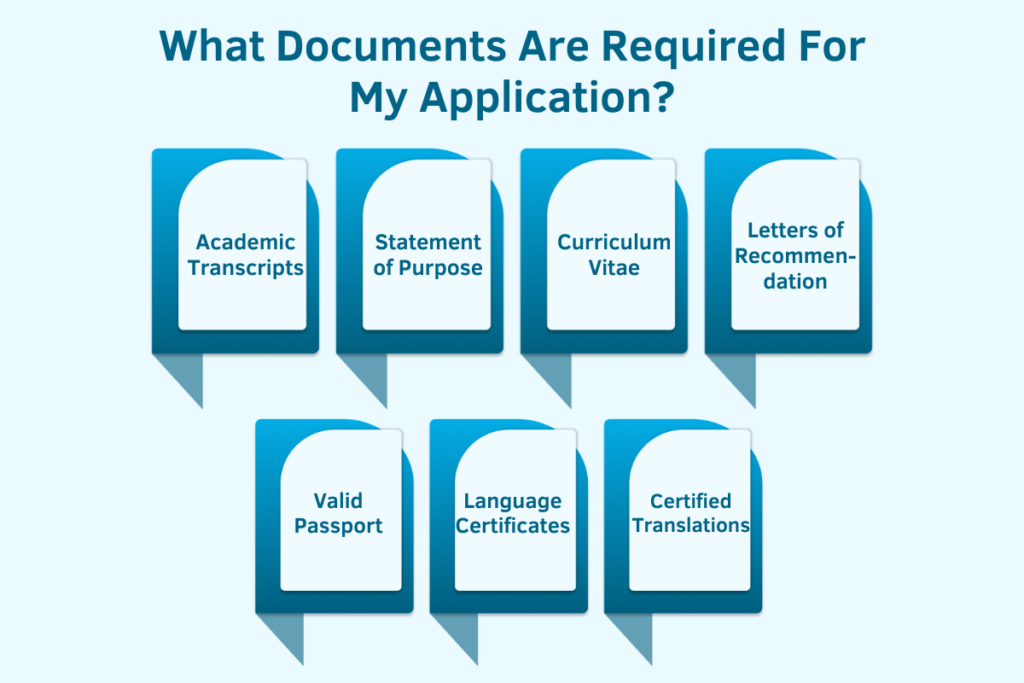
German universities require specific paperwork, and missing even one can lead to delays or rejection.
Below is a structured list of the essential documents required for a German university application.
- Academic Transcripts: Certified copies of previous academic records, such as high school diplomas and bachelor’s degrees, are essential for university applications.
- Statement of Purpose (SOP): A letter outlining your motivation and goals is typically required.
- Curriculum Vitae (CV): An updated CV detailing your academic and professional background is often necessary.
- Letters of Recommendation: Some programs may ask for recommendation letters from previous instructors or employers.
- Valid Passport: A copy of your valid passport is required for identification purposes.
- Language Certificates: Proof of language proficiency, such as IELTS, TOEFL, TestDaF, or DSH scores, is mandatory depending on the language of instruction.
- Certified Translations: If your documents are not in English or German, certified translations are necessary.
Ensuring that all these documents meet the required standards increases your chances of a successful application without delays.
When Are The Deadlines For Applying To German Universities?
A big part of applying to German universities is timing. German universities have fixed deadlines for each intake. They’re also highly competitive and seats can fill up pretty quickly. Missing deadlines can delay your studies by months.
German university application deadlines vary depending on the intake:
| Intake | Application Period |
|---|---|
| Winter Semester (October start) | May to 15 July |
| Summer Semester (April start) | December to 15 January |
Also Read: Intakes in Germany 2026
How Many Universities Can I Apply To In Germany?
There is no fixed limit on the number of universities you can apply to in Germany. However applying to multiple universities increases your chances of admission, but there are specific limits depending on the application method.
UniAssist: Allows multiple applications with a single processing fee.
- First application: INR 7.1K (€75)
- Each additional application: INR 2.8K (€30)
Direct Applications: Universities set their own rules. Some allow multiple applications, while others have restrictions.
Strategically applying based on acceptance rates, ranking, and career goals is essential. Since there’s no nationwide limit, applicants should balance quantity with quality to maximise their chances of getting accepted.
What Happens After I Submit My Application?
After submitting your application, the university will review your documents and notify you of the decision. Public universities usually take 4-12 weeks, while private universities respond in 2-6 weeks. You can track your application status via most universities' online portals. If accepted, you'll receive a letter of admission (Zulassungsbescheid), required for your student visa. Then, you’ll need to pay the fees and confirm your enrollment.
What Should I Do If My Application Is Rejected?
A rejection letter can be disappointing, but it’s not the end of the road. Understanding why your application was unsuccessful can help you improve and reapply with a stronger profile.
Common reasons for application rejection are:
- Missing or incorrect documents
- Low GPA or insufficient test scores
- High competition for limited seats
So, how to apply for German universities if the application gets rejected?
- Appeal if you believe there was an error in processing.
- Reapply in the next intake after strengthening your application.
- Consider applying to different universities with better chances of admission.
- Improve your SOP, recommendation letters, or language proficiency scores.
What Should I Do If I Receive Multiple Admission Offers?
If you receive multiple admission offers, making the right choice is important for your academic and career goals. Carefully assess each university and make an informed choice. Compare universities based on costs, rankings, and career opportunities.
Also Read: List of Public Universities in Germany for International Students
How Do I Apply for a Student Visa After Getting Accepted?
Once you receive an offer from your university, you can apply for a German student visa at the nearest German embassy or consulate.
Here are a few German student visa requirements to keep in mind:
- University admission letter
- Valid passport
- Visa application form
- Language proficiency
- Proof of accommodation
- Health insurance
The application process to avail a German student visa will look like this:
- Open a blocked account with INR 10.4L (EUR11K) to prove financial stability.
- Book a visa appointment at the nearest German consulate or embassy.
- Submit the documents as per German student visa requirements
- Wait for 6 to 12 weeks till the visa is processed
You should double-check all requirements before submission so that your chances of approval increase.
Also Read: Germany Study Visa
How Much Does it Cost to Study in Germany?
Before planning your studies in Germany, it's essential to understand the costs involved. While public universities offer minimal tuition fees, private institutions can be more expensive. Additionally, living expenses vary depending on the city and lifestyle.
Below is a breakdown of the estimated costs.
| Factor | Public Universities | Private Universities |
|---|---|---|
| Tuition Fees | No tuition fees | INR 9.4L to 14.3L (EUR 10K to EUR 15K) per year |
| Enrollment Fee | INR 9.5K to INR 30K (EUR 100 to EUR 350) per semester | Varies |
| Living Expenses | INR 11.4L (EUR 12K) per year | INR 11.4L (EUR 12K) per year |
Are German Public Universities Free For International Students?
Yes, German public universities are tuition-free for international students, except in Baden-Württemberg, where non-EU students pay INR 1.4L (€1.5K) per semester.
However, all students must pay semester fees of INR 9.5K to 30K (€100 to €350), covering administrative costs and student services. Despite the small administrative charge, studying in Germany remains highly affordable compared to other countries.
What Are the Tuition Fees at Private Universities in Germany?
Unlike public universities, private institutions in Germany charge tuition fees, which vary depending on the university and program.
Here’s an overview of the tuition fees for some private universities.
| University Name | Average Annual Fees |
|---|---|
| Jacobs University Bremen, Bremen | INR 19L (EUR 20K) per year |
| EBS University of Business and Law, Wiesbaden | INR 17L (EUR 18K) per year |
| SRH University Heidelberg, Heidelberg | INR 5.2L (EUR 5.5K) to INR 6.2L (EUR 6.5K) per semester |
What Scholarships Are Available For International Students?
Germany offers numerous scholarships to support international students financially. The DAAD (Deutscher Akademischer Austauschdienst) is the largest provider, offering merit-based and need-based funding across various disciplines.
The Erasmus+ program provides grants for exchange students within Europe. Additionally, many universities have their scholarships based on academic performance or specific criteria.
Here are some top scholarships:
| Scholarship | Offered By | Funding Amount |
|---|---|---|
| DAAD Scholarships | German Academic Exchange Service | €992 to €1.3K (94K to INR 1.2L) per month |
| Erasmus+ | European Union | €330 to €385 (INR 31K to INR 37K) per month |
| Deutschlandstipendium | German Government + Private Donors | €300 (INR 28K) per month |
| Heinrich Böll Foundation | Heinrich Böll Foundation | €934 to €1.3K (INR 88K to INR 1.2L) per month |
| Konrad-Adenauer-Stiftung | Konrad Adenauer Foundation | €850 to €1.2K (INR 81K to INR 1.1L) per month |
Also Read: Fully Funded Scholarships in Germany for International Students
How Can I Apply For A Daad Scholarship?
Applying for a DAAD scholarship involves a structured process, and meeting all requirements is crucial for a successful application.
Here is the application process:
- Create an account on the DAAD portal and submit your application.
- Upload academic transcripts, CV, SOP, and recommendation letters.
- Submit a research proposal (mandatory for postgraduate applicants).
- Provide proof of language proficiency (English/German, depending on the program).
- If shortlisted, attend an interview.
A well-prepared application with strong academic certifications and a clear research proposal can significantly improve your chances of securing DAAD funding.
Other Common Questions About Studying in Germany
While the application process is essential, many international students have additional concerns about studying in Germany. Below are answers to some common questions.
What Is the Acceptance Rate For International Students in Germany?
Acceptance rates for international students in Germany vary depending on whether you’re applying to a public or private university.
Public universities are highly competitive due to tuition-free education and the large number of applications they receive. For example, the University of Freiburg has an acceptance rate of 15.38%. This reflects the tough competition for limited spots.
Private universities, on the other hand, tend to have higher acceptance rates. With more flexible admission criteria, universities like IU International University of Applied Sciences report acceptance rates of almost 100%.
Also Read: Which are the top German Universities with high acceptance rates in 2025?
What Are the Best Universities in Germany For International Students?
Germany is home to some of the world’s best universities, known for academic excellence, research opportunities, and strong international collaboration.
Here are the top-ranked universities for international students based on global rankings:
| University | QS World Ranking 2026 |
|---|---|
| Technical University of Munich (TUM) | 22 |
| Ludwig Maximilian University of Munich (LMU) | 58 |
| Heidelberg University | 80 |
| RWTH Aachen University | 105 |
| Humboldt University of Berlin | 130 |
| University of Freiburg | 201 |
| University of Tübingen | 215 |
Also Read: Best Universities in Germany for Indian Students 2026
Can I Work While Studying In Germany?
Yes, international students in Germany can work while studying. They are permitted to work 140 full days or 280 half days per year without requiring additional approval. Alternatively, students can work up to 20 hours per week during the academic semester.
Germany offers Indian students countless opportunities, ranging from tuition-free education to promising career paths. However, managing applications, visas, and finances can be challenging, but expert guidance simplifies the process. With careful planning and the right guidance, your study abroad dream can become a reality.
Find your preferred university and take your first step towards studying in Germany with LeapScholar today!
Frequently Asked Questions
-
Q. How can I get admission to a German university?
A. To apply for German universities, first select a suitable programme and check its eligibility criteria. Most universities require academic transcripts, a statement of purpose (SOP), letters of recommendation, and proof of language proficiency (English or German). Applications are submitted via Uni-Assist or directly to the university. Once accepted, secure your funding, arrange health insurance, and apply for a student visa.
-
Q. When should I start applying for German universities?
A. The application period depends on the intake. For the winter intake (starting in October), applications typically open from May to July. For the summer intake (starting in April), applications are accepted from December to January. Since visa processing and financial arrangements take time, it is recommended to start preparing at least a year in advance.
-
Q. Is it hard to get into a German university?
A. Admission to German public universities is highly competitive, especially for popular courses like engineering, business, and medicine. Some universities have strict academic requirements and low acceptance rates. However, private universities generally have a higher acceptance rate and flexible admission criteria. Meeting the minimum eligibility requirements does not guarantee admission, so strong academic records and a well-prepared application are crucial.
-
Q. What is the eligibility to study in Germany?
A. The general eligibility criteria include a recognised school-leaving certificate (such as 12th-grade completion for undergraduate courses), proof of language proficiency (English or German), and meeting the specific academic requirements of the chosen programme. Some universities may also require entrance exams, work experience, or portfolio submissions for specialised fields.
-
Q. Is IELTS required for Germany?
A. IELTS is required for admission to English-taught programs in Germany. Most universities require a minimum IELTS band score of 6.0 to 6.5, though some may accept alternative English proficiency tests such as TOEFL (minimum 80 iBT) or PTE. If your previous education was in English, some universities may exempt you from the test, provided you submit proof of English proficiency.
-
Q. How can I go to Germany to study after 12th?
A. After completing the 12th grade, you need to choose a bachelor's programme that matches your academic background. If your school-leaving certificate is not equivalent to the German Abitur, you may need to complete a preparatory Studienkolleg course before starting university. You must also provide language proficiency (IELTS or TestDaF for German-taught programs), apply to German universities, secure funding, and obtain a student visa.
-
Q. What GPA is required for Germany?
A. The required GPA varies by university and programme. Generally, a GPA of at least 2.5 on a 4.0 scale (equivalent to 60% or above) is needed for most public universities. Highly competitive programs, such as engineering and medicine, may require a GPA of 3.0 or higher (70%+). Private universities tend to have more flexible requirements.
-
Q. What is the easiest university to get into in Germany?
A. Private universities generally have higher acceptance rates compared to public universities. Institutions like the University of Applied Sciences Europe, SRH Hochschule Berlin, and the Berlin School of Business and Innovation have more flexible admission criteria. However, public universities with higher acceptance rates include the University of Kiel, the University of Siegen, and the University of Kassel.
-
Q. Does Germany have a visa interview?
A. Yes, Germany requires a visa interview for student visa applicants. The interview is conducted at the German embassy or consulate in your home country and assesses your study plans, financial stability, and intent to return after graduation. You must provide documents like your university admission letter, blocked account proof, and health insurance.
-
Q. Which intake is best for Germany?
A. The winter intake (October) is the most preferred, as it offers the highest number of courses and better scholarship opportunities. The summer intake (April) has fewer available programs but may be beneficial for students who miss the winter deadline or prefer a smaller applicant pool.
-
Q. How much money is required to study in Germany?
A. For public universities, students must cover only semester fees, which range from INR 13K to 30K (€150 to €350) per semester. Private universities charge between INR 4.7L to 28L (€5,000 to €30,000) per year, depending on the programme. Additionally, students need approximately INR 11L (€11,208) per year for living expenses, as required for the blocked account.
-
Q. Is Germany accepting 5.5 bands in IELTS?
A. Most German universities require a minimum IELTS score of 6.0. However, some universities and foundation programs may accept 5.5 bands if supplemented with a preparatory English course. It is recommended to check with the specific university before applying.













Have Questions? Get Guidance to reach your Dream University
Connect with India's finest counsellors and biggest study abroad community.
Get Guidance