
Quick Read
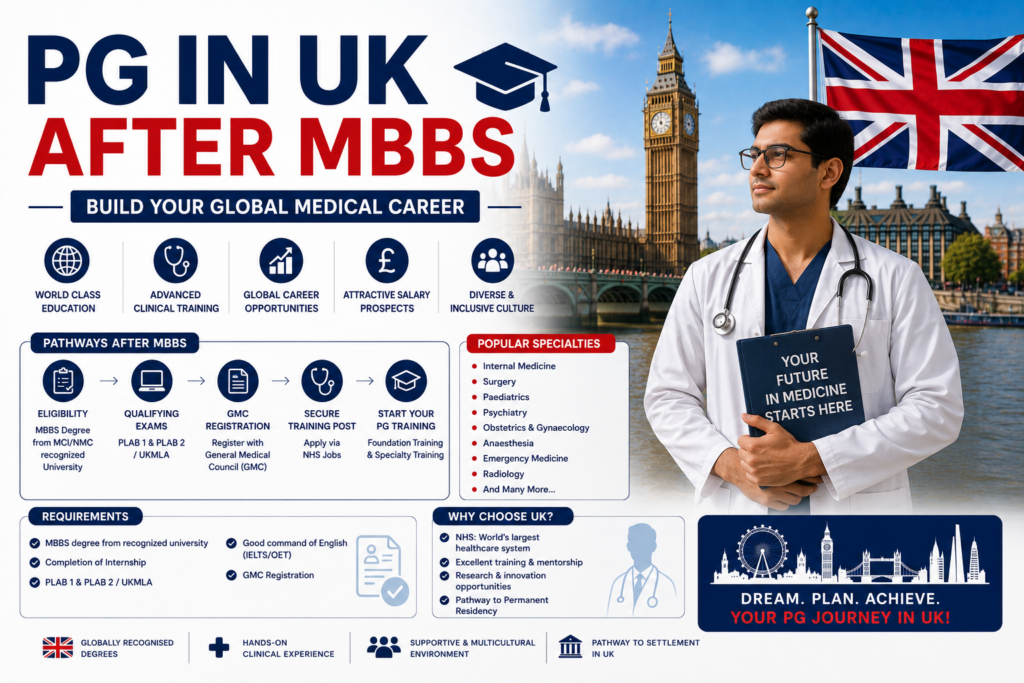
- PG in UK after MBBS has two routes: clinical (UKMLA → GMC → NHS) or academic (MSc/MPH at UK universities).
- Total PLAB journey costs approximately Rs. 3.57L–3.95L in 2026.
- NHS FY1 salary starts at £40,190/year (Rs. 51.31L/year).
- UK PG qualifies for NExT exam exemption when returning to India.
Why Pursue PG in UK After MBBS in India?
Over one in three NHS doctors in England are non-UK nationals, and Indian-trained physicians are the single largest international group. For Indian doctors, PG in UK after MBBS delivers globally recognized qualifications, structured specialty training, and NHS salaries that begin repaying your investment from day one.
- Global Recognition: NMC India recognizes MRCP and MRCS as equivalent to MD/MS degrees.
- Earn While You Train: The clinical route pays NHS salaries throughout training, unlike self-funded academic degrees costing Rs. 55L–80L/year.
- NExT Exemption: UK PG graduates are exempt from India’s NExT exam (replacing FMGE from 2026). Degrees from Russia, China, Ukraine, and Georgia do not get this exemption.
- Settlement: 5 years of NHS employment → Indefinite Leave to Remain → British Citizenship eligibility.

Choose your dream country
 UK
UK
 USA
USA
 Germany
 Australia
 Ireland
 Canada
 UAE
UAE
 France
 Sweden
 Italy
Italy
 Other
Other
When do you want to study abroad?
What's your highest level of education?
Have you completed Class 12th?
What was your Class 12 CGPA/percentage?
Are you a student or a parent/guardian?
What do you want to study?
Select your current city
How Leap will help you

Personalised University Shortlist

Express Applications with Quicker Admits

End-to-End Application Support

Clinical vs Academic: The Two Types of PG in UK After MBBS (Know This First)
The most common mistake Indian doctors make when researching how to do PG in UK after MBBS in India is conflating clinical training with academic degrees. These are entirely different pathways with different costs, outcomes, and licensing implications.
| Goal | Route | Key Exam | Outcome |
| Clinical PG Training: work as a doctor in the NHS and progress to consultant. | UKMLA → GMC → NHS → Specialty Training | UKMLA AKT + CPSA | GMC Registration, CCT, NHS Consultant |
| Academic Degree: MSc, MPH, masters in UK after MBBS, MD(Res)/PhD | UK university admission + Student Visa | None (university process) | Degree certificate, no clinical license |
An MSc or MPH alone does NOT give you the right to practice clinically in the UK. If your goal is clinical practice, your entire plan must revolve around GMC registration through UKMLA.
Eligibility Requirements for PG in UK After MBBS 2026
- MBBS Degree: From a WDOMS-listed institution. Must pass EPIC primary source verification (run by Intealth/ECFMG); a CV claim is not sufficient.
- Internship: 12-month compulsory rotating internship completed in India.
- English Proficiency: IELTS Academic 7.5 overall (7.0 minimum in each band, single sitting) OR OET Medicine Grade B (350 points) in all four components.
- Certificate of Good Standing: From NMC or State Medical Council.
- EPIC Verification: Start this alongside IELTS prep, not after results arrive. This step is the most common cause of timeline slippage for Indian doctors.
UKMLA vs PLAB: What Indian Doctors Need to Know for 2026
In short: PLAB = UKMLA. The two-part structure, format, and progression rules are identical. Only the branding has changed. The content is now mapped to the MLA Content Map, so pre-2024 PLAB study materials are no longer adequate.
| Component | Format | Venue | Fee 2026 (GBP) | Fee 2026 (INR) |
| AKT (Applied Knowledge Test) | 180 SBA MCQs, 3 hours. Clinical reasoning is assessed using the MLA Content Map, which covers approximately 430 core conditions. Longer vignettes assess application rather than memorization. | India (Pearson VUE) + worldwide | £283 | Rs. 36,130 |
| CPSA (Clinical & Professional Skills Assessment) | 18 OSCE stations, 8 mins each. Clinical examination, communication, and professional skills. | GMC Assessment Centre, Manchester, only | £980–1,000 | Rs. 1,25,116–1,27,670 |
Note: PLAB has not been replaced by a separate exam called UKMLA. The PLAB exam has been rebranded as the UK Medical Licensing Assessment (UKMLA). PLAB 1 is now called the Applied Knowledge Test (AKT), and PLAB 2 is now the Clinical and Professional Skills Assessment (CPSA). If you log on to the GMC portal today to book your exam, you will still see it labeled "PLAB 1" and "PLAB 2"; this information is correct. There is no separately named "UKMLA" booking; it does not exist as a separate entry. Your PLAB 1 pass remains valid for 3 years and can be used to progress to CPSA. Always confirm current exam nomenclature at gmc-uk.org before registering.
Step-by-Step: How to Do PG in UK After MBBS via PLAB/UKMLA
- Clear IELTS (7.5) or OET (Grade B) start EPIC degree verification simultaneously
- Create GMC Online account; submit degree documents for primary source verification
- Book and pass UKMLA AKT available in India; no travel needed
- Book UKMLA CPSA; travel to Manchester
- Pass CPSA → apply for GMC full registration (fee: £481 / Rs. 61,409)
- Apply for NHS Foundation/Trust Grade posts; obtain Health and Care Worker Visa (£324 / Rs. 41,367 for up to 3 years)
Counselor Insight: UKMLA AKT pass rates dropped noticeably vs. old PLAB benchmarks in 2025. Budget 3 to 6 months for AKT prep and 2–3 months for CPSA, using only materials mapped to the 2026 MLA Content Map. Poor preparation for the 4-attempt limit is expensive.
PLAB 2026: The Most Common Route for PG in UK After MBBS
PLAB (Professional and Linguistic Assessments Board) is still the term most Indian doctors know, and it remains the most common starting point for PG in UK after MBBS in India. From 2024 onwards, PLAB content is now fully aligned with the UKMLA framework, but the booking portal and exam label may still say "PLAB 1" and "PLAB 2." The standard, syllabus, and process are now UKMLA-compliant.
PLAB is the entry point for GMC registration. MRCP and MRCS are taken after GMC registration to enter specialty training, in addition to PLAB.
| Parameter | PLAB 1 (UKMLA AKT) | PLAB 2 (UKMLA CPSA) |
| Format | 180 Single Best Answer MCQs, 3 hours. Tests clinical reasoning using the MLA Content Map (~430 conditions) | 18 OSCE stations, 8 mins each. Tests clinical examination, communication, professional skills |
| Venue | India (Pearson VUE centres) + worldwide no travel needed | GMC Assessment Centre, Manchester, UK, only |
| Fee (2026) | £283 (Rs. 36,130) | £980–1,000 (Rs. 1,25,116–1,27,670) |
| Validity | Must pass PLAB 2 within 3 years of PLAB 1 | Apply for GMC registration within 2 years of passing PLAB 2 |
| Max Attempts | 4 attempts | 4 attempts |
PLAB Pass Rates (2021–2025)
| Year | PLAB 1 Pass Rate | PLAB 2 Pass Rate |
| 2021 | 74.1% | 69.9% |
| 2022 | 70.9% | 64.8% |
| 2023 | 72.0% | 62.9% |
| 2024 | 70.5% | 65.8% |
| 2025 | 62.2% | 59.8% |
Pass rates dropped significantly in 2025 following the move to the new MLA Content Map. The 2026 AKT uses longer clinical vignettes testing reasoning, not memorization. Budget 3 to 6 months for PLAB 1 and 2 to 3 months for PLAB 2 preparation.
Total Cost of the PLAB Journey (2026)
| Expense | Cost (GBP) | Cost (INR) |
| IELTS Academic | £200 | Rs. 25,534 |
| EPIC Degree Verification | £230 | Rs. 29,364 |
| PLAB 1 (UKMLA AKT) | £283 | Rs. 36,130 |
| PLAB 2 (UKMLA CPSA) | £980–1,000 | Rs. 1,25,116–1,27,670 |
| Travel + Accommodation (Manchester for PLAB 2) | £600–900 | Rs. 76,602–1,14,903 |
| GMC Full Registration | £481 | Rs. 61,409 |
| Total PLAB Journey | £2,794–3,094 | Rs. 3.57L–3.95L |
Counsellor Insight: PLAB 1 can be taken from India so you can start your UK medical career without leaving the country. Once you pass PLAB 1, book PLAB 2 in Manchester. Most Indian doctors spend 4–8 months on this combined process. The total PLAB-to-GMC cost of Rs. 3.5–4L is the lowest entry cost of any comparable destination for Indian doctors.
Medical Training (Prioritisation) Act 2026: Critical Update for Indian Doctors
This legislation is the single most important regulatory change of 2026 and is absent from most guides. The Medical Training (Prioritization) Act 2026 became law on 5 March 2026.
| What the Act Changes | What It Does NOT Affect |
| UK and Irish medical graduates now have priority access to the NHS Foundation Programme and specialty training posts. From 2027, prioritization will also apply at the shortlisting and interview stage, making it significantly harder for IMGs to reach the interview stage. | • GMC registration (Indian doctors still register via UKMLA) • Non-training NHS posts Trust Grade, Clinical Fellow, Staff Grade remain fully open to IMGs• MRCP and MRCS exams unaffected • NHS employment and salaries unaffected |
Practical strategy: Obtain GMC registration → secure Trust Grade or Clinical Fellow posts → build NHS portfolio → apply for specialty training from within the system, where "significant NHS experience" will become a prioritization factor from 2027.
Counselor Insight: The Act closes the direct-entry route to specialty training but does not affect the NHS itself. Trust Grade posts pay £40,000+/year and allow MRCP/MRCS to be taken in parallel. Doctors with 2–3 years of UK NHS experience will be substantially better positioned for training applications from 2027.
Pathways to PG in UK After MBBS: All Routes Compared
| Pathway | Best For | Key Requirement | Outcome |
| PLAB / UKMLA Route | How to do PG in UK after MBBS in India: standard entry for most Indian doctors with <3 years of experience. PLAB 1 can be taken from India. | PLAB 1 (UKMLA AKT) + PLAB 2 (UKMLA CPSA) | GMC Full Registration → NHS Trust Grade → Specialty Training |
| MRCP/MRCS Route (without PLAB) | PG in UK after MBBS in India without PLAB doctors completing all MRCP or MRCS parts | All parts of MRCP or MRCS | GMC registration via Royal College route bypasses UKMLA |
| MTI (Sponsored) | 3+ years' experience; short-term UK exposure | Royal College sponsorship under MTI | Time-limited GMC registration (1–2 years) in NHS |
| CESR (Specialist) | Senior specialists 8+ years post-qualification | Portfolio of UK-equivalent competencies | Direct entry to GMC Specialist Register; NHS Consultant |
| Academic Route | Masters in UK after MBBS; research; public health; teaching | UK university admission + Student Visa | Degree certificate, no clinical license |
Counselor Insight (MRCP/MRCS from India): Both MRCP Part 1 and MRCS Part A can be taken from India before relocating. Starting these while still in India is the best thing you can do to strengthen your specialty training application and reduce your post-arrival timeline.
Best Branches for PG in UK After MBBS in India
Choosing the right specialization is the most strategic decision for PG in UK after MBBS. Below are the best branches ranked by accessibility for Indian doctors post-2026.
| Specialisation | Clinical Qualification | NMC India Equivalence | IMG Accessibility Post-2026 |
| Internal Medicine | MRCP | MD (General Medicine) | Moderate recommended |
| Surgery (General/Ortho/ENT) | MRCS | MS (Surgery) | Moderate recommended |
| Paediatrics | MRCPCH | MD (Paediatrics) | Moderate |
| Psychiatry | MRCPsych | MD (Psychiatry) | Good, less competitive, strong IMG opportunity |
| Obstetrics & Gynaecology | MRCOG | MS (Obs & Gynae) | High competition |
| Cardiology | MRCP + Subspecialty | MD (Cardiology) | Very high competition |
| Public Health | MPH | Not MD/MS equivalent | Academic route only |
| Dermatology | MRCP + Specialty Training | MD (Dermatology) | Extremely high 20:1+ competition; plan 3–5 yrs UK experience first |
Internal Medicine (MRCP) and Surgery (MRCS) offer the best balance of accessibility, NMC recognition, and career trajectory for Indian doctors doing PG in UK after MBBS.
PG in UK After MBBS Fees: 2026 Complete Cost Breakdown
Understanding the cost of PG in UK after MBBS is essential. The clinical route is front-loaded but self-sustaining once you start NHS employment.
| Expense | Cost (GBP) | Cost (INR @ Rs. 127.67/£) |
| IELTS Academic | £200 | Rs. 25,534 |
| EPIC Degree Verification | £230 | Rs. 29,364 |
| UKMLA AKT | £283 | Rs. 36,130 |
| UKMLA CPSA | £980–1,000 | Rs. 1,25,116–1,27,670 |
| UK Visit Visa (CPSA travel) | £115 | Rs. 14,682 |
| Travel + Accommodation (Manchester) | £600–900 | Rs. 76,602–1,14,903 |
| GMC Full Registration | £481 | Rs. 61,409 |
| Health and Care Worker Visa (up to 3 yrs) | £324 | Rs. 41,367 |
| Mandatory Total | £3,213–3,513 | Rs. 4.10L–4.48L |
| Pre-job living costs (3–6 months) | £2,500–6,000 | Rs. 3.19L–7.66L |
| MRCP Part 1 (international) | £672 | Rs. 85,794 |
| MRCS Part A (India, incl. 18% GST) | £767 | Rs. 97,894 |
Sources: RCS England MRCS Fees, MRCP(UK) Examination Fees
Once in NHS employment, Foundation Year 1 doctors earn £40,190/year (Rs. 51.31L/year) the clinical route pays for itself quickly. NHS consultants start at £1,09,725/year (Rs. 1.40 Cr/year). NHS Employers Medical Pay Scales 2026/27
Top UK Universities for Academic PG After MBBS 2026
For PG courses in UK after MBBS and masters in UK after MBBS, these are the top institutions. Note: Academic PG costs Rs. 55L–80L/year all-inclusive and does not provide a clinical license.
| University | QS Rank 2026 | Annual Tuition (GBP) | Annual Tuition (INR) |
| Imperial College London | #2 | £37,800–£42,000 | Rs. 48.26L–Rs. 53.62L |
| University of Oxford | #4 | £35,000–£52,000 | Rs. 44.68L–Rs. 66.39L |
| University of Cambridge | #6 | £32,352–£40,000 | Rs. 41.30L–Rs. 51.07L |
| University College London | #9 | £35,000–£43,000 | Rs. 44.68L–Rs. 54.90L |
| King's College London | #31 | £34,000–£38,300 | Rs. 43.41L–Rs. 48.90L |
| University of Edinburgh | #34 | £35,000–£37,500 | Rs. 44.68L–Rs. 47.88L |
| University of Manchester | #35 | £34,700–£39,900 | Rs. 44.29L–Rs. 50.94L |
Scholarships for PG in UK After MBBS
Scholarships apply to academic programs only. Clinical NHS training is paid employment.
| Scholarship | Coverage | Key Eligibility |
| Chevening | Full: tuition + stipend + airfare | 2 years' work experience; return to India for 2 years post-graduation |
| Commonwealth | Full: tuition + travel + living stipend | Commonwealth citizenship; demonstrated home-country impact |
| GREAT Scholarship | £10,000 towards tuition | Indian passport holder; offer from participating UK university |
| Gates Cambridge | Full Cambridge costs | Exceptional academics; non-UK applicants; any PG subject |
| Rhodes | Full Oxford costs + stipend | Academic excellence + leadership; highly competitive |
Returning to India: NMC Recognition and NExT Exemption 2026
- NMC Equivalence: MRCP = MD; MRCS = MS. Both are directly recognized for specialist practice in India.
- NExT Exemption: UK PG graduates do NOT need to clear NExT (replacing FMGE from 2026). This exemption does not apply to PG from Russia, China, Ukraine, or Georgia. NMC India Foreign Medical Graduates
- Senior Residency Waiver (2025 Rule): UK-trained specialists can skip the mandatory 1-year Senior Residency to become Assistant Professors in Indian medical colleges (requires 1 year of UK teaching experience).
- Registration: Submit MBBS + UK certificates to the State Medical Council for "Additional Qualifications" registration.
3 Takeaways
1. Start UKMLA and EPIC simultaneously. The most significant delays come from EPIC verification, not exam preparation. Begin both from day one.
2. Target Trust Grade posts first, not specialty training. The 2026 Act makes direct specialty training entry very difficult for IMGs. Trust Grade and Clinical Fellow posts pay £40,000+/year, allowing you to build a portfolio and sit for MRCP/MRCS.
3. Start MRCP or MRCS Part 1 from India. Both are available internationally. Beginning before you relocate shortens your post-arrival timeline and strengthens specialty training applications significantly.
Have questions about PG in UK after MBBS or want guidance on which pathway fits your profile? Book a free session with a LeapScholar counselor.
Frequently Asked Questions About PG in UK After MBBS for Indian Doctors
-
What happens if my PLAB 1 pass expires before I take PLAB 2?
PLAB 1 is valid for three years from the date you sat the exam. If you do not pass PLAB 2 within that window, your pass lapses, and you must retake PLAB 1 using another of your four attempts. Please book PLAB 2 as soon as your PLAB 1 results are confirmed, and begin your standard visitor visa application immediately.
-
How long does the full PLAB-to-GMC registration process take?
Typically, the entire process takes 14 to 24 months: 3 to 4 months for IELTS preparation, 3 to 6 months for PLAB 1 preparation (including waiting for a seat), 4 to 6 months to book and travel for PLAB 2, and 4 to 6 weeks for GMC registration after PLAB 2. Apostille delays and visa waiting times push the total toward 24 months.
-
What is the NHS salary for Indian doctors in 2026?
FY1 basic salary is £38,831/year (Rs. 49.68 lakh/year); FY2 is £44,439/year (Rs. 56.84 lakh/year); ST1/CT1 is £52,656/year (Rs. 67.35 lakh/year). With on-call supplements, total FY1 earnings run to approximately £45,900/year (Rs. 58.73 lakh/year). NHS consultants start at £105,504/year (Rs. 1.35 crore/year) on the 2025-26 pay scales.
-
Is a UK PG medical qualification recognized by NMC in India?
The NMC recognizes MRCP and MRCS as equivalent to Indian MD/MS. A UK MSc or MPH degree from a university is not automatically equivalent. If returning to India with specialist credentials matters, MRCP or MRCS is the correct pathway to pursue.
-
Can I do PG in UK after MBBS without PLAB?
For clinical NHS practice, no. For an academic degree (MSc, MPH), yes. The direct university route does not require PLAB but does not give you GMC registration or rights to work as a clinician in the NHS.
-
What IELTS score is needed for GMC registration?
You need IELTS Academic 7.5 overall with no single band below 7.0, and both scores must come from the same sitting. A 7.5 overall score built across two separate attempts does not count. OET Medicine at Grade B across all four components is the alternative if you find OET's clinical scenarios easier to prepare for. Go for IELTS for UKVI specifically; one test clears both the GMC requirements and your visa application. One thing that catches people out is that if you score 7.0 overall or drop a band to 6.5, a pre-sessional English course will not fix the issue for the GMC. That workaround only works for university admissions. You retake it.
-
What are the PLAB exam fees in rupees for 2026?
PLAB 1 is £283 (Rs. 36,188), PLAB 2 is £1,036 (Rs. 1,32,514), and GMC full registration is £481 (Rs. 61,535), which is Rs. 2,30,237 for exams and registration alone. By the time you add the IELTS, the standard visitor visa for your Manchester trip, flights, and a couple of weeks of accommodation, the realistic total lands between Rs. 2.62 lakh and Rs. 3.90 lakh. The fees changed in April 2026, so please confirm the current figures before booking anything.
-
What is the step-by-step process for PG in UK after MBBS in India?
Clear IELTS 7.5. Set up GMC Online and submit documents for verification. Pass PLAB 1 in India. Apply for a Standard Visitor Visa and travel to Manchester for PLAB 2. Once you have GMC registration, you apply for NHS jobs, and your employer sponsors a Health and Care Worker Visa. This route is IHS-exempt, which saves a significant sum upfront compared to a Student Visa. Most Indian MBBS graduates take 14 to 24 months from their first IELTS to holding a GMC number. The wide range is mainly due to how long you wait for PLAB 1 seats and how smoothly the Manchester visa goes.
-
Is PLAB still required in 2026, or has UKMLA replaced it?
PLAB remains the exam that Indian doctors book for GMC registration. UKMLA is the overarching framework. PLAB now follows the UKMLA content map but keeps its name, per GMC's own guidance. When you log into GMC Online, you book PLAB. The name will be modernized later, but for 2026 the process is unchanged.









Have Questions? Get Guidance to reach your Dream University
Connect with India's finest counsellors and biggest study abroad community.
Get Guidance