
Quick Read
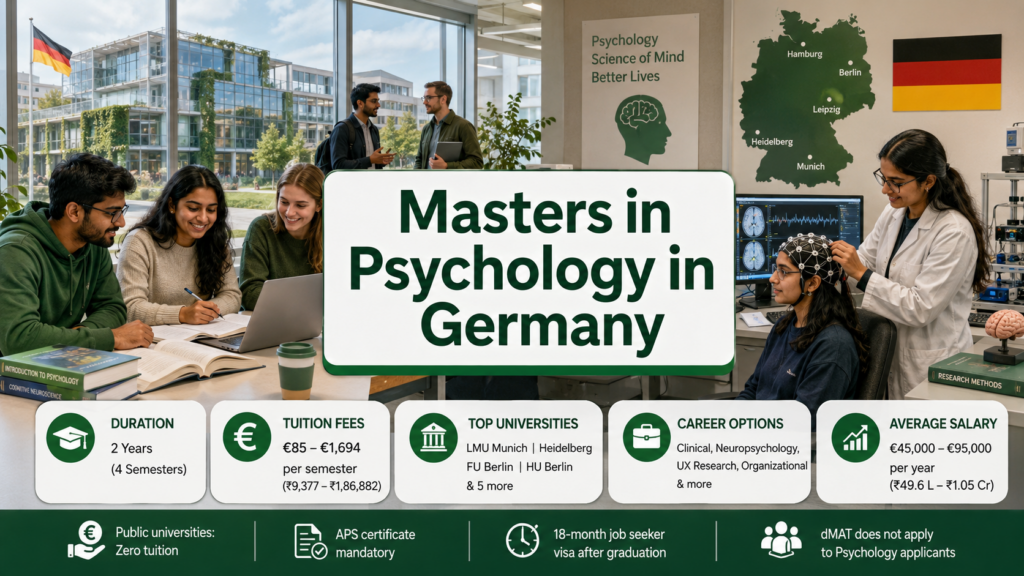
- Public universities charge zero tuition for most Masters in Psychology in Germany programs.
- The dMAT exam does not apply to Psychology bachelor’s degree holders.
- APS certificate verification is mandatory for every Indian applicant.
- Graduates get an 18-month visa to search for a qualifying job.
Why Pursue a Masters in Psychology in Germany?
Here’s what makes a Masters in Psychology in Germany worth the paperwork:
- Near-zero tuition at public universities, ranked in the QS World University Rankings by Subject 2026 top 350 for Psychology globally.
- Werkstudent part-time work, letting you earn while you study, legally, up to 20 hours/week in term time.
- A genuine research culture, built around the university where modern experimental psychology began.
- An 18-month job seeker visa after graduation, one of the longest post-study windows in Europe.
- A real language decision to make early: English-taught research tracks vs German-required clinical tracks, which is where most Indian applications actually go wrong.

Choose your dream country
 UK
UK
 USA
USA
 Germany
 Australia
 Ireland
 Canada
 UAE
UAE
 France
 Sweden
 Italy
Italy
 Other
Other
When do you want to study abroad?
What's your highest level of education?
Have you completed Class 12th?
What was your Class 12 CGPA/percentage?
Are you a student or a parent/guardian?
What do you want to study?
Select your current city
How Leap will help you

Personalised University Shortlist

Express Applications with Quicker Admits

End-to-End Application Support
Counselor insight: Students who assume "zero tuition" means "zero cost" usually underestimate the semester fee and blocked account requirement until they're mid-application. Budget for both from day one, not just tuition.
Top Universities for a Masters in Psychology in Germany
Here's how the top 9 stack up on QS Psychology rank and semester cost, the two numbers that actually decide most shortlists.
| University | QS Psychology Rank (2026) | Semester Fee (Euro) | Semester Fee (INR) |
| LMU Munich | #58 | €85 | Rs.9,377 |
| Heidelberg University | #80 | €1,661 | Rs.1,83,242 |
| Freie Universität Berlin | #88 | €359 | Rs.39,605 |
| Humboldt Uni Berlin | #130 | €320 | Rs.35,302 |
| Uni Mannheim | #101-150 | €1,694 | Rs.1,86,882 |
| University of Tübingen | #101-150 | €1,661 | Rs.1,83,242 |
| University of Freiburg | #201 | €1,690 | Rs.1,86,441 |
| University of Bonn | #201-250 | €300 | Rs.33,096 |
| Leipzig University | #101-150 | €312 | Rs.34,420 |
Exchange rate used: €1 = Rs.110.32 as of July 2026. Verify the current rate before finalizing your budget.
Source: QS World University Rankings by Subject 2026 for rankings; LMU Munich's official fee page confirms LMU charges no tuition, only a semester contribution. Other university fees were cross-checked against each institution's published semester-fee schedule as of mid-2026; always confirm the current figure on the university's own site before budgeting, since these are revised each semester.
Universities in Baden-Württemberg (Heidelberg, Mannheim, Freiburg, Tübingen) charge non-EU students an additional €1,500 (Rs.165,480) per semester on top of the base semester fee shown above, under state-level tuition rules that have applied since Winter Semester 2017/18.
Note: Germany hasn't published subject-wise QS rankings for 2027 yet; they're expected only in March or April 2027, so every ranking figure in this guide uses the QS 2026 subject table, the most current one available. For how Psychology careers stack up against Germany's broader shortage-occupation job market, see our Average Salary in Germany guide.
Top Specialisations for a Masters in Psychology in Germany (2027-28 Intake)
The rule that decides most applications: Consecutive Master's. Your specialization must closely match your bachelor's subject, and that single mismatch rejects more Indian applicants than GPA ever does.
| Specialisation | University | Duration | Language |
| Neuro-Cognitive Psychology | LMU Munich | 2 years | English |
| Cognitive Neuroscience | FU Berlin | 2 years | English |
| Clinical Psychology & Psychotherapy | HU Berlin | 2 years | German (C1/TestDaF 16) |
| Organizational Psychology | Uni Mannheim | 2 years | English/German |
| Clinical Psychology | Uni Hamburg | 2 years | German (TestDaF 15) |
| Neural & Behavioral Sciences | Uni Tübingen | 2 years | English |
Two quick filters before you shortlist:
- Language track first, university second. A masters in clinical psychology in Germany almost always requires German at the C1 level or TestDaF 15-16, since clinical training involves direct patient contact. A fully English-taught clinical program is rare.
- Want to study psychology in English in Germany? Research-track specializations, Neuro-Cognitive Psychology at LMU Munich and Cognitive Neuroscience at FU Berlin, are your realistic options, not the clinical track.
See what our counselors say about studying in Germany without IELTS if your bachelor's medium of instruction was English throughout, and read expert answers on whether IELTS is compulsory for a German master's either way, since the answer changes by specialization and university.
Counselor insight: If your bachelor's was in general or applied psychology without a strong statistics and research-methods component, research-heavy German programs will ask for evidence of that coursework separately. Get your transcript's module breakdown translated early; don't wait for a rejection to find out it's missing.
Public Universities in Germany for Psychology vs Private Institutes
If your GPA or budget doesn't fit the public-university track above, here's how the private alternative compares.
| Factor | Public Universities | Private Institutes |
| Tuition | Zero to low (semester fee only) | €5,000-20,000/year (Rs.5,51,600-22,06,400) |
| Competition | High, GPA and NC-restricted | Lower, more flexible entry |
| Scholarship access | DAAD, Erasmus+, Deutschlandstipendium | Limited to institute-specific grants |
| English-taught options | Concentrated in research tracks | Broader, marketed to international students |
| Recognition for Approbation | Full state recognition | Verify accreditation per program |
Exchange rate used: €1 = Rs.110.32 as of July 2026. Verify the current rate before finalizing your budget.
Public-vs-private fee patterns reflect standard German higher-education structure (public universities are state-funded and tuition-free at most levels; private institutes are self-funded and fee-charging), consistent with DAAD's own description of the German university system.
Most Indian applicants target public universities in Germany for psychology precisely because of this tuition gap, and public universities in Germany for psychology generally outnumber private options in specialization choice as well. Private institutes suit students with a borderline GPA who can't clear public-university Numerus Clausus limits.
Read expert answers on Germany's master's fee and payment structure from LeapScholar counselors for a fuller cost breakdown across both tracks.
Eligibility for a Masters in Psychology in Germany: What Indian Applicants Need
Before you shortlist a single university for a Masters in Psychology in Germany, check whether you clear these baseline requirements, since German admissions committees screen on paper before they screen on fit.
| Requirement | What You Need |
| Academic background | Bachelor's degree in Psychology or a closely related field |
| Minimum GPA | 2.5 on the German scale (roughly 73-75% in the Indian system. ) |
| English proficiency | IELTS 6.5+ / TOEFL 90+ (for English-taught tracks) |
| German proficiency | TestDaF 15-16 or equivalent (for clinical tracks) |
| Mandatory verification | APS certificate for every Indian applicant, regardless of program |
| APS fee | Rs.18,000, non-refundable |
Source: Official APS India dMAT leaflet, June 2026.
The eligibility for a Masters in Psychology in Germany comes down to matching your bachelor's subject closely enough (more on this under Specializations below), clearing the GPA bar, and getting your APS certificate done early, since it gates every subsequent step of the application regardless of whether your target program is tuition-free.
Read expert answers on the documents and requirements for APS and GMAT/BMAT exams for a full checklist beyond what's covered here.
Note on NC: Psychology is one of Germany's most numerus-clausus-restricted subjects. NC (Numerus Clausus) is the GPA cutoff below which an applicant is not considered in the current intake cycle. Unlike CGPA, NC in Germany is expressed on the 1.0-4.0 grade scale and resets each semester based on applicant pool strength. Indian applicants must first convert their percentage to a German grade using the Bavarian formula, then check the previous semester's NC at their target university. LMU Munich's NC for Psychology has historically sat between 1.3 and 1.6, among Germany's most competitive. FU Berlin and HU Berlin are typically more accessible for international applicants.
Counselor insight: Universities ask for your original transcript's module names, not the degree title. A "BA Psychology" transcript heavy on sociology electives gets flagged more often than a BSc with a thin research-methods section because reviewers check subject-hour breakdowns, not just the label on your degree.
Does the New dMAT Exam Apply to Psychology Applicants?
Short answer: no, and here's precisely why.
APS India's Digital Master Test (dMAT), announced on 29 June 2026, applies only to master's applicants with a bachelor's degree in Engineering, Commerce, Accounting, Finance, Economics, or Business and Management for Summer Semester 2027 admissions onwards. Psychology is not on the affected fields list.
If your bachelor's is in Psychology, you follow the standard APS route for your masters in psychology in Germany with no dMAT requirement, regardless of which intake you're targeting.
See what our counselors say about whether the GMAT is also required for APS certification, since the GMAT, BMAT, and dMAT are three separate and frequently confused requirements.
Documents Required for a Masters in Psychology in Germany
Everything below goes into one Masters in Psychology in Germany application file, so build this checklist before you touch the university portal.
| Document | India-Specific Detail |
| APS Certificate | Mandatory since Nov 2022; Rs.18,000 fee, non-refundable |
| Bachelor's certificate & transcripts | Semester-wise, not consolidated marksheets |
| SOP | Program-specific ties bachelor's coursework to specialization. |
| 2-3 LORs | At least one from a research supervisor if available |
| CV | Europass format preferred |
| Language proof | IELTS/TOEFL or TestDaF depending on track |
| Passport & photos | Standard biometric requirements |
Which Student Profile Fits a Masters in Psychology in Germany?
Here are three common starting points, along with what each one should do differently:
- If you're a final-year BSc Psychology student graduating in 2027, targeting Winter Semester 2027/28: start APS registration the moment your final semester begins; don't wait for your provisional degree certificate. APS accepts provisional certificates with a registrar's letter.
- If you're a working professional switching into organizational or UX-research roles: target Mannheim or a similarly business-psychology-focused program, and use work experience as SOP evidence, since German committees weigh applied experience more than Indian panels typically do.
- If your GPA sits below 65% (below 2.5 on the German scale), a public university masters in psychology in Germany is a genuine stretch. Strengthen your research-methods evidence, target GPA-flexible programs at Siegen or Jena, or consider a private institute with clear approbation-track accreditation.
Month-by-Month Planning Calendar for Winter 2027-28 Intake
Work backward from your October 2027 start date using this timeline.
| Month (2027) | Action |
| February-March | Shortlist universities; confirm specialisation matches your bachelor's |
| April | Register for APS and request semester-wise transcripts from your Indian university |
| May-June | Collect LORs, draft SOP, book IELTS/TestDaF if not already done |
| July | Standard Uni-Assist deadline window for Winter 2027/28 (confirm exact date per university) |
| August-September | Track application status and respond to any document requests |
| October | Winter Semester 2027/28 begins |
Counselor insight: Don't build your calendar around the day APS "should" take. Processing officially runs 3-4 weeks but regularly stretches to 8-10 weeks in peak season, since most Indian applicants file in the same April-June window.
Cost of Living for a Masters in Psychology in Germany
Your real monthly budget, beyond the semester fee, breaks down like this:
| Expense | Euro/Month | INR/Month |
| Rent & Utilities | €400-700 | Rs.44,128-77,224 |
| Food & Groceries | €200-250 | Rs.22,064-27,580 |
| Health Insurance | €110-120 | Rs.12,135-13,238 |
| Miscellaneous | €100-150 | Rs.11,032-16,548 |
| Total | €810-1,220 | Rs.89,359-1,34,590 |
Exchange rate used: €1 = Rs.110.32. Verify the current rate before finalizing your budget.
You'll also need a blocked account of €11,904 (Rs.13,13,249) to prove funds before your visa is issued.
Source: Federal Foreign Office, Opening a blocked bank account (Sperrkonto) for students, Germany's official government visa portal.
Is a master's degree in Germany free for international students when you take these numbers into account?
Tuition itself is genuinely free at public universities; your real monthly cost is the semester fee plus living expenses above, not a hidden tuition bill.
Scholarships for a Masters in Psychology in Germany
Tuition being free doesn't mean funding a Masters in Psychology in Germany is irrelevant; living costs and the blocked account still add up, and these five sources are where Indian Psychology applicants realistically get help.
| Scholarship | Offered By | Benefit | Best Fit For |
| DAAD Scholarship | German Government | €992/month (Rs.1,09,437) | Strong academic record, upper-third of your batch |
| Erasmus+ | European Union | €1,400/month (Rs.1,54,448) + tuition waiver | EU-partnered joint-degree programs |
| Deutschlandstipendium | German universities | €300/month (Rs.33,096) | Merit-plus-need, university-specific selection |
| Heinrich Böll Foundation | German political foundation | €934/month (Rs.1,03,039) | Students with a social or political-engagement profile |
| Konrad Adenauer Foundation | German political foundation | €992/month (Rs.1,09,437), 2-year cap | Leadership or civic-engagement background |
Most of these can't be combined; DAAD and the political foundations both expect exclusivity, so pick your strongest-fit application rather than applying to all five in parallel. The Deutschlandstipendium is the exception: it's university-administered and can sometimes stack with smaller institutional grants.
For detailed eligibility criteria, application requirements, funding benefits, and deadlines, refer to our comprehensive guide on the DAAD Scholarship Germany.
Counselor insight: DAAD applications for the following year's intake typically close 9-12 months ahead. If you're targeting Winter 2027/28, your DAAD window is already closing by the time most students start looking. Apply the moment shortlisting is done, not after your APS certificate arrives.
What to Do When Things Go Wrong
Here are three scenarios that can derail otherwise-strong applications, along with the actual fix for each:
- APS certificate delayed past your intake deadline: Contact the admissions office directly; several universities accept an APS "in process" confirmation alongside a provisional transcript, though the outcome varies and isn't guaranteed.
- GPA falls below the 2.5 German-scale cutoff: Target GPA-flexible public universities (Siegen, Jena) or strengthen your file with GRE scores and demonstrable research experience, which some committees weigh alongside GPA.
- You miss the Winter Semester 2027/28 deadline: Most psychology programs only admit in Winter, so a missed deadline usually means waiting a full year, not switching to Summer. Confirm your program's intake pattern before assuming a Summer fallback exists.
The Path to Practicing as a Psychologist in Germany
Completing your masters and getting licensed to practice clinically are two different things; here's the distinction that trips up most applicants.
A Masters in Psychology in Germany makes you a "psychologist," a protected title for anyone who completed a psychology degree, not automatically a licensed "psychotherapist." How to become a psychologist in Germany with full clinical practicing rights runs through Approbation, a state license granted after specialized postgraduate training and a state exam under the Psychotherapists' Act.
Source: Anerkennung in Deutschland, the German government's official portal for foreign qualification recognition.
Counselor insight: Decide whether you're aiming for approbation or a non-clinical career (UX research, HR, organizational consulting) before you pick a specialization, not after. Clinical tracks require German C1 and a multi-year licensing path; research tracks don't.
Career Scope and Salary After Masters in Psychology in Germany
Here's what a Masters in Psychology in Germany pays across five realistic career paths, from entry-level to specialized roles:
| Role | Annual Salary (Euro) | Annual Salary (INR) |
| School Psychologist | €45,000-63,000 | Rs.49,64,400-69,50,160 |
| Clinical Psychologist | €50,000-75,000 | Rs.55,16,000-82,74,000 |
| UX Researcher/Consultant | €48,000-65,000 | Rs.52,95,360-71,70,800 |
| Neuropsychologist | €52,000-92,000 | Rs.57,36,640-1,01,49,440 |
| Organizational Psychologist | €55,000-95,000 | Rs.60,67,600-1,04,80,400 |
Source: Bundesagentur für Arbeit, Entgeltatlas: Psychologe/Psychologin (clinical psychology occupational category), Germany's Federal Employment Agency official wage database, anchors the Clinical Psychologist figures directly (lower to upper quartile, full-time gross). Other roles are related specialisations cross-checked against published German salary surveys for 2026; treat as indicative ranges, not guaranteed offers, and verify against current listings before making a decision.
For a role-by-role salary comparison against Germany's highest-paying shortage occupations like software engineering and data roles, see our detailed salary breakdown by profession.
The spread widens fast with experience and city: Berlin and Munich pay at the top of these bands but cost more to live in, while midsize university towns pay closer to the low end with a much cheaper cost of living, so factor city choice into the real take-home comparison, not just the salary figure.
Graduates get an 18-month job seeker visa to find qualifying work. If you're targeting an EU Blue Card after that, the 2026 threshold is €50,700 (Rs.55,93,224) gross annually for standard roles, or €45,934.20 (Rs.50,67,461) if you graduated within the last three years, since recent graduates qualify for the lower band regardless of field.
Source: Make it in Germany, EU Blue Card, the Federal Government's official skilled-immigration portal.
Counselor insight: Clinical and neuropsychology roles clear the EU Blue Card threshold comfortably even at entry level. Organizational and UX-research roles clear it too, but only once you're a year or two in. Factor that gap into your first-year financial planning if you're counting on the Blue Card immediately after your job seeker visa.
3 Takeaways on Masters in Psychology in Germany
- Confirm your specialization's language requirement (English vs German C1) before you shortlist, not after you apply.
- Start APS at least 6 months before your intake; dMAT does not apply to Psychology applicants, so this is your only mandatory checkpoint.
- Decide early whether you're targeting an approbation-track licensing or a non-clinical career, since that decision determines which specialization and university fit you.
Verified by: LeapScholar's Germany counseling team, with hands-on experience guiding Indian students through APS certification, specialization selection, and approbation-track planning.
Have questions about your Masters in Psychology in Germany application? Book a free session with a LeapScholar counselor.
Frequently Asked Questions About Masters in Psychology in Germany
-
Is Germany a good option for a masters in psychology?
Germany combines near-zero public university tuition with universities ranked in the QS World University Rankings by Subject 2026 top 350 for Psychology globally. The research infrastructure is strong, and the 18-month post-study visa gives genuine time to find qualifying work, though clinical-track admission is competitive and often requires German proficiency.
-
Can you study psychology in English in Germany?
Research-focused specializations like Cognitive Neuroscience at FU Berlin and Neuro-Cognitive Psychology at LMU Munich are taught fully in English. Clinical psychology and psychotherapy tracks usually require German at the C1 level or TestDaF 15-16, since they involve direct patient contact during training.
-
What is the eligibility for a masters in psychology in Germany?
You need a bachelor's degree in Psychology or a closely related field, a minimum GPA of 2.5 on the German scale (roughly 73-75% in the Indian system), and English or German proficiency depending on your chosen specialization. An APS certificate is mandatory for every Indian applicant regardless of program.
-
Does the dMAT exam apply to a masters in psychology in Germany application?
No. The dMAT applies only to Master's applicants whose bachelor's degree is in Engineering, Commerce/Accounting/Finance/Economics, or Business/Management, for Summer Semester 2027 intakes and later. Psychology bachelor's holders follow the standard APS process with no additional test.
-
Are masters free in Germany for international students?
Public universities charge no tuition, only a semester administrative fee ranging roughly €85-1,694 (Rs.9,377-1,86,882) depending on the university and state. Baden-Württemberg adds a further €1,500 (Rs.1,65,480) per semester for non-EU students on top of that base fee.
-
How long is a master's degree in psychology in Germany?
Most programs run for 2 years (4 semesters) full-time, whether the specialization is Clinical Psychology, Cognitive Neuroscience, or Organizational Psychology. Duration of MS in Germany rarely drops below 4 semesters for psychology; a small number of applied or part-time tracks extend slightly longer instead, so confirm program length before applying.
-
How do you become a psychologist in Germany after a masters degree?
Completing your masters makes you a "psychologist," a protected but less restricted title. To practice psychotherapy independently or bill health insurance, you additionally need approbation, a state license requiring specialized postgraduate training and a state exam, which applies specifically to the "psychotherapist" title.
-
What happens if your APS certificate is delayed or your GPA is borderline?
A delayed APS certificate rarely voids an application outright; contact the admissions office directly, since several universities accept an in-process confirmation alongside a provisional transcript. You can better address a borderline GPA by targeting GPA-flexible universities or strengthening your file with GRE scores and demonstrable research experience.
-
What is the average salary after a masters in psychology in Germany?
Salaries range from roughly €45,000 (Rs.49,64,400) for school psychologists to €95,000 (Rs.1,04,80,400) for senior organizational psychologists, depending on specialization and experience. Clinical and neuropsychology roles typically sit in the €50,000-92,000 (Rs.55,16,000-1,01,49,440) range.








Have Questions? Get Guidance to reach your Dream University
Connect with India's finest counsellors and biggest study abroad community.
Get Guidance