
Quick Read
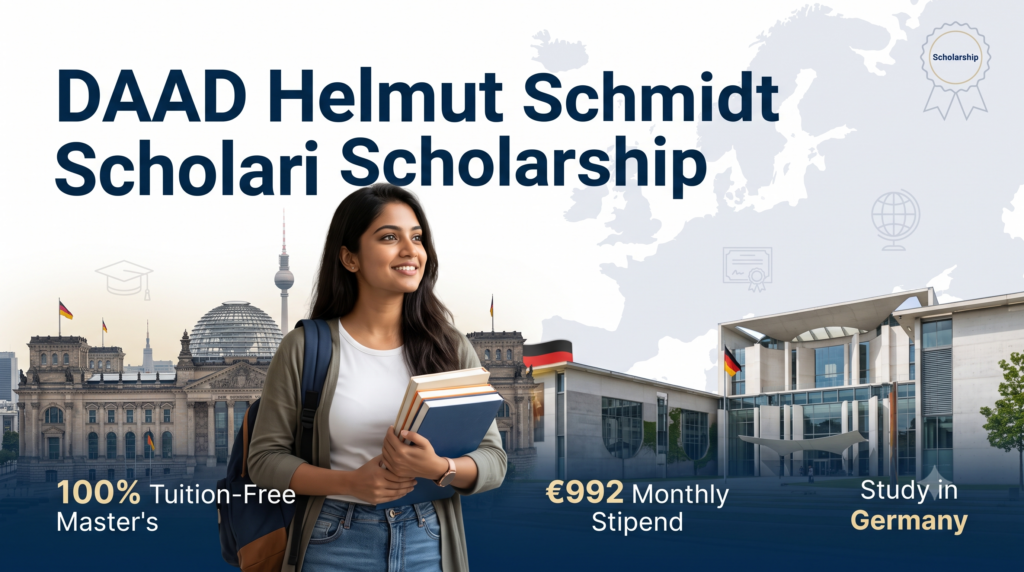
- DAAD Helmut Schmidt Scholarship funds a fully tuition-free master’s degree in Germany.
- Current stipend is Euro 992 a month, not the older Euro 934 figure.
- India is confirmed on the current DAAD eligible-country list.
- The 2027-28 cycle’s application window (submitted in 2026) closed on July 31, 2026.
- Seven master’s programmes across six German universities currently qualify.
- January 2027 applications open September–October 2026 with a compressed 6–8 week window.
What Is the DAAD Helmut Schmidt Scholarship
The DAAD Helmut Schmidt Scholarship is a fully funded master’s programme in Germany for graduates from developing and emerging countries who want to build a career in public policy and good governance.
- Funded entirely by Germany’s Federal Foreign Office, not DAAD’s general budget.
- Built for graduates in social sciences, political science, law, economics, or public administration.
- Covers a full master’s degree at one of seven qualifying programmes in Germany.
- Open to both fresh graduates and mid-career professionals, not just recent students.
- Since 2009, the programme has trained around 800 scholars from more than 100 countries.
Important for students to know:DAAD tracks its own outcomes closely, and the numbers explain why the selection bar matters: more than 95% of chosen scholars finish their degree with good or very good results, and over 90% say they were satisfied with their programme years later. In plain terms, the people who make it through selection tend to be genuinely well-matched to the programme, not just lucky. Treat your application with that level of seriousness, especially the motivation letter.
My insight: Students often assume “public policy” means the scholarship is closed to anyone without a political science background. It isn’t. Law, economics, and administration graduates apply successfully every cycle, the deciding factor is your practical experience and motivation, not your exact major.
DAAD Helmut Schmidt Scholarship Eligibility
Eligibility here is less about your grades alone and more about whether your profile matches what the programme is actually built for.
| Criteria | Requirement |
|---|---|
| Citizenship | A developing or emerging country on DAAD’s official eligible-country list; India is currently included |
| Academic background | A first university degree (bachelor’s or equivalent) in social sciences, political science, law, economics, or public administration |
| Degree standing | Above-average results, generally upper third of your graduating class |
| Practical experience | Professional work, internships, or political and social engagement is expected, not just preferred |
| Language | Programmes are taught in English; basic German helps with daily life but isn’t mandatory for admission |
| Age limit | None specified in the general criteria |
Which German Universities Offer This Scholarship
This is the part most articles about this scholarship skip entirely: DAAD doesn’t fund the Helmut Schmidt Scholarship as one generic award, it funds seven specific master’s programmes, and you apply to a programme, not to DAAD directly.
| University | Program | Who Is It Best For |
|---|---|---|
| University of Applied Sciences Bonn-Rhein-Sieg | Social Protection | Candidates focused on welfare policy, social insurance, and poverty reduction |
| University of Duisburg-Essen | Development and Governance | Candidates from a development studies or international relations background wanting a shorter, two-semester track |
| Willy Brandt School of Public Policy, University of Erfurt | Public Policy | Candidates wanting a broad, generalist public policy degree with a mandatory internship |
| University of Magdeburg | Peace and Conflict Studies | Candidates interested in conflict analysis, human rights, and interdisciplinary approaches |
| Osnabrück University of Applied Sciences | Management in Nonprofit Organisations | Candidates with existing nonprofit-sector experience aiming for NGO leadership roles |
| University of Passau | Development Studies | Candidates wanting a broad, development-economics-focused track |
| University of Passau | Governance and Public Policy | Candidates interested in comparative governance and institutional theory, taught bilingually in English and German |
You can apply to up to two of these programmes with a single DAAD Helmut Schmidt Scholarship application form, but each one runs its own selection process and, in most cases, its own DAAD Helmut Schmidt Scholarship application portal. If your background doesn’t fit any of the seven, it’s worth checking other fully funded scholarships in Germany rather than forcing a fit here.
What the DAAD Helmut Schmidt Scholarship Actually Pays
Here’s where a lot of older articles, including this one before its last update, get the number wrong.
| Benefit | Amount |
|---|---|
| Monthly stipend | Euro 992 (Rs.1,09,041 at the rate below) |
| Reduced-rate final semester (Social Protection track only) | Euro 500 (Rs.54,960) |
| Tuition fees | Fully waived at all seven programmes |
| Health insurance | Included for the full study period |
| Travel allowance | Covers travel between Germany and your home country |
| Rent subsidy and family allowance | Provided where applicable |
| German language course | Up to six months before your studies begin, mandatory |
Source: Confirmed across multiple participating universities’ own programme pages, including Bonn-Rhein-Sieg’s and Passau’s own admissions pages.
DAAD Helmut Schmidt Scholarship 2027-28 Application Timeline
The honest answer to “is the 2027-28 cycle open right now” is no, and here’s what actually matters for your planning.
| Status | Detail |
|---|---|
| 2027-28 cycle (studies starting September 2027) | Closed. Applications ran June 1 to July 31, 2026 |
| Next cycle, 2028-29 (studies starting September 2028) | Expected to open around June 2027, exact dates not yet confirmed |
If you’re reading this after August 2026, you’ve missed the window to the Daad Helmut Schmidt Scholarship for the 2027-28 academic year. Mark your calendar for June 2027, when the 2028-29 cycle is expected to open, and spend the months before then strengthening your practical experience and motivation letter.
For context, the Daad Helmut Schmidt Scholarship 2025 application form fed the 2026-27 cohort now settling into their studies, and the Daad Helmut Schmidt Scholarship 2026 application form was the one that just closed. It’s worth mapping this against broader Germany intake timelines too, so you’re not planning around this scholarship in isolation.
Documents You’ll Need to Apply for DAAD Helmut Schmidt Scholarship
Each participating university has minor variations, but the core document set stays consistent across all seven programmes.
| Document | Note |
|---|---|
| DAAD application form | Submit once, even if applying to two programmes |
| APS Certificate | Required specifically for applicants from India and the People’s Republic of China, in addition to the standard document set |
| Letter of motivation | One letter covering both programmes if you’re applying to two |
| Curriculum vitae | Reverse chronological, no unexplained gaps |
| Degree certificates | Certified translation required if not in English or German |
| Transcript of records | Include an explanation of your university’s grading system |
| Proof of practical experience | Internships, professional work, or political and social engagement |
| Proof of English proficiency | Required since programmes are taught in English |
| Letter of recommendation | From a current employer or university lecturer |
Should You Apply? Three Scenarios
If you have a law, economics, or political science degree and at least a year of relevant work or internship experience, you’re close to the exact profile this scholarship is built for. Pick the two programmes that best match your specific interest inside good governance, rather than applying broadly. Once you know which two, the actual steps to the Daad Helmut Schmidt Scholarship apply are straightforward, it’s the programme selection that takes the real thought.
If you’re a fresh graduate with strong grades but limited practical experience, you can still apply. DAAD explicitly welcomes young graduates, but you’ll need your motivation letter to work harder. Volunteering, student politics, or NGO involvement all count as relevant experience here.
If your degree is outside the listed fields but adjacent to governance work, check each programme’s specific admission requirements individually before assuming you’re excluded. Some programmes read “relevant field” more broadly than others.
Common Reasons for Rejection and How to Avoid Them?
- Applying to more than two programmes. DAAD’s own rules cap you at two; a scattered application signals you haven’t picked a real focus.
- A generic motivation letter. Reviewers read hundreds of these. A letter that doesn’t name specific coursework or explain why this exact programme fits your goals gets set aside quickly.
- Missing or uncertified translations. Degree certificates and transcripts not in English or German need certified translations, not just any translation.
- Thin evidence of practical experience. A CV listing only coursework, with no internships, volunteering, or professional history, struggles against candidates who show real fieldwork.
- Late submission to the university, not just to DAAD. Since applications go directly to each programme, missing a university’s specific internal deadline is a common and avoidable mistake.
If you’re not shortlisted this cycle, ask the programme coordinator for feedback where possible, and use the next application window to address the specific gap rather than resubmitting an identical application.
Three Key Takeaways on DAAD Helmut Schmidt Scholarship
- Pick your programme, not just the scholarship. You’re applying to one of seven specific master’s courses, so match your background to the right one before you write a single document.
- Budget your timeline around the real window. The application period runs a narrow two months each summer; missing it means waiting a full year for the next cycle.
- Lead with practical experience, not just grades. DAAD weighs professional or civic engagement heavily, a strong CV without it is a weaker application than a modest CV with real fieldwork behind it.
Verified by: LeapScholar’s Germany counseling team, with hands-on experience guiding Indian students through DAAD scholarship applications.
Have questions about the DAAD Helmut Schmidt Scholarship? Book a free session with a LeapScholar counselor.
Frequently Asked Questions About DAAD Helmut Schmidt Scholarship
-
Does the DAAD Helmut Schmidt Scholarship actually cover everything?
Closely, yes. Tuition is fully waived, and you get a monthly stipend, health insurance, travel allowance, and a mandatory language course before your studies even start. The exact add-ons like rent subsidy or family allowance depend on your personal situation, not every scholar gets every extra.
-
Is India on the eligible-country list?
Yes, and this trips people up because a lot of pages just say “developing countries” without confirming which ones. India is currently on DAAD’s list for this program, confirmed directly through participating universities’ own eligibility pages.
-
Can I apply to more than one of the seven master’s programs?
Up to two, using a single DAAD Helmut Schmidt Scholarship application form and one shared motivation letter. Anyone who did the DAAD Helmut Schmidt Scholarship 2026 apply to two programs at once still had to rank their preference clearly in that letter, since each programs evaluates you independently, and the same rule will apply to the next cycle.
-
Is the application handled through a central DAAD portal?
Not exactly. There’s a shared DAAD Helmut Schmidt Scholarship application form, but you submit it directly through your chosen university’s own DAAD Helmut Schmidt Scholarship application portal, not through a single centralized DAAD system. Each university runs its own process from there.
-
What happened to the 2027-28 application window?
It’s closed. The DAAD Helmut Schmidt Scholarship 2026 application form, which covers the 2027-28 academic year, accepted submissions from June 1 to July 31, 2026, for students starting their master’s in September 2027. That’s a step ahead of the DAAD Helmut Schmidt Scholarship 2025 application form cycle, which is already enrolled and studying. Anyone who managed to receive the DAAD Helmut Schmidt Scholarship 2026 before that deadline should expect a shortlist decision around November or December, with final results typically followed by early next year. If you’re reading this after that window, you’re looking at the 2028-29 cycle, expected to open around June 2027.
-
Can I still apply if I already hold a master’s degree?
Generally no, this scholarship is meant for your first master’s. If you’re aiming for a different field entirely from your existing degree, some programs may still consider you, but check with the specific university rather than assuming either way.
-
Is there an age limit?
Not in the general criteria DAAD publishes. Individual universities occasionally set their own preferences, so it’s worth a quick check if you’re well outside the typical applicant age range.
-
How competitive is this scholarship really?
Genuinely competitive. With around 800 scholars selected since 2009 across all seven programs combined, seats are limited, and DAAD’s own data shows over 95% of those selected complete their degree with strong results, meaning the selection process is doing real filtering, not just checking boxes.





Have Questions? Get Guidance to reach your Dream University
Connect with India's finest counsellors and biggest study abroad community.
Get Guidance