Struggling to find the right words during your IELTS speaking test? You’re not alone. Many test-takers know what they want to say but can’t express it effectively. The difference between a Band 6 and a Band 8 often comes down to one thing: vocabulary. In fact, it’s the difference between saying a city is “very old” and describing it as “steeped in history” or “architecturally rich.”
But building vocabulary doesn’t mean memorising endless lists of complex terms. In fact, examiners can spot your forced, unnatural responses with complex terms. The result? They often work against your score rather than boosting it. Vocabulary is about knowing which words to use, when to use them, and how to use them naturally in conversation.
Wondering “How do I command the words that examiners want to hear?” Keep on scrolling to find 500+ carefully curated vocabulary for IELTS speaking to earn your band score, effortlessly!
Why Vocabulary for IELTS Speaking Matters?
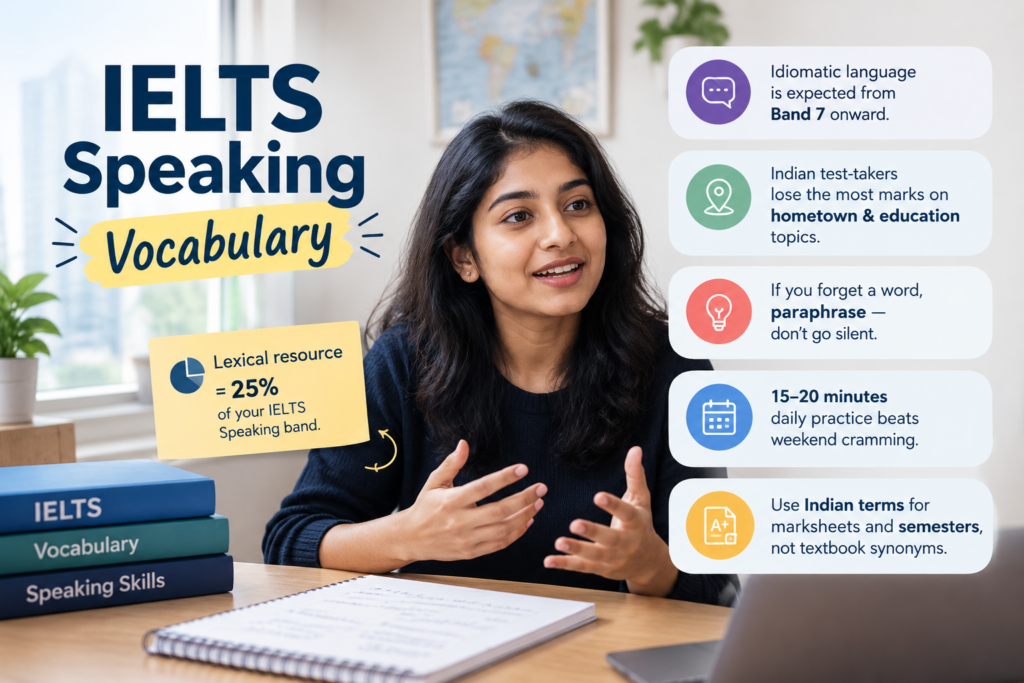
Your choice of words will affect your IELTS Speaking score directly. In fact, vocabulary or lexical resources make up 25% of your total Speaking score. Lexical resource refers to your range and accuracy of vocabulary in the IELTS speaking test. It measures how effectively you use words, phrases, collocations, and idiomatic expressions to communicate your ideas clearly and naturally. Most candidates fail to stand out because they overuse common words.
You cannot achieve Band 7 or above without strong vocabulary skills. You don’t need thousands of words or GRE-level preparation. Your IELTS speaking vocabulary is about three important factors: range, accuracy, and appropriateness of the words. Now, let’s find out what examiners focus on when they evaluate your word choice.
What Examiners Check in Lexical Resource
Examiners evaluate four key aspects of your vocabulary usage. They will:
- Check your range of words across different topics
- Assess how accurately you use these words in context
- See whether you use collocations naturally
- Observe your ability to paraphrase instead of repeating the same expressions
Band 6 vs Band 9 Vocabulary Usage
Band 6 speakers use simple terms and might make some mistakes. Band 9 test takers have advanced vocabulary control. They use idiomatic language easily and commit very few mistakes. Their selection of words is precise and subtle.
- Band 6 Example: “I think technology is really good because it helps people to do things faster.”
- Band 9 Example: “I think technological changes have transformed the way we tackle routine activities, greatly raising productivity and efficiency.”
To go from band 6 to 9, expand your vocabulary by learning synonyms and replacing generic words (good → beneficial, excellent, advantageous).
Common IELTS Speaking Vocabulary
If you’re preparing for multiple exams to study abroad, passing the IELTS with a higher band can give you the edge. Here’s the IELTS vocabulary list with meanings that you can add to your answers right away.

Get a Free IELTS Vocabulary Cheatsheet
With 350+ words you should know for a 7+ IELTS band score.
1. Advertisement Vocabulary
Advertisements are a top IELTS academic vocabulary topic. You’ll need the right words to discuss marketing, consumer behaviour, and media effectively.
| Subpar Word | Word | Meaning | Example |
|---|---|---|---|
| Convincing | Persuasive | Convincing and appealing | The advertisement was highly persuasive, making customers want to buy immediately. |
| Effort | Campaign | Organised marketing effort | The brand launched an innovative campaign to promote its new product. |
| Group | Target audience | Specific consumer group | Companies identify their target audience before creating advertisements. |
| Recognition | Brand awareness | Product recognition level | Social media has significantly increased brand awareness among young consumers. |
| Ad | Commercial | Paid promotional content | The commercial during the sports match reached millions of viewers. |
| Confusing | Misleading | Deceptive or confusing | Some advertisements contain misleading information about product benefits. |
| Recommendation | Endorsement | Celebrity recommendation | The athlete’s endorsement boosted the sports drink’s popularity considerably. |
| Buyer | Consumer | Product buyer | Modern consumers are more informed about products before purchasing. |
| Popular | Viral | Rapidly spreading content | The creative advertisement went viral within hours of posting. |
| Plan | Marketing strategy | Planned promotional approach | The company developed a comprehensive marketing strategy for the festival season. |
2. Technology Vocabulary
Technology is at the centre of the IELTS vocabulary by topic. You need to be aware of the latest terms and resources in the modern world.
| Subpar Word | Word | Meaning | Example |
|---|---|---|---|
| Development | Innovation | New technological development | Artificial intelligence represents a groundbreaking innovation in computing. |
| Computer intelligence | Artificial intelligence | Machine learning systems | Artificial intelligence is transforming industries from healthcare to education. |
| Computer skills | Digital literacy | Computer and internet skills | Digital literacy has become essential in today’s job market. |
| Achievement | Breakthrough | Significant advancement | Scientists achieved a breakthrough in renewable energy technology. |
| Easy | User-friendly | Easy to operate | The application’s user-friendly interface appeals to people of all ages. |
| Advanced | Cutting-edge | Most advanced available | The smartphone features cutting-edge technology that competitors cannot match. |
| Old | Obsolete | Outdated and no longer useful | Traditional film cameras have become obsolete in the digital age. |
| Smooth | Seamless | Smooth and effortless integration | The software provides seamless integration with existing business systems. |
| Automatic | Automation | Machine-performed tasks | Automation has increased productivity in manufacturing industries significantly. |
| Security | Cybersecurity | Digital protection measures | Companies invest heavily in cybersecurity to protect customer data. |
3. Travel & Tourism
Travel, the most frequent vocabulary topics in IELTS, require a strong vocabulary to explain places, experiences, and cultural experiences.
| Subpar Word | Word | Meaning | Example |
|---|---|---|---|
| Place | Destination | Travel location or place | Thailand remains a popular destination for international tourists. |
| Plan | Itinerary | Planned travel schedule | We created a detailed itinerary covering all major attractions. |
| Housing | Accommodation | Lodging or housing facility | The hotel offers comfortable accommodation with excellent amenities. |
| Beautiful | Picturesque | Visually beautiful scenery | The village nestled in the mountains offers picturesque views year-round. |
| Engaging | Immersive | Deeply engaging experience | The cultural festival provided an immersive experience of local traditions. |
| Remote | Off-the-beaten-track | Unexplored remote location | We discovered an off-the-beaten-track cafe with authentic local cuisine. |
| Travel desire | Wanderlust | Strong desire to travel | Her wanderlust inspired her to explore over fifty countries. |
| Real | Authentic | Genuine local experience | Travellers seek authentic experiences rather than typical tourist attractions. |
| Monument | Landmark | Notable historical site | The ancient temple is an iconic landmark visited by thousands daily. |
| Cultural site | Heritage site | Culturally significant location | UNESCO protects numerous heritage sites around the world. |
4. Art, Books & Paintings
Talking about creative endeavours enhances your IELTS speaking vocabulary. It allows you to showcase descriptive language and express aesthetic appreciation.
| Subpar Word | Word | Meaning | Example |
|---|---|---|---|
| Great work | Masterpiece | Exceptional outstanding artwork | The painting is considered a masterpiece of Renaissance art. |
| Interesting | Compelling | Captivating and interesting | The novel tells a compelling story about human resilience. |
| Deep | Thought-provoking | Mentally stimulating content | The exhibition featured thought-provoking contemporary installations. |
| Bright | Vivid | Strikingly bright or clear | The artist used vivid colours to create an energetic atmosphere. |
| Modern | Contemporary | Modern current artistic style | Contemporary art often challenges traditional aesthetic boundaries. |
| Non-realistic | Abstract | Non-representational artistic form | Many viewers find abstract paintings difficult to interpret initially. |
| Type | Genre | Artistic category or type | Science fiction is her favourite literary genre. |
| Display | Exhibition | Public art display | The museum hosts an exciting exhibition of local artists monthly. |
| Books | Literature | Written artistic works | She studied English literature at university for four years. |
| Story | Narrative | Story or account | The film’s narrative explores complex themes of identity. |
5. Family & Relationships
Personal relationships are the core of most IELTS Speaking Part 1 questions. You require subtle vocabulary to narrate varying relationship scenarios.
| Subpar Word | Word | Meaning | Example |
|---|---|---|---|
| Close | Close-knit | Tightly bonded family unit | We come from a close-knit family that gathers every weekend. |
| Helpful | Supportive | Emotionally helpful and caring | My parents have always been supportive of my career choices. |
| Caring | Nurturing | Caring and encouraging environment | A nurturing environment is essential for children’s healthy development. |
| Connection | Bonding | Relationship-building process | Family vacations provide excellent bonding opportunities for everyone. |
| Age difference | Generation gap | Age-related cultural differences | The generation gap often creates misunderstandings about technology use. |
| Good time | Quality time | Meaningful focused interaction | Spending quality time together strengthens family relationships significantly. |
| Childhood | Upbringing | Childhood education and care | Her upbringing in a multicultural environment shaped her worldview. |
| Respect | Mutual respect | Reciprocal regard between people | Mutual respect forms the foundation of any healthy relationship. |
| Relatives | Extended family | Beyond immediate family | Extended family gatherings are common during festival celebrations. |
| Friendship | Companionship | Friendly supportive presence | Pets provide valuable companionship, especially for older adults. |
6. Food & Diet
Food-related questions often appear in IELTS Speaking tests. It assists you in discussing eating habits, nutrition, and cuisine with refinement.
| Subpar Word | Word | Meaning | Example |
|---|---|---|---|
| Healthy | Nutritious | Health-promoting food quality | Fresh vegetables provide nutritious benefits essential for good health. |
| Good diet | Balanced diet | Varied nutritional intake | Doctors recommend maintaining a balanced diet with diverse food groups. |
| Factory food | Processed food | Manufactured packaged products | Nutritionists advise limiting processed food consumption for better health. |
| Natural | Organic | Pesticide-free natural produce | Many consumers prefer organic vegetables despite higher costs. |
| Cooking | Culinary | Cooking-related skills | She developed excellent culinary skills after attending cooking classes. |
| Food style | Cuisine | Regional cooking style | Indian cuisine offers an incredible variety across different regions. |
| Component | Ingredient | Food component element | Quality ingredients make a significant difference in dish flavour. |
| Plant-eater | Vegetarian | Plant-based diet follower | More people are becoming vegetarians for environmental and health reasons. |
| Hunger | Appetite | Desire for food | Regular exercise helps maintain a healthy appetite throughout the day. |
| Tasty | Delicious | Very pleasing taste | The restaurant serves delicious traditional dishes prepared with care. |
7. Health & Fitness
Health terms indicate your up-to-date knowledge of wellness trends. Health awareness keeps growing internationally, making it an essential topic for vocabulary for IELTS speaking in 2026.
| Subpar Word | Word | Meaning | Example |
|---|---|---|---|
| Inactive | Sedentary | Inactive sitting lifestyle | Many office workers lead sedentary lifestyles requiring minimal physical activity. |
| Heart | Cardiovascular | Heart-related exercise activity | Cardiovascular exercise strengthens the heart and improves blood circulation. |
| Mental health | Mental wellbeing | Psychological health state | Meditation and exercise significantly improve mental well-being over time. |
| Prevention | Preventive care | Proactive health measures | Preventive care reduces the risk of developing serious illnesses later. |
| Long-term | Chronic | Long-term persistent condition | Diabetes is a chronic condition requiring continuous medical management. |
| Endurance | Stamina | Physical endurance capacity | Regular training gradually builds stamina for long-distance running competitions. |
| Relaxation | Meditation | Mindfulness relaxation practice | Daily meditation helps reduce stress and improve concentration levels. |
| Health | Wellness | Overall health state | Companies increasingly promote employee wellness through various programs. |
| Healing | Recovery | Healing restoration process | Adequate rest is crucial for recovery after intense physical activity. |
| Living habits | Lifestyle | Daily living habits | A healthy lifestyle includes proper nutrition, exercise, and sufficient sleep. |
8. School & Education
Education discussions appear throughout the IELTS writing task 2 vocabulary questions. This vocabulary enables sophisticated responses about learning and academic experiences.
| Subpar Word | Word | Meaning | Example |
|---|---|---|---|
| Course | Curriculum | Course structure and content | The curriculum includes both theoretical knowledge and practical application. |
| Teaching method | Pedagogy | Teaching methods approach | Modern pedagogy emphasises student-centred learning approaches over traditional lectures. |
| Required | Compulsory | Mandatory required education | Mathematics is a compulsory subject throughout secondary school education. |
| Complete | Holistic | Comprehensive complete approach | Schools should adopt a holistic approach addressing academic and emotional development. |
| Thinking | Critical thinking | Analytical reasoning skills | Critical thinking enables students to analyse information objectively and independently. |
| Money help | Scholarship | Merit-based financial aid | She received a full scholarship based on outstanding academic performance. |
| College student | Undergraduate | Bachelor’s degree student | Undergraduate programs typically last three to four years, depending on the country. |
| Homework | Assignment | Academic work task | The professor assigned a challenging assignment requiring extensive research. |
| Study | Research | Systematic investigation study | University students conduct research to contribute new knowledge to their field. |
| Teachers | Faculty | Teaching staff members | The university employs experienced faculty members from diverse academic backgrounds. |
9. Environment & Climate
Environmental issues call for scientific and social understanding. Vocabulary related to climate makes frequent appearances in the IELTS band 7 vocabulary range.
| Subpar Word | Word | Meaning | Example |
|---|---|---|---|
| Eco-friendly | Sustainable | Environmentally responsible practice | Sustainable farming practices protect soil quality for future generations. |
| Pollution measure | Carbon footprint | Emission impact measurement | Individuals can reduce their carbon footprint by using public transportation regularly. |
| Clean energy | Renewable energy | Clean unlimited power sources | Solar panels generate renewable energy without depleting natural resources. |
| Species variety | Biodiversity | Species variety in an ecosystem | Rainforests contain remarkable biodiversity supporting countless plant and animal species. |
| Protection | Conservation | Protection preservation efforts | Wildlife conservation efforts have saved several endangered species from extinction. |
| Tree cutting | Deforestation | Forest destruction clearing | Deforestation contributes significantly to climate change and habitat loss worldwide. |
| Green | Eco-friendly | Environment-conscious product | Consumers increasingly prefer eco-friendly products made from recycled materials. |
| Contamination | Pollution | Harmful environmental contamination | Air pollution causes serious respiratory problems in major cities globally. |
| Reusing | Recycling | Waste material reprocessing | Recycling plastic reduces environmental damage and conserves valuable resources. |
| Climate change | Global warming | Earth’s temperature increase | Global warming threatens coastal cities with rising sea levels. |
10. People, Personalities & Character
Describing humans through subtle adjectives shows your vocabulary scope. These words enable you to discuss personality features, behaviours, and personality with accuracy.
| Subpar Word | Word | Meaning | Example |
|---|---|---|---|
| Charming | Charismatic | Naturally appealing and charming | The charismatic leader inspired employees to achieve extraordinary results. |
| Careful | Conscientious | Careful, thorough, and responsible | She’s a conscientious worker who always completes tasks with attention to detail. |
| Strong | Resilient | Able to recover quickly | Resilient individuals bounce back quickly from setbacks and challenges. |
| Understanding | Empathetic | Understanding others’ feelings | An empathetic manager understands employees’ concerns and provides appropriate support. |
| Goal-driven | Ambitious | Goal-oriented driven person | His ambitious nature drove him to pursue advanced qualifications constantly. |
| Practical | Pragmatic | Practical realistic approach | We need a pragmatic solution addressing immediate concerns effectively. |
| Flexible | Versatile | Adaptable multi-skilled person | The versatile employee handles multiple responsibilities across different departments. |
| Hardworking | Diligent | Hardworking persistent person | Diligent students consistently achieve better academic results than their peers. |
| Positive | Optimistic | Positive hopeful outlook | Her optimistic attitude helps the team remain motivated during difficult projects. |
| Self-assured | Confident | Self-assured and certain | Confident speakers engage audiences effectively through strong body language. |
11. Home & Accommodation
Housing vocabulary helps you describe living spaces effectively and is frequently featured in IELTS Speaking Part 1. This vocabulary helps you describe residences and neighbourhoods effectively.
| Subpar Word | Word | Meaning | Example |
|---|---|---|---|
| Big | Spacious | Large and open area | The apartment features a spacious living room perfect for entertaining guests. |
| Comfortable | Cozy | Warm comfortable atmosphere | The cottage provides a cozy atmosphere ideal for winter holidays. |
| With furniture | Furnished | Equipped with furniture | We rented a fully furnished apartment including appliances and kitchenware. |
| Improve | Renovate | Improve the repair structure | They plan to renovate the kitchen with modern cabinets and appliances. |
| Area | Vicinity | Surrounding area | Several excellent restaurants are located in the vicinity of our hotel. |
| Facilities | Amenities | Available facilities services | The building offers numerous amenities, including a gym and swimming pool. |
| Owner | Landlord | Property owner lessor | The landlord promptly addresses any maintenance issues reported by tenants. |
| Area | Neighbourhood | Surrounding residential area | We live in a peaceful neighbourhood with parks and good schools. |
| Contract | Lease | Rental agreement contract | The lease agreement specifies the rent amount and tenant responsibilities clearly. |
| Design | Architecture | Building design structure | Colonial architecture characterises many buildings in the historic district. |
12. Work & Careers
Professional life discussions appear throughout IELTS Speaking tests. This vocabulary enables sophisticated responses about employment and career aspirations.
| Subpar Word | Word | Meaning | Example |
|---|---|---|---|
| Satisfying | Rewarding | Personally satisfying fulfilling | Teaching is a rewarding career that positively impacts students’ lives. |
| Difficult | Demanding | Requiring considerable effort | The demanding position requires working long hours under significant pressure. |
| Advancement | Promotion | Career advancement opportunity | She earned a promotion after consistently exceeding performance expectations. |
| Time balance | Work-life balance | Professional-personal time equilibrium | Maintaining work-life balance prevents burnout and improves overall well-being. |
| Business | Entrepreneurship | Business ownership venture | Entrepreneurship requires creativity, dedication, and a willingness to take calculated risks. |
| Connections | Networking | Professional connection building | Networking at conferences helps professionals discover new career opportunities. |
| Skills | Expertise | Specialized knowledge skill | His expertise in data analysis makes him invaluable to the company. |
| Coworker | Colleague | Work associate peer | My colleagues provide helpful support when tackling challenging projects together. |
| Certificate | Qualification | Professional credential certification | Professional qualifications enhance employment prospects in competitive job markets. |
| Efficiency | Productivity | Work efficiency output | Remote work has significantly increased productivity for many employees. |
Vocabulary for IELTS Speaking: Band 8
Band 8 requires consistent control of vocabulary. You must demonstrate idiomatic expressions naturally, without sounding memorised. Here are some tips to help you move towards Band 8:
- Focus on collocations rather than isolated words: Collocations are words that go together in English. Native speakers use word combinations naturally. Practise phrases like make progress instead of do progress.
- Develop paraphrasing skills to avoid repetition: If you use the term important once, try alternatives such as crucial, significant, or vital later.
- Record yourself speaking: It will help you identify repeated words and replace them with more advanced alternatives.
High-Value Vocabulary Examples for IELTS Speaking
Let’s look at high-value vocabulary items that take your answers to the next level. These words, when used correctly with proper IELTS collocations, mark Band 8 ability.
| Basic Word | Advanced Alternatives | Example Sentences |
|---|---|---|
| Very important | Crucial, vital, paramount, indispensable, pivotal | Education plays a crucial role in shaping our future careers. Time management is paramount when preparing for IELTS. |
| Very good | Excellent, outstanding, exceptional, remarkable, superb | The museum offers an exceptional collection of historical artefacts. Her presentation skills are truly remarkable. |
| Very bad | Terrible, dreadful, appalling, disastrous, abysmal | The traffic congestion in my city has become appalling during rush hours. Pollution has had a disastrous impact on marine life. |
| Big | Enormous, substantial, considerable, massive, significant | Technology has made a substantial difference in how we communicate. Climate change poses a significant threat to our planet. |
| Small | Minute, negligible, minimal, trivial, modest | The price difference between the two products is negligible. I made only minimal changes to my daily routine. |
| Show | Demonstrate, illustrate, exhibit, display, reveal | This graph illustrates the rising trend in online shopping. The documentary reveals the harsh realities of poverty. |
| Help | Assist, facilitate, support, aid, contribute | Volunteering can facilitate personal growth and development. Libraries assist students in conducting research effectively. |
| Change | Transform, modify, alter, adapt, revolutionise | Social media has transformed the way we interact with others. We need to adapt our lifestyle to protect the environment. |
| Make | Create, produce, generate, establish, and develop | The government should establish stricter laws against pollution. Artists create meaningful connections through their work. |
| Get | Obtain, acquire, receive, gain, secure | I hope to acquire valuable work experience during my internship. Students can obtain scholarships based on academic merit. |
IELTS Speaking Vocabulary by Part
The IELTS Speaking examination has three unique parts, with each being diverse in the type of vocabulary required. Let’s dissect the particular vocabulary requirements for Parts 1, 2, and 3.
Part 1 – Everyday Vocabulary
Part 1 questions will be about your work, studies, hometown, hobbies, daily routine, and preferences. The examiner asks questions like “Are you a student?”, “What do you do in your free time?”. Use natural, conversational vocabulary. Think of it as talking to a friendly acquaintance.
Part 2 – Descriptive Vocabulary
Part 2 is where your examiner asks you to describe a person, place, event, or object. Use sensory language, specific adjectives, and descriptive phrases that help the examiner visualise what you’re describing.
Part 3 – Abstract Vocabulary
Part 3 is a two-way discussion where the examiner asks follow-up questions related to the Part 2 topic. For example, if Part 2 was about a journey you made, Part 3 might ask about the travel’s impact on local communities.
Idiomatic Vocabulary for IELTS Speaking
Idioms are words whose meaning is not the same as the literal meaning of the words. Used appropriately, they can contribute positively to your speaking score, as is the case in TOEFL. Do not use them excessively or try to force unnatural phrases. Below are some popular idioms with natural context
| Idiom | Meaning |
|---|---|
| A blessing in disguise | Hidden benefit in misfortune |
| Hit the books | Study intensively |
| On the same page | Having mutual understanding |
| Think outside the box | Use creative thinking |
| Get the ball rolling | Start something new |
| Piece of cake | Very easy task |
| Break the ice | Make people comfortable |
| Once in a blue moon | Very rarely happens |
| The best of both worlds | All advantages together |
| In the long run | Over an extended time |
Idioms to Avoid in Formal Responses
Some idioms are too informal for IELTS Speaking, which could indicate disabilities, violence, or could be interpreted as insensitive. For instance,
- “Sold down the river” — linked to slavery and betrayal.
- “Going postal” — references workplace violence and mental health inappropriately.
- “Circle the wagons” — has historical connotations of settler colonialism and indigenous conflicts.
Collocations & Paraphrasing Practice
Collocations are referred to as word partnerships, which make your speech sound native and natural. Here are some collocations for common IELTS topics.
| Collocation | Meaning | Why It’s Better for IELTS? |
|---|---|---|
| Raise awareness | Increase public knowledge | Sounds more academic and formal in vocabulary. |
| Bridge the gap | Connect two different things | Demonstrates metaphorical language use |
| Draw attention to | Make people notice | More idiomatic and advanced, and works well in discussion and opinion answers. |
| Meet expectations | Fulfill requirements | Replaces basic words like “do well” with formal, workplace-ready vocabulary. |
| Gain experience | Acquire practical knowledge | Common in professional contexts, it shows you can talk about skills and learning in a mature way. |
| Take into account | Consider as a factor | Higher-register phrase for consideration; widely used in academic and policy discussions. |
| Make an effort | Try hard | More versatile than “try” and works in both casual and formal contexts; sounds collaborative. |
| Pay attention | Focus carefully | Shows control over emphasis and concentration terms; fits well in advice or instruction answers. |
| Play a role | Be important factor | Allows abstract discussion about contribution without sounding simplistic. |
| Face challenges | Deal with difficulties | More formal and adaptable than “have problems”; works well in problem-solution answers. |
Paraphrasing Drills with Model Speaking Answers
Paraphrasing refers to the practice of expressing the same idea using different words. Take a look at some paraphrasing drills based on common IELTS topics:
| Original Sentence | Paraphrases |
|---|---|
| I like reading books. | I’m passionate about literature. |
| I’m an avid reader. | |
| Reading is one of my favourite pastimes. | |
| I find immense pleasure in reading. | |
| Books have always fascinated me. | |
| Technology is very important nowadays. | Technology plays a crucial role in modern life. |
| We’ve become increasingly reliant on technology. | |
| Technological advancement has transformed society. | |
| Technology is integral to contemporary living. | |
| It’s hard to imagine life without technology today. | |
| Young people use social media a lot. | Social media is ubiquitous among the younger generation. |
| Youth today are heavily engaged with social platforms. | |
| Young people are active social media users. | |
| The younger demographic spends considerable time on social networks. | |
| Social media consumption is particularly high among adolescents. |
Linking Words for IELTS Speaking
Linking words, also called connectives or discourse markers, are important to achieve a high score in your IELTS. Connectives structure your response and guide the listener through your ideas. Here are some examples of connectives,
| Type | Examples |
|---|---|
| Opinion Markers | In my view, from my perspective, I firmly believe, personally speaking, I would argue that |
| Contrast Markers | However, on the other hand, conversely, whereas, although, nevertheless |
| Addition Markers | Furthermore, moreover, additionally, besides, in addition |
| Example Markers | For instance, for example, such as, to illustrate |
| Result Markers | Therefore, consequently, as a result, thus, hence |
Discourse Markers for Fluency
Discourse markers are words and phrases that make your speech sound natural and create a flow for your conversation. Some examples include,
| Marker | Usage Purpose |
|---|---|
| Well | Starting response, thinking time |
| Actually | Adding new information |
| Basically | Simplifying explanation |
| Essentially | Focusing on the main point |
| Fundamentally | Emphasising the core concept |
| To be honest | Giving a frank opinion |
| In fact | Emphasizing truth |
| As a matter of fact | Confirming reality |
| Generally speaking | Making a general statement |
| By and large | Overall, in general |
IELTS Speaking: Preparation Tips
Smart and consistent preparation will build your vocabulary. Here are some proven strategies to help you:
- Watch English documentaries and note useful expressions.
- Create personal word lists organised by topic.
- Use new vocabulary in various contexts until it becomes a habit.
- Learn adaptable phrases and modify them based on the questions.
- Practise pronunciation by listening to online dictionaries.
- Participate in speaking practice groups or find conversation partners.
- Take an IELTS mock test to manage your efficiency and time management.
IELTS Speaking Sample Questions & Answers
Let’s examine full sample answers that illustrate good use of vocabulary in all three parts of the Speaking test. These samples help you to add the vocabulary that you have learned into natural-sounding responses.
Part 1: Sample Answers
Question: Do you like reading physical books or e-books?
Answer: “I’m really fond of physical books, as a matter of fact. There’s just something soothing about leafing through the pages and smelling the paper. That said, I do sometimes use e-books when travelling for convenience.”
Original idea: Simple preference for physical books over e-books.
Made better by: Adding emotive language with phrases like “really fond of”, “soothing”, and sensory details, “leafing through the pages”, and “smelling the paper” makes the answer more vivid.
Part 2: Cue Card with Descriptive Vocabulary
Topic: Describe a place you would like to visit
Sample Answer: “I’d really like to visit Iceland. As far as I understand, the scenery is just incredible, with its rugged waterfalls and geothermal pools, a chance to engage with genuine Nordic culture.” The nation provides a unique blend of natural features, ranging from incredible northern lights to breathtaking volcanic formations.
Original idea: Wanting to visit Iceland.
Made better by: Using descriptive vocabulary: words like “incredible”, “rugged waterfalls”, “geothermal pools”, “genuine Nordic culture” paint a clear picture of multiple attractions.
Part 3: Discussion with Abstract Vocabulary
Question: How has tourism affected developing nations?
Answer: “Tourism has far-reaching implications for developing countries. In one way, it produces huge revenues and provides jobs. The solution lies in adopting sustainable tourism that reconciles economic gains with culture preservation and protecting the environment.”
Original idea: Tourism affects developing nations.
Made better by: Using abstract vocabulary: terms like “far-reaching implications”, “reconciles economic gains”, “culture preservation”, “sustainable tourism” demonstrate higher-level thinking.
Advanced Vocabulary for IELTS Speaking to Achieve a High Band Score
A good vocabulary for IELTS speaking requires strategic preparation that emphasises what really counts in the exam, rather than the words. More than anything, you must put the words into use naturally through collocations, example sentences, and context-sensitive responses. If you are preparing for exams to study abroad, clearing the IELTS with a high band can give you the edge.
Are you new to IELTS? Check out study materials and quizzes from Leap Scholar to supplement your vocabulary study. Begin smart, stay regular, and observe your confidence enhance with each conversation.
Frequently Asked Questions
-
How much vocabulary is sufficient for IELTS?
You require approximately 3,000-5,000 words for IELTS to achieve a high band score. Quality is more important than quantity, learn how to utilise each word appropriately in sentences instead of memorising random vocabulary words from the IELTS Vocabulary Words PDF.
-
What is the best vocabulary for IELTS?
Learn academic vocabulary such as “significant,” “demonstrate,” and “consequence.” Utilise topic-specific words in widely used essay topics such as environment, education, and technology.
-
Do idioms raise the IELTS Speaking band?
Idioms will come in handy only if you naturally and appropriately use them. Do not force idioms in every single answer because then it won’t sound natural. Use one or two suitable idioms to reflect your robust language skills. But simple communication is what counts the most. You can get high without idioms using diverse, precise vocabulary instead.
-
What are the common IELTS Speaking topics?
Common topics include family, hobbies, work, education, hometown, travel, technology, health, environment, and daily routines. You might also discuss books, movies, sports, or social issues.
-
How can I improve my vocabulary for IELTS quickly?
Read English articles daily, learn topic-specific words, use flashcards, practice synonyms, and apply new words in speaking and writing regularly.
-
Is IELTS 7 hard or easy?
IELTS 7 is moderately challenging for most students. You need strong grammar, varied vocabulary, clear pronunciation, and coherent writing. With 2-3 months of focused preparation and existing intermediate-advanced English skills, it’s achievable.
-
How can I get 8.5 in IELTS?
Learn complex grammatical structures and use sophisticated vocabulary naturally. Practice extensively across all four skills: reading, writing, listening, and speaking. Get regular feedback from experienced tutors and improve your accuracy.


Have Questions? Get Guidance to reach your Dream University
Connect with India's finest counsellors and biggest study abroad community.
Get Guidance