
Quick Read
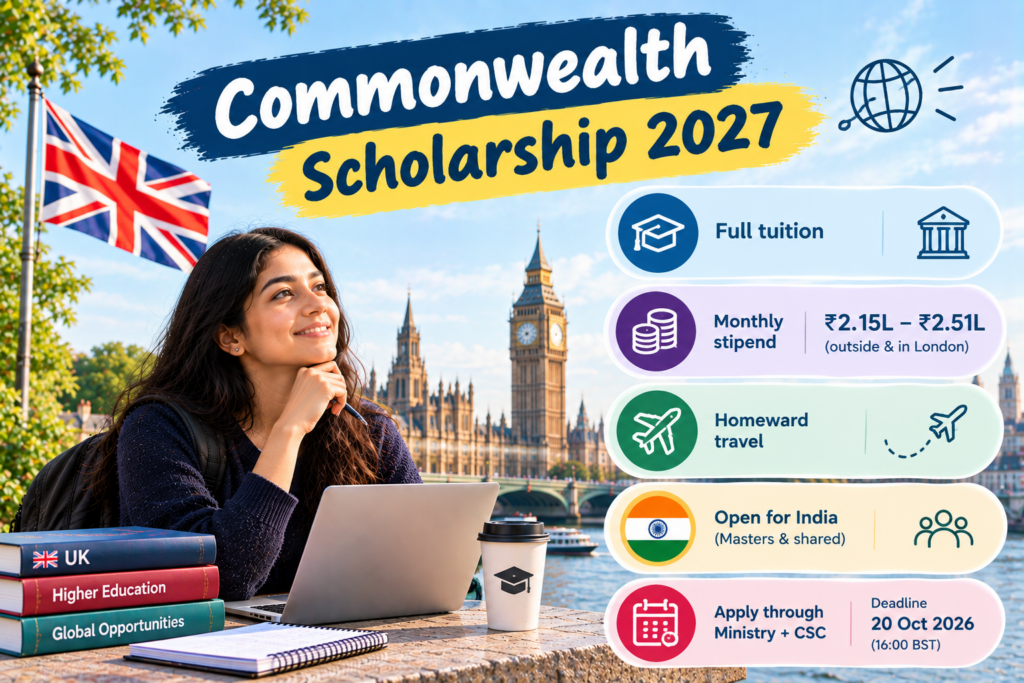
- The Commonwealth Scholarship pays your UK tuition in full, gives you a monthly living stipend, and flies you back home once you graduate.
- Monthly stipend is Rs. 2,15,310 (£1,712) outside London and Rs. 2,51,440 (£2,000) in London.
- India is open for the Commonwealth Masters Scholarship and the Commonwealth shared scholarship.
- No age limit exists for Indian applicants, as confirmed by the official CSC.
- You cannot apply directly to the CSC for the Masters route. Indian applicants apply through the Ministry of Education (SAKSHAT portal) and CSC Central.
- The CSC Central deadline for the 2027/28 cycle closes at 16:00 BST on 20 October 2026.
What Is the Commonwealth Scholarship and Fellowship Plan (CSFP)?
The UK government has been funding postgraduate study for students from Commonwealth countries since 1960, and the Commonwealth Scholarship is the flagship award that delivers it. Run by the Commonwealth Scholarship Commission (CSC) and backed by the Foreign, Commonwealth and Development Office (FCDO), it pays full tuition, provides a monthly living stipend, and covers your return airfare from India.
The scheme sits under the Commonwealth Scholarship and Fellowship Plan (CSFP), which started in 1959. Over 34,000 scholars have gone through it since the first cohort landed in the UK in 1960.
What makes the scheme different from most scholarships is the expectation that you return to India after your degree and use what you have learned for the country’s benefit. Every part of the application, from your personal statement to your development impact plan, is read through that lens. Students who treat the application as a mere box to tick usually fail to progress.
For a comparison with another fully funded UK government scholarship, see the Chevening Scholarship guide.
Types of Commonwealth Scholarships Available to Indian Students in 2027
Not every Commonwealth Scholarship type is open to Indian applicants. The table below shows the full picture.
| Scholarship Type | Study Level | Is India Eligible? | Application Route |
|---|---|---|---|
| Commonwealth Masters Scholarship | 1-year taught Master’s | Yes | Ministry of Education (SAKSHAT portal) + CSC Central |
| Commonwealth Shared Scholarship | 1-year taught Master’s | Yes | Directly to the participating UK university (the university nominates you) |
| Commonwealth Professional Fellowship | Up to 6 months | Yes | CSC Central / host organization |
| Commonwealth PhD Scholarship | Up to 3 years | No. Reserved for least developed countries only. | National Nominating Agency |
| Commonwealth Distance Learning Scholarship | Varies | Paused. Not running in 2026 or 2027. | N/A |
| Commonwealth Split-Site PhD Scholarship | Up to 12 months | Paused. Not running in 2026 or 2027. | N/A |
For Indian students, the live routes are the Commonwealth Masters Scholarship, the Commonwealth shared scholarship, and the Professional Fellowship. The Distance Learning and split-site PhD routes have no confirmed reopening date.
To compare other government-funded scholarship options alongside the Commonwealth Scholarship, the National Overseas Scholarship is worth looking at.
Note on MBAs: MBA degrees are not funded under any Commonwealth Scholarship type.
UK Universities and Programs Covered
The Commonwealth Scholarship is tenable at any CSC-approved UK university for a one-year full-time taught Master’s program. For the Commonwealth shared scholarship, only specific courses at specific universities qualify each cycle. The table below shows confirmed data for the 2027/28 cycle that was published.
| University | Programs (2027/28 Cycle) | What Is Funded? | Application Deadline |
|---|---|---|---|
| Imperial College London | MSc Human and Biological Robotics; MSc Biomedical Engineering; MRes Nanomedicine and Nanodiagnostics | Full tuition (paid to university); Rs. 2,51,440 (£2,000)/month stipend (London rate); return economy airfare from India; warm clothing allowance; study travel grant | 6 January 2027 (Round 2 closes) |
| University of Edinburgh | MSc Africa and International Development; MSc Global Crime, Justice and Security; MSc Global Health Policy; MSc Future Governance; MSc Comparative Education and International Development | Full tuition (paid to university); stipend (Edinburgh rate: Rs. 2,15,310 / £1,712 per month); return economy airfare from India; warm clothing allowance; study travel grant | December 2026 (expected; confirm on university page when open) |
Sources: Imperial College London, Imperial Commonwealth Scholarships; University of Edinburgh, Commonwealth Shared Scholarship
The 2027/28 Shared Scholarship list covers approximately 200 programs across 25 to 30 universities and is typically published by the CSC around mid-2026. Imperial’s bid for 2027/28 is subject to CSC approval, with the outcome announced in November 2026.
My insight: Many students pick a university they like and assume it qualifies. With the Commonwealth shared scholarship, the course itself must be on the CSC’s approved list for that specific cycle, not just the university. Check the course list first, then shortlist. Going the other way around wastes weeks.
Commonwealth Scholarship Eligibility for Indian Students 2027
Core Requirements
- Be a citizen of India and permanently resident in India at the time of application
- Hold a bachelor’s degree of at least upper second-class (2:1) standard, which is roughly 60% aggregate in most Indian universities
- Be genuinely unable to fund UK studies on your own. This is a formal eligibility condition, not just background context.
- Commit to returning to India after the award ends
India-Specific Conditions
- You must not have studied or trained in a high-income country for more than six months before applying, whether self-funded or on a scholarship
- The CSC doesn’t require IELTS at application, but each UK university sets its own English requirement, so check your course
- There is no age limit for Indian applicants. If your employer has age-based leave restrictions, that is an HR matter. It does not affect CSC eligibility.
- Holding a master’s degree from a UK institution makes you ineligible to apply again.
Source: Commonwealth Scholarship Commission, Master’s Scholarships: Applicant Eligibility
My insight: Financial need is the condition that quietly eliminates most applicants. Students who scored 70%+ sometimes get rejected because the CSC concluded they could have funded UK studies themselves. If your family background is financially comfortable, be honest about that in your application and present a clear case for why the scholarship is still necessary. Trying to downplay financial capacity without solid evidence often backfires.
Commonwealth Scholarship Benefits: What You Actually Receive
Spouse and partner costs are not covered. The CSC’s own handbook notes that family allowances cover only a part of the real cost. Budget for these expenses separately before accepting an offer.
You also cannot hold a second scholarship that covers the same costs (tuition, airfare, or stipend). If you receive two concurrent offers, you must choose one.
| Benefit | Amount |
|---|---|
| Tuition fees | Fully covered. Paid directly to the UK university. |
| Monthly stipend (outside London) | Rs. 2,15,310 (£1,712) per month |
| Monthly stipend (London universities) | Rs. 2,51,440 (£2,000) per month |
| Return airfare | Economy class from India to the UK and back |
| Warm clothing allowance | One-time grant on arrival |
| Study travel grant | Towards study-related travel within the UK or overseas |
| Child allowance (if applicable) | Rs.78,198 (£622) for the first child; Rs.19,361 (£154) for the second and third children under 16. Applies only if widowed, divorced, or a single parent with the child living with you in the UK. |
Source: Commonwealth Scholarship Commission, Financial Assistance: Commonwealth Master’s Scholarships
How to Apply for the Commonwealth Scholarship from India?
Step 1: Go to the CSC scholarships filter, select your scholarship type, and verify that India appears on the eligible countries list for that specific award in the current cycle. Do this step before anything else.
Step 2: India’s nominating agency is the Ministry of Education. Indian applicants submit two applications: one on CSC Central (closes 20 October 2026, 16:00 BST) and one on the Ministry’s SAKSHAT portal, where you upload your CSC application PDF. Check education.gov.in for the Ministry’s own date, which may differ.
Step 3: Apply to UK universities directly. List three courses in order of preference. If the CSC cannot place you at your first choice and you listed no alternatives, the scholarship lapses.
Step 4: Complete your application on CSC Central by 16:00 BST on 20 October 2026, then save it as a PDF and upload it on the Ministry’s SAKSHAT portal by the Ministry’s own deadline.
Step 5: Upload all supporting documents within CSC Central by the same deadline. Documents sent by email are not accepted.
For the Commonwealth shared scholarship, you skip the Ministry of Education and CSC Central steps. Apply directly to the participating UK university for an eligible course and indicate on the admissions form that you want to be considered for a Commonwealth Shared Scholarship. The university then nominates you to the CSC. Each university sets its own deadline, usually between November and January, so the 20 October date does not apply. Check that the course is on the CSC’s approved list first, then check the university’s page for its date.
My insight: CSC Central uses two-factor authentication, and the system becomes congested in the 48 hours before the deadline. Prepare all your answers offline using the template form available on the CSC website. Open the live form only when your answers are finalized and ready to paste in.
Documents Required
| Document | India-Specific Notes |
|---|---|
| Valid passport copy | Must show photo, date of birth, and citizenship |
| Full academic transcripts | All degrees, including in-progress transcripts; a consolidated marksheet is acceptable if all semesters are covered; a certified English translation is required if in another language |
| Two references (minimum) | On institutional letterhead or a formal institutional email, personal email accounts are not accepted |
| Development Impact Statement | Four-part structured response within the CSC Central form |
| Personal statement | Must address your background and development motivation, not general career goals |
| Proof of citizenship | Passport or national ID card |
If you miss the Ministry of Education’s deadline, you cannot be nominated to the CSC even if your CSC Central form is fully submitted.
Who Gets the Commonwealth Scholarship: Selection and What Works
Around 700 Commonwealth Scholarships are awarded each year. The CSC selects from the pool of nominated candidates across all eligible countries.
The Three Selection Criteria
| Criterion | What It Means in Practice |
|---|---|
| Candidate merit | Academic record, professional experience, and fit with the proposed study |
| Quality of plan of study | How well your chosen course connects to your development goals |
| Development impact | How specifically and credibly do you explain what will change in India after you return? |
Development impact is the most important factor. Strong academics help, but the CSC consistently selects people who can articulate concrete, measurable change in India. Writing about career goals will not get you there.
Your Development Impact Statement has four parts: how your study connects to national and global development issues, how you will apply your new skills on return, what outcomes you expect within what timeframe, and how the impact can be measured.
Six CSC Development Themes
All awards fall within these themes. Your subject does not need to match exactly, but your application should clearly connect to at least one:
- Science and technology for development
- Strengthening health systems and capacity
- Promoting global prosperity
- Strengthening global peace, security, and governance
- Strengthening resilience and response to crises
- Access, inclusion, and opportunity
Source: British Council India, Commonwealth Scholarships
My insight: A development impact statement that reads like a CV bullet point (“I will contribute to India’s renewable energy sector”) will not pass the CSC’s review. What the selection panel looks for is something concrete: “I will return to my district in Rajasthan and apply my water resource management training to the state government’s groundwater recharge program, which currently covers only 18% of affected villages. ” Specific location, named program, and measurable gap. That is the level of detail that meets the standard.
Who Should Apply for the Commonwealth Scholarship?
Applying this week? CSC Central closes at 16:00 BST on 20 October 2026 (8:30 pm in India). Do CSC Central and the Ministry of Education’s SAKSHAT portal first, and check education.gov.in for the Ministry’s own date.
Missed it? The 2027/28 Masters window closes on 20 October. The next window is expected around August to October 2027, for study from September 2028. Use the months in between to start your development impact statement and shortlist courses.
If you are a final-year undergraduate graduating in 2027 with 60% or above, you are targeting the 2028/29 cycle.
Start drafting your development impact statement now, before your final results come out, and shortlist CSC-supported courses while the window is closed. The Ministry of Education and CSC Central run on separate deadlines, with the CSC window expected to open around August or September 2027.
If you are a working professional with 2 to 5 years of sector experience:
The Commonwealth Professional Fellowship may fit better than a full degree. It is built for mid-career professionals, not recent graduates.
If you hold a Master’s from an Indian university and want to do research in the UK:
The Split-Site PhD and PhD routes are currently unavailable for Indian applicants.
You can explore alternative options through our guide on PhD scholarships for Indian students abroad.
For a broader view of UK funding options, see the guide on fully funded scholarships to study in the UK.
3 Takeaways Before You Apply for the Commonwealth Scholarship
- Know your route before you start. The Commonwealth Masters Scholarship and the Commonwealth shared scholarship are India’s two live options. Confirm these details on the CSC website before spending time on the application.
- The Ministry of Education’s deadline is separate from CSC Central’s. Check education.gov.in for the date, because missing it means the CSC never sees your application.
- Your development impact statement decides your outcome. Specific, measurable, and grounded in India. That is what clears the CSC’s bar. Generic sector ambitions do not.
Verified by: LeapScholar’s UK counselling team, with hands-on experience guiding Indian students through Commonwealth Scholarship applications, nominating agency processes, and UK postgraduate admissions.
Have questions about the Commonwealth Scholarship? Book a free session with a LeapScholar counsellor.
Frequently Asked Questions About the Commonwealth Scholarship
-
Is there an age limit for the Commonwealth Scholarship from India?
There is no age limit. The CSC confirms this information on both the Master’s and Shared Scholarship pages. If your employer has age-related leave restrictions, that is an HR matter, and the CSC will not disqualify you.
-
How do Indian students apply for the Commonwealth Masters Scholarship?
India’s nominating agency is the Ministry of Education, and you need to apply through two channels: CSC Central and the Ministry’s SAKSHAT portal, where you upload your CSC application PDF. The Ministry screens candidates first and sends nominations to the CSC in December. If you only submit on CSC Central without going through the Ministry, the CSC will not consider your application. Check education.gov.in for the Ministry’s own deadline, which may differ from CSC Central’s.
-
What is the Commonwealth Scholarship application deadline for 2027?
The CSC Central deadline for the 2027/28 cycle is 16:00 BST on 20 October 2026. The Ministry of Education will have its own cutoff, so check education.gov.in. Scholarship results are typically announced by July 2027. Always verify the current cycle’s exact dates on the CSC website before you start.
-
Is the Commonwealth Scholarship fully funded?
Yes, and it is genuinely comprehensive. You pay nothing for tuition. The CSC settles that directly with the university. On top of that, you get a monthly stipend of Rs. 2,15,310 (£1,712) if you study outside London or Rs. 2,51,440 (£2,000) if your university is in London. Return airfare, a clothing allowance, and a travel grant for study-related trips are also included. Spouse and dependent costs are not covered. Exchange rate: Rs.125.72 per GBP as of 12 October 2026.
-
What percentage is required for the Commonwealth Scholarship from India?
You need at least 60% aggregate in your bachelor’s degree, which is roughly what a UK 2:1 maps to in the Indian grading system. If your university uses CGPA, convert it to a percentage first, or ask your nominating agency whether they have a specific CGPA threshold. Keep in mind that 60% is just the floor. You still need to clear financial need and development impact criteria.
-
Which Commonwealth Scholarship types are open to Indian students in 2027?
Right now, three routes are open: the Commonwealth Masters Scholarship (through the Ministry of Education and CSC Central) the Commonwealth shared scholarship (directly through the participating UK university), and the Commonwealth Professional Fellowship. The PhD Scholarship is off the table for India since it covers only the least developed countries. The Distance Learning and Split-Site PhD programs are currently paused, with no confirmed return date.
-
Can I apply directly to the CSC without a nominating agency?
For the Commonwealth Masters Scholarship, direct applications to the CSC are not accepted. Indian applicants go through the Ministry of Education and also complete CSC Central. For the Commonwealth shared scholarship, you apply directly to the participating UK university, which then nominates you to the CSC, so there is no Ministry step.
-
What happens if I miss the Commonwealth Scholarship deadline?
There are no exceptions to the deadline. Miss the CSC Central cutoff, and that cycle is done. Miss the Ministry of Education’s cutoff, and you cannot be nominated even if your CSC Central form is complete. If such an event happens, reapply in the next cycle, provided you still meet eligibility.









Have Questions? Get Guidance to reach your Dream University
Connect with India's finest counsellors and biggest study abroad community.
Get Guidance