Blogs
Blogs  Leap Digest
  Events
  About Us
 Expert Insights
Why Uzbekistan’s New Water Diplomacy Degree is a Game-Changer for 2026
If you've been keeping an eye on global trends, you've probably heard it more than once: Water is the new oil. In the next decade, the world won't just be negotiating over borders or trade tariffs; we'll be negotiating over every drop of fresh water.
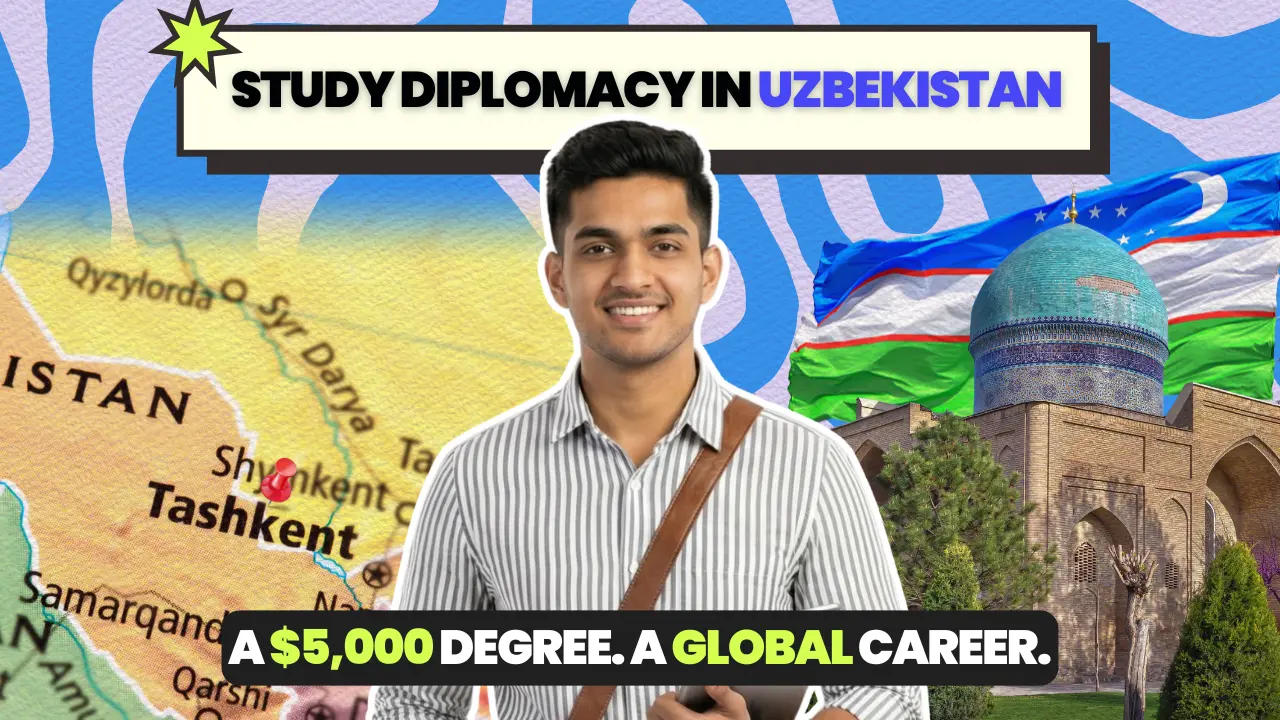
For a long time, Indian students looking to study international relations or environmental science headed straight for the UK or the US. But here's the thing, the most exciting, high-stakes environmental work is happening in the heart of Central Asia. Uzbekistan is officially stepping up by introducing its specialized Master's Program in Water Diplomacy for the 2026-2027 academic cycle.
If you're a young professional or a student who wants to be at the intersection of law, science, and high-level negotiation, this might just be the pivot you've been looking for. Let's dive into why this program is making waves and why Tashkent should be on your radar.
Why Water Diplomacy? Why Now?
You might be wondering, "Why is Uzbekistan the place for this?" To understand that, you have to look at the map. Central Asia depends on two massive rivers, the Amu Darya and the Syr Darya. With climate change accelerating and the Aral Sea crisis still a vivid lesson for the world, Uzbekistan has become a living laboratory for water management.
By 2026, the country isn't just reacting to water scarcity; it's leading the dialogue. The government has launched the Tashkent Water Week 2026, positioning the capital as a global hub for "Blue Peace." This isn't a dry academic course; it's a program born out of necessity. As a student here, you won't just be reading case studies about water conflicts, you'll be witnessing them from your classroom window.
The program is a joint degree offered by UWED (University of World Economy and Diplomacy) and TIIAME (Tashkent Institute of Irrigation and Agricultural Mechanization Engineers). It runs for 1 to 2 years full-time, is taught entirely in English for international cohorts, and costs approximately $3,500 – $5,500 USD per year. TIIAME is ranked in the Top 500 globally (THE 2026), and graduates are finding careers at the UN, UNESCO, climate NGOs, and ministries of foreign affairs.
The Curriculum: Where Science Meets the Suit
One of the most unique aspects of this new Master's program is its "hybrid" nature. It's a joint effort between the University of World Economy and Diplomacy (UWED) and the Tashkent Institute of Irrigation and Agricultural Mechanization Engineers (TIIAME-NRU).
Think of it as a bridge between two worlds:
1. The Science (TIIAME side): You'll learn about hydrology, satellite monitoring, and "green" water-saving technologies. This is where you get your hands dirty with the technical details.
2. The Strategy (UWED side): You'll dive into international law, transboundary river treaties, and the art of mediation. This is where you learn to negotiate and navigate complex political landscapes.
For an Indian student, this is a massive advantage. We often see these fields as separate, you're either an engineer or a diplomat. This program says you can (and should) be both. That combination? That's what makes you invaluable in today's job market.
The 2026-2027 Scenario: What to Expect
As we look toward the 2026-2027 academic year, Uzbekistan's education sector is undergoing a massive upgrade. TIIAME has recently climbed into the Top 500 of the Times Higher Education (THE) World University Rankings 2026, making it the first Uzbek university to hit this milestone.
What does this mean for you?
International Faculty: Thanks to the Erasmus+ HWCA project, you'll likely have guest lecturers from Sweden, Hungary, and Finland bringing global perspectives into your classroom.
Modern Tech: Expect to use AI-driven remote sensing and satellite data to track water flows. These aren't just theoretical skills, they're in high demand globally, especially in climate tech companies and international organizations.
Networking: With Tashkent hosting major international water forums, your "internship" could easily be assisting a UN delegation during a regional summit. You're not just studying about diplomacy; you're watching it happen in real-time.
How Does it Compare?
Choosing a niche program is a big decision. Let's see how a Master's in Water Diplomacy stacks up against more traditional degrees:
Comparison: Specialization vs. Traditional Degrees
Metric | Water Diplomacy (UZ) | Traditional IR (Global) | Environmental Science |
| Niche Focus | High (High demand, low supply) | Low (Very crowded market) | Medium (Technical focus) |
| Cost (Annual) | $3,500 - $5,500 | $25,000 - $50,000 | $15,000 - $35,000 |
| Field Experience | Real-time regional conflicts | Simulated case studies | Lab-based research |
| Employability | High in Sustainability/Govt | Moderate (Highly competitive) | High in Corporate ESG |
The numbers tell a compelling story. You're getting specialized training at a fraction of the cost, with real-world experience that most traditional programs can't offer.
Living in Tashkent: A Mentor's Perspective
I often tell students that studying abroad isn't just about the degree; it's about the life you build around it. Tashkent is one of those hidden gems that Indian students are only just starting to discover.
Cost of Living: It's incredibly affordable. You can live comfortably, rent, food, and social life included, on about $400–$500 a month. For a student on a budget, your money goes three times further here than in Europe. That's real financial breathing room.
Cultural Connection: There's an immense amount of goodwill toward Indians in Uzbekistan. From Bollywood being a staple on local TV to the historical Silk Road connection, you'll feel a sense of "home away from home" that's rare in the West. The food is familiar, the hospitality is warm, and you won't feel like a complete outsider.
Safety: Tashkent is consistently ranked as one of the safest cities in the region. The "Mahalla" (community) culture means people look out for one another. It's that kind of place where neighbors actually know your name.
The Road to Admission: 2026 Checklist
If you're eyeing the September 2026 intake, you need to start your prep by late 2025. Here's what you'll need:
Academic Transcripts: A Bachelor's degree in a related field (International Relations, Law, Economics, or Engineering).
Apostille: All your Indian certificates must be apostilled by the Ministry of External Affairs (MEA). This is crucial, don't leave this for the last minute because the MEA process can take weeks.
Language Proficiency: While the program is in English, you'll need an IELTS score of at least 6.0 or 6.5. Standard requirement, nothing too intimidating.
Motivation Letter: This is the most important part. Since it's a niche program, the admissions committee wants to know why you care about water. Generic letters won't cut it here, they want to see genuine passion and understanding of the field.
The Bottom Line
The world is changing, and the "safe" career paths of yesterday aren't always the most rewarding ones today. Choosing a program like Water Diplomacy in a country like Uzbekistan shows that you have foresight. You're not just following the crowd to London or Melbourne; you're going where the world's most critical problems are being solved.
It might feel a bit daunting to be the first in your circle to head to Central Asia, but remember: the pioneers are the ones who get the best seats at the table. While everyone else is competing for the same saturated markets, you'll be building expertise in a field that's only going to become more critical.
You've got the ambition; now you just need the right map. And honestly, Tashkent in 2026 might just be exactly where you need to be.
Ready to Take the Next Step?
The path to studying a niche degree in a rising destination can be confusing, but you don't have to walk it alone. Book a free consultation with a Leap Scholar mentor today!

Kirti Singhal
Kirti is an experienced content writer with 4 years in the study abroad industry, dedicated to helping students navigate their journey to international education. With a deep understanding of global education systems and the application process, Kirti creates informative and inspiring content that empowers students to achieve their dreams of studying abroad.
Users also read

Top 10 Industries That Create the Most Billionaires in 2026: Guide for Indian Students

Stanford MBA Career Diversity: Industries, Salaries and What Indian Students Need to Know

Anthropic Academy: 16 Free AI Courses With Certificates in 2026 That Indian Students Cannot Afford to Ignore