Blogs
Blogs  Leap Digest
  Events
  About Us
 Expert Insights
From a Two-Room Chennai Flat to CEO of Google: What Sundar Pichai's Story Means for Indian Students
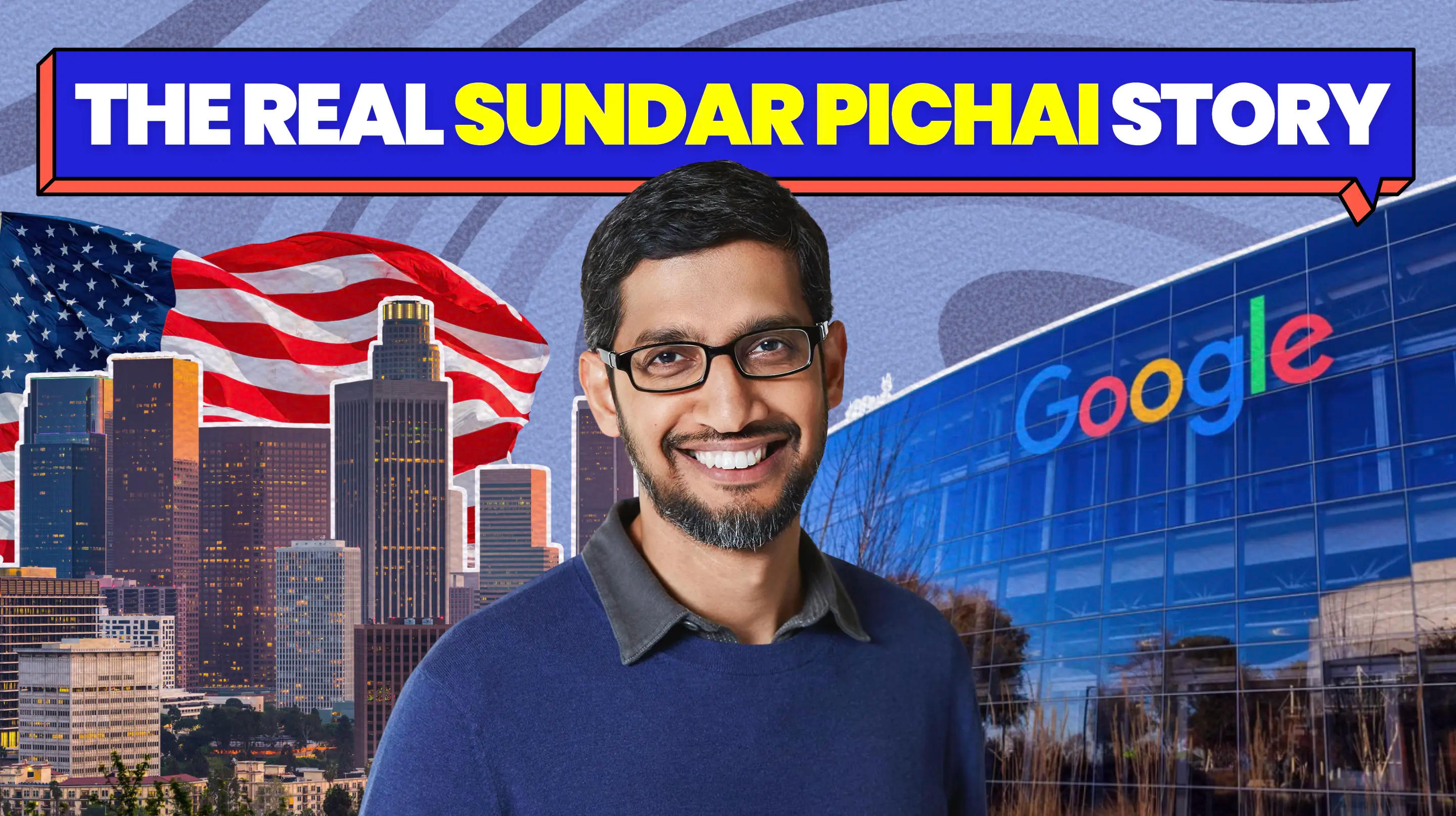
There's a version of Sundar Pichai's story that gets told often: the IIT graduate who flew to America, joined Google, and eventually became its CEO. It's accurate, but it skips the part that actually matters.
Before any of that, there was a family in a two-room Chennai apartment making a quiet, enormous decision. No telephone. No computer. A father who cycled to work and a mother who managed every rupee carefully. And one day, they handed their son money equal to an entire year's income for a flight ticket and a university application without flinching.
That moment is the real story. Everything else followed that.
A Childhood Built on Discipline, Not Advantage
Sundar Pichai was born on June 10, 1972, in Madurai, Tamil Nadu, to Regunatha, an electrical engineer, and Lakshmi, a stenographer. The family wasn't in poverty, but they weren't comfortable either. Resources were tight. Choices were deliberate.
What the household did have, in abundance, was an unspoken commitment: the children would be educated, whatever it cost.
Sundar was a curious, sharp kid with an unusual memory, reportedly able to recall telephone numbers with ease, which said something about how his mind worked even before he had any real access to technology. He moved through school steadily, earned a place at IIT Kharagpur, and graduated in 1993 with a degree in metallurgy and a silver medal.
The metallurgy part tends to receive a footnote in most retellings, but it deserves more attention. Everything Sundar would later build at Google, Chrome, Android, Gmail, and Google Drive, had nothing to do with metals. What IIT gave him wasn't domain knowledge. It was a way of thinking: rigorous, structured, patient with complexity. The subject was almost incidental. The training of mind was everything, and it would travel with him across every role he ever held.
The Flight That Cost a Year's Salary
When the time came to apply abroad, the combined cost of Sundar's Stanford application and flight ticket amounted to roughly his father's full annual salary. Not a portion of it. All of it.
His family paid it.
In 1993, he secured a scholarship to Stanford University for a Master's in Materials Science and Engineering, his first step into America on an F-1 visa. The scholarship is what made the investment rational rather than reckless. The IIT silver medal earned the scholarship. The preparation justified the sacrifice.
There's one more detail that rarely surfaces in his story: professors at IIT Kharagpur encouraged him to apply. They told him, directly, that he belonged in those rooms. For many Indian students, the barrier to applying abroad isn't ability; it's the absence of anyone around them who treats it as a normal, achievable thing. One conversation with a professor changed Sundar's perspective. It's a small thing that changed everything.
What a Foreign Degree Actually Does
Stanford didn't build Sundar Pichai. IIT Kharagpur had already done that work.
What Stanford offered was a different kind of environment, new problems, sharper peers, and access to networks that didn't exist in India at the time. He initially planned to stay for a PhD, then changed course, spent a brief period at Applied Materials, and made his next pivotal decision: applying to the Wharton School of Business at the University of Pennsylvania.
At Wharton, he was named both a Siebel Scholar and a Palmer Scholar, the program's highest academic distinctions. He was still earning his place, not assuming it. The business education didn't replace his engineering instincts; it sat alongside them and gave him a fuller set of tools.
This is the part of studying abroad that tends to become misrepresented. A foreign degree isn't a transformation; it's an amplifier. It takes what a student already has and creates better conditions for it to develop. Those who arrive expecting the institution to construct them tend to leave underwhelmed. Those who arrive already built, looking to accelerate, tend to find exactly that.
Eleven Years Before the Title
Sundar joined Google in 2004 as a product manager, not an executive, not a VP, a product manager.
What came next was over a decade of work that looked ordinary from the outside. He advocated for Google Chrome internally at a time when the idea had real opposition from senior leadership. He built the team anyway. He shipped it quietly. Chrome now holds 68.9% of the global browser market.
He went on to lead Gmail, Google Maps, and Android. By 2014, his name was circulating outside Google; Twitter was interested, and Microsoft was seriously considering him as a replacement for Steve Ballmer. That role went to Satya Nadella. Sundar stayed. In 2015, he became Google's CEO. In 2019, CEO of Alphabet.
Eleven years between joining as a mid-level hire and running the company. That gap, filled with consistent, focused, unglamorous work, is the part of his story that motivational content tends to skip. It's also the most instructive part.
What the Story Is Actually Saying
Three things stand out, and they're worth naming plainly.
The first is that the subject of a degree matters far less than what the degree teaches someone to do with their mind. Sundar studied metallurgy and built the world's most-used browser. Rigour is portable. Anxiety about being in the wrong field is almost always misplaced.
The second is that studying abroad works best when it's treated as acceleration, not escape. Sundar didn't go to Stanford to leave India behind. He went there because better conditions existed for what he was already capable of. That distinction changes everything about how someone prepares, applies, and shows up when they arrive.
The third is that the financial cost is real, and preparation is what makes it defensible. His family gave a year's salary. What justified that wasn't hope. It was a silver medal, a scholarship, and a real application behind it. The work of applying seriously, scores, essays, and the right shortlist of universities is inseparable from the investment being worth making.
He Still Goes Back
Sundar Pichai still speaks with students at IIT Kharagpur over video calls. Regularly. The CEO of one of the world's most powerful companies makes time, still, for the place where his story turned.
He hasn't forgotten what a scholarship application and a professor's encouragement did for him. That's not a small thing to carry at his level.
For any Indian student sitting somewhere right now with a half-finished application and a family quietly preparing to back them, his story isn't distant or exceptional. It's familiar. The circumstances were different. The shape of the decision is exactly the same.
Verified by LeapScholar's study-abroad counseling team, with hands-on experience guiding Indian students through US university applications, scholarship processes, and visa planning. Have questions about studying in the USA? Book a free session with a Leap Scholar counselor.

Kirti Singhal
Kirti is an experienced content writer with 4 years in the study abroad industry, dedicated to helping students navigate their journey to international education. With a deep understanding of global education systems and the application process, Kirti creates informative and inspiring content that empowers students to achieve their dreams of studying abroad.
Users also read
Top 18 MBA Schools Producing the Highest-Paid Graduates in 2026

How to Format an ATS-Friendly Resume for German Tech Companies in 2026

Growing Demand for HR Professionals in India: Why a Foreign Degree Is Opening Doors for Indian Students in 2026