Blogs
Blogs  Leap Digest
  Events
  About Us
 Student Reviews
Climate Tech & Startups: Aparna Raturi's Paris MBA Journey

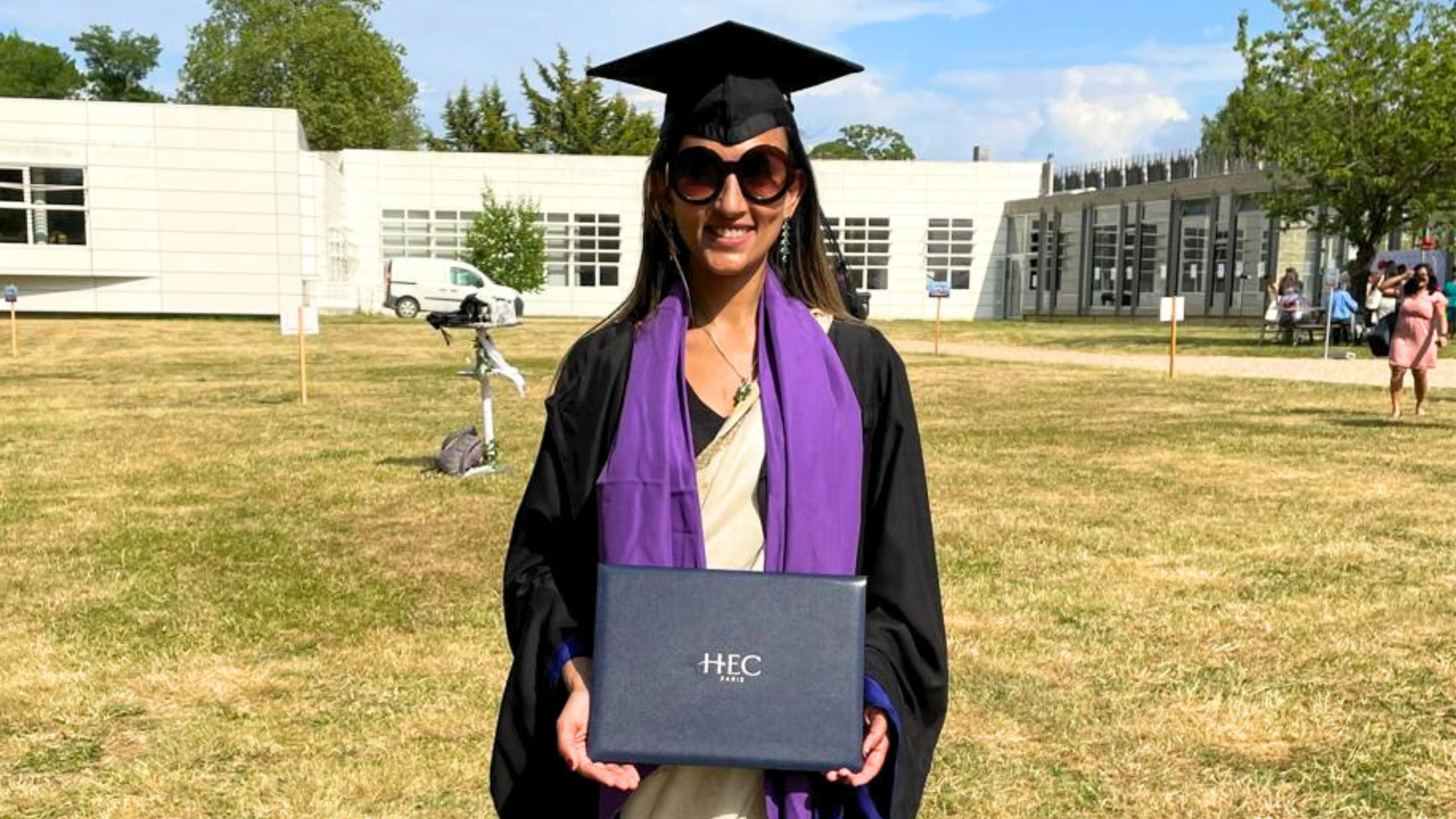
Aparna Raturi is a climate change strategist currently based in Paris, working at the intersection of law, policy, and sustainability. She completed her MBA at HEC Paris and holds a BA LLB (Hons) in Law from the National Law Institute University, Bhopal. Leap sat down for an interview session with Aparna to discuss her journey from practicing law in India to studying and working in Paris.
Q. Tell us about your background.
I did my undergraduate degree in law in India. I initially enrolled at Symbiosis Law School for a year but was later accepted into NLIU Bhopal. At first, I wasn’t very fond of the move from Pune to Bhopal. But I ended up really enjoying my legal education.
During those five years, I traveled extensively while in law school, visiting at least ten different countries and participating in several competitions abroad. I also did an exchange program in Switzerland, spending six months there when I was 21. Straight after graduating, I took my first job in Mumbai, based at the head office of what was then India’s largest private-sector bank, ICICI. I also worked at Amarchand Mangaldas, one of India's largest law firms.

Q. Why did you decide to study abroad, and why an MBA after law?
It happened during COVID. I went back home to be with my parents and worked from there for a while. My father was really surprised at the amount of workhours I was doing and asked me if that’s what I wanted to do in my youth. I’d always wanted to do a master’s—either an LLM or an MBA. Ultimately, I believed that an MBA would provide a more diverse background, greater mobility, and open more doors for me. So I quickly prepared for the GMAT and started applying. My family helped with application process and SOPs.
I focused only on European schools. For me, the MBA was a way to explore what else I could do professionally. In hindsight, I’m glad I deliberately chose not to apply to any American programs. The reason was simple: I wanted to fund my MBA entirely on my own, without taking loans or asking my parents for help.When I was 21, I’d travelled through France and visited Paris, which left a lasting impression. So, I chose HEC Paris.
Q. How was it living and studying in Paris?
I felt a great sense of relief and calm in not having to deal with clients after six or seven years in the legal world. I really embraced that change. I’ve always been someone who likes to do multiple things at once, and my classmates used to tease me about how I was constantly juggling ten different activities during my MBA. The program offered a vast variety of experiences, and I tried to take advantage of as many as possible.
I was part of the organizing committee for the largest inter-school sports tournament. I also served on the MBA Council, which involved participating in a comprehensive election process. Beyond that, I was active in four different clubs.

Q. How did you land your role and can you tell us little bit about your work?
During my MBA, I interned over the summer and also did what’s often called an end-of-term internship. I knew that switching abruptly from law to investment banking would be tough to pull off. I started interning at a climate tech startup in Paris. I was one of the first few employees, and it turned out to be an ideal time to join.
Our company operates in a particularly exciting sector: carbon credits. It’s a relatively new area where, for example, shifting from unsustainable to sustainable cultivation practices allows farmers to claim carbon credits. Fortunately, the startup raised funding that same year, allowing me to transition into a full-time role and take on more responsibility.
Q. What’s been the highlight of working at a startup in Europe?
As part of my work, I’ve been able to travel quite a bit for work. I’ve represented our startup at conferences and panel discussions in places like Singapore, Cambodia, and Thailand. This role has let me take on much more diverse and dynamic opportunities, especially within the climate change space.
One particularly exciting moment came two years ago, when a prominent French journal unexpectedly featured me as one of the Top 10 Women in Tech to Watch in 2024. That was a really special recognition, and it’s moments like these that make the risk I took feel completely worth it.
Q. What advice would you give to people who are looking to do their higher education in Paris?
One big piece of advice is that if you’re already earning well in India (around 35 lakh), I would really urge you to think twice before moving. However, if you’re younger, around 26 or 27 and earning below that bracket, then it can make sense. You can use the move strategically to boost your salary and broaden your experience.
My advice is to start early—ideally before you have more than five years of work experience. And be very targeted in your choice of business school. The job market here is already saturated, and the ROI isn’t great if you choose just any school. Focus on the top grandes écoles in France, because employers actually value them.
If you do come here, plan to do a master’s and intern as much as possible while you’re studying. Unlike India, there’s no “placement” system here. Universities and business schools won’t hand you a job, and companies don’t line up to recruit you directly. You’ll need to find your opportunities through networking.
Users also read

From HR in India to Quant Analyst in New York: How Carnegie Mellon Helped Tapasya Reinvent Her Career

Leap Scholar Review: A Rejection First, Then Eight Offers Out of Eleven Applications

Leap Scholar Review: A Coffee Conversation That Turned Into an MBA at Liverpool