Blogs
Blogs  Leap Digest
  Events
  About Us
 Expert Insights
South Korea Expands Visa Options to Retain International STEM Students: The 2026-2027 Roadmap
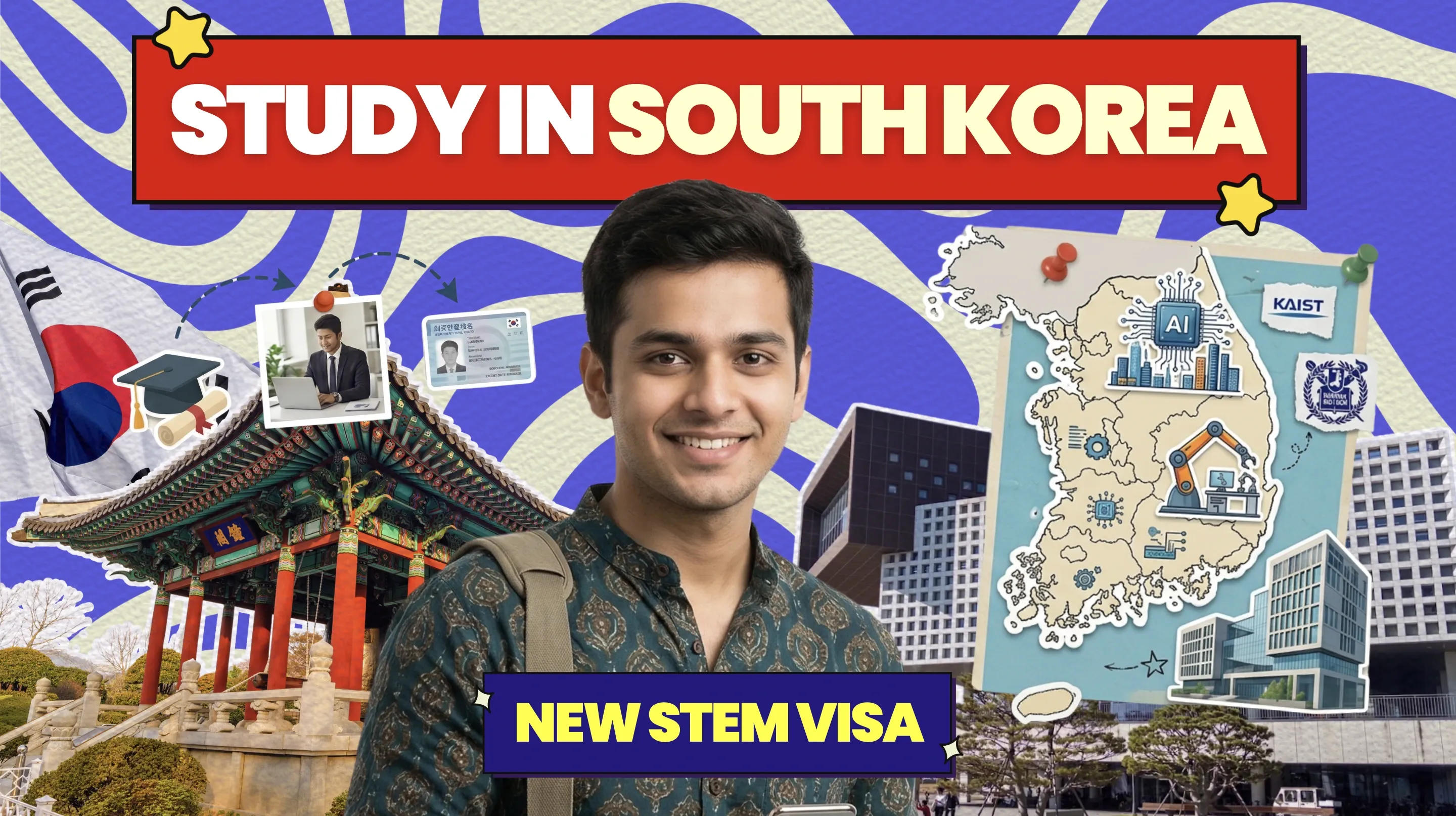
The global race for talent has found a new frontrunner. For years, students looking to build a career in Science, Technology, Engineering, or Mathematics (STEM) focused almost exclusively on the "Big Four", the US, UK, Canada, and Australia. However, as we look at the landscape in 2026, South Korea has emerged as a powerhouse alternative, specifically for those who want more than just a degree.
The South Korean government has officially pivoted from being a "study destination" to a "settlement destination." Through the 2026 rollout of the K-STAR visa and expanded residency pathways, the message to international STEM students is clear: Korea doesn't just want you to study here, it wants you to stay, work, and lead its next technological revolution.
The 2026 Shift: From Student to Resident
In the past, the transition from a D-2 (Student) visa to a working visa was often a bureaucratic hurdle. In 2026, that hurdle was replaced by a bridge. The Ministry of Justice has fully implemented the K-STAR Visa Track (Korea Science & Technology Advanced Human Resources), designed specifically to retain top-tier STEM talent.
The most significant change is the "Direct Residency" option. High-achieving STEM graduates from 32 designated universities can now skip the traditional job-seeker phase and transition directly to an F-2 (Resident) visa upon graduation. This allows students to live and work in Korea with nearly the same freedom as a local citizen, without needing a company to sponsor their visa immediately. That's huge, you're not scrambling for a sponsor in your final semester.
Why STEM Students Are Choosing Korea Now
South Korea's strategy isn't just about paperwork, it's about survival and innovation. Facing a demographic shift, the country is doubling down on international talent to fuel its AI, semiconductor, and biotechnology sectors.
1. The Extended D-10 Job Seeker Window
For those who don't qualify for the immediate K-STAR F-2 residency, the D-10 Job Seeker visa has been significantly upgraded. As of 2026, the maximum stay on a D-10 has been extended from 2 years to 3 years. Additionally, the renewal cycle has moved from every 6 months to 1-year increments, drastically reducing the administrative stress for young professionals. No more panicking every six months about renewal paperwork.
2. Lowered Financial and Language Barriers
To make the country more accessible, the government has lowered the financial proof requirements for student visas. Instead of needing ₩26.5 million [~$19,830 / ₹16.4 Lakhs], the threshold for degree-seeking students has been reduced to approximately ₩20 million [~$14,960 / ₹12.4 Lakhs] for those in Seoul, and as low as ₩16 million [~$11,970 / ₹9.9 Lakhs] for those studying in regional areas. That's ₹4-6 Lakhs saved just on the visa requirement.
Language requirements have also been adjusted. While TOPIK (Test of Proficiency in Korean) Level 4 was once the standard for internships, many STEM-specific internships now only require Level 2, allowing students to gain workplace experience while they're still mastering the language. You can work while you learn, you don't need to be fluent on day one.
Spotlight: High-Demand STEM Sectors for 2026-2027
If you're planning your career in South Korea, certain industries are receiving massive government subsidies and "priority visa" status. Here are the sectors where international talent is currently most sought after:
- Semiconductors & Nano-Technology: With the "K-Semiconductor Belt" project in full swing, companies in Gyeonggi-do are actively recruiting international engineers for R&D roles. Think Samsung and SK Hynix, they're hiring aggressively.
- Green Energy & Hydrogen Tech: As Korea pushes for carbon neutrality by 2050, the demand for environmental engineers and sustainable energy specialists has spiked by 25% since 2024. Climate tech is booming.
- Artificial Intelligence (AI) & Big Data: The government has launched "AI Innovation Hubs," offering specific grants for international Master's and PhD students who stay to work in local startups. Government money backing your research career.
- Bio-Health & Pharmaceuticals: Songdo (Incheon) has become a global bio-hub. Graduates with degrees in Biotechnology or Chemical Engineering often find placement before their final semester ends. Companies are headhunting at universities.
Regional Specialization: The F-2-R Visa
One of the most exciting developments for 2026 is the expansion of the F-2-R (Regional Specialization) visa. South Korea is actively encouraging students to look beyond the bright lights of Seoul. Regions like North Jeolla (specializing in Agri-food and Automotive engineering) and Daegu (specializing in Robotics) are offering simplified visa tracks.
If you commit to living and working in these "designated population-decline areas" for five years, the government provides a fast-track to permanent residency. For many Indian students, this represents a much higher "Return on Investment" (ROI) compared to the saturated job markets of other Western countries. Seoul is expensive and competitive, these regions offer better odds and lower costs.
Key Deadlines for the 2026-2027 Academic Cycle
If you're looking to start or transition your journey in mid-to-late 2026, keep these critical dates in mind:
- March 2026: Opening of the Global Korea Scholarship (GKS) Graduate Track interviews. This is the prime time to secure full funding for STEM research.
- May - June 2026: Application window for the Fall 2026 Intake at top universities like KAIST, SNU, and POSTECH.
- August 2026: Deadline for the K-STAR Talent Recommendation for summer graduates. You must secure a recommendation from your university head to bypass the job-seeker visa.
- September 2026: Commencement of the Fall 2026 semester and the opening of the 2027 Spring Intake early-bird applications.
- October 2026: Deadline for the EPS-TOPIK and specialized language evaluations for students transitioning to E-7 professional work visas in early 2027.
A Balanced Perspective on the Cost of Living
While the visa path is smoother, Korea remains a developed economy with associated costs. In 2026, a student should budget for:
Monthly Living Expenses: Approx. ₩1.2M - ₩1.5M[~$895–$1,120 / ₹74,500–₹93,000] including rent and food. Seoul is at the higher end; regional cities are cheaper.
Part-time Work: International students can now work up to 35 hours per week (up from 30) during semesters, with unlimited hours during vacations, helping to offset these costs. That's nearly full-time work while studying, doable if you manage your schedule. Additionally, under the 2026 trial scheme, international students enrolled in 16 designated workforce-focused technical programs can also now work up to 35 hours per week, even at the undergraduate level.
Note: All currency conversions are based on exchange rates as of March 10, 2026 (1 KRW ≈ 0.062 INR / 0.00075 USD).
Conclusion: You Can Do This
The shift in South Korea's visa policy isn't just a minor update, it's a fundamental change in how the country views international students. For the first time, a STEM graduate can finish their degree and feel a sense of security that their place in the local workforce is not only permitted but actively encouraged.
The path to residency that used to take six years has been slashed to three for many STEM tracks. While moving to a new country with a different language can feel daunting, the 2026-2027 landscape proves that South Korea is ready to meet you halfway. If you have the technical skills and the ambition, the "Land of the Morning Calm" is ready to become your long-term home.
Need help shortlisting the right South Korean university for your STEM degree? Book a free consultation with a Leap Scholar expert today.

Kirti Singhal
Kirti is an experienced content writer with 4 years in the study abroad industry, dedicated to helping students navigate their journey to international education. With a deep understanding of global education systems and the application process, Kirti creates informative and inspiring content that empowers students to achieve their dreams of studying abroad.
Users also read

Top 10 Industries That Create the Most Billionaires in 2026: Guide for Indian Students

Stanford MBA Career Diversity: Industries, Salaries and What Indian Students Need to Know

Anthropic Academy: 16 Free AI Courses With Certificates in 2026 That Indian Students Cannot Afford to Ignore