Blogs
Blogs  Leap Digest
  Events
  About Us
 Expert Insights
Navigating the Lion City: Your Guide to the Singapore Job Market (2026-2027)
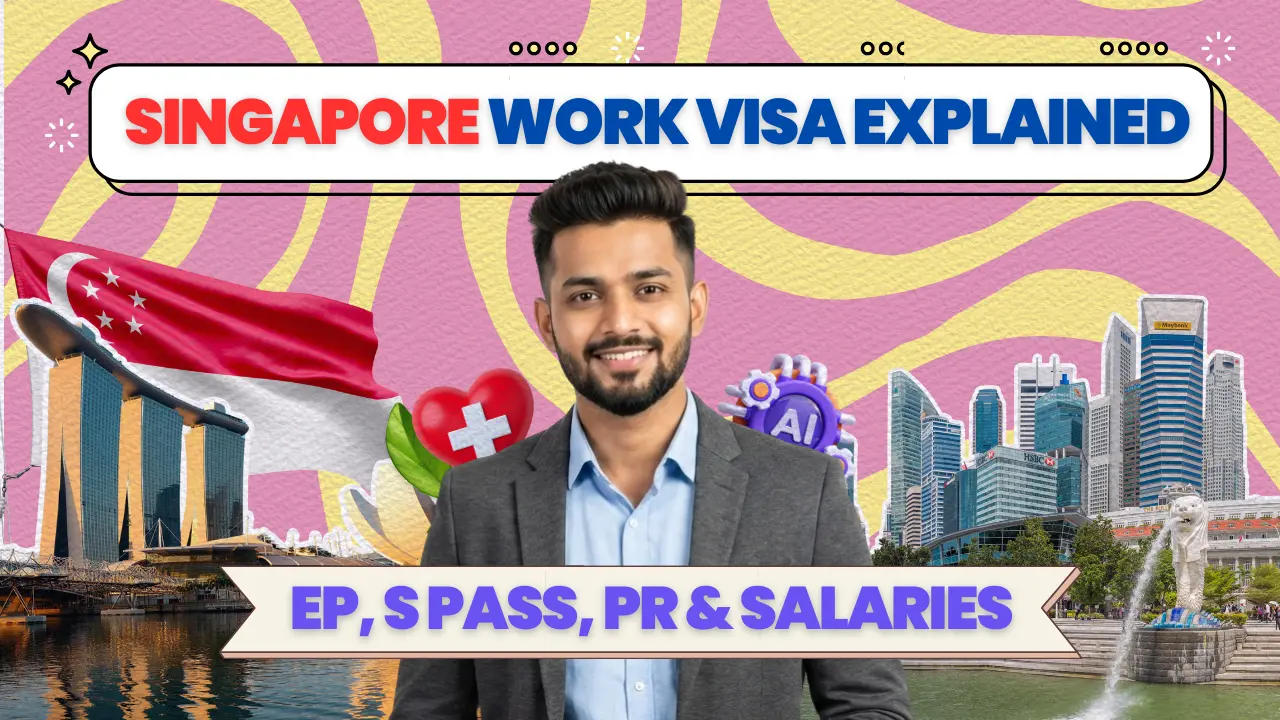
Singapore has long been a beacon for ambitious Indian students and young professionals. As we move into the 2026-2027 period, the "Lion City" is no longer just a financial powerhouse; it has transformed into a global nerve center for AI governance, the green economy, and high-tech manufacturing. If you're eyeing a career here, the landscape is structured and rewarding, but it requires a strategic approach.
For many, the transition from a student desk to a professional workstation in Singapore can feel like navigating a high-stakes maze. However, with the right information on the newest work pass frameworks and PR pathways, you can turn this dream into a very tangible reality. Let's break down exactly what the current scenario looks like for you.
Post-Study Work Permits: Your First Steps
The transition from a Student Pass to a work permit in Singapore is well-defined. Unlike the "one-size-fits-all" post-study visas in other countries, Singapore offers specialized paths based on your qualifications and the role you land.
1. The Long-Term Visit Pass (LTVP)
If you've graduated from an Institute of Higher Learning (IHL) in Singapore (like NUS, NTU, or SMU), you're eligible for a one-year, non-renewable LTVP. This is your "search period." It allows you to stay in the country legally to attend interviews and network without the immediate pressure of leaving when your student visa expires. That breathing room is invaluable, you're not scrambling to find a job in the final weeks of your studies.
2. Training Employment Pass (TEP)
For those who land a high-value internship or a short-term professional training stint, the TEP is a great bridge. It requires a minimum monthly salary of SGD 3,000 (approximately ₹2,13,900) and is valid for up to three months. It's an excellent way for fresh graduates to prove their worth to a top-tier employer before converting to a full EP.
3. The S Pass
This is geared toward mid-level skilled staff. In the 2026-2027 context, the qualifying salary for an S Pass is SGD 3,300 (approximately ₹2,35,290). Note that companies have a "quota" for S Pass holders, so competition can be stiff. It's not impossible, but you need to bring something valuable to the table.
The COMPASS Era: Securing Your Employment Pass (EP)
If you're aiming for a professional or managerial role, the Employment Pass (EP) is your target. From 2023, and refined further for 2026, the Ministry of Manpower (MOM) uses the COMPASS (Complementarity Assessment Framework).
As of 2026, the minimum qualifying salary for an EP is SGD5,600 (approximately ₹3,99,280) per month, while Financial Services roles require SGD6,200 (approximately ₹4,42,060). That's the baseline, you need to earn at least this much for your application to even be considered.
To get your EP approved, your application must score at least 40 points across these categories:
- Salary (C1): You score more if your salary meets the 65th percentile of local PMET (Professional, Manager, Executive, and Technician) wages for your age. The higher you earn relative to your peers, the more points you get.
- Qualifications (C2): Degrees from "top-tier" institutions (like the IITs in India or top global 100 universities) automatically fetch 20 points. This is where your university choice really pays off.
- Diversity (C3) & Local Support (C4): These are company-level scores. You gain points if your employer has a diverse workforce and a strong record of hiring locals. This is beyond your control, but it's worth knowing when evaluating job offers.
- Skills Bonus (C5): If your job is on the Shortage Occupation List (SOL), you get a massive 20-point bonus. AI Engineering, Sustainability/Carbon Trading, and Healthcare are the top "Shortage Occupations" offering the fastest routes to a work pass.
In-Demand Roles and 2026 Salary Projections
Singapore's "Green Plan 2030" and the "National AI Strategy 2.0" have dictated the job market's direction for 2026-2027. Here's where the opportunities are densest:
1. AI and Machine Learning
With Singapore aiming to become a global AI hub, roles like AI Scientists and ML Engineers are in high demand.
Entry-level Salary: SGD83,000 – SGD110,000 (approximately ₹59.1 Lakhs – ₹78.4 Lakhs) per year. Senior roles: Can exceed SGD160,000 (approximately ₹1.14 Crore) per year.
If you've got the skills, this sector is literally throwing opportunities at qualified candidates.
2. Sustainability and the Green Economy
Carbon traders, sustainability managers, and "Green" engineers are sought after as firms race to meet net-zero targets.
Average Salary: SGD75,000 – SGD120,000 (approximately ₹53.4 Lakhs – ₹85.5 Lakhs) per year.
3. Healthcare and Bio-Medical Sciences
As an aging society, Singapore is constantly hiring registered nurses, physiotherapists, and diagnostic radiographers. These roles are frequently on the Shortage Occupation List, making visa sponsorship much easier.
Average Salary: SGD60,000 – SGD90,000 (approximately ₹42.7 Lakhs – ₹64.1 Lakhs) per year.
Comparison of Singapore Work Passes (2026-2027)
Feature | Employment Pass (EP) | S Pass | Training Employment Pass (TEP) |
| Min. Monthly Salary | SGD5,600 (approx. ₹3,99,280) | SGD3,300 (approx. ₹2,35,290) | SGD3,000 (approx. ₹2,13,900) |
| Selection Criteria | COMPASS Points System | Quota & Levy System | Employer Sponsorship |
| PR Eligibility | Very High | Moderate | Low |
| Family Pass (DP) | Available if salary > SGD6,000 (approx. ₹4,27,800) | Available if salary > SGD6,000 (approx. ₹4,27,800) | Not available |
| Typical Duration | 2-3 Years (Renewable) | 2 Years (Renewable) | 3 Months (Non-renewable) |
The Path to Permanent Residency (PR)
Singapore is unique in how it integrates talent. For many Indian professionals, PR is the ultimate goal, providing stability, lower tax rates, and the ability to purchase property.
The Student Pathway
A significant change in recent years has made it easier for students. International students can apply for Permanent Residency if they've resided in Singapore for at least two years and passed at least one national exam (like the GCE A-Levels or polytechnic diploma). You no longer need to wait for years of work experience to apply.
The PTS Scheme (Professionals, Technical Personnel, and Skilled Workers)
Most professionals apply via this route after working on an EP or S Pass. While you can technically apply after 6 months, the "sweet spot" is usually after 2 years of consistent tax contributions. The authorities look at your ability to integrate into local culture and your long-term commitment to the country.
Don't just think about the job, think about your community involvement, your understanding of Singaporean culture, and your genuine intention to build a life there.
The Bottom Line
The Singapore job market of 2026-2027 is selective, but it remains one of the most meritocratic in the world. By focusing on high-growth sectors like AI and sustainability, and ensuring your qualifications align with the COMPASS criteria, you're setting yourself up for a career that's both financially lucrative and professionally fulfilling.
Challenges like rising salary thresholds and stricter visa points are simply hurdles, not dead ends. With the right preparation, Singapore offers a lifestyle and a career trajectory that few other global cities can match. The tax rates are low, the infrastructure is world-class, and you're at the center of Asia's economic boom.
You've got the ambition, now it's time to take the first step. Start researching those shortage occupation roles, understand what COMPASS points you can realistically achieve, and position yourself accordingly.
Take the First Step Toward Your Singapore Career
Planning a move to Singapore involves many moving parts, from university selection to understanding complex visa points. Book a free consultation with a Leap Scholar expert today to get a personalized roadmap for your study-abroad journey and ensure you meet all the 2026 eligibility requirements.

Kirti Singhal
Kirti is an experienced content writer with 4 years in the study abroad industry, dedicated to helping students navigate their journey to international education. With a deep understanding of global education systems and the application process, Kirti creates informative and inspiring content that empowers students to achieve their dreams of studying abroad.
Users also read

Top 18 MBA Schools Producing the Highest-Paid Graduates in 2026
How to Format an ATS-Friendly Resume for German Tech Companies in 2026

Growing Demand for HR Professionals in India: Why a Foreign Degree Is Opening Doors for Indian Students in 2026