Blogs
Blogs  Leap Digest
  Events
  About Us
 Trending News
UGC Dual Degree Programs with Foreign Universities: What Indian Students Need to Know in 2026
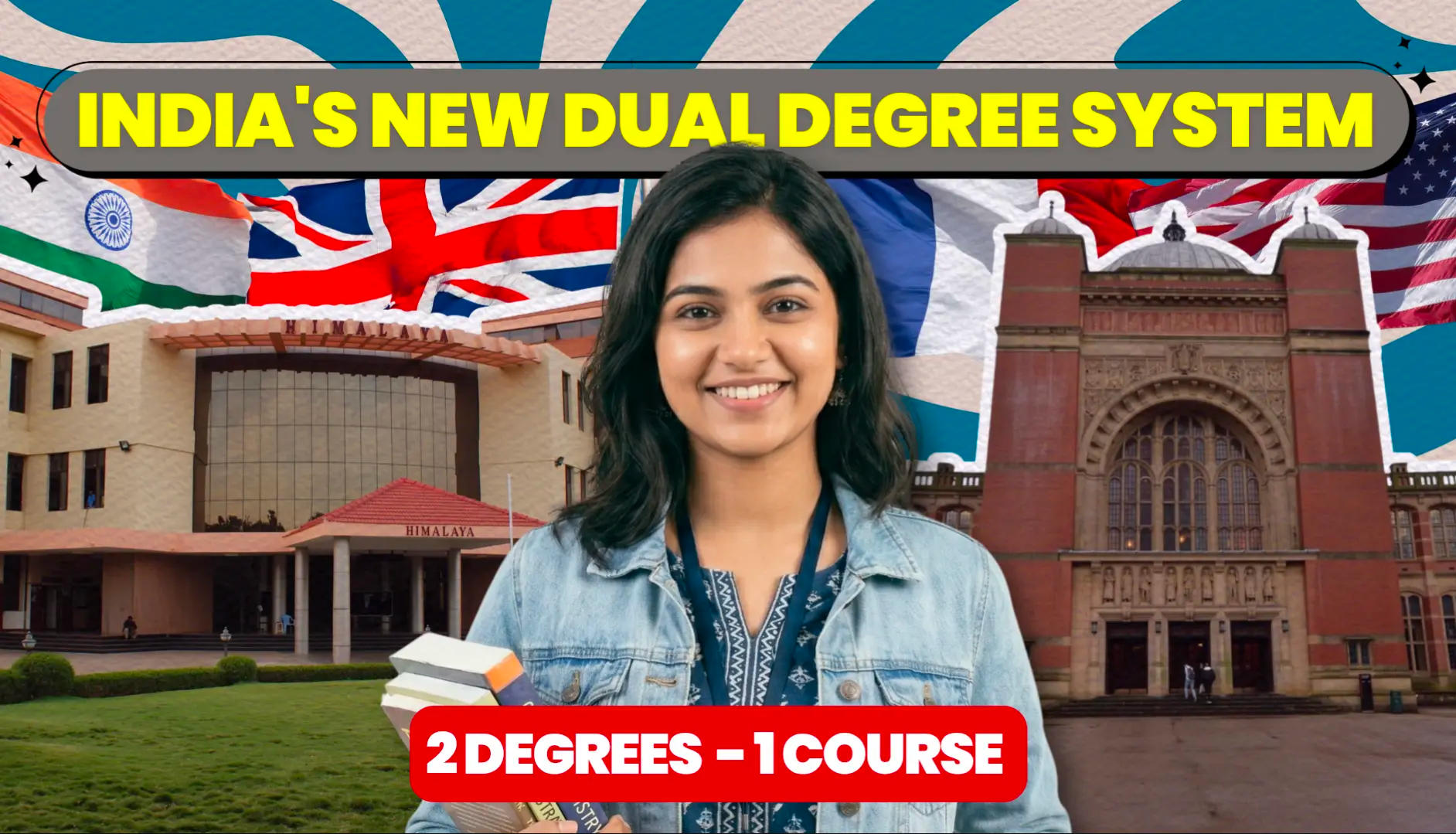
For decades, an Indian student who wanted a degree from a globally ranked foreign university had one option: leave India, pay international tuition, manage living costs abroad, and return years later with a foreign credential. That has changed.
The University Grants Commission approved regulations on May 2, 2022, and updated them with a formal recognition framework in 2025 that allows Indian universities to collaborate with foreign institutions to offer three kinds of academic programs: twinning programs, joint degrees, and dual degrees. Under the dual degree model, students can earn two separate degrees from two different countries, one from an Indian institution and one from a foreign institution, while spending part of their time in India.
A note on scope: These regulations govern cross-border academic collaboration with foreign institutions. They are separate from the UGC's domestic framework that allows students to pursue two Indian degrees simultaneously. This blog covers only the cross-border foreign collaboration framework.
Several universities are already offering programs under these regulations.
What the UGC Regulation Actually Says
The UGC (Academic Collaboration between Indian and Foreign Higher Education Institutions to Offer Joint Degree, Dual Degree, and Twinning Programs) Regulations, formally approved on May 2, 2022 , allow three distinct types of collaboration.
1. Twinning Program: A student enrolls at an Indian institution and spends up to 30% of their program credits at a foreign institution. The degree is awarded by the Indian university. The foreign institution issues a certificate for the credits earned there.
2. Joint Degree: Both the Indian and foreign institutions collaborate to design and deliver a shared curriculum. One joint degree is awarded, typically in both institutions' names.
3. Dual Degree: Both institutions award separate degrees simultaneously upon completion. A student completes the credit requirements of both institutions and graduates with two degrees, one Indian and one foreign.
Who is eligible: All three program types are open to students at the undergraduate degree level (e.g. B.Tech, B.A. Hons, B.Sc), postgraduate, and doctoral levels. The only explicit exclusion is undergraduate diploma and certification programs; standard full bachelor's degree students are fully eligible.
What was new in 2022: Before this regulation, UGC did not recognize dual degrees from cross-border collaborations. The 2022 rules changed this; degrees from approved collaborations are now explicitly equivalent to corresponding Indian degrees.
The 2025 update: The UGC Recognition and Grant of Equivalence to Qualifications from Foreign Educational Institutions Regulations further streamlined how foreign degrees obtained through these programs are treated for employment, postgraduate admission, and research purposes in India.
Who Can Collaborate: The Two-Tier Framework
Not every Indian university can partner with any foreign institution without approval. The framework creates two tiers.
Automatic collaboration: no UGC approval needed:
- Indian institution: NAAC accredited with a score of 3.01 or above, or in the top 100 of the NIRF university category, or an institution of eminence.
- Foreign institution: in the top 500 of the QS World University Rankings or Times Higher Education rankings.
Approval-required collaboration:
- Other Indian institutions can collaborate with foreign institutions accredited in their home country, subject to UGC review and approval.
What is explicitly not allowed:
- Online or distance learning programs. These regulations apply to in-person programs only.
- Franchise arrangements or study centers. A foreign institution cannot use an Indian institution as a delivery proxy for its degree.
- Collaborations where a foreign institution delivers the program in India without a genuine partnership structure.
Programs Already Running Under These Regulations
Several Indian universities have already formalized collaborations, and students are currently enrolled in these programs.
- IIT Madras and University of Birmingham (UK): A dual-degree collaboration in engineering. Students split time between Chennai and Birmingham and graduate with credentials from both institutions.
- Pondicherry University and Université Paris I Panthéon-Sorbonne (France): Dual-degree programs at the postgraduate level in social sciences and humanities.
- Pondicherry University and University of Toulon (France): Collaboration in science programs.
- Karnataka public universities and Pennsylvania State System of Higher Education (PASSHE, USA): The Karnataka government facilitated partnerships between four public universities and PASSHE institutions in 2023.
- University of Southampton; physically located at International Tech Park, Gurugram (Haryana): marketed as "University of Southampton Delhi": The first globally ranked UK institution to receive a UGC license to establish a campus in India, with its first student cohort beginning August 2025. Union education minister Dharmendra Pradhan inaugurated the University of Southampton in Haryana's Gurugram, making it the first foreign university to start a campus in India under the University Grants Commission's regulations.
- IIM Bangalore, IIM Ahmedabad, IIT Delhi: All have existing international partnerships that they are restructuring to align with the dual degree framework.
How to Find and Apply for These Programs
This procedure is the step that most blogs about UGC dual degrees skip entirely. Knowing the regulation exists is not useful if you cannot locate the actual programs.
Step 1: Check the UGC's official list of eligible Indian institutions at ugc.gov.in under the Academic Collaboration section.
Step 2: Go to the international relations or global partnerships office of your target Indian institution and search for "dual degree," "joint degree," or "international collaboration."
Step 3: Verify the foreign institution's recognition. Before applying, confirm that the foreign partner's home country's education authority recognizes it. For UK institutions, you should check the Office for Students' register. For US institutions, you should check the CHEA database. For European institutions, the ENIC-NARIC network is the place to check.
Step 4: Confirm credit transfer terms in writing. The percentage of credits to be completed in India versus abroad, the degree awarding authority, and the graduation timeline must be clearly stated in the collaboration agreement. Ask the admission office for the MOU summary or collaboration document before you pay any fees.
Three Ways This Changes Your Options
Option 1: Earn two degrees, one Indian and one foreign, across UG, PG, or doctoral levels: A student at a NAAC 3.01+ institution partnered with a QS top-500 foreign institution can earn both degrees by completing credit requirements at both. This is available to undergraduate degree students (B.Tech, B.A. Hons.), postgraduate students, and doctoral students alike. The only students excluded are those in UG diploma or certification programs.
Option 2: Twinning: study mostly in India and spend one semester abroad: For students who want international exposure but cannot fund a full foreign degree, the twinning model allows them to spend one or two semesters abroad as part of an Indian degree, with the Indian degree as the primary qualification.
Option 3: Joint degree at a fraction of the cost: Some joint degree programs are priced at a blended tuition rate significantly lower than the foreign institution's standard international fee. The exact pricing varies by partnership.
The recognition advantage: Degrees earned through UGC-approved collaborations do not require a separate equivalency certificate for employment or postgraduate admission in India.
Four Things to Verify Before You Enroll
1. Confirm the partnership has formal UGC recognition. Some Indian universities advertise "international partnerships" that are MOUs without structured degree programs. Check whether the collaboration has formal UGC recognition before enrolling.
2. Check the foreign institution's recognition in its home country. Under the 2025 regulations, the foreign qualification must originate from an institution legally recognized in its home country. A degree from an unrecognized foreign institution under an Indian partnership has limited value.
3. Confirm the degree format. Twinning, joint, and dual degrees are structured differently. Understand which model your target program uses, what percentage of credits require physical presence abroad, and what credential you will hold at graduation.
4. Online delivery is excluded. The regulations explicitly do not apply to programs delivered online or through distance learning modes. A program offered purely online under an Indian-foreign collaboration does not carry the same recognition.
The Bigger Shift This Represents
India's higher education system is changing faster in 2025-26 than at any point in the past two decades. The UGC dual degree framework, the arrival of the University of Southampton campus in Delhi, the National Education Policy's emphasis on internationalization, and the growing list of IITs and central universities with active foreign partnerships all point in the same direction.
Indian students who previously had a binary choice, study in India or study abroad, now have a third: study in India and earn a foreign credential simultaneously. For families who cannot fund full overseas education but want internationally recognized qualifications, this arrangement is a genuine structural shift.
The list of active dual degree programs is still small relative to the number of Indian institutions. But it is growing every year, and the regulatory infrastructure to support much wider implementation is now in place.
Book a free session with a Leap Scholar counselor to understand which Indian universities currently offer UGC-approved dual degree programs with foreign institutions, whether the programs align with your field and career goals, and how this option compares financially to studying abroad directly.
Sources: UGC Official, Academic Collaboration Regulations 2022 | UGC Official, Recognition of Foreign Educational Institutions Regulations 2025 | Careers360, UGC Approves Dual, Joint, Twinning Degree Regulations, April 2022 | Careers360, State Universities Bet on Foreign Tie-ups, April 2026 | Leverage Edu, Indian Universities Tie Up with Foreign Universities 2025-26 | British Council, Eligible Indian Institutions for Academic Collaborations | Eduprogress, UGC Foreign Degree Recognition Guidelines 2025 | Nishith Desai Associates, UGC Academic Collaboration Regulations Analysis

Kirti Singhal
Kirti is an experienced content writer with 4 years in the study abroad industry, dedicated to helping students navigate their journey to international education. With a deep understanding of global education systems and the application process, Kirti creates informative and inspiring content that empowers students to achieve their dreams of studying abroad.
Users also read

Vietnam Steps Into the Global Academic Spotlight at APAIE 2026: And Indian Students Should Pay Attention
Vietnam Steps Into the Global Academic Spotlight at APAIE 2026: And Indian Students Should Pay Attention

Indian Passport Fees Rise From July 1, 2026. Here Is What It Means If You Plan to Study Abroad.