Blogs
Blogs  Leap Digest
  Events
  About Us
 Trending News
France Opens Its Doors: Visa-Free Transit and the Road to 30,000 Indian Students by 2030
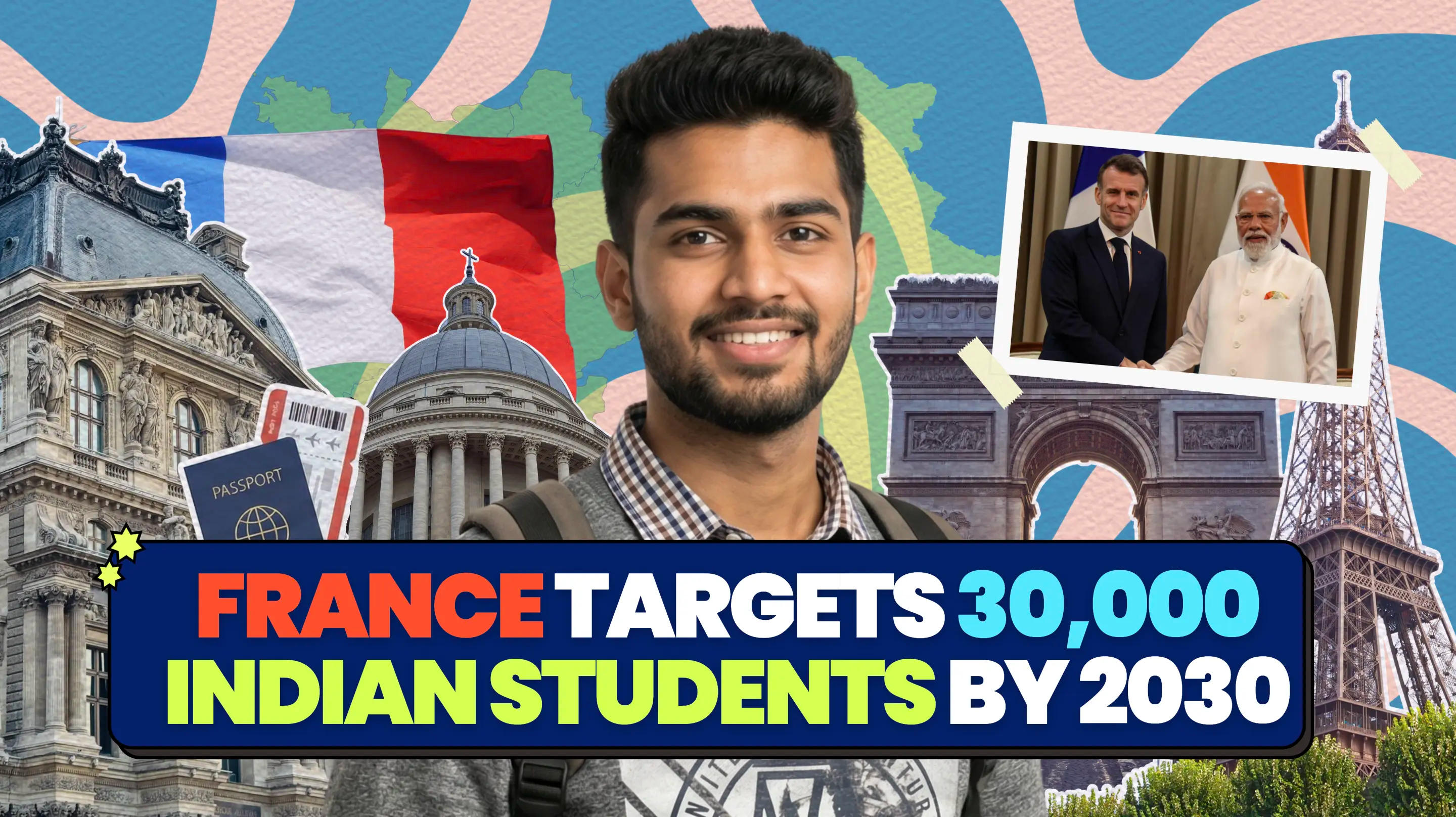
The dream of walking down the cobblestone streets of Paris or researching in the high-tech labs of Toulouse has never been closer for Indian students. In a landmark series of announcements during President Emmanuel Macron's official visit to India from February 17 to 19, 2026, France signaled a massive shift in its international education strategy. By 2030, France aims to welcome 30,000 Indian students annually, a nearly threefold increase from current numbers.
This isn't just about a higher target, it's about making the journey smoother. With the introduction of a pilot visa-free transit program and streamlined residency rules announced this month, the "Special Global Strategic Partnership" between India and France is moving from diplomatic tables to university lecture halls.
The 2026-2027 Shift: Why France is Winning
As of February 2026, the global education landscape has shifted. While traditional destinations like the UK and Canada have introduced stricter migration caps, France is rolling out the red carpet. During the high-level talks in New Delhi, President Macron and PM Narendra Modi elevated bilateral ties, ensuring that education and innovation are the core pillars of the next decade.
The current scenario is defined by two major pillars: accessibility and innovation. The requirement to be fluent in French is no longer a barrier to entry. With the launch of the India-France Year of Innovation 2026, the country is expanding its Classes Internationales (International Classes). These are one-year foundation programs designed exclusively for Indians, allowing students to start their degree in English while receiving intensive French language training. You don't need to speak French on day one; they'll teach you.
Breaking Down the New Visa-Free Transit Pilot (2026)
One of the most significant updates from the February 2026 visit is the Visa-Free Transit facility. Previously, Indian nationals transiting through French airports to reach non-Schengen destinations (like the USA or Canada) often required an Airport Transit Visa (ATV). That was an extra headache, extra paperwork, extra fees, extra stress.
Under the new six-month pilot program launched in February 2026, the requirement for an Airport Transit Visa has been dropped for Indian passport holders. You can now pass through the international zones of any French airport, such as Paris-Charles de Gaulle, without the extra paperwork or fees. This makes France the most convenient gateway for Indian travelers heading to the West. Flying to New York via Paris just got significantly easier.
Streamlined Student Visas: Practical and Faster
President Macron addressed a major pain point for Indian students: bureaucracy. In his February 2026 speech at AIIMS Delhi, he promised that visa procedures would be simplified and practical. Here's what that actually means:
1. Course-Aligned Visas: Long-term student visas will now match the actual length of the academic course. If a PhD takes three years, the visa will be granted for three years upfront, ending the cycle of stressful annual renewals. No more renewing your visa every 12 months while trying to finish your research.
2. Faster Processing: The French Embassy is streamlining the sourcing process with universities to ensure admissions and visa approvals are faster than ever.
3. The 5-Year Alumni Golden Ticket: The benefit for Indian alumni remains strong. Any Indian student who has completed at least one semester of a Master's degree (or higher) in France is eligible for a 5-year multi-entry Schengen visa, allowing them to maintain professional and personal ties across 29 European countries. That's access to most of Europe for five years, for business, travel, or networking.
The Financial Landscape: Cost of Study in 2026-2027
France continues to be one of the most cost-effective global destinations due to government-subsidized tuition. Here's a breakdown of what to expect for the 2026-2027 intake:
Expense Category | Public Universities (Annual) | Private/Business Schools (Annual) |
| Bachelor's Tuition | €2,770 (~₹2,51,300) | €7,000 – €18,000 (~₹6,35,000 - ₹16,33,000) |
| Master's Tuition | €3,770 (~₹3,41,800) | €8,000 – €25,000 (~₹7,25,000 - ₹22,68,000) |
| PhD Tuition | €380 (~₹34,400) | Often Funded |
| Monthly Living Cost | €700 – €1,000 (~₹63,500 - ₹90,700) | €1,000 – €1,500 (~₹90,700 - ₹1,36,000) |
Note: Conversions are based on February 2026 exchange rates where 1 EUR ≈ ₹90.72.
Look at those PhD fees, ₹34,400 per year at a public university. That's less than many Indian private colleges charge per semester. And that Master's tuition of ₹3.4 Lakhs? That's the total cost, not per semester.
Innovation Hubs: AI and Healthcare 2026
The partnership isn't just about traditional degrees. Several new initiatives were launched during the February 2026 visit:
1. Indo-French Centre for AI in Health: Launched at AIIMS New Delhi, this center creates massive research opportunities for med-tech and science students. If you're interested in how AI can revolutionize healthcare, this is where it's happening.
2. Mumbai Innovation Hub: A new campus bringing together ESSEC Business School and CentraleSupélec has been welcomed to foster business and engineering excellence. That's two top French institutions setting up shop in Mumbai.
3. Digital Science Centre: A new binational center between INRIA (France) and India's Department of Science and Technology is set to open, focusing on cutting-edge digital research.
Navigating Your Journey to France
If you're planning your intake for late 2026 or 2027, the steps are clearer than ever:
1. Look for Classes Internationales: If you don't speak French yet, these programs are your best bet to integrate into the French system seamlessly. They're designed specifically for international students like you.
2. Utilize CAF Subsidies: France remains the only country providing housing subsidies (CAF) to international students, which can return €100–€200 (~₹9,000 - ₹18,000) of your monthly rent. That's real money back in your account every month, not a loan, not a scholarship you have to compete for, just a government subsidy that everyone gets.
3. Check for Scholarships: With 2026 being the Year of Innovation, additional funding of €3.5 million (~₹31.7 Crores) has been announced for university cooperation and grants. More money in the system means more scholarships available.
4. Language Barrier is a Myth: With over 1,600 programs in English, you can focus on your degree while the "International Classes" help you pick up French for the job market. French is useful for working in France post-graduation, but it's not required to study there.
The Bottom Line
The February 2026 announcements have changed the game. France is no longer just a romantic getaway but a strategic launchpad for Indian students. With visa-free transit, course-aligned stay permits, and a focus on AI and innovation, the barriers to entry have never been lower.
If you've been looking for an affordable, high-quality, and welcoming alternative to traditional study abroad destinations, 2026 is the year to say "Oui" to France.
Ready to explore your options in France? Book a free consultation with a Leap Scholar expert today.

Kirti Singhal
Kirti is an experienced content writer with 4 years in the study abroad industry, dedicated to helping students navigate their journey to international education. With a deep understanding of global education systems and the application process, Kirti creates informative and inspiring content that empowers students to achieve their dreams of studying abroad.
Users also read

Vietnam Steps Into the Global Academic Spotlight at APAIE 2026: And Indian Students Should Pay Attention
Vietnam Steps Into the Global Academic Spotlight at APAIE 2026: And Indian Students Should Pay Attention
Indian Passport Fees Rise From July 1, 2026. Here Is What It Means If You Plan to Study Abroad.