Blogs
Blogs  Leap Digest
  Events
  About Us
 Expert Insights
Government Universities in Singapore for Indian Students: Your 2026–2027 Success Guide
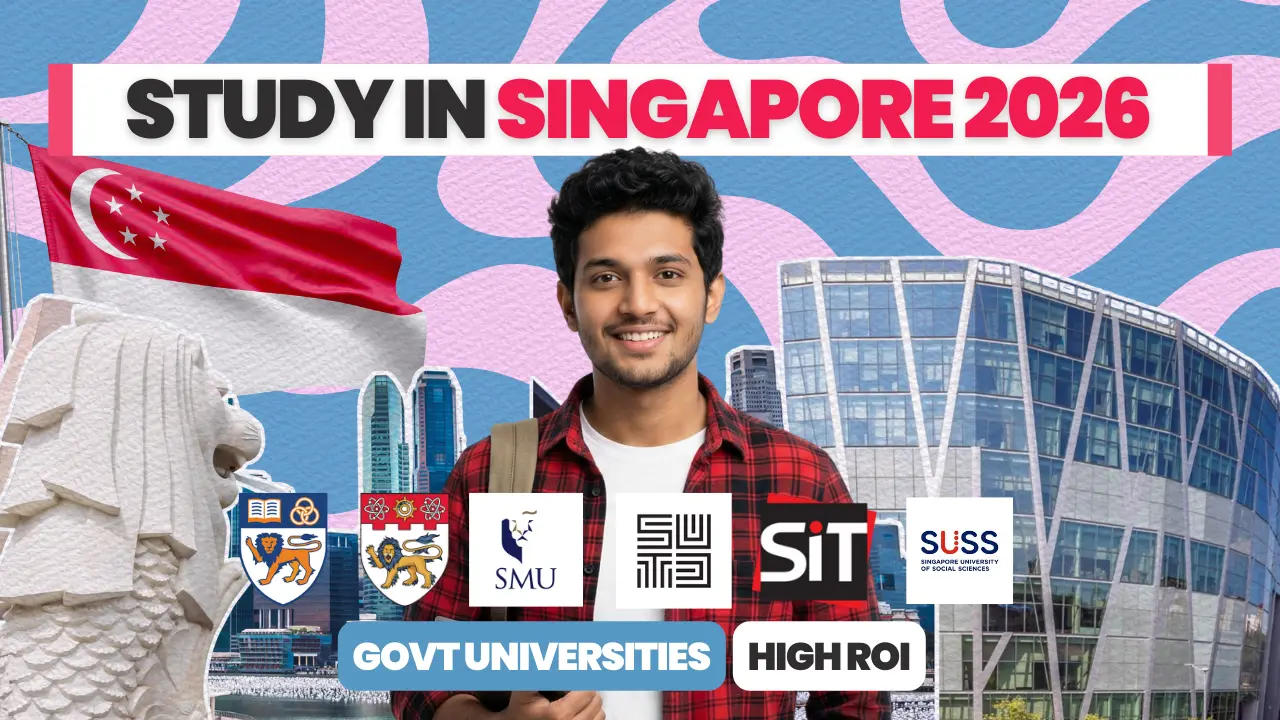
Thinking about studying abroad in 2026? While the US and UK often dominate the conversation, a quiet powerhouse has been rising right in our backyard. Singapore, known as the "Global Schoolhouse," has transformed into a premier destination for Indian students. With world-class rankings, cutting-edge AI-integrated curricula, and a culture that feels like a "home away from home," the 2026 intake is shaping up to be the most exciting one yet.
Let’s see why Singapore's government universities are more than just an academic choice, they're a strategic career move.
Why Singapore is the Smart Choice for 2026
The 2026–2027 academic landscape is shifting, making Singapore a stable and high-ROI alternative to Western destinations. Here is why it stands out for Indian students:
- Stable & Welcoming Environment: As global visa regulations tighten in many Western countries, Singapore remains a reliable and accessible destination for international students.
- Global Exposure Close to Home: You can gain the same level of global exposure found in hubs like London or New York, while remaining just a 4-to-5-hour flight from India.
- Living Laboratory for Innovation: Through the "Smart Nation 2.0" initiative, Singapore is investing billions in the future. Students in Computer Science, Sustainability, or Fintech don't just study these trends in textbooks, they live in a city that is actively building them.
- Academic Excellence: National institutions like NUS and NTU consistently rank in the Global Top 15, competing directly with prestigious universities like Yale and Oxford.
- Strategic Financial Advantage: The MOE Tuition Grant can reduce your fees by nearly 50%. By agreeing to work in Singapore for three years post-graduation, you secure both financial aid and a guaranteed pathway to international work experience.
The "Big Six": Exploring Singapore's Public Universities
Singapore has six autonomous government universities, each with a distinct personality. Here's the breakdown for the 2026 cycle:
1. National University of Singapore (NUS)
NUS is the heavyweight champion. Ranked #8 globally (QS 2026), it's the highest-ranked university in Asia. For 2026, keep an eye on their College of Design and Engineering (CDE), which has revamped its curriculum to be more flexible and industry-aligned.
Best for: Computer Science, Medicine, Law, and Business.
2026 Reality Check: Aim for 95%+ in CBSE/ISC to be truly competitive. Yes, the bar is high, but that's exactly why the degree carries so much weight.
2. Nanyang Technological University (NTU)
Ranked #12 globally, NTU is a haven for STEM lovers. In 2026, NTU is doubling down on "Double Majors," such as AI and Society or Process Engineering and Synthetic Chemistry. Their campus is also one of the most beautiful "green" campuses in the world, seriously, it feels more like a botanical garden than a university.
Best for: Engineering, Data Science, and Communication Studies.
3. Singapore Management University (SMU)
Located right in the heart of the city, SMU follows a seminar-based learning approach. There are no "back benchers" here; everyone participates. If you want to work in the Central Business District (CBD), you're literally across the street from your future employers. That networking advantage is real.
Best for: Business Management, Accountancy, and Economics.
4. Singapore University of Technology and Design (SUTD)
Established in collaboration with MIT, SUTD is for the innovators. It doesn't have traditional "departments"; it has "pillars." It's highly collaborative and focuses on design-thinking. If you're the kind of person who thinks differently, SUTD might be your perfect match.
Best for: Architecture, Sustainable Design, and AI-driven Engineering.
5. Singapore Institute of Technology (SIT) & Singapore University of Social Sciences (SUSS)
SIT is the "Applied Learning" university, perfect if you prefer hands-on projects and industry placements over pure theory. SUSS focuses on social sciences and lifelong learning, making it great for students interested in human services and community leadership.
2026 Admission Requirements for Indian Students
If you're aiming for 2026, your preparation starts now. Here's what the "Big Six" generally look for from Indian applicants:
Academic Excellence: For NUS and NTU, Indian students from CBSE/ISC boards usually need 90-95%+ for competitive courses. I know that sounds intense, but remember—you're competing for spots at Asia's top universities.
Entrance Exams:
- JEE Advanced: While not mandatory, a good rank is highly valued by NUS/NTU
- SAT/ACT: Strictly required by SMU; optional but highly recommended for others to boost your profile
- GRE/GMAT: Mandatory for most Master's programs
English Proficiency: If you scored above 85-90% in English in Class 12, some universities may waive the IELTS/TOEFL requirement. However, having a score of IELTS 7.0+ or TOEFL 100+ is always the safer bet for 2026. Don't leave this to chance.
Comparison of Government Universities (2026 Estimates)
University | QS World Rank (2026) | Application Deadline (Aug '26 Intake) | Est. Annual Subsidized Fee (INR) |
| NUS | #8 | 23 February 2026 | ₹11L – ₹18L |
| NTU | #12 | 19 March 2026 | ₹11L – ₹17L |
| SMU | Top 500 (Elite Biz) | 19 March 2026 | ₹15L – ₹22L |
| SUTD | Top 50 (Emerging) | 2 March 2026 | ₹17L – ₹23L |
| SIT | Applied Leader | 19 March 2026 | ₹12L – ₹16L |
| SUSS | Social Sciences Leader | 19 March 2026 | ₹11L – ₹15L |
Note: Fees are based on current projections and include the MOE Tuition Grant subsidy. Non-subsidized fees are typically 2x higher.
Most applications for the August 2026 intake open in late 2025 and close by February or March 2026. Mark these dates now.
The Financial Outlook: Costs vs. ROI
Singapore isn't "cheap," but it's incredibly "cost-effective." The MOE Tuition Grant is the game-changer here. By opting for this, the Singapore government pays a substantial portion of your fees. In return, you sign a "bond" to work for a Singapore-registered company for 3 years after graduation.
This isn't just a subsidy; it's a guaranteed pathway to international work experience. Think about it, you're getting subsidized education AND a clear path to employment in one of Asia's most dynamic economies.
For Indian families, the return on investment (ROI) is incredibly high. A starting salary for an NUS Computer Science graduate can be around SGD 5,000 – 6,000 per month (approximately ₹3.1L – ₹3.7L). Compared to the cost of education, you could potentially break even within 2–3 years of working.
The 2026 Job Market: The COMPASS Framework
A major benefit for 2026 graduates is the clarity of the COMPASS (Complementarity Assessment Framework) system, which became active on January 1, 2026. Under this points-based system for Employment Passes (EP), graduates from "Top-Tier Institutions" (which includes all six public universities) automatically earn 20 points.
Since you need 40 points to qualify for a work pass, your degree from a Singaporean government university does half the heavy lifting for your visa. That's a massive advantage when you're competing in the job market.
The Bottom Line
Stepping into a Singaporean university in 2026 is about more than just a degree; it's about joining a global elite. Yes, the admission process is competitive, and yes, the standards are high, but that's exactly why the degree is so valuable.
The application window for 2026 is rapidly approaching. Between drafting your Statement of Purpose (SOP) and managing your board exam prep, it's easy to feel overwhelmed. But remember: every hurdle is just a step toward a much larger world. With the right strategy and a bit of early planning, those gates at NUS or NTU are well within your reach.
There's a massive shift happening in 2026 toward Interdisciplinary Degrees and AI-focused programs across all public universities. If you've been thinking about combining fields, like AI and Business, or Engineering and Design, this is your moment.
Ready to Start Your 2026 Journey?
The competition for Singapore's top universities is fierce, but you don't have to navigate it alone. From shortlisting the right courses to perfecting your application for the MOE Tuition Grant, having the right guidance makes all the difference.
Book a free 1-on-1 profile evaluation with a Leap Scholar expert today and get a personalized roadmap for your 2026 Singapore application.

Kirti Singhal
Kirti is an experienced content writer with 4 years in the study abroad industry, dedicated to helping students navigate their journey to international education. With a deep understanding of global education systems and the application process, Kirti creates informative and inspiring content that empowers students to achieve their dreams of studying abroad.
Users also read

Top 10 Industries That Create the Most Billionaires in 2026: Guide for Indian Students

Stanford MBA Career Diversity: Industries, Salaries and What Indian Students Need to Know

Anthropic Academy: 16 Free AI Courses With Certificates in 2026 That Indian Students Cannot Afford to Ignore