Blogs
Blogs  Leap Digest
  Events
  About Us
 Expert Insights
The 2026 Germany Strategy: Low-Cost Tuition, Fast PR, and High STEM Demand
If you're an Indian student looking at a Master's degree abroad, you're currently facing a $75,000 question: How do I secure a world-class degree and a stable immigration future without drowning in loans?
As Indian students face growing uncertainty and rising costs in traditional destinations like Canada and the UK, Germany is emerging as a strong alternative.
You've probably heard about "free education" and "easy PR" in Germany. Let's separate the facts from the hype.
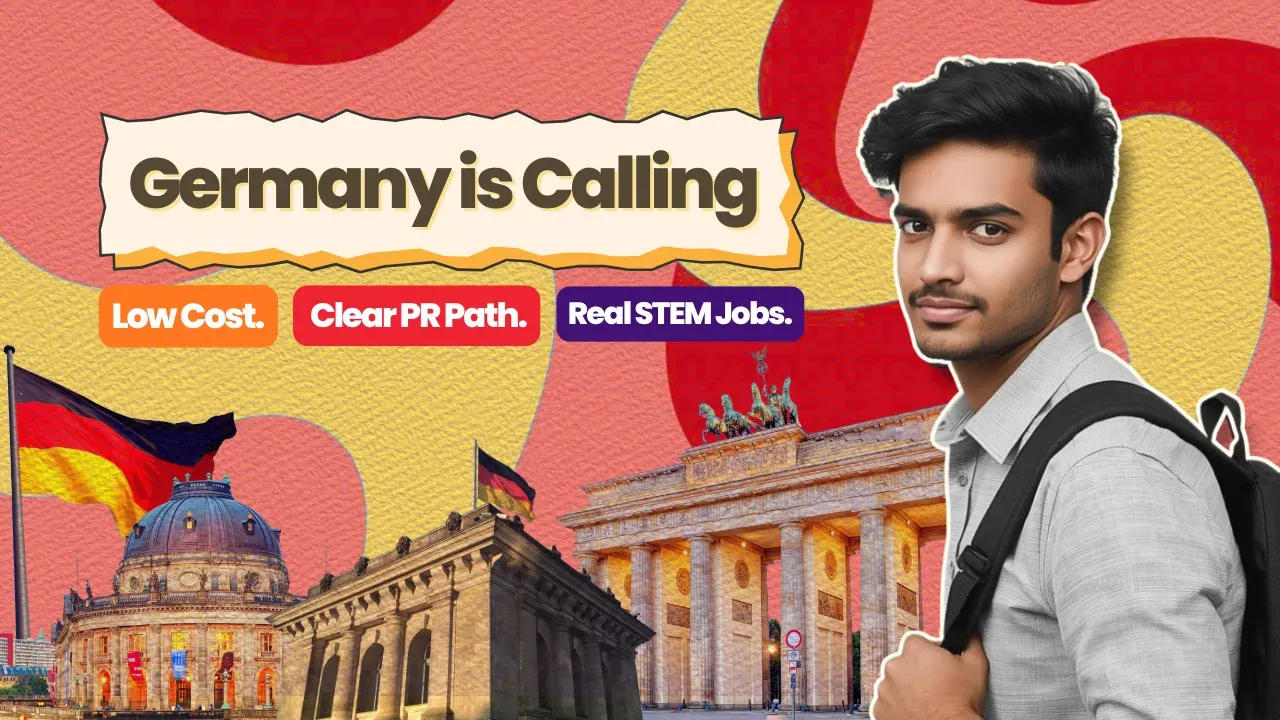
The path to success in Germany isn't easy, but it is strategic. With a clear plan, Germany offers world-class education at a fraction of typical costs, one of the fastest permanent residency pathways globally, and access to a booming high-tech job market.
Here's the complete 2026 strategy for Indian students, based on verified information.
The "Free Tuition" Reality: What You Actually Pay
The "free tuition" claim is mostly true, but there are important details you need to know.
What's Actually Free:
- Over 300 public universities in Germany charge no tuition fees for Bachelor's and most Master's programs (especially consecutive Master's degrees, which follow directly from a related Bachelor's). The benefit is equally applicable to domestic as well as international (non-EU) students.
- This helps in eliminating the largest financial barrier - the €10,000 to €40,000 annual tuition fees, a commonality among countries like the US, UK, and Australia.
What You Must Pay
The real cost isn't tuition. It's two other mandatory expenses.
1. The Blocked Account (Sperrkonto)
This is the biggest financial requirement for your visa. You must prove you can support yourself.
- 2025/2026 requirement: €11,904 (approximately ₹10.6 Lakhs) must be deposited into a special blocked bank account before you apply for your visa.
- How it works: You can only withdraw €992 (approximately ₹88,000) per month while in Germany. This ensures you have consistent living expenses throughout the year.
2. The Semester Contribution (Semesterbeitrag)
This is a mandatory administrative fee paid to the university every six months.
- Cost: Between €100 and €400 (approximately ₹9,000 to ₹36,000).
- The benefit: This fee is exceptional value. As of 2024/2025, most public universities include the Deutschlandsemesterticket, which gives you unlimited access to all local transport across the entire country, not just your city. This saves you hundreds of euros on transportation.
Important Exceptions: Where You Pay Tuition
Not all German universities are tuition-free for international students.
- Baden-Württemberg state: Cities like Stuttgart and Heidelberg charge non-EU students €1,500 (approximately ₹1.34 Lakhs) per semester.
- Technical University of Munich (TUM): One of the top choices for Indian students, TUM charges non-EU students between €2,000 and €6,000 per semester depending on the program.
Always verify tuition policies for your specific university and program before applying.
The Fast Track to Permanent Residency: 21-24 Months
This is Germany's biggest advantage over other countries. While most destinations require 5+ years, Germany offers one of the world's fastest pathways to permanent residency.
Here's the step-by-step process:
Step 1: Graduate from Your German University
Complete your Master's degree from a German university.
Step 2: Get the 18-Month Job Seeker Visa
Immediately after graduating, you receive an 18-month residence permit specifically to find a job matching your qualifications. This gives you plenty of time without visa pressure.
Step 3: Secure a Job and Get the EU Blue Card
Once you land a job in your field (engineering, IT, data science, etc.), you apply for an EU Blue Card, Germany's special work visa for highly skilled professionals.
Salary requirement for 2025: For shortage occupations (all STEM, IT, and MINT roles), the minimum annual salary is €43,759.80 (approximately ₹39 Lakhs). This is lower than the standard Blue Card threshold.
Step 4: Apply for Permanent Residency (The Fast Track)
Here's where it gets interesting. As a German university graduate with an EU Blue Card, you have multiple accelerated pathways:
- Standard Blue Card path: Permanent residency after 27 months of employment with basic A1 German language skills.
- Fast track with B1 German: Permanent residency in just 21 months if you demonstrate B1-level German proficiency.
- German graduate special path: As a German university graduate working in your field with B1 German, you can qualify for PR in 24 months (2 years).
The timeline: From student to permanent resident in as little as 21-24 months after starting your first job. This level of stability and speed is unmatched by other major study destinations.
Why Germany Needs You: The Skills Shortage (Fachkräftemangel)
Germany's generous PR policies exist because the country faces a massive skills shortage, called Fachkräftemangel. They urgently need skilled graduates.
The job market for STEM professionals is booming, with over 137,000 open IT positions alone.
High-Demand Fields for 2026
- IT & Tech: Software developers, data scientists, AI engineers, and cybersecurity experts are in huge demand. Berlin's startup scene often operates primarily in English.
- Engineering: Germany is an industrial powerhouse. Mechanical, electrical, and automotive engineers are the backbone of its economy and are consistently in demand.
- Green Economy: Germany is investing billions in renewable energy. Engineers with expertise in solar, wind, environmental technology, and sustainable systems are extremely sought after.
- Healthcare & Life Sciences: Medical technology, pharmaceuticals, and biotechnology sectors are growing rapidly.
The Language Reality: English vs. German
Let's be honest about language requirements.
- For IT jobs in Berlin: You can find positions operating primarily in English, especially at startups and international companies.
- For long-term career growth in most of Germany: You need German. About 90% of German companies operate primarily in German, even if they have some English-speaking employees.
Your Strategic Approach
- Choose an English-Taught Program (ETP) for your Master's degree
- Use those two years to attend the university's German language classes (often free or heavily subsidized)
- Aim to graduate with both your degree and a B1 German certificate
- This combination makes you the most valuable and hireable candidate
Why B1 matters: Beyond career advantages, B1 German unlocks the 21-month fast track to permanent residency. It's worth the investment.
Living Costs Beyond the Blocked Account
While the blocked account covers €992 per month, here's what that actually means for your budget:
- Rent: €300-500 in smaller cities, €500-800 in major cities (student housing is cheaper)
- Food: €200-250 per month
- Health insurance: €110 per month (mandatory for students)
- Transportation: Covered by your semester contribution in most cities
- Personal expenses: €100-200
- Total realistic monthly budget: €800-1,000, which fits within your blocked account withdrawal limit.
Your Action Plan for 2026
Step 1: Research universities offering tuition-free programs in your field. Focus on public universities outside Baden-Württemberg to avoid tuition fees.
Step 2: Prepare financially. Start saving for the blocked account (₹10.6 Lakhs) well in advance.
Step 3: Learn basic German before arrival. Even an A1 level helps with daily life and shows commitment.
Step 4: Apply early. German universities have specific application deadlines (typically July 15 for the winter semester, January 15 for the summer semester).
Step 5: Plan your language learning. Enroll in German courses as soon as you arrive. Aim for B1 by graduation.
Step 6: Network during your studies. Join student organizations, attend industry events, and connect with professionals in your field.
Germany offers a compelling package for Indian students: low-cost education at world-class universities, clear pathways to employment in high-demand fields, and one of the fastest routes to permanent residency in any developed country.
The challenges are real. You need to arrange the blocked account funds upfront, commit to learning German, and navigate a different education system. But for students willing to make those investments, Germany provides exceptional long-term stability and career prospects.
The strategy is clear: get a low-cost degree, learn German to B1 level, secure employment in a high-demand field, and access the 21-month fast track to permanent residency.
Ready to build your Germany strategy? Talk to a Leap Scholar expert today to find the right public university, understand the application process, and plan your language-learning journey.

Kirti Singhal
Kirti is an experienced content writer with 4 years in the study abroad industry, dedicated to helping students navigate their journey to international education. With a deep understanding of global education systems and the application process, Kirti creates informative and inspiring content that empowers students to achieve their dreams of studying abroad.
Users also read

Top 10 Industries That Create the Most Billionaires in 2026: Guide for Indian Students

Stanford MBA Career Diversity: Industries, Salaries and What Indian Students Need to Know

Anthropic Academy: 16 Free AI Courses With Certificates in 2026 That Indian Students Cannot Afford to Ignore