Blogs
Blogs  Leap Digest
  Events
  About Us
 Expert Insights
Why Germany Cannot Fill 70% of Its Open AI Roles - And What That Means for Indian STEM Graduates
Something fundamental is shifting in the global job market - and the numbers make it impossible to ignore.
By 2030, 92 million jobs will disappear - data entry, routine administration, repetitive manufacturing. The work that has employed millions of graduates across the world for the past two decades is being automated at scale. In its place, 78 million new roles are being created - almost entirely in AI, machine learning, and advanced engineering (World Economic Forum, Future of Jobs Report 2025).
And that is precisely where the opportunity lies for Indian students- the countries with the most urgent demand for these roles are not the ones with the supply to meet it.
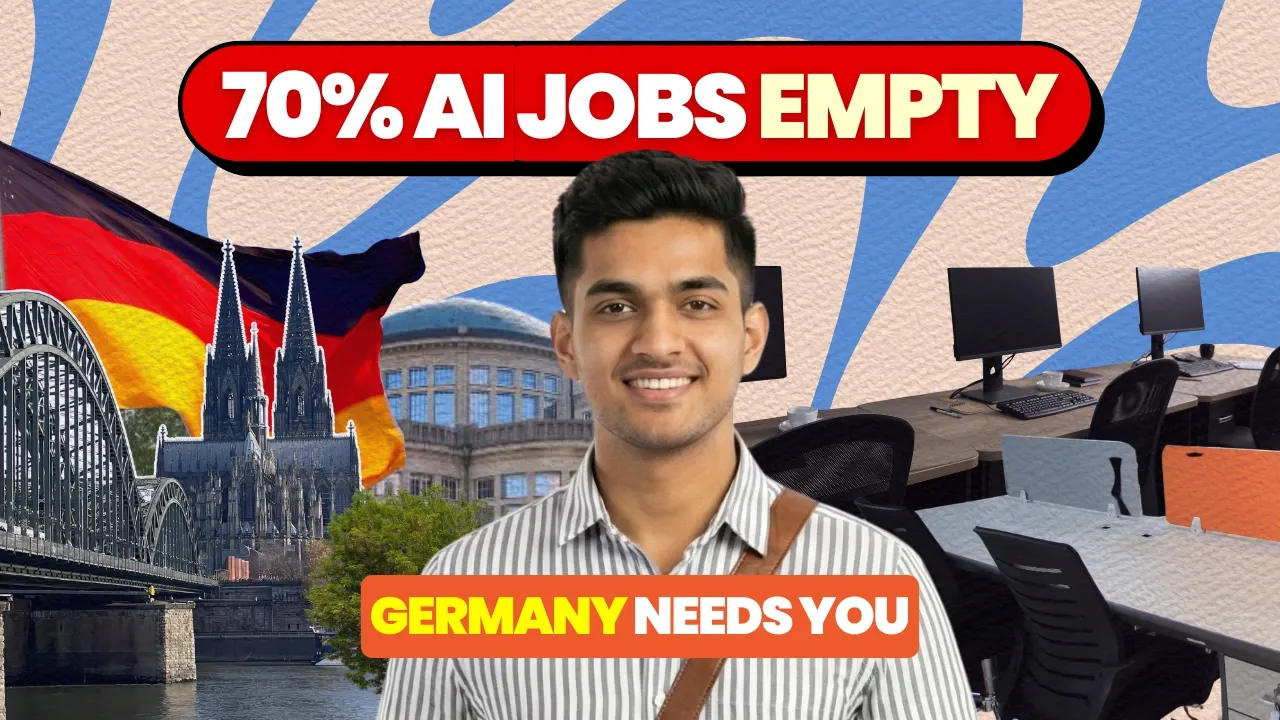
In Germany alone, 70% of AI roles are projected to go unfilled by 2027 - 190,000 to 219,000 open positions, with only 62,000 professionals available to fill them. (Bain & Company, AI Talent Gap Report, March 2025) 109,000 IT roles sit vacant today, with 85% of German companies reporting they cannot find the specialists they need. (Bitkom e.V., August 2025)
This is not a hiring slowdown. It is what happens when industrial demand compounds faster than any country can produce the talent to meet it. Germany is not short on jobs. It is short on people to run them.
This is not just Germany’s Problem
The AI skills gap is a global structural failure. ManpowerGroup's 2026 survey of 39,063 employers across 41 countries found that AI model development and AI literacy have overtaken all other skills as the hardest to find globally - for the first time in the survey's history. The demand exists everywhere. The supply does not.
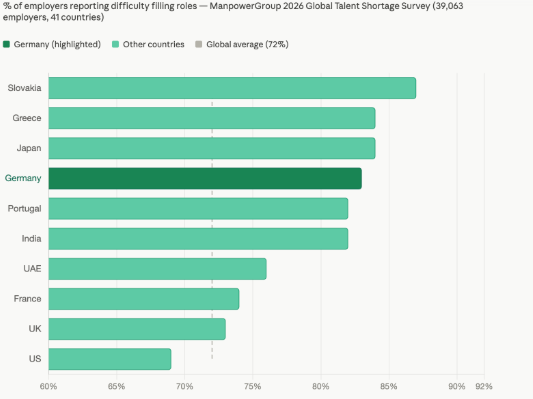
Germany ranks 4th on this chart, behind Slovakia, Greece, and Japan. But as the Bain data established, Germany's AI-specific gap is starker than its general ranking suggests - and that gap is not what makes it the most compelling destination for Indian STEM graduates either. It is the combination that no other country in this list offers simultaneously: near-zero tuition, a fully reformed immigration system, English-taught programs at Master's level, a sub-two-year investment break-even, and a permanent residency pathway within 21-33 months of graduating.
Slovakia and Greece rank higher on shortage - but offer no practical entry point for international graduates and lack the industrial ecosystem to match.
Japan has both the gap and the industrial demand - but Japanese fluency is required for nearly all professional roles, and immigration pathways remain structurally limited (OECD Employment Outlook 2025, Japan; IMF Working Paper WP/25/184, September 2025)
The US has the door but tuition runs $31,880 per year at public universities for out-of-state students and up to $45,000 at private ones - ₹28-40L per year in fees alone, before living costs. (College Board - Trends in College Pricing and Student Aid 2025)
France has near-zero tuition - but requires French fluency for most programs and professional environments. The UK has manageable language access but master's tuition for international students runs £15,000-£40,000 per year - ₹17-44L per year in fees alone, before living costs (UKCISA - UK Council for International Student Affairs)
Germany is the only country where all four conditions align simultaneously: an open gap, an open door, near-zero cost, and an accessible language of instruction.
How Germany built a gap it cannot close from within
To understand why Germany is short 190,000 AI engineers, we need to further understand what Germany is trying to become.
Germany invests over 3% of its GDP in research and development - one of the highest rates in the EU (Destatis; World Bank, R&D Expenditure Data). It is simultaneously mid-transition into Industry 4.0: an economy being rebuilt around smart factories, AI-integrated manufacturing, and automated industrial systems. In practical terms, this means production lines are becoming self-optimising - machines that learn from data, communicate with each other, and run with minimal human intervention.
The AI and engineering talent this transition demands is compounding faster than any domestic pipeline can respond to. There are three structural reasons:
An ageing workforce. 1 in 5 Germans is already of retirement age. By 2035, that rises to 1 in 4. (Destatis, Population Projections) Germany's engineering talent pool is ageing out faster than it is being replaced - and has been for over a decade.
Demand outpacing university output. 40% of German manufacturing companies already cannot find workers skilled in AI and robotics (Straits Research -
Germany Industry 4.0 Market Report, 2024, citing BMBF 2024 data). The transformation is moving faster than universities can retrain graduates for it.
A historically closed immigration system. For decades, Germany's skilled worker immigration framework was slow, bureaucratic, and heavily credential-dependent. Qualified professionals from outside the EU faced months of qualification recognition delays before they could legally begin work. The system was built for a different era and it held until the gap became too large to manage from within.
The result: a country with the infrastructure, the investment, and the industrial ambition - but not enough people to run it.
Then Germany did something it had never done before
Between November 2023 and June 2024, Germany overhauled its entire immigration framework in three phases under the Fachkräfteeinwanderungsgesetz (Skilled Immigration Act):
Phase 1 - November 2023: Reformed the EU Blue Card with lower salary thresholds, removing the requirement for jobs to match specific qualification fields. International graduates can now enter any role that fits their skills, not just those that map to a credentialed specialism (Make it in Germany - EU Blue Card).
Phase 2 - March 2024: Introduced the recognition partnership pathway. Candidates can now start work while their foreign qualifications are still being processed, eliminating months of waiting that previously blocked entry (Make it in Germany - Recognition Partnership)
Phase 3 - June 2024: Launched the Chancenkarte - a points-based job seeker visa giving international graduates up to 12 months in Germany to find work, with part-time work rights during the search. International students simultaneously gained the right to work 140 full days per year - up from 120. (Make it in Germany - Chancenkarte, Studying in Germany, March 2024).
One year in, the Federal Ministry of the Interior confirmed that numbers of foreign skilled workers and students had risen considerably (Federal Ministry of the Interior, Germany - Skilled Immigration Act review, December 2024)
For an Indian STEM graduate, this is not a side door. It is a front door that has been deliberately, structurally widened. Germany didn't just acknowledge the shortage, it redesigned its immigration system around solving it.
The question is no longer whether the door is open. It is who walks through it.
India is overproducing degrees, not skills - and that's Germany's gain
India graduates 1.5 million engineers a year. 83% leave without a job offer (Unstop Talent Report 2025, via Business Standard). The national graduate employability rate sits at 54.81% as per the Wheebox India Skills Report 2025, published with AICTE and CII.
Nearly half of all graduates are economically unplaced - not because they are unqualified, but because the roles they were trained for are disappearing.
AI is accelerating this. The entry-level roles that absorbed millions of Indian graduates over the past two decades - data entry, back-office processing, routine software testing, basic IT support - are being automated at scale. Indian IT services companies have already cut entry-level roles by 20-25% due to automation (EY, November 2025 - cited via Rest of World, December 19, 2025). Entry-level hiring at the 15 largest tech companies has fallen by more than 50% since 2019 (SignalFire - State of Tech Talent Report 2025)
On the other side of that displacement sit roles in AI engineering, ML systems, data architecture, and industrial automation - precisely the skills Germany cannot find enough of. The Deloitte-NASSCOM report projects India's AI talent pool will grow from 650,000 to over 1.25 million by 2027 - but with the AI market expanding at 25-35% annually, demand is outpacing even that growth.
Indian students in Germany have grown by 214% since 2016 - making India the largest international student cohort in the country, per DAAD 2025. They did not arrive by accident. They ran the numbers.
The cost is real. So is the return.
The 2-year master's in AI, Data Science, or Engineering is the most practical entry point for Indian graduates.
Germany's public universities charge near-zero tuition - a semester fee of ₹11,000-₹44,000 per term, per the DAAD - Germany's official academic exchange service. The total 2-year all-in investment runs ₹22-26L. The starting salary for AI and Data Science roles ranges from ₹49-71 LPA (€45,000-€65,000). After German income tax and rent, most graduates are saving ₹1.5-2 lakh per month - clearing the full investment in 11 to 26 months depending on role and city.
For context, IIT Delhi's MTech AI median sits at ₹14 LPA. Germany's entry-level is 4-5x that, on a degree that costs roughly the same as a private engineering college in India.
Sources: IIT Delhi fee structure 2025-26; NIRF 2025; Leap Scholar MS Germany Cost Guide, April 2026; Glassdoor Germany, March 2026; StepStone Gehaltsreport 2025; Destatis; €1 = ₹110, April 2026
Depending on role and city, most graduates clear the full ₹22-26L investment within 11 to 26 months - and all three salary scenarios clear the EU Blue Card threshold of €45,934 for IT and engineering roles (EU Blue Card - Make it in Germany, official portal).
What About German?
The most common objection to Germany over the US or UK is language. As of 2025, nearly 2,400 English-language master's programs are available at German public universities (DAAD, 2025).
International students do not need German to get in or to complete the degree. At the entry level, roles at German MNCs - Bosch, SAP, Siemens, BMW, operate largely in English, particularly in engineering and tech functions.
German becomes important at mid-senior levels, but most graduates reach that point two to three years into their career - by which time they have had a full working life in Germany to learn it. B1 proficiency, the level needed for professional fluency, takes around 6-9 months of structured learning. Most students begin a language course in their first semester and reach B1 by graduation (Goethe-Institut course structure; DAAD language programme guidance).
| Path 01 | Path 02 | Path 03 |
| Stay abroad | Study, work, then decide | Return to India |
| ₹49-71 LPA (€45,000-€65,000) in Year 1 (median: ~₹63L / €55K) | €50K+ (≈ ₹55L+) | ₹20-35 LPA (≈ €18K-€32K) |
Highest immediate earning potential. Investment of ₹22-26L recovered in ~11-26 months. PR via EU Blue Card in ~21-33 months. | Work 2 to 3 years before making a long-term decision. ₹1.52L saved monthly. Full investment recovered within this period. | 2 to 3 years of German AI/engineering experience leads to strong roles in India. Strong demand across 1,800+ German MNCs (Bosch, Siemens, SAP, BMW) that value system familiarity. |
Sources: Germany Trade & Invest (GTAI) (1,800+ German companies operating in India) · Zinnov & Indo-German Chamber of Commerce (AHK India) - Germany's India Advantage, October 2025 (80+ German firms, 150+ GCCs, 130,000+ professionals employed in India)
Where does this leave Indian STEM graduates
As of early 2026, approximately 260,000-280,000 Indians live in Germany, including roughly 208,000 NRIs, according to the Ministry of External Affairs - making it one of the fastest-growing Indian migrant communities in Europe, having more than tripled over the past decade (SWP Berlin). This is what it looks like when demand meets supply across borders.
Germany's shortage is not temporary. Its demand is compounding. And its system is now designed to absorb external talent. It now sits at the sharpest edge of that global failure - the country with the most urgent industrial need, the clearest policy response, and the widest open door. Near-zero tuition. ₹49-71 LPA to start - depending on role, city, and profile. A job market actively short of exactly the skills Indian STEM graduates carry. A visa structure that lets one stay, save, and build - or return with the experience that commands a premium in any market.
Sources
- World Economic Forum - Future of Jobs Report 2025 (92M jobs displaced; 78M new roles by 2030)
- Bain & Company - AI Talent Gap Report, March 2025 (70% of Germany's AI roles unfilled by 2027; 190,000-219,000 open roles)
- Bitkom e.V. - Official Press Release, August 2025 (109,000 open IT positions; 85% companies reporting shortage)
- ManpowerGroup - 2026 Global Talent Shortage Survey (83% of German employers reporting shortage - #4 of 41 countries surveyed; global average 72%)
- IMF Working Paper WP/25/184 - The Impact of Aging and AI on Japan's Labour Market, September 2025
- OECD Employment Outlook 2025 - Japan country note (Working-age population declined 16% since 1995; projected to fall 31% by 2060)
- Federal Ministry of the Interior, Germany - Skilled Immigration Act review, December 2024
- Make it in Germany - EU Blue Card (official portal)
- Make it in Germany - Recognition Partnership (official portal)
- Make it in Germany - Chancenkarte (official portal)
- Studying in Germany - International student employment freedoms, March 2024
- Unstop Talent Report 2025 - via Business Standard (83% engineering graduates without job offer)
- DAAD - Official Press Release, November 2025 (59,000 Indian students in Germany; 214% rise since 2016)
- IIT Delhi - Official Fee Structure 2025-26
- NIRF 2025 - Ministry of Education (IIT Delhi MTech Data Science median: ₹14 LPA)
- Destatis - R&D Expenditure as % of GDP
- World Bank - Germany R&D Expenditure
- GTAI - Smart Manufacturing Germany / Industry 4.0 transition
- Germany Trade & Invest (GTAI) - via The Dollar Business, August 2017 (1,800 German companies operating in India - Asha-Maria Sharma, Director, GTAI India)
- Glassdoor Germany - Data Scientist salaries, March 2026 (3,435 reported salaries)
- Glassdoor Germany - ML Engineer salaries, April 2026 (504 reported salaries)
- StepStone Gehaltsreport 2025
- Leap Scholar - MS Germany Cost Guide, April 2026
- Leap Scholar - Average Salary in Germany 2026
- EU Blue Card - Make it in Germany (€45,934 threshold for IT/engineering)
- Destatis - Earnings & Wages 2025
- Destatis - 16th Population Projection, December 2025 (1 in 5 Germans of retirement age; rising to 1 in 4 by 2035)
- EY, November 2025 - cited via Rest of World, December 19, 2025 (Indian IT entry-level roles cut by 20-25% due to automation)
- SignalFire - State of Tech Talent Report 2025 (new graduate hiring at the 15 largest tech companies has fallen by more than 50% since 2019)
- CNBC - August 4, 2025 ("Entry level routine jobs are being displaced" - Sonal Varma, Chief Economist, Nomura India)
- Wheebox India Skills Report 2025 (54.81% national graduate employability rate - published with AICTE and CII)
- Business Standard - September 2024 (India graduates 1.5 million engineers a year)
- Business Standard - March 2025 (83% of engineering graduates leave without a job offer)
- College Board - Trends in College Pricing and Student Aid 2025 (US public university out-of-state tuition: $31,880/yr; private nonprofit: $45,000/yr)
- Goethe-Institut - Goethe-Zertifikat B1 official exam page (B1 proficiency requires 350-650 lessons - approximately 6-9 months of structured learning)
- Zinnov & Indo-German Chamber of Commerce (AHK India) - Germany's India Advantage, October 2025 (80+ German firms, 150+ GCCs, 130,000+ professionals in India) · prnewswire.com/news-releases/germanys-offshore-centers-in-india-expand-to-150-centers-and-130-000-talent-driving-erd-and-digital-transformation-302574598.html
- Deloitte-NASSCOM - Bridging the AI Talent Gap to Boost India's Tech and Economic Impact (India's AI talent pool projected to grow to 1.25M by 2027; demand growing at 25-35% annually) · deloitte.com/in/en/about/press-room/bridging-the-ai-talent-gap
- Straits Research - Germany Industry 4.0 Market Report, 2024 (40% of German manufacturing companies cannot find AI/robotics workers - original data: BMBF, 2024)
- SWP Berlin - Research Paper 2025: Indian Migration to Germany · swp-berlin.org/10.18449/2025RP04/
- Ministry of External Affairs, Government of India - Population of Overseas Indians 2025 · mea.gov.in/population-of-overseas-indians.htm
- UK DSIT AI Labour Market Survey 2025 (97% of UK AI businesses report at least one skills gap)
- UKCISA - UK Council for International Student Affairs (international master's tuition for international students: £15,000-£40,000/yr).

Kirti Singhal
Kirti is an experienced content writer with 4 years in the study abroad industry, dedicated to helping students navigate their journey to international education. With a deep understanding of global education systems and the application process, Kirti creates informative and inspiring content that empowers students to achieve their dreams of studying abroad.
Users also read

The True Cost of Moving to Germany as a Software Engineer: An Indian Professional's Guide for 2026

How to Switch from the Graduate Route to a Sponsored Job in the UK: The Complete 2026 Guide
TU vs. FH in Germany: Which Degree Actually Lands You a Tech Job Faster in 2026?