
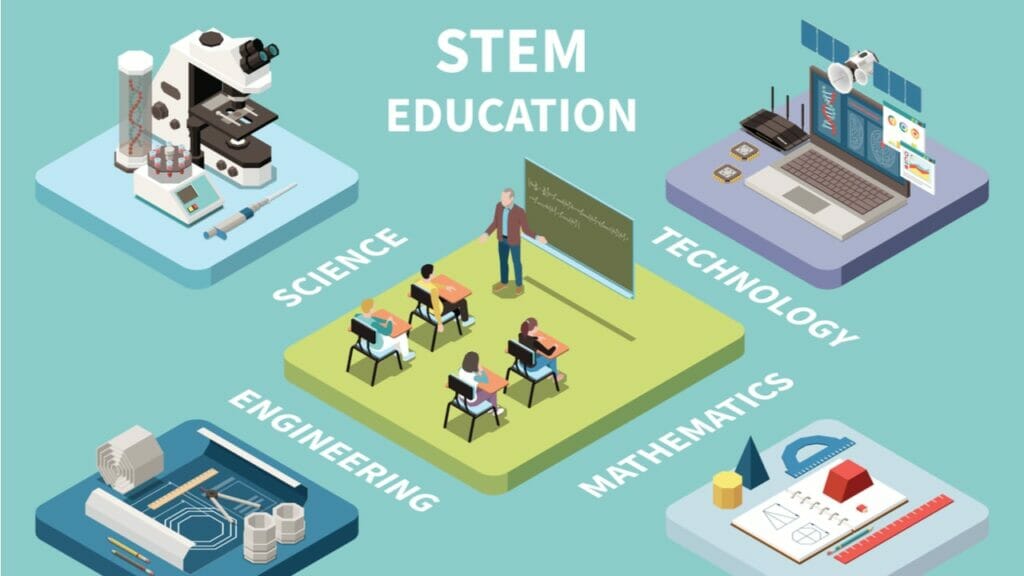
Dreaming of a high-paying, future-proof career in the US? STEM in USA are the backbone of innovation, with graduates earning an average starting salary of USD 70,000–100,000 (₹61.6-88 lakh) annually. The USA, home to tech giants, leading research labs, and world-class universities, is the top choice for ambitious international students. With rapid advancements in technology, healthcare, renewable energy, and infrastructure, the demand for skilled STEM professionals is higher than ever making now the perfect time to pursue a STEM degree in the USA.
STEM in USA full form is Science, Technology, Engineering, and Mathematics, and these fields collectively form the backbone of modern industries. From computer science and artificial intelligence to aerospace engineering and biomedical sciences, the scope of STEM is vast and future-oriented.
The USA is home to top-ranked universities, groundbreaking research facilities, and excellent job opportunities. It also offers international students the advantage of STEM-designated degrees, which comes with an extended Optional Practical Training (OPT) period of 36 months- making it easier to gain real-world work experience.
What are STEM Courses in USA?

Choose your dream country
 UK
UK
 USA
USA
 Germany
 Australia
 Ireland
 Canada
 UAE
UAE
 France
 Sweden
 Italy
Italy
 Other
Other
When do you want to study abroad?
What's your highest level of education?
Select you current city
How Leap will help you

Personalised University Shortlist

Express Applications with Quicker Admits

End-to-End Application Support
STEM meaning is academic programs that fall under the four disciplines of Science, Technology, Engineering, and Mathematics. Unlike traditional courses that often focus on theory alone, STEM programs are designed to be interdisciplinary and application-oriented.
- Science includes subjects like Physics, Chemistry, Biology, Environmental Science, and Astronomy. These programs focus on understanding the natural world and solving global challenges, such as climate change, healthcare, and sustainable energy.
- Technology focuses on fields like Computer Science, Information Technology, Artificial Intelligence, Cybersecurity, and Data Science. These courses prepare students for the digital economy, where demand for IT and data professionals is continuously rising.
- Engineering covers branches such as Mechanical, Civil, Electrical, Aerospace, and Chemical Engineering. These disciplines build the infrastructure, machines, and systems that power modern society.
- Mathematics includes topics like Statistics, Calculus, Algebra, Probability, and Number Theory. Math forms the analytical backbone of all STEM fields, providing the tools needed for problem-solving and innovation.
One of the biggest strengths of STEM programs in the USA is that they focus on hands-on learning, research, and industry exposure. Many universities collaborate directly with industries, offering internships, co-op programs, and research assistantships that prepare students for global careers.
Why Study STEM in USA?
There are several reasons why students, particularly from India, prefer the USA for STEM education:
1. Home to World-Class Universities
The USA hosts some of the best-ranked universities in the world, including MIT, Stanford, Harvard, and Caltech. These institutions not only top the QS World Rankings but also provide access to Nobel laureates, experienced faculty, and cutting-edge labs. Their research-driven education ensures students are equipped with both academic knowledge and industry skills.
2. Gateway to Silicon Valley and Global Tech Hubs
The USA is often referred to as the tech capital of the world, with Silicon Valley being home to industry giants like Google, Apple, Meta, and Tesla. Many STEM graduates from US universities find opportunities in these hubs, either through internships or full-time employment. This access to innovation-driven companies makes the USA one of the most attractive destinations for STEM students.
3. Higher Standard of Living and Global Exposure
The United States offers not just education but a comprehensive student experience. International students enjoy a multicultural environment, advanced infrastructure, extracurricular activities, and opportunities to network with people from across the globe. This exposure helps broaden perspectives and prepares students for international careers.
4. Strong Research and Innovation Ecosystem
US universities are leaders in research output. Whether in medicine, AI, renewable energy, or aerospace, American institutions contribute significantly to global progress. Students pursuing STEM courses often get opportunities to work on projects funded by the government and private industries, which helps them gain practical exposure and career-defining experience.
5. Work Opportunities through OPT and STEM Extension
The F-1 student visa allows students to apply for Optional Practical Training (OPT) after completing their degree. While non-STEM graduates can work for 12 months, STEM graduates get a 24-month extension, giving them up to 36 months of work authorization. This is a significant advantage for international students aiming for global work experience.
Popular STEM Courses in USA
STEM is a wide umbrella that covers over 300+ courses. Some of the most popular programs among international students include:
| Field | Popular Courses |
| Science | Biology, Chemistry, Physics, Environmental Science, Astronomy |
| Technology | Computer Science, Data Science, Information Technology, Cybersecurity, Web Development |
| Engineering | Civil, Mechanical, Electrical, Aerospace, Chemical Engineering |
| Mathematics | Calculus, Statistics, Linear Algebra, Probability, Differential Equations, Number Theory |
Why These Courses are Popular?
Computer Science & Data Science are highly in demand due to the global digital economy. Graduates often secure jobs in artificial intelligence, cybersecurity, or software development.
- Engineering fields such as Civil, Mechanical, and Aerospace are crucial for infrastructure and technology development. These fields offer stable and high-paying jobs worldwide.
- Mathematics and Statistics are essential for careers in finance, research, machine learning, and analytics.
Additionally, universities like MIT, Caltech, Columbia, and Stanford also offer specialised one-year STEM programs, such as Architectural Engineering, Behavioral Sciences, and Applied Physics, which help students build focused expertise.
Top 10 Universities for STEM Courses in USA
The numerous prestigious universities and Ivy League colleges in the USA are known worldwide for the high quality and rigorous education they provide. Getting into these colleges is every student’s dream.
The USA focuses on creating better technology for the world and is the pioneer in cutting-edge scientific innovations. With the technology and science sector booming, the USA focuses on creating new visionaries who can work in these sectors. This is why STEM courses are promoted at many renowned universities in the USA.
Some of the top universities that offer STEM in USA for International students are:
| University | QS World Ranking | Average Annual Tuition Fees in INR |
| Massachusetts Institute of Technology | 1 | USD 53,790(₹47.33 lakh) |
| Harvard University | 4 | USD 54,269(₹47.76 lakh) |
| Stanford University | 5 | USD 55,473(₹48.81 lakh) |
| University of California, Berkeley | 10 | USD 45,602(₹40.13 lakh) |
| California Institute of Technology | 15 | USD 54,600(₹48.05 lakh) |
| Columbia University | 23 | USD 61,788(₹54.37 lakh) |
| University of Michigan, Ann Arbor | 44 | USD 51,200(₹45.05 lakh) |
| Carnegie Mellon University | 52 | USD 50,100(₹44.08 lakh) |
| University of Washington, Seattle | 65 | USD 39,114(₹34.42 lakh) |
| Georgia Institute of Technology (Georgia Tech) | 97 | USD 32,876(₹28.93 lakh) |
Elite institutions like MIT, Stanford, and Harvard stand out for global prestige but come with higher costs exceeding ₹45–50 lakh annually. Mid-range options such as Georgia Tech, UC Berkeley, and University of Washington combine academic excellence with relatively affordable fees, making them strong choices for budget-conscious students. Specialized hubs like Carnegie Mellon and Caltech excel in research-heavy fields like robotics, AI, and engineering innovation, while Columbia University offers unmatched networking in New York despite higher costs. Choosing the right university ultimately depends on balancing budget, career goals, and academic aspirations.
Details About the Universities are Mentioned Below:
- The university is known for its Physics, Chemical Engineering, Electrical Engineering and Mechanical Engineering programs.
- It is a private university.
- The acceptance rate is 4%.
- The university is known for its Biological Sciences, Computer Science, Chemistry, Physics, and Mathematics programs.
- It is a private university.
- The acceptance rate is 4%.
- The university is known for its Chemical Engineering, Civil Engineering, Chemistry, Physics, Mathematics, and Biological Sciences programs.
- It is a private university.
- The acceptance rate is 3.9%.
- The university is known for its Chemical Engineering, Civil Engineering, Biological Sciences, Computer Science, Chemistry, Physics and Mathematics programs.
- It is a public university.
- The acceptance rate is 14.4%.
- The university is known for its Computer Science, Mechanical Engineering, and Physics programs.
- It is a private university.
- The acceptance rate is 4%.
6. Columbia University
- The university is renowned for its Computer Science, Data Science, and Applied Mathematics programs.
- It is a private Ivy League university.
- The acceptance rate is around 6%.
7. University of Michigan, Ann Arbor
- The university excels in Mechanical Engineering, Aerospace Engineering, Computer Science, and Physics programs.
- It is a public university.
- The acceptance rate is around 20%.
8. Carnegie Mellon University
- The university is best known for its Artificial Intelligence, Robotics, Computer Science, and Engineering programs.
- It is a private university.
- The acceptance rate is around 14%.
9. University of Washington, Seattle
- The university is strong in Biological Sciences, Environmental Sciences, Engineering, and Computer Science programs.
- It is a public university.
- The acceptance rate is around 48%.
10. Georgia Institute of Technology (Georgia Tech)
- The university is recognized for its Civil Engineering, Computer Science, and Mechanical Engineering programs.
- It is a public university.
- The acceptance rate is around 18%.
Eligibility Criteria for STEM Courses in USA
- The student must hold a 3-4 year bachelor’s degree in STEM.
- Prior approval for a USA F-1 Student Visa is necessary.
- It is highly recommended that you have work experience to have an edge over other applicants, but note that it is not compulsory.
- Submission of GRE/GMAT scores according to the university’s requirements.
- Submission of English proficiency test scores like IELTS or TOEFL.
Documents Required for STEM Courses in USA
Documents are needed to apply for STEM in USA and show that you meet the requirements.
These papers, like academic records, test scores (like GRE or GMAT), recommendation letters, a statement about your goals, and proof of English skills, help universities evaluate if you're a good fit for their STEM programs.
It's like giving them a clear picture of your abilities and helping them decide if you can join their program.
The applicant must have the following documents to apply for a STEM course in the USA:
- Official and certified academic transcripts
- Photocopy of passport
- Statement of Purpose (SOP)
- Letter of Recommendation (LOR)
- CV/resume
- Two Letters of Reference as proof of your details
- If the transcripts are in a language other than English, the applicant must submit translated and certified copies.
How to Apply for STEM Courses in USA?
After taking care of all the requirements and eligibility criteria, follow this process to apply to your university of choice:
- Research & Shortlist Programs – Visit official university websites and identify programs based on ranking, fees, and eligibility.
- Create an Online Application – Most universities have dedicated admission portals.
- Submit Required Documents – Upload transcripts, SOP, LORs, English test scores, and GRE/GMAT scores.
- Pay Application Fees – Typically ranges between USD 75–150 (₹6,600–₹13,200) per university.
- Await Decision – Admission decisions take 4–8 weeks, depending on university timelines.
- Receive I-20 Form – Upon acceptance, the university issues an I-20 form for visa application.
- Apply for F-1 Visa – Pay the SEVIS fee (~USD 350 / ₹30,800) and book your visa interview.
- Confirm Enrollment – Pay tuition fees and secure your place at the university.
Scholarships for STEM in USA
Several universities and government bodies in the USA offer scholarships to international students pursuing STEM. These can be need-based, merit-based, or research-focused, and they significantly reduce the financial burden.
- Fulbright Foreign Student Program – A prestigious government-funded scholarship covering tuition, airfare, living stipend, and health insurance. Ideal for graduate-level STEM aspirants.
- Stanford Knight-Hennessy Scholars – Offers full funding for graduate programs, including STEM disciplines, along with leadership training and networking opportunities.
- AAUW International Fellowships – Supports women pursuing STEM research in the USA at master’s and doctoral levels. Funding ranges from USD 20,000 – 50,000 (₹17.6–44 lakh).
- University-specific scholarships – Examples include MIT’s Research Assistantships, Harvard’s Graduate Fellowships, and Georgia Tech’s Presidential Scholarships. Many universities also offer partial tuition waivers for international students.
Applying early, maintaining a strong academic profile, and showcasing research or extracurricular achievements can improve scholarship chances.
Cost of Studying STEM in USA
The cost of studying STEM in the USA depends on your chosen university, program, and location. Here’s a breakdown:
1. Tuition Fees
- Range: USD 25,000 – 55,000 (₹22 – 48.4 lakh) per year
- Top-ranked universities like MIT, Harvard, and Stanford may exceed this, especially for master’s programs.
2. Living Expenses
- Range: USD 12,000 – 18,000 (₹10.6 – 15.8 lakh) per year
- Costs are higher in cities like New York, Boston, and San Francisco, while smaller towns and midwestern states are more affordable.
3. Total Cost (Tuition + Living)
- USD 37,000 – 73,000 (₹32.5 – 64.2 lakh) per year
While the investment is significant, careful budgeting, scholarships, and part-time work opportunities can make studying STEM in the USA more affordable for international students.
Job Opportunities for STEM Courses in USA
The fields that STEM courses help you enter are extremely lucrative and rewarding. With a host of opportunities in this growing field, students holding a STEM degree can take advantage of America's attractive job prospects.
The jobs offered in the STEM field come with great pay packages that align with the standard of living in the USA. Here’s a list of job prospects, along with their average pay packages:
| Job Profile | Average Annual Salary in INR |
| Civil Engineer | 65.1L |
| Mechanical Engineer | 66.9L |
| Physicist | 1.29Cr |
| Aeronautical Engineer | 73.9L |
| Biochemist | 44.9L |
| Computer Scientist | 80L |
| Chemical Engineer | 69.5L |
| Statistician | 69.5L |
| Architect | 75.7L |
| Chemist | 58.1L |
As students need an F-1 visa to study a STEM course, this visa benefits STEM graduates. After completing STEM in USA, you can opt to work in the country and extend your visa time period by 24 months. This gives you time to gain exposure and gain invaluable knowledge.
Career Pathways & OPT Extension Explained
One of the strongest advantages of choosing a STEM degree in the USA is the post-graduation career pathway. International students are eligible for Optional Practical Training (OPT), which allows them to work in the USA after completing their degree.
- Standard OPT: Offers 12 months of work authorization for international students in any field.
- STEM OPT Extension: Students in STEM fields get an additional 24 months extension, making it a total of 36 months (3 years) of work authorization.
This extended work period enables STEM graduates to gain practical industry experience, increase chances of securing H-1B visas, and earn attractive salaries. For example, STEM professionals in the USA often start with salaries between USD 65,000 – 90,000 (₹57.2–79.2 lakh) annually, depending on specialization and location.
Moreover, career pathways for STEM graduates are vast—ranging from tech (AI, data science, software engineering), healthcare (biotech, pharmaceuticals), to engineering (civil, mechanical, aerospace). Many STEM graduates also progress into leadership or research-intensive roles in top firms like Google, Microsoft, Tesla, or research labs across the USA.
Final Thoughts
Pursuing STEM in USA is one of the most rewarding investments for international students. With access to Ivy League institutions, Silicon Valley, cutting-edge research, and strong job opportunities, graduates enjoy excellent career prospects and global mobility.
For Indian students, the USA also provides a diverse cultural experience, financial returns in the form of high salaries, and long-term benefits such as PR or H-1B visa opportunities.
If you’re planning to study STEM in USA, LeapScholar can guide you with university applications, visa processes, and test preparation (IELTS, GRE, GMAT) to help you secure your dream admission.
Frequently Asked Questions(FAQ’s)
-
Q. What is a STEM course in the USA?
A. STEM course in the USA refers to programs in Science, Technology, Engineering, and Mathematics. These degrees are designed to build technical expertise, analytical skills, and innovation-driven knowledge. They range from undergraduate to postgraduate programs and cover fields like Computer Science, Data Science, Mechanical Engineering, Biotechnology, Physics, Mathematics, and more.
-
Q. What is the best course in STEM?
A. The “best” STEM course depends on your career goals, but globally, Computer Science, Data Science, Artificial Intelligence, and Engineering (Mechanical, Electrical, Civil) are considered top choices. They are highly employable, offer strong starting salaries, and align with industry demand across technology, healthcare, and infrastructure sectors.
-
Q. What is STEM OPT in USA F1 visa?
A. STEM OPT is a 24-month extension of Optional Practical Training (OPT) available to international students on an F-1 visa who graduate with a STEM degree. This means STEM graduates can work in the USA for up to 36 months (12 months standard OPT + 24 months STEM extension) in a role related to their field of study.
-
Q. Who is eligible for STEM in the US?
A. To be eligible for STEM courses in the USA, students must:
- Hold a 3–4 year bachelor’s degree (for master’s programs) or have completed high school (for undergraduate programs).
- Meet English language requirements like IELTS 6.0–7.0 or TOEFL 80–100.
- Provide standardized test scores such as GRE/GMAT if required by the university.
- Receive admission to a SEVP-certified US institution and hold a valid F-1 visa. -
Q. Which STEM major is most in demand?
A. Currently, the most in-demand STEM majors are Computer Science, Data Science, Artificial Intelligence, Cybersecurity, and Biotechnology. These fields are driving growth in technology and healthcare, making graduates highly sought-after by US employers.
-
Q. What is the minimum salary for STEM OPT?
A. The minimum salary during STEM OPT varies by field and location, but on average, graduates earn between USD 60,000 – 70,000 annually (₹52.8 – 61.6 lakh) in their first year. High-demand sectors like software development and AI often pay above this range.
-
Q. What jobs can you get in STEM?
A. A STEM degree opens doors to a wide range of careers, including Software Developer, Data Scientist, Civil Engineer, Mechanical Engineer, Biochemist, Statistician, Physicist, and Cybersecurity Specialist. With industries increasingly relying on technology and analytics, the career opportunities are vast and future-proof.













Have Questions? Get Guidance to reach your Dream University
Connect with India's finest counsellors and biggest study abroad community.
Get Guidance