
Quick Read
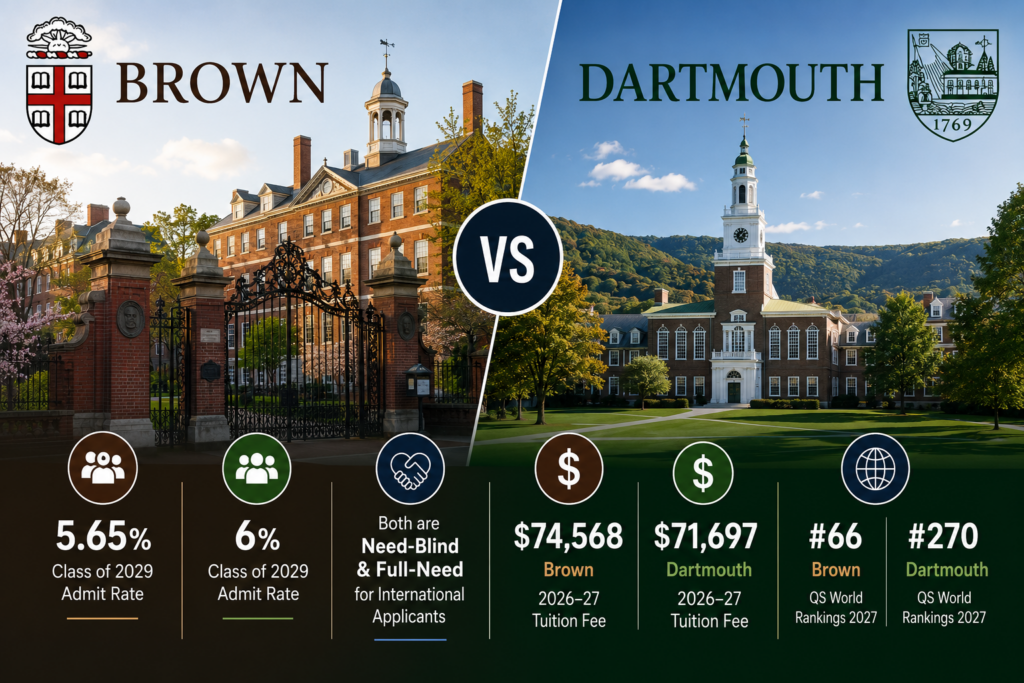
- Brown admitted 5.65% of Class of 2029 applicants; Dartmouth admitted 6%.
- Both schools are now need-blind and full-need for international applicants.
- Brown’s 2026-27 tuition fee is Rs.71.7 lakh ($74,568); Dartmouth’s is Rs.68.97 lakh ($71,697).
- Brown ranks #66 globally on QS 2027; Dartmouth ranks #270.
- Both admit only in the Fall intake; neither offers a Spring first-year entry.
- SAT or ACT scores are again required at both Brown and Dartmouth for 2026-27 applicants.
Brown vs Dartmouth at a Glance
| Detail | Dartmouth College | Dartmouth College |
|---|---|---|
| Founded | 1764 | 1769 |
| Location | Providence, Rhode Island | Hanover, New Hampshire |
| Known for | Open Curriculum, no core requirements, liberal arts flexibility | D-Plan quarter system, undergraduate focus, Tuck and Thayer schools |
| Popular courses | Computer Science, Economics, Biology, International Relations, Applied Math | Economics, Government, Computer Science, Engineering Sciences, Biology |
| Program length | 4-year Bachelor’s (AB/ScB) | 4-year Bachelor’s (AB/BE) |
| Common ranking (US News 2026) | Tied #13, National Universities | Tied #13, National Universities |
| Undergraduate enrolment | Approx. 7,160 | Approx. 4,570 |
| Setting | Small city, active off-campus scene | Small rural town, campus-centred |
Counselor insight: Indian families often treat a one-rank gap on any single list as decisive. It rarely is. Before considering a rank number, examine what you will actually study and where you will live for four years.

Choose your dream country
 UK
UK
 USA
USA
 Germany
 Australia
 Ireland
 Canada
 UAE
UAE
 France
 Sweden
 Italy
Italy
 Other
Other
When do you want to study abroad?
What's your highest level of education?
Have you completed Class 12th?
What was your Class 12 CGPA/percentage?
Are you a student or a parent/guardian?
What do you want to study?
Select your current city
How Leap will help you

Personalised University Shortlist

Express Applications with Quicker Admits

End-to-End Application Support
Rankings: Which Ranking Bodies Actually Matter
Different ranking bodies measure different things, and Brown and Dartmouth land in very different places depending on which one you check.
| Ranking Body | Brown University | Dartmouth College | What it measures? |
|---|---|---|---|
| QS World University Rankings 2027 | #66 | #270 | Heavily weights research citations and international faculty ratio, favouring Brown's larger research output |
| US News Best Colleges 2026 | Tied #13 | Tied #13 | The ranking most US applicants and counselors reference first for National Universities |
| Times Higher Education World University Rankings 2026 | #65 | #180 | Weights teaching environment and research quality, again favouring Brown's research scale |
Counselor insight: Dartmouth's lower QS and THE position reflects its smaller size and undergraduate focus, not weaker teaching. Both metrics reward research volume, which a 4,570-student college will always struggle to match against a larger research university.
Entry Requirements: SAT/ACT, Acceptance Rates and Documents
(Note: GRE applies to graduate programs, not undergraduate admission. For Brown and Dartmouth's first-year application, the relevant test is the SAT or ACT.)
| Requirement | Brown | Dartmouth |
|---|---|---|
| Acceptance rate (Class of 2029) | 5.65% (2,418 of 42,765 applicants) | 6% (1,702 of 28,230 applicants) |
| Standardised test | SAT or ACT, mandatory for 2026-27 | SAT or ACT, mandatory for 2026-27 |
| Application platform | Common Application | Common Application |
| Letters of recommendation | Counselor + 2 teacher recommendations | Counselor + 2 teacher recommendations, optional peer recommendation |
| Application fee | $80 (Rs.7,696), waivable | $80 (Rs.7,696), waivable |
| English proficiency | Waived if medium of instruction was English | Waived if medium of instruction was English |
| Interview | Not guaranteed for India-based applicants | Not guaranteed for India-based applicants |
| Early Decision deadline | November 1 | November 1 |
| Regular Decision deadline | January 5 | January 1 |
Counselor insight: Both schools superscore SAT and ACT results. If you have two attempts, each school takes your best section scores across sittings, so a single weak sitting will not sink your application if you have a stronger one on file.
Intakes and Popular Streams at Brown vs Dartmouth
Both Brown and Dartmouth admit first-year undergraduates only in the Fall intake, beginning in late August or September. Neither offers a separate Spring first-year intake, so if you miss the Regular Decision deadline for a given year, your next opportunity is the following Fall cycle.
- Brown, Fall intake: Most popular declared concentrations are Computer Science, Economics, Biology, International Relations, and Applied Mathematics.
- Dartmouth, Fall intake: Most popular majors are Economics, Government, Computer Science, Engineering Sciences, and Biology.
Both schools also run study-abroad and internship terms through the academic year: Brown through summer and semester breaks and Dartmouth through its D-Plan off-terms, but neither offers a second undergraduate entry point mid-year.
Brown vs Dartmouth: Tuition Fee, Cost of Living and Scholarships
1. Tuition Fees Compared
Both tuition figures sit close to Rs.70 lakh a year before any aid is applied.
| University | Tuition Fee (2026-27) |
|---|---|
| Brown University | $74,568 (Rs.71.7 lakh) |
| Dartmouth College | $71,697 (Rs.68.97 lakh) |
Sources: Brown Student Financial Services, Dartmouth Office of Financial Aid
2. Cost of Living in Providence and Hanover
Providence is a small city with an active rental market; Hanover is a rural college town where most students live on campus.
| City | Meal, inexpensive restaurant | 3-course meal for two | Estimated monthly cost (single person) |
|---|---|---|---|
| Providence, RI | $20 | $80 | Roughly Rs. 2-2.2 lakh ($2,000-2,300), driven mainly by off-campus rent |
| Hanover, NH | $18 | $75 | Roughly Rs. 1.1-1.3 lakh ($1,150-1,350), reflecting New Hampshire's lower housing cost |
Sources: Numbeo Cost of Living, Providence; Numbeo Cost of Living, Hanover.
Note: Hanover's Numbeo dataset has very few contributors, so treat this figure as directional and check Numbeo directly closer to your budgeting date.
3. Scholarships
Neither school offers merit scholarships. Both meet 100% of demonstrated financial need for international students through named institutional aid programs.
| University | Scholarship / Aid Program |
|---|---|
| Brown University | The Brown Promise (need-based, no-loan grants replacing all student loans) |
| Dartmouth College | No Loan Initiative and Zero Parent Contribution Initiative for families with an income under $125,000 |
Counselor insight: Neither program is a scholarship you apply for separately. They activate automatically once your CSS Profile shows demonstrated need, so the real work is submitting accurate financial documentation on time, not writing a scholarship essay.
For more information on eligibility and other details, check our Scholarships for Indian students in the USA.
Note: Brown's need-blind policy applies to applicants entering from Fall 2025 onwards (Class of 2029 and later). Students admitted before Fall 2025 remain under the earlier need-aware policy.
Brown’s Open Curriculum vs Dartmouth’s D-Plan
This is the single biggest day-to-day difference between the two schools, and it matters for every major, not just STEM.
Brown University: The Open Curriculum
- No distribution requirements outside your concentration.
- You can combine any two subjects (Economics and Literary Arts, Biology and Public Policy) without a core curriculum competing for schedule space.
- Concentration declaration isn't due until sophomore year, so you have time to explore before committing.
- Suits students who already have a sense of direction and want to design their own four years.
- The trade-off: No one checks your progress for you, so tracking prerequisites and staying on pace for graduation is entirely your responsibility.
Dartmouth College: The D-Plan
- A quarter-based calendar with three mandatory terms a year and an optional fourth.
- Students take built-in off-terms for internships, research, or travel without losing a full academic year.
- Some general education requirements apply, including a first-year writing course, giving more early structure.
- Suits students who want the university to build flexibility into the calendar for them, across any major.
- The trade-off is a faster pace during active terms and more planning around off-term housing and travel.
Counselor insight: We tend to hear this question mostly from engineering and CS applicants, but the curriculum choice matters just as much for humanities and social science students. Brown's freedom to double-concentrate across unrelated departments, and Dartmouth's off-terms for research or internships, apply to every major on campus, not just the technical ones.
Post-Study Work Rights: OPT and STEM OPT for Brown vs Dartmouth Graduates
- Post-study work rights come from federal immigration rules, not the university.
- Under the F-1 visa, graduates of both Brown and Dartmouth qualify for 12 months of Optional Practical Training (OPT) after graduation.
- If your major is on the Department of Homeland Security's STEM Designated Degree Program list, most engineering and computer science majors at both schools qualify; you can extend OPT by 24 months through STEM OPT.
- That brings total possible work authorization to 36 months across both OPT phases.
- The process is identical whether you graduate from Brown or Dartmouth; your declared major decides eligibility, not the school name.
Which School Fits You? A Decision Framework for Indian Applicants
If you are a final-year B.Tech.-track student focused on CS or engineering:
Dartmouth's D-Plan gives built-in off-terms for internships, and Thayer's industry pipeline is well established. Brown works just as well if you want to combine CS with another discipline and prefer to design your own schedule.
If you are a humanities or social sciences applicant unsure of your exact major:
Brown's Open Curriculum is built for students like you, letting you sample widely before committing to a concentration in sophomore year. Dartmouth's general education requirements, including a first-year writing course, give more early structure instead.
If your family's ability to pay is the deciding factor:
Both schools are need-blind and meet full demonstrated need for international students, so neither should be ruled out on cost before you run each school's net price calculator with your actual financials. The tuition gap between them is smaller than the swing your aid package will produce.
Counselor insight: We see applicants pick a school based on a relative's experience at a third, unrelated university. Base your decision on your major, budget, and how much structure you want, not secondhand impressions of "Ivy League" as one category.
What to Do If Your Brown or Dartmouth Application Doesn’t Go As Planned
If waitlisted at either school: Both allow updated senior-year grades or a new test score. Contact admissions directly to confirm what they accept; do not assume your position is fixed.
If you missed the SAT retake window: Submit your strongest existing score rather than skipping the requirement, since an incomplete application will not be reviewed.
If your visa is delayed after admission: Review US visa rejection rates and reasons before your interview date, and keep your slot flexible until your I-20 is confirmed.
If deferred from Early Decision to Regular Decision: treat this as a genuine second review, not a rejection. Use the gap to submit a strong midyear grade report and, if relevant, an updated test score.
3 Key Takeaways on Brown vs Dartmouth
- First, the cost gap between them is marginal once need-blind aid applies, so let your net price calculator result decide the budget question, not the sticker price.
- Second, both schools require SAT or ACT scores again for 2026-27, so do not plan around skipping standardized testing.
- Third, the real difference is curriculum style: Brown's Open Curriculum rewards students who already know their direction, while Dartmouth's D-Plan builds structure and internship flexibility into the calendar for you.
Verified by: LeapScholar's USA counseling team, with hands-on experience guiding Indian students through Ivy League applications, financial aid documentation, and F-1 visa processes.
Have questions about applying to Brown, Dartmouth, or other Ivy League schools? Book a free session with a LeapScholar counselor.
Frequently Asked Questions About Brown vs Dartmouth
-
Is Brown or Dartmouth better?
Honestly, that depends on what you're optimizing for. Brown's Open Curriculum suits someone who already knows their direction and wants to design their own path. Dartmouth's D-Plan builds internship and travel windows right into the calendar for you. Neither wins outright, so weigh your major, your appetite for structure, and your aid comparison before prestige.
-
Is Brown or Dartmouth harder to get into? What is the acceptance rate for Brown vs Dartmouth?
Brown was slightly harder for the Class of 2029, taking 2,418 of 42,765 applicants (5.65%) against Dartmouth's 1,702 of 28,230 (6%). That difference is real but tiny; it won't meaningfully shift your odds either way, and both remain within reach for almost every applicant we've worked with.
-
Is Brown or Dartmouth better for financial aid as an international student?
Both meet 100% of the demonstrated need for international students without factoring your ability to pay into the admission decision. Dartmouth was the first to arrive, back in 2022, and Brown followed with the Class of 2029. If you're hoping for a merit scholarship independent of income, though, neither school offers one.
-
What is the QS ranking difference between Brown and Dartmouth?
It's a big gap on paper: Brown sits at #66 globally in QS 2027 and Dartmouth at #270. Don't read too much into it, though. QS leans heavily on research citations and international faculty ratio, categories where a larger research university like Brown naturally outperforms a smaller, undergraduate-focused college like Dartmouth.
-
Is Brown or Dartmouth better for computer science and engineering?
Both departments are genuinely strong, so the decision comes down to how you like to work rather than which one is "better." Dartmouth's D-Plan lets CS and engineering students slot internships into off-terms throughout the year. Brown's Open Curriculum lets you pair CS with literally any other concentration without a core curriculum getting in the way.
-
What is the difference between Brown's Open Curriculum and Dartmouth's D-Plan?
Brown drops distribution requirements entirely outside your concentration, so your course selection stays wide open. Dartmouth runs on quarters instead of semesters, three mandatory terms a year plus an optional fourth, specifically so students can step away for internships or research without falling behind.
-
How do Brown vs Dartmouth vs Cornell compare for Indian applicants?
All three give you Ivy League status and need-blind aid, but the similarities mostly end there. Cornell's size and separate undergraduate colleges suit someone chasing a specific specialized program. Brown suits the self-directed type. Dartmouth suits someone who wants structured internship terms built in. Look at the actual programs you want, not the "Ivy League" label that all three share.
-
What happens if I am waitlisted at both Brown and Dartmouth?
Reach out to each admissions office and ask exactly what supplementary material they'll look at, since the process varies by cycle and isn't always publicized. An updated transcript or a stronger test score is usually welcome at both, but neither guarantees you'll move off the list, so keep other admitted options warm in the meantime.





Have Questions? Get Guidance to reach your Dream University
Connect with India's finest counsellors and biggest study abroad community.
Get Guidance