
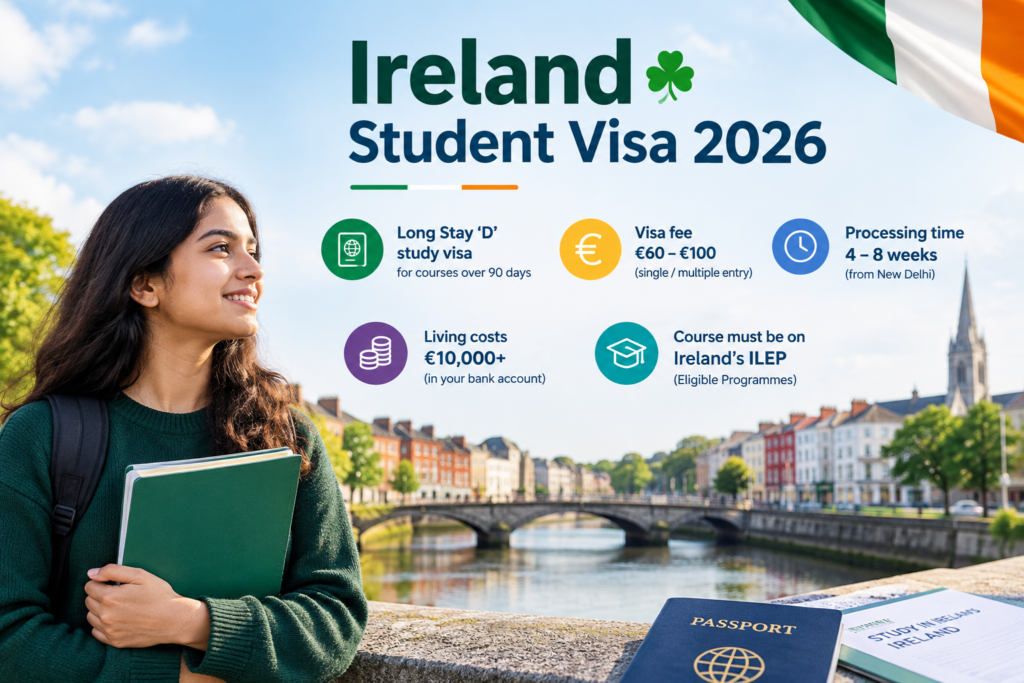
Quick Read
- Courses over 90 days need the Long Stay ‘D’ study visa, Ireland’s main student visa category.
- The Ireland student visa fee is €60 (~Rs.6,573) for single entry and €100 (~Rs.10,955) for multiple entry.
- The standard processing time for an Ireland student visa is 4 to 8 weeks from the Embassy in New Delhi.
- An appeal after refusal can take up to 6 calendar months to decide.
- You need at least €10,000 (Rs.10.96L) for living costs, shown in your bank account.
- Your course must be on Ireland’s Interim List of Eligible Programmes (ILEP).
Types of Ireland Student Visa: Which One Do You Need
Which visa you need depends on one question: how long is your course?
| Visa Type | Course Duration | Registration After Arrival |
|---|---|---|
| Short Stay ‘C’ Visa | 90 days or less | Not required |
| Long Stay ‘D’ Visa | More than 90 days | Required for your Irish Residence Permit (IRP) |

Choose your dream country
 UK
UK
 USA
USA
 Germany
 Australia
 Ireland
 Canada
 UAE
UAE
 France
 Sweden
 Italy
Italy
 Other
Other
When do you want to study abroad?
What's your highest level of education?
Have you completed Class 12th?
What was your Class 12 CGPA/percentage?
Are you a student or a parent/guardian?
What do you want to study?
Select your current city
How Leap will help you

Personalised University Shortlist

Express Applications with Quicker Admits

End-to-End Application Support
Almost every Indian student applying for a degree, whether it's a bachelor's, master's, or PhD, needs the Long Stay 'D' visa. The rest of this guide focuses on that one, since it's what the vast majority of readers here actually need for an Ireland visa for Indian students.
My insight: Students assume the 'C' visa is a cheaper way to "get started" and switch later. It isn't built for that. If your actual plan is a full degree, apply for the 'D' visa from the start rather than trying to convert a short-stay visa once you're already in Ireland.
Ireland Student Visa Requirements: Documents Checklist
Before you touch the application form, confirm that your course is on the Interim List of Eligible Programmes (ILEP). If it isn't listed, your visa application won't go anywhere, regardless of how strong your documents are. This is the one check for Ireland's study visa requirements that's easy to overlook since it happens before you even start gathering paperwork.
Here's what the Irish Immigration Service Delivery (ISD) asks every applicant to submit:
| Document | India-Specific Detail |
|---|---|
| Passport | Valid for at least 12 months from your arrival date; include copies of any previous passports |
| Letter of acceptance | Must confirm your course, fees, and that it's full-time (minimum 15 hours of daytime teaching a week) |
| Proof of funds | At least €10,000 for living expenses, in your own account for 3-6 months |
| Tuition payment proof | Full amount if fees are €6,000 or less; at least €6,000 upfront if fees are higher |
| English proficiency | IELTS or an equivalent test accepted by your university |
| Private medical insurance | Mandatory for your entire stay; the university may arrange this |
| Summary of finances form | A specific ISD form required for every long-stay study visa application |
| Academic gap explanation | Any break since your last full-time study, with employment details if applicable |
Two things cause more problems for genuine applicants than anything else on this list:
- Academic gaps: An unexplained gap since your last full-time study is a concern, even when the reason is ordinary. Address it directly instead of leaving it out.
- English proficiency proof: Immigration doesn't set a fixed score; it varies by university.
Check your specific program's cutoff in our guide to the minimum IELTS score for Ireland.
My insight: The Summary of Finances form is easy to skip since it's less obvious than a bank statement. Applications missing it get flagged for follow-up, which adds weeks you don't need to lose.
How to Apply for an Ireland Student Visa?
The process runs through Ireland's own online system, not a general visa portal, so don't confuse the application with services built for other countries.
- Apply online through AVATS, Ireland's official visa system, answering every question completely and honestly.
- Print and sign the summary form the system generates once you finish.
- Book your biometrics and document submission appointment at the VFS Global Visa Application Centre.
- Submit your documents in the order and format the summary form specifies.
- Wait for your decision; you'll be notified through the same channel you applied with.
You should apply up to 90 days before you travel, and the Embassy recommends starting the process two to three months ahead of your planned arrival. This isn't a "nice to have," biometric clearance and document verification both take real time on their end.
Once you arrive and register for your IRP, that permission also covers part-time work during your studies.
What happens after you graduate is a separate question worth planning for early: our guide to the Post-Study Work Visa for Ireland covers how long you can stay on once your course ends.
For students still finalizing their SOP alongside this, our guide on SOP for Ireland covers what your statement should include.
Ireland Student Visa Fees
The Ireland study visa itself is one of the cheaper study visa fees among popular destinations, though the total cost adds up once you include registration after arrival.
| Fee | Amount | In INR |
|---|---|---|
| Single-entry visa | €60 | Rs. 6,573 |
| Multiple-entry visa | €100 | Rs. 10,955 |
| Irish Residence Permit (IRP), after arrival | €300 | Rs. 32,865 |
Source: Irish Immigration Service Delivery, Preclearance, and Entry Visa Fees
Two things worth knowing before you pay:
- The visa fee is non-refundable, even if you withdraw or get refused. Double-check your documents before paying, not after.
- The €10,000 funds requirement is meant to cover realistic living costs.
See our cost of living in Ireland guide for a city-by-city breakdown of whether that's actually enough for where you're headed.
Ireland Student Visa Processing Time (and What Happens If You’re Refused)
This is the part most guides get vague about, so here are the actual current numbers published by the Embassy of Ireland in New Delhi, the office that processes applications from Indian students.
| Stage | Timeline |
|---|---|
| First-instance decision | 4 to 8 weeks from the date your application reaches the Embassy |
| Appeal decision | Up to 6 calendar months |
| Appeal filing deadline | Within 2 months of your refusal letter, free of charge |
A couple of things this table doesn't tell you on its own:
- The clock starts when your application reaches the Embassy, not when you drop it at the VFS centre. Build in a few extra days for document transit on both ends.
- If refused, you have two options: file a formal appeal within the two-month window, or submit a fresh application if the issue was something fixable, like incomplete paperwork.
Our guide on the Ireland student visa rejection rate covers the most common refusal reasons.
Source: Embassy of Ireland, New Delhi, Processing Times and Decisions
My insight: An appeal taking up to 6 months is a long time if your intake starts in a few weeks. If your refusal is about something you can fix quickly, like a missing document or an unclear financial statement, a fresh application is often faster than waiting out an appeal.
What Affects Your Ireland Student Visa Acceptance Rate
There's no single published acceptance rate, and treat any number quoted online with some skepticism since it isn't officially released per country. What is published, and worth paying attention to instead, is why applications actually get refused.
- Financial documents that don't add up: Funds that appeared right before applying, without a consistent history, get flagged for further checks.
- An unclear study purpose: If your course doesn't obviously follow from your academic or work background, you need to explain why in your application letter, not leave the visa officer to guess.
- Incomplete forms: A missing Summary of Finances form or an unsigned summary sheet is a completely avoidable reason to lose weeks.
- Unexplained education gaps: Time between your last full-time study and this application needs an account of what you were doing, ideally backed by evidence.
If you're a final-year student applying straight after graduation, you'll generally have an easier time on this front than someone with a multi-year gap or a career switch, since there's less to explain. That's not a reason to worry if you do have a gap, it just means your application letter needs to do more work.
My insight: We tell students to write their application letter as if the visa officer knows nothing about their background. Assuming a fact is "obvious" from your resume is exactly how genuinely strong applications end up under-explained on paper.
Three Key Takeaways on the Ireland Student Visa
- Confirm your course is on the ILEP list before anything else. An Ireland student visa application for a non-eligible program won't succeed no matter how complete your other documents are.
- Apply the moment you can, ideally 2 to 3 months before travel. With processing running 4 to 8 weeks and appeals taking up to 6 months, there's very little margin for a late start.
- Treat the Summary of Finances form and gap explanations as seriously as your bank statement. These are the quiet, avoidable reasons genuine applicants lose weeks to follow-up requests.
Verified by: LeapScholar's Ireland counseling team, with hands-on experience guiding Indian students through Irish student visa applications and appeals.
Have questions about your Ireland student visa? Book a free session with a LeapScholar counselor.
Frequently Asked Questions About the Ireland Student Visa
-
How long does an Ireland student visa take to process?
The Embassy of Ireland in New Delhi currently states 4 to 8 weeks for a first-instance decision, counted from when your complete application reaches them. Applying with everything in order the first time is really the biggest lever you have over that timeline.
-
What documents do I actually need for an Ireland student visa?
Your passport, letter of acceptance, proof of funds (at least €10,000), tuition payment proof, IELTS or equivalent scores, private medical insurance, and a completed Summary of Finances form. Missing even one of these is one of the most common reasons applications get delayed rather than approved outright.
-
How much does the Ireland student visa cost?
€60 for a single-entry visa, €100 for multiple entry. That's separate from the €300 Irish Residence Permit fee you pay after you arrive, so budget for both, not just the visa itself.
-
Is there an age limit for an Ireland student visa?
Not really; no fixed cutoff exists for adult applicants. What matters more is whether your course logically follows your academic or career history. If you're older and switching fields, just explain that reasoning clearly rather than assuming age itself is the issue.
-
What's the difference between Ireland student visa requirements and Ireland study visa requirements?
Honestly, they're the same thing. Ireland's Long Stay 'D' visa gets called both a student visa and a study visa depending on where you're reading about it, but for an Ireland visa for Indian students specifically, the requirements and process are identical either way.
-
What happens if my Ireland student visa gets refused?
You'll get a letter explaining the specific reason. From there, you can appeal within two months at no cost or submit a new application if the issue was something fixable, like a document gap. Appeals can take up to 6 months, so weigh that against your intake timeline before choosing which route to take.
-
Can I track my Ireland student visa application status?
Yes. The Embassy publishes visa decisions and processing updates regularly, and you can check your application using the reference number from your AVATS summary form. There isn't a real-time individual tracker beyond that, so avoid contacting the Visa Office directly for status updates; they explicitly ask applicants not to.
-
Do I need to book an appointment for my Ireland student visa?
Yes, after your online AVATS application, you'll need to book a biometrics and document submission appointment at your nearest VFS Global centre. Do this as soon as your online application is complete rather than waiting; slots can fill up during peak intake months.
-
How much money do I need to show for an Ireland student visa?
At least €10,000 for living expenses, held in your own account for 3 to 6 months before you apply, plus tuition proof of either the full fee or a minimum €6,000 upfront, whichever is lower.








Have Questions? Get Guidance to reach your Dream University
Connect with India's finest counsellors and biggest study abroad community.
Get Guidance