
Quick Read
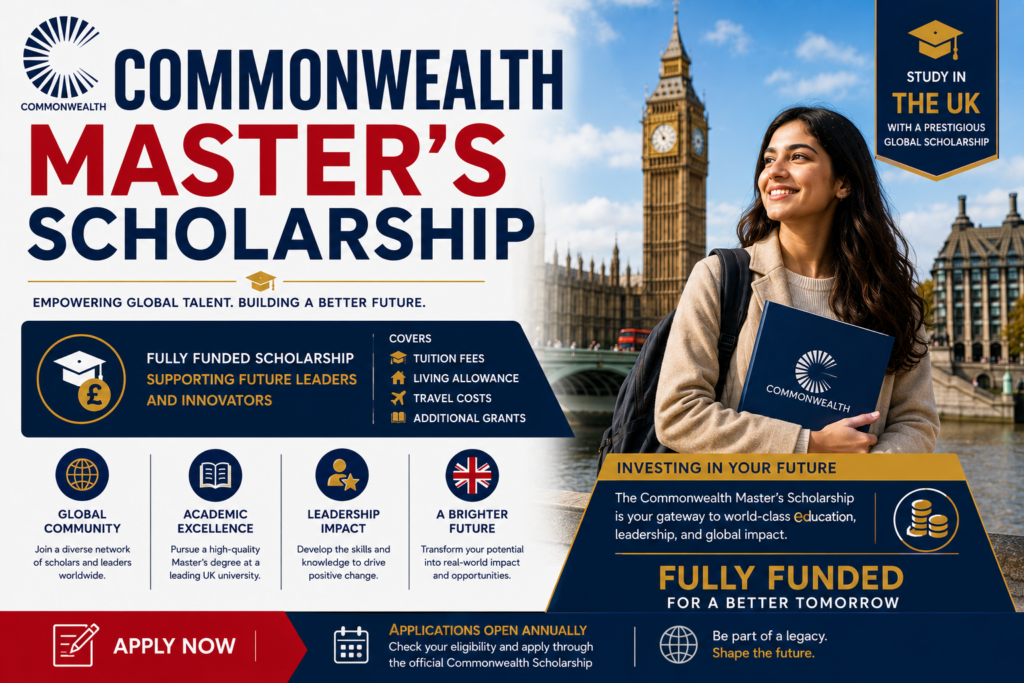
- Fully funded scholarship for Indian students to pursue a one-year taught Master’s in the UK, commencing September 2026.
- Monthly stipend of Rs. 1,85,490 (outside London) or Rs. 2,27,455 (in London) Full tuition and return airfare paid.
- Indian applicants need to apply on both CSC Central and MoE’s SAKSHAT portals.
- The course must connect to one of six CSC development themes; MBA programs are not funded.
What is the Commonwealth Master’s Scholarship?
The Commonwealth Master’s Scholarship is a fully funded, agency-nominated grant for students from eligible low- and middle-income Commonwealth countries to pursue a one-year taught Master’s degree at a UK university. Here is what defines it:
- Funder: UK Foreign, Commonwealth and Development Office (FCDO)
- Administrator: Commonwealth Scholarship Commission in the UK (CSC)
- Who it is for: Students from eligible Commonwealth countries, including India, who could not otherwise afford UK postgraduate study
- Selection basis: Academic merit, quality of study plan, and potential development impact in the home country
- Financial need: An explicit eligibility condition, not just a preference
- Not funded: MBA programs, second Master’s degrees (not normally)
- Duration: One academic year, full-time study only
One thing to get clear from the start: You cannot apply directly to the CSC. Indian students must go through two portals simultaneously: CSC Central and the Ministry of Education’s SAKSHAT portal. Miss either one, and the application is void regardless of how strong it is.
Is the Commonwealth Master’s Scholarship Fully Funded?
Yes, and it covers considerably more than just tuition. Most Indian students hear “fully funded” and picture tuition plus a small allowance. The Commonwealth Master’s Scholarship goes further.
Commonwealth Master’s Scholarship Benefits
| Benefit | Amount (GBP) | Amount (INR) |
|---|---|---|
| Tuition fees | Fully covered by CSC-university agreement | Full |
| Monthly stipend (outside London) | £1,452 per month | Rs. 1,85,490 per month |
| Monthly stipend (London metropolitan area) | £1,781 per month | Rs. 2,27,455 per month |
| Return airfare (economy class) | Approved amount | Approved amount |
| Warm clothing allowance | Applicable in first year | Applicable in first year |
| Study travel grant | Towards study-related travel | Towards study-related travel |
| Child allowance (1st child, single parents only) | £622 per month | Rs. 79,417 per month |
| Child allowance (2nd and 3rd child, single parents) | £154 per month | Rs. 19,663 per month |
Key point to note for the students: The distance learning variant suits working professionals who cannot relocate for a year. It covers tuition and a study grant but has no stipend or airfare.
For a full picture of what a UK Master’s costs without a scholarship, check out our guide on cost of MS in UK for Indian students.
Eligibility Criteria for Commonwealth Master’s Scholarship 2026
There is no partial eligibility here; the CSC applies every criterion strictly.
Citizenship and residency: Citizen of an eligible Commonwealth country (India qualifies), and permanently resident in India at the time of application.
Academic qualification: First degree of at least 2:1 honors by September 2026. For Indian graduates, this means a minimum of 60% marks. Candidates with a lower second-class degree (50 to 59% marks) may qualify if they also hold a relevant postgraduate qualification, usually a Master’s degree.
Financial need: You must demonstrate a genuine inability to fund UK study without this scholarship.
No prior UK Master’s: The CSC does not normally fund a second UK Master’s degree. If applying for a second Master’s, you must provide justification. Studying in the UK for one academic year or more generally makes you ineligible.
No IELTS is required by the CSC: The CSC itself does not need an IELTS score, though the UK universities you apply to for admission will have their own language requirements.
No age limit: There is no upper or lower age limit for CSC applications.
India-specific condition: You must not have studied or trained abroad for more than six months in the period leading up to application, whether on scholarship or self-funded.
For a deeper look at how the CSC assesses Indian profiles, read our guide on Commonwealth scholarship eligibility and selection.
Which Courses are Eligible for the Commonwealth Master’s Scholarship?
Your course must connect to one of six CSC development themes. There is no fixed subject list, but courses with no development link will not make it through.
| CSC Development Theme | Example Disciplines |
|---|---|
| Science and Technology for Development | Engineering, computer science, data science, renewable energy |
| Improving Population Health, Health Systems and Capacity | Public health, epidemiology, health policy, pharmaceutical science |
| Promoting Innovation and Entrepreneurship | Innovation management, social enterprise, economic development |
| Strengthening Peace, Security and Governance | International relations, law, public administration |
| Strengthening Resilience and Response to Crises | Disaster risk reduction, climate adaptation, water management |
| Access, Inclusion and Opportunity | Education, gender studies, development studies, urban planning |
Indian applicants most commonly target Science and Technology, Population Health, and Innovation themes. MBAs are not funded under any theme. A strong course-theme argument matters far more than the reputation of the university alone.
How to Apply for the Commonwealth Master’s Scholarship from India?
Two portals, both mandatory. Completing only one disqualifies your application regardless of how strong it is.
Step 1: Get your UK university admission first
Apply to at least three CSC-scheme universities before scholarship portals open. Many programs close admissions between January and July, well before the CSC deadline. The MoE will not nominate you without a confirmed admission letter, so your application genuinely comes first.
Step 2: Apply on CSC Central
Register at CSC Central. The portal uses two-factor authentication and does not save automatically, so draft your answers offline before you begin. The form covers your academic background, work experience, three references, a four-part Development Impact Statement, study plan, and five-year career goals. Make sure to check everything since no changes can be done after submitting.
Step 3: Submit on the MoE’s SAKSHAT portal
You can apply through the Ministry of Education’s SAKSHAT portal. Upload a saved PDF of your CSC Central application here. The SAKSHAT deadline is set independently by the MoE and typically falls several months after CSC Central closes. Always confirm dates on education.gov.in.
Step 4: MoE shortlisting and CSC results
The MoE nominates 39 candidates to the CSC from over 4,500 SAKSHAT submissions each cycle. Being nominated is competitive on its own, but it is not a guarantee. The CSC makes the final selection and announces results in July.
On the Development Impact Statement
Most strong Indian applications lose out here, not on academics. It must cover four things: the development problem your course addresses, how you will apply your learning after returning to India, what measurable outcomes you expect and by when, and how you will evidence that impact. Treat it as a policy brief, not a personal statement.
A strong SOP framework for UK universities is a useful structural reference.
Documents needed
You will need a valid passport or national ID, full transcripts of all qualifications (with certified translation if not in English), at least two signed references on institutional letterhead, a saved PDF of your CSC application, and a UK university admission letter. The CSC does not charge any fees at any stage; any request for payment is a warning sign.
For reference letter guidance, see letter of recommendation for Masters.
Commonwealth Master’s Scholarship vs Other Commonwealth Programs
The CSC runs three distinct Master’s programs. Indian applicants regularly mix them up or miss the distance learning option entirely.
| Feature | Agency-Nominated Master’s | Commonwealth Shared Scholarship | Commonwealth Distance Learning |
|---|---|---|---|
| Study mode | Full-time, UK campus | Full-time, UK campus | Part-time, online from India |
| Who nominates? | National agency (MoE for India) | UK university directly | National agency or direct |
| Tuition covered | Full | Shared (university co-funds) | Full |
| Monthly stipend | Yes | Yes | No |
| Return airfare | Yes | Yes | No |
| 2026/27 CSC deadline | 14 Oct 2025 (closed) | 9 Dec 2025 (closed) | Varies by university |
| MBA funded | No | No | No |
The distance learning variant suits working professionals who cannot relocate for a year. It covers tuition and a study grant but has no stipend or airfare.
If you are comparing this scholarship against Chevening, Gates Cambridge, or GREAT, check fully funded scholarships in UK for Indian students
Application Timeline for the 2027/28 Cycle
The 2026/27 cycle is now fully closed: CSC Central shut on 14 October 2025 and the MoE’s SAKSHAT portal (which ran an extended window that year) closed on 31 May 2026.
The calendar below is for the 2027/28 cycle, based on the standard pattern confirmed by MoE notifications across previous cycles.
| Month | Action |
|---|---|
| March to July 2026 | Research approved UK universities; apply for admission (many close by July) |
| September 2026 | CSC Central portal expected to open; SAKSHAT portal also expected to open around the same time |
| September to October 2026 | Complete application on CSC Central; simultaneously apply on SAKSHAT; upload all documents |
| October 2026 | CSC Central deadline (expected mid-October; confirm on cscuk.fcdo.gov.uk) |
| October to November 2026 | SAKSHAT deadline; typically falls after CSC Central closes (confirm on education.gov.in) |
| December 2026 | MoE shortlists and submits 39 nominations to the CSC |
| July 2027 | CSC announces final results |
| September 2027 | Begin Master’s programme in the UK |
The most common mistake is leaving university admissions too late. Strong programmes at UCL, Edinburgh, and LSE close by March or April. If you miss the university deadline, the scholarship application is automatically void.
If you are deciding between London and non-London universities based on the stipend difference, this guide to top universities in London gives a realistic picture alongside costs.
For what the UK student visa process looks like after your scholarship is confirmed, see the UK student visa guide for Indian students.
Selection Criteria and What Happens After Selection?
How the CSC selects scholars:
- Candidate merit: Your academic record, professional experience, and personal background. Merit is assessed relative to your circumstances; the CSC considers barriers you may have faced, so a strong profile from a smaller institution is not at a disadvantage.
- Quality of study plan: Why this course, at this university, at this point in your career. It needs to be specific. A generic “Edinburgh is a top-ranked university” answer is not a study plan.
- Development impact: The decisive factor for most Indian profiles. The CSC wants a clear, measurable outcome for India, not a general aspiration. The stronger and more specific this argument, the better your chances.
What happens after you are selected:
- You receive a provisional selection letter: you are selected in principle, pending admission terms being agreed upon with your university.
- Once confirmed, the CSC issues a Notification of Award, which is your formal scholarship offer.
- You submit a Health and Disability Form before the CSC issues a Confirmation of Award.
- Throughout the scholarship: you must live in the UK, get CSC approval before any overseas travel, and seek permission for paid work.
- At the end of the award: all scholars sign an undertaking to return to India. Switching to a Graduate Visa or any other UK immigration route is not permitted under the scholarship terms.
For a full comparison of how Commonwealth stacks up against Chevening, GREAT, and other UK awards, see our guide to best scholarships for Masters in UK for Indian students.
Why Do Applications Get Rejected?
The Development Impact Statement is too vague
Writing that your Master’s will “contribute to India’s growth” without naming the specific problem, the people affected, or how impact will be measured is the single biggest rejection trigger. The CSC reads thousands of these, and generic ones do not pass.
Only one portal was used
A surprisingly common mistake. Some students complete CSC Central but miss the MoE’s SAKSHAT portal entirely, or vice versa. Either way, the application is void. Both portals are mandatory; no exceptions.
Transcripts are incomplete.
Missing even one page, including for a qualification still in progress, triggers automatic disqualification. Upload everything, including semester-wise marksheets.
The course has no development link.
Applying for a well-ranked program that has no clear connection to any CSC development theme will not work, even if your academic profile is strong. The commission will not bridge a weak course-theme fit on your behalf.
University admission was left too late.
MoE nomination requires an admission letter from a CSC-approved UK university. Students who assume the scholarship will come before the admission offer routinely miss both deadlines.
Submitting on the last day
The CSC portal slows significantly near the deadline, and technical failures are not accepted as grounds for late submission. Aim to submit at least a week early.
3 Key Takeaways Before You Apply to the Commonwealth Master’s Scholarship
- The Commonwealth Master’s Scholarship is fully funded: tuition, return airfare, and a monthly stipend of Rs. 1,85,490 to Rs. 2,27,455. Financial need is a stated eligibility condition, not an afterthought.
- Indian applicants must submit to both CSC Central and the MoE’s SAKSHAT portal. The two portals run on different timelines: CSC Central closes in October, and the MoE’s SAKSHAT portal typically opens and closes several months later. Completing only one disqualifies the application regardless of its strength.
- The Development Impact Statement is what separates competitive profiles from the rest. It is where most strong Indian candidates lose the scholarship and where focused preparation makes the most significant difference.
Frequently Asked Questions About Commonwealth Master’s Scholarship
-
Is the Commonwealth Master’s Scholarship fully funded?
Yes. Tuition, return airfare, monthly stipend, warm clothing allowance, and a study travel grant are all covered. All covered. The stipend works out to Rs. 1,85,490 per month outside London and Rs. 2,27,455 per month in London. Your university never sends you a tuition bill; the CSC handles that directly with the institution.
-
What is the deadline for the Commonwealth Master’s Scholarship 2026?
The 2026/27 cycle is closed on both ends. CSC Central shut on 14 October 2025, and the MoE’s SAKSHAT portal closed on 31 May 2026. If you are planning for 2027/28, keep August to September 2026 in mind as the likely opening window for CSC Central. That said, dates shift every year, so bookmark cscuk.fcdo.gov.uk and education.gov.in and check them directly.
-
What is the SAKSHAT portal, and why do Indian students need it?
CSC Central is where the scholarship application is submitted. The MoE’s SAKSHAT portal is where the Indian government reviews all applications and selects its nominations to send to the CSC. Both are mandatory. Submitting on only one portal disqualifies the application regardless of its strength. The two portals also run on different timelines; SAKSHAT typically opens several months after CSC Central closes. Confirm current dates on education.gov.in before either portal opens.
-
How many nominations does India get each year?
India receives 39 nominations per cycle. The MoE selects these from over 4,500 SAKSHAT submissions, making the nomination stage competitive independent of CSC selection. Nomination does not guarantee the scholarship; the CSC conducts its selection from the nominated pool.
-
What percentage is required for the Commonwealth Master’s Scholarship from India?
The CSC’s minimum requirement maps to a UK 2:1, which is broadly equivalent to 60% for Indian graduates. Candidates with 50–59% may still apply if they hold a relevant postgraduate qualification, such as a PG diploma or completed Master’s degree, by September of the intake year.
-
Can I apply for a second Master’s degree?
The CSC does not normally fund a second Master’s degree. Applications for a second Master’s are considered only where a clear justification is provided. Candidates who have previously completed a Master’s degree in the UK are not eligible under any circumstances.
-
When do Commonwealth scholarship results come out?
Results for the 2026-27 cycle are expected in July 2026. The CSC notifies candidates by email. Check your spam and promotions folders, as automated notifications from cscuk.fcdo.gov.uk are occasionally filtered. Scholarship offers include a response deadline; failing to reply within the stated window can result in the offer being withdrawn.
-
Does the Commonwealth Master’s Scholarship require IELTS?
No, not from the CSC’s side. The scholarship application itself has no IELTS requirement. But your UK university will have one for admission, usually 6.5 or 7.0. Those are two separate things. Sort the university’s language requirements independently.
-
What is the difference between the Commonwealth Master’s Scholarship and the Commonwealth Shared Scholarship?
Funding-wise, both cover the same things: tuition, stipend, and airfare for a one-year UK Master’s. The difference is in the application path. The agency-nominated route goes through India’s MoE via SAKSHAT, with CSC closing on 14 October 2025. The Shared Scholarship goes directly through individual UK universities, which set their own deadlines, usually around December. Universities also co-fund the shared route, whereas the agency-nominated one is entirely CSC-funded.







Have Questions? Get Guidance to reach your Dream University
Connect with India's finest counsellors and biggest study abroad community.
Get Guidance