
Quick Read
- Germany’s public universities charge near-zero tuition for Indian students.
- UK Masters degrees take one year; Germany’s take two years.
- Germany’s EU Blue Card enables PR in as few as 21 months with B1 German.
- A blocked account of Rs.13,35,770 (€11,904) is mandatory for a German student visa.
- UKVI now requires proof of B2 English for most student visa applications from January 2026.
UK vs Germany 2026: Side-by-Side Comparison for Indian Students
This article covers total cost, visa requirements, post-study work options, PR timelines, and a scenario-based decision framework to help you choose between UK vs Germany for Indian students in 2026. Every fee figure uses fixed conversion rates of £1 = Rs.129.40 and €1 = Rs.112.22.
| Category | United Kingdom | Germany |
|---|---|---|
| Language of Study | English throughout | English (1,500+ Masters programs); German needed for daily life and most jobs |
| Average Tuition (Masters) | Rs.18,38,480–Rs.40,97,200 (£14,200–£31,650/year) | Rs.0–Rs.3,22,636 (€0–€2,874/year in semester fees only); Bavaria/TU Munich: fees apply for non-EU students |
| Course Duration | 1 year | 2 years |
| Top Strengths | Business, Finance, Law, Management, Humanities | Engineering, IT, Automotive, Research, Data Science |
| Post-Study Work | 2-year Graduate Route (apply by 31 Dec 2026); 18 months from 1 Jan 2027 onward (gov.uk) | 18-month Job Seeker Visa (Make it in Germany) |
| Starting Salary: STEM Graduates | Rs.40,14,800–Rs.51,39,500 (£31,000–£39,700/year) | Rs.39,27,700–Rs.56,11,000 (€35,000–€50,000/year) |
| PR Timeline | 5–8 years (Graduate Route + Skilled Worker + ILR) | 21 months with Blue Card + B1 German; 27 months without B1 (Make it in Germany) |
| Mandatory Pre-Visa Step | None beyond IELTS/CAS | APS Certificate: Rs.20,200 (€180), mandatory since Nov 2022, takes 4–8 weeks |
| Total Estimated Cost (Full Degree, all-in) | Rs.35L–Rs.60L (1 year) | Rs.20L–Rs.28L (2 years at a public university) |
| Visa Acceptance Rate | ~99% | ~90% |
Exchange rate note: All INR figures in this article use Rs.129.40 per pound sterling and Rs.112.22 per euro. Exchange rates fluctuate daily. Verify the current rate before finalizing your budget.

Choose your dream country
 UK
UK
 USA
USA
 Germany
 Australia
 Ireland
 Canada
 UAE
UAE
 France
 Sweden
 Italy
Italy
 Other
Other
When do you want to study abroad?
What's your highest level of education?
Have you completed Class 12th?
What was your Class 12 CGPA/percentage?
Are you a student or a parent/guardian?
What do you want to study?
Select your current city
How Leap will help you

Personalised University Shortlist

Express Applications with Quicker Admits

End-to-End Application Support
Note on Bavaria and TU Munich: TU Munich and other Bavarian public universities charge non-EU students approximately €3,000–€5,000 per semester. Confirm fees directly on the university's admissions page before applying.
Counselor insight: The correct comparison is total degree cost, not tuition alone. A 2-year Germany Masters at a public university costs Rs.20L–Rs.28L all-in. A 1-year UK Masters at a mid-ranked university costs Rs.35L–Rs.45L all-in. Germany is cheaper, but one additional year there means one additional year before you start earning.
Top UK and Germany Universities: QS Rank, Subject Strength and International Fees
Source: QS World University Rankings 2026; fee data from official university websites. All INR figures use £1 = Rs.129.40 and €1 = Rs.112.22.
United Kingdom
| University | QS Rank 2026 | Subject Strength | Avg. International Masters Fee |
|---|---|---|---|
| Imperial College London | #2 | Engineering, Computing, Business | Rs.23,74,490–Rs.51,82,580 (£18,350–£40,050/year) |
| University of Oxford | #4 | Humanities, Law, Sciences, MBA | Rs.27,23,820–Rs.45,93,700 (£21,050–£35,500/year) |
| University College London (UCL) | #9 | Computer Science, Architecture, Social Sciences | Rs.22,57,180–Rs.41,36,680 (£17,450–£31,975/year) |
| University of Edinburgh | #34 | Engineering, Business, Informatics | Rs.30,53,240–Rs.39,96,700 (£23,600–£30,890/year) |
| University of Manchester | #53 | Business, Engineering, Life Sciences | Rs.21,92,680–Rs.32,98,060 (£16,950–£25,490/year) |
Germany
| University | QS Rank 2026 | Subject Strength | Avg. International Masters Fee |
|---|---|---|---|
| TU Munich (TUM) | #22 | Engineering, CS, Management, Natural Sciences | Rs.8,97,600–Rs.13,46,400 (€4,000–€6,000/semester for non-EU); semester fee Rs.10,884 (€97) only for EU students |
| LMU Munich | #54 | Natural Sciences, Medicine, Humanities, Law | Rs.13,466/semester (€120 semester fee); zero tuition for all students |
| Heidelberg University | #80 | Medicine, Life Sciences, Physics, Humanities | Rs.1,68,330/semester (€1,500/semester for non-EU students) |
| RWTH Aachen University | #105 | Mechanical Engineering, Automotive, Materials Science | Rs.37,976/semester (€338/semester); zero tuition for all nationalities |
| TU Berlin | #145 | CS, Civil Engineering, Economics, Urban Planning | Rs.40,398/semester (€360/semester); zero tuition for all nationalities |
Key note: TU Munich is the only major German public university that charges full tuition to non-EU students. All other universities in the table above charge only the semester administration fee, which covers public transport. Heidelberg and other Baden-Württemberg universities charge a €1,500/semester surcharge for non-EU students on top of the standard semester fee. Verify your specific program's fee at the university's official admissions page before applying.
UK vs Germany Tuition Fees and Total Cost for Indian Students in 2026
UK
Most UK universities charge international students £14,200–£31,650/year (Rs.18,38,480–Rs.40,97,200) for a Masters. Engineering programs at civic universities sit closer to £16,000–£20,000 (Rs.20,70,400–Rs.25,88,000).
UK students on a student visa can also work up to 20 hours/week during term. In London, this can offset Rs.20,000–40,000/month in living costs at minimum wage (£11.44/hr as of 2025).
Germany
Public universities in most German states charge only a semester fee of €150–€350 (Rs.16,833–Rs.39,277), covering public transport and student services. Total university fees over two years come to approximately Rs.67,332–Rs.1,57,108.
Working during your degree: Germany's Werkstudent system allows you to work up to 20 hours/week in a field-relevant role at €12–€15/hour (Rs.1,348–Rs.1,683/hour). Over two years, this role can offset Rs.3–5 lakh of living costs and build a German employer reference simultaneously.
The blocked account: Before your German student visa is approved, you must deposit €11,904 (Rs.13,35,770) into a blocked account with Expatrio, Fintiba, or Deutsche Bank. This money is yours: released at €992 (Rs.1,11,322)/month after arrival. It is not a fee, but you must have this sum ready before your visa appointment.
Source: IDP India: Germany Blocked Account 2026
Living costs: quick comparison
| Expense | UK (London) | UK (Other Cities) | Germany (Munich) | Germany (Berlin/Other) |
|---|---|---|---|---|
| Rent (shared room) | Rs.90,580–Rs.1,12,878/month (£700–£872) | Rs.57,298–Rs.77,640/month (£443–£600) | Rs.72,293–Rs.89,776/month (€644–€800) | Rs.50,499–Rs.67,332/month (€450–€600) |
| Food and groceries | Rs.19,410–Rs.25,880/month (£150–£200) | Rs.15,528–Rs.19,410/month (£120–£150) | Rs.14,388–Rs.22,444/month (€128–€200) | Rs.11,222–Rs.17,957/month (€100–€160) |
| Transport | Rs.16,822–Rs.25,880/month (£130–£200) | Rs.5,176–Rs.9,058/month (£40–£70) | Covered by semester fee (public transport pass) | Covered by semester fee |
| Health insurance | Covered by IHS paid with visa | Covered by IHS paid with visa | Rs.9,890–Rs.11,222/month (€88–€100, statutory insurance) | Rs.9,890–Rs.11,222/month |
| Estimated monthly total | Rs.1,26,812–Rs.1,63,832 | Rs.77,640–Rs.1,05,264 | Rs.96,681–Rs.1,23,442 | Rs.71,221–Rs.1,11,780 |
Source: Numbeo, 2025; UK financial requirement of £1,334/month for London and £1,023/month outside London from Student visa money page.
Exchange rate note: All INR figures in this article use Rs.129.40 per pound sterling and Rs.112.22 per euro. Exchange rates fluctuate daily. Verify the current rate before finalizing your budget.
For part-time work options to offset living costs in Germany, see our guide to part-time jobs in Germany for Indian students.
UK vs Germany Scholarships: Real Options for Indian Students in 2026
For UK study:
- Chevening Scholarships: Fully funded by the UK government, covering tuition, living costs, and flights. The 2025–26 cycle closed in November 2025. The next cycle (for September 2027 entry) opens in August 2026.
- Commonwealth Masters Scholarships: Fully funded for students from Commonwealth countries, including India. Applications for 2026–27 entry typically open in late 2025.
- University merit awards: Most Russell Group universities offer partial scholarships of £2,000–£8,000 (Rs.2,58,800–Rs.10,35,200) based on academic profile.
For Germany study:
- DAAD (Deutscher Akademischer Austauschdienst): The DAAD Masters scholarship for October 2026 enrollment closed in November 2025; if you are reading this now, the October 2026 DAAD window has passed. Instead, plan for the next cycle, which opens in late 2026 for entry in October 2027.
- Deutschlandstipendium: Rs.33,666/month (€300/month) merit scholarship awarded by individual universities. Crucially, applications open after you enroll, typically in March or April of your first semester. This is the most accessible scholarship for Indian students in Germany in 2026. See our DAAD scholarship guide for details on both programs.
- Heinrich Böll Foundation: Approximately 1,500 scholarships per year for Masters and PhD students. Application deadlines are 1 March and 1 September.
Counselor insight: A pattern repeats every year: students shortlist Germany because of zero tuition, then Google "DAAD scholarship" and assume they can apply after receiving an offer. The DAAD Masters window for October 2026 closed in November 2025. The Deutschlandstipendium is the realistic route for most Indian students arriving in October 2026. Set a calendar reminder for March of your first semester, or you will miss this one too.
UK vs Germany Student Visa Requirements for Indian Applicants in 2026
Germany Student Visa (National Visa D)
Germany introduced a new two-step online application process in February 2025. You first apply through the Consular Services Portal, then attend an in-person appointment at a VFS Global centre for biometrics and original document verification. The online step alone is not sufficient.
Mandatory documents: Germany student visa
| Document | India-Specific Details |
|---|---|
| APS Certificate | Mandatory for all Indian applicants; apply at aps-india.de; fee: Rs.20,200 (€180); takes 4–8 weeks; interview in New Delhi, Mumbai, or Chennai |
| Academic transcripts | All semester marksheets (institution-certified copies); provisional certificate accepted if final degree not yet issued |
| IELTS Academic (UKVI) or TOEFL iBT | IELTS 6.0–6.5 minimum for most programs |
| Blocked account confirmation | €11,904 (Rs.13,35,770) deposited with an approved provider |
| Health insurance proof | Valid statutory health insurance active from arrival |
| University admission letter | Original Zulassungsbescheid from the German university |
APS Certificate: What it is and Why it comes first
The APS certificate comes before everything else. Without it, no German university can process your application and no visa can be issued.. If you are graduating in May 2026 and targeting October 2026 entry, initiate APS this week using your provisional certificate. New Delhi slots fill up within days during peak season.
One More Germany-Side Requirement: The dMAT
Since 29 June 2026, APS India and g.a.s.t. have added the Digital Master Test (dMAT) to the APS documentation process. It does not replace the APS certificate. It is a second document inside the same file, and it applies to a specific set of applicants.
This is worth reading before you finalise a UK-or-Germany decision, because it lands entirely on Germany's side of the ledger. The UK has no equivalent requirement.
| UK | Germany | |
|---|---|---|
| Pre-application test burden | IELTS for UKVI only | IELTS or TOEFL, plus the dMAT for affected disciplines from Summer 2027 |
| Added cost | None | Rs. 16,833 (EUR 150), non-refundable, on top of the APS fee |
| Added lead time | None | Registration closes weeks before each test date; certificate follows roughly three weeks after the test |
Who it applies to. Applicants whose bachelor's degree is in engineering, business or management, commerce, accounting, economics or finance, targeting Summer Semester 2027 or a later intake. Two important exclusions for readers of this page: if you are targeting October 2026 entry, it does not apply to you, and if you filed a complete APS application before 29 June 2026, you are covered by transitional arrangements. The full list is on the dMAT exemption page.
The practicals if it does apply. Registration runs through the g.a.s.t. portal separately from your APS file, and the dMAT registration process covers the steps. Seats at each test center in India go first come, first served with no waitlist. The test is in English, structured as a core module plus a subject module as set out in the dMAT exam pattern. How the two documents sit together in one submission is explained in the APS and dMAT guide.
Source: d-mat.de and APS India.
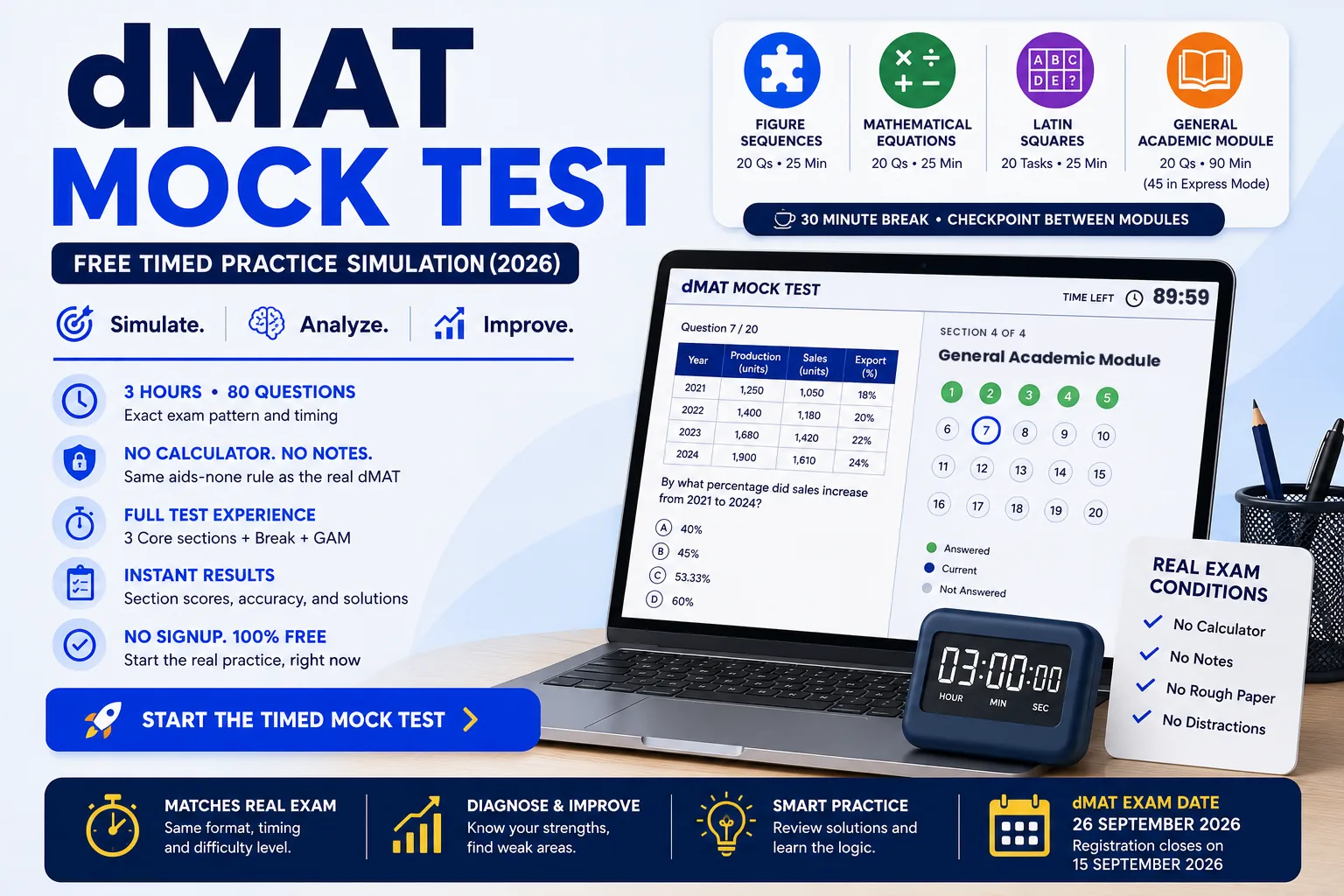
What the test involves. It is an aptitude paper rather than a subject exam on your degree syllabus, which helps if you have been working for a couple of years. The core module measures general analytical ability, and three formats account for most of the difficulty Indian candidates report, largely because they are unfamiliar: figure sequences, Latin squares and mathematical equations. In the introductory phase, affected applicants take the General Academic Module as their subject module. Your dMAT score does not decide admission on its own; universities weigh it independently and only a small number currently use it as a selection criterion.
Preparing for it. Take one dMAT mock test before studying anything, then work through the dMAT syllabus, drill the unfamiliar formats with sample questions, and follow the how to prepare for dMAT plan. Four focused weeks is realistic, and it can run alongside your IELTS preparation rather than after it.
UK Student Visa
Mandatory documents: UK student visa
| Document | India-Specific Details |
|---|---|
| CAS number | Issued by your UK university after accepting the offer and paying the deposit |
| Bank statements (28-day rule) | Tuition fees (as on CAS) + Rs.1,72,658 (£1,334)/month for London or Rs.1,32,377 (£1,023)/month elsewhere, held for 28 consecutive days |
| IELTS for UKVI (Academic) | The UKVI version specifically; standard IELTS Academic is not accepted for the visa |
| TB test certificate | Required for Indian applicants: from a UKVI-approved clinic in India |
| IHS payment confirmation | Rs.1,00,598/year (£777/year); paid online as part of the application |
Note from January 2026: UKVI introduced a new B2 English requirement. Verify current requirements at gov.uk.
Counselor insight: The 28-day bank balance rule causes more UK visa refusals than any other requirement. The balance must not dip even once below the threshold during the window. Check your statement line by line before applying.
UK vs Germany Post-Study Work Visas and PR Pathways in 2026
Post-Study Work and PR: UK vs Germany
UK Graduate Route
The Graduate Route allows international graduates to work at any skill level in the UK with no job offer required.
- Duration: 2 years (Masters) / 3 years (PhD) for applications submitted by 31 Dec 2026. From 1 Jan 2027: 18 months for Masters.
- Cost: Rs.1,21,208 (£937) application fee + Rs.1,34,048/year (£1,035/year) IHS.
- Route to UK PR: The Graduate Route does not count toward settlement. You need 5 additional years on a Skilled Worker visa (minimum Rs.53,97,180/year, £41,700) before applying for ILR. Total from arrival: 6–8 years.
September 2026 intake students: A 1-year Masters completing in September 2027 falls after the 31 Dec 2026 deadline. Your Graduate Route will be 18 months, not 2 years.
Germany: EU Blue Card and PR
After graduation, you apply for an 18-month job seeker visa and then the EU Blue Card once employed.
EU Blue Card 2026 salary thresholds (from 1 January 2026):
- Standard occupations: €50,700/year (Rs.56,89,554)
- Shortage occupations (IT, engineering, healthcare): €45,934.20/year (Rs.51,55,325)
- Recent graduates (degree within last 3 years): eligible for the lower threshold in all fields
Source: Tafapolsky & Smith LLP
Blue Card holders can apply for a settlement permit after 21 months with B1 German or 27 months with lower language proficiency.
See our Germany PR guide and job seeker visa guide.
Counselor insight: The Graduate Route does not count toward UK settlement at all. Germany's Blue Card path to a settlement permit in 21 months is genuinely faster for STEM graduates who secure employment at or above the Blue Card threshold and commit to B1 German.
UK vs Germany for Masters: Which Country Fits Your Field in 2026
Engineering and Computer Science
Germany. TU Munich, RWTH Aachen, and KIT rank in the global top 50 for Engineering per QS Subject Rankings 2026, and the employer pipeline is built into the degree: RWTH runs joint research with Siemens, BMW, and Bosch; TU Munich's Garching campus houses labs co-funded by Airbus and Intel. Entry-level engineer salaries average €55,000/year (Rs.61,72,100), clearing the Blue Card shortage threshold from day one. UK universities like Imperial and UCL also have strong CS outcomes, but at nearly double the total cost and a shorter post-study work window after January 2027. Source: Glassdoor Germany: Entry Level Engineer 2026
Automotive Engineering
Germany only. Volkswagen, BMW, Mercedes-Benz, Bosch, and Continental have their headquarters and largest R&D pipelines within 200 km of three universities: RWTH Aachen (ranked #33 globally for Engineering, dedicated automotive labs), University of Stuttgart (Daimler and Porsche's home city), and TU Munich (automotive electronics and autonomous systems). UK options like Coventry and Cranfield exist but cannot match this employer proximity. For Mechanical, Automotive, or EE graduates from Indian engineering colleges, an MS from any of these three puts you at the front of Europe's most specialised hiring queue.
Data Science and AI/ML
The answer splits by career direction. For finance-adjacent DS roles (quant, risk analytics, fintech, investment banking data science), go to the UK. UCL, Imperial, and Warwick graduates feed directly into Goldman Sachs, HSBC, and London's fintech cluster through pipelines that simply do not run through German universities. For research-led or industrial DS (computer vision for autonomous vehicles, predictive maintenance, AI/ML in manufacturing), Germany is the stronger choice. TU Munich's MSc in Data Engineering and Analytics and TU Berlin's MSc in Data Science have direct links to BMW's autonomous driving division and Volkswagen's digital labs, with entry-level AI/ML salaries of €55,000–€70,000/year (Rs.61,72,100–Rs.78,55,400). Note: outside Berlin and Munich, even English-posted DS roles expect B1–B2 German for daily collaboration.
MBA, Finance, Management, and Consulting
UK. London Business School ranked #9 globally for Business in QS Subject Rankings 2026, and McKinsey, BCG, Goldman Sachs, and KPMG all run their graduate recruitment cycles through London campuses. A 1-year MSc Finance at Imperial, Warwick, or LSE returns you to the workforce in 12 months with a credential India's BFSI sector and Big 4 recognise without explanation. Germany's ESMT Berlin is a genuine exception for an internationally focused MBA, but for most Indian professionals targeting finance or consulting, Germany is not a realistic substitute.
Humanities and Law
UK only. Virtually all Humanities and Law programs at German universities are taught in German and require B2-C1 proficiency for admission. For an Indian student from an English-medium background, this is not achievable within a normal preparation window. An LLM at UCL, King's, Edinburgh, or LSE is fully English-medium, globally recognised, and feeds directly into international law firms and corporate legal teams. The only exception: if you already hold B2 German and are specifically targeting EU or constitutional law, German programs become relevant. Otherwise, Germany is off the table for these fields. See best courses to study in Germany for a full list of English-taught German programs by field.
Which Country Is Right for You: UK vs Germany Decision Framework for Indian Students
Scenario 1: Final-year B.Tech (CS, ECE, or EE), CGPA 7.0+, budget up to Rs. 28L. Germany. Your field and CGPA are well-suited for public university admission. Immediate action: initiate APS using your provisional certificate. See winter intake in Germany for the full October 2026 timeline.
Scenario 2: Final-year B.Tech., CGPA below 6.5. Apply to both and let admissions results decide. German Fachhochschulen accept 5.5–6.5 with a strong SOP. UK mid-ranked universities accept 6.0+ with relevant experience and a strong personal statement.
Scenario 3: Working professional, 2+ years in finance, consulting, or management. Go to the UK. You have already built work experience, so spending two years in a German program is a poor trade, especially since management roles outside engineering also require B2 German. A 1-year Russell Group MBA or MSc Management gets you back to earning in 12 months, and the London professional network for finance and Big 4 consulting is one that German business schools simply cannot replicate for Indian professionals targeting those sectors.
Scenario 4: Budget Rs. 15L–Rs. 20L, open to learning German, targeting a STEM career in Europe. Germany is your realistic path. In cities like Dresden, Aachen, or Stuttgart, a 2-year Masters at a public university lands between Rs.20L and Rs.25L total: this includes the blocked account, semester fees, rent, and food. Munich pushes that higher by Rs.3L–Rs.5L, so factor that in if TU Munich is your target. The non-negotiable is German: a B1 level by the time you start job hunting is what unlocks the 21-month PR path. Enroll in a German course now, before your first semester begins.
What to Do When UK vs Germany Plans Go Wrong
Study abroad plans break down at predictable points. Here is what to do at each one.
- APS delayed past July 2026: Germany Winter 2026 is no longer viable. Pivot to the UK in September 2026 if documents are ready, or plan for Germany Summer 2027 (applications open November 2026). See summer intake Germany.
- UK Student visa refused: Read the refusal notice for the specific reason. Most 2026 refusals trace to the 28-day bank rule, submitting standard IELTS Academic instead of IELTS for UKVI, or an incorrect financial evidence format. All are correctable on reapplication.
- Germany Student visa refused: Request a written statement of reasons from the consulate. Common causes: self-attested copies (rejected under 2026 rules) and incomplete marksheet sets. Contact APS India directly if the interview was the issue.
- CGPA below 6.0 and German public university rejections: Switch to Fachhochschulen with flexible entry criteria, or pivot to UK. A Fachhochschule degree still qualifies for the EU Blue Card.
3 Takeaways for UK vs Germany for Indian Students
First: Germany wins on total cost and PR speed for STEM graduates who commit to B1 German and can handle a 2-year program. At Rs.20L–Rs.28L all-in versus Rs.40L–Rs.55L for the UK, the savings are real, and the 21-month Blue Card path to a settlement permit is materially faster than the UK's 7+ year route to ILR.
Second: UK wins on speed-to-degree, English environment, and business and finance career track at a significantly higher total cost. If your goal is a career in London financial services or Indian BFSI within 2 years, the 1-year UK Masters followed by the Graduate Route is the faster and more direct path.
Third: Regardless of which country you choose, if you are targeting October 2026 German entry or September 2026 UK entry, your immediate action is identical: book your IELTS for the UKVI test this week. For Germany, initiate your APS application immediately after. You cannot rush these two steps, which have the longest lead times.
Verified by: LeapScholar's UK and Germany counseling team, with direct experience guiding Indian students through university applications, APS certification, visa processes, and post-study work transitions for both destinations.
Have questions about choosing between UK vs Germany for your specific profile? Book a free session with a LeapScholar counselor.
Frequently Asked Questions About UK vs Germany for Indian Students
-
My CGPA is below 6.5. Can I still apply for Masters in UK or Germany?
Yes. German Fachhochschulen accept 5.5–6.5 with a strong SOP. UK mid-ranked universities accept 6.0+ with relevant experience and a strong personal statement. A CGPA below 5.5 significantly narrows options at both destinations.
-
What is the UK Graduate Route visa, and how long does it last?
The Graduate Route lets international graduates work in the UK at any skill level, no job offer required. Duration: 2 years (Masters) for applications by 31 Dec 2026; 18 months from 1 Jan 2027. PhD graduates retain 3 years regardless. It does not lead directly to settlement.
-
Which country is better for an MBA: UK or Germany?
For most Indian profiles targeting an MBA, Germany is not a close competitor. If you are targeting investment banking, Big 4 consulting, or corporate finance, recruiting pipelines run through London, not Frankfurt or Munich. London Business School, Warwick, and Alliance Manchester actively recruit into those sectors in a way that German business schools (outside ESMT Berlin) do not yet match for Indian candidates. Germany's MBA options are solid if you want to stay in Europe long-term and are building toward an engineering-adjacent management role, but for a direct India-facing career in BFSI, the UK wins on placement outcomes.
-
What happens to my Germany application if my APS is delayed?
You will miss the 15 July Uni-Assist deadline for most programs. Options: Germany Summer 2027 (apply from November 2026) or Germany Winter 2027. Your APS certificate remains valid; you lose one intake, not your Germany plan.
-
What is the APS certificate, and how long does it take?
The APS verifies the authenticity of your Indian academic credentials. Mandatory for all Indian applicants since November 2022. Cost: Rs.20,200 (€180), nonrefundable, valid for life. Processing: 4–6 weeks standard, 6–8 weeks peak season.
-
Do I need to learn German to study and work in Germany?
For studying: no. For working: practically yes. Most engineering, IT, and management roles outside Berlin require B1–B2 German to be competitive. Daily life (housing, banking, government offices) is significantly harder without basic German. Start language study before you arrive.
-
How long does Germany PR take for Indian students?
After graduation: 18 months on a job seeker visa, then an EU Blue Card from the employment date. Settlement permit: 21 months after the Blue Card with B1 German or 27 months with lower proficiency. Total: approximately 3–4 years for STEM graduates who find employment quickly.
-
Is a 1-year UK Masters degree recognized in India and internationally?
A 1-year UK Masters from a reputable university is widely recognized by India's private sector, particularly in BFSI, consulting, and tech. Some Indian PSUs and government bodies may require a 2-year postgraduate qualification; verify with the specific employer before assuming recognition.
-
Which is cheaper overall for an Indian student: UK or Germany?
Germany is substantially cheaper for the full degree. A 2-year Masters at a German public university typically costs Rs.20L–Rs.28L all-in, including living costs, semester fees, APS, and the blocked account. A 1-year UK Masters typically costs Rs.35L–Rs.55L all-in, including tuition, living costs, and visa fees. Germany is the more affordable option, even accounting for the extra year of living expenses.







Have Questions? Get Guidance to reach your Dream University
Connect with India's finest counsellors and biggest study abroad community.
Get Guidance