
Quick Read
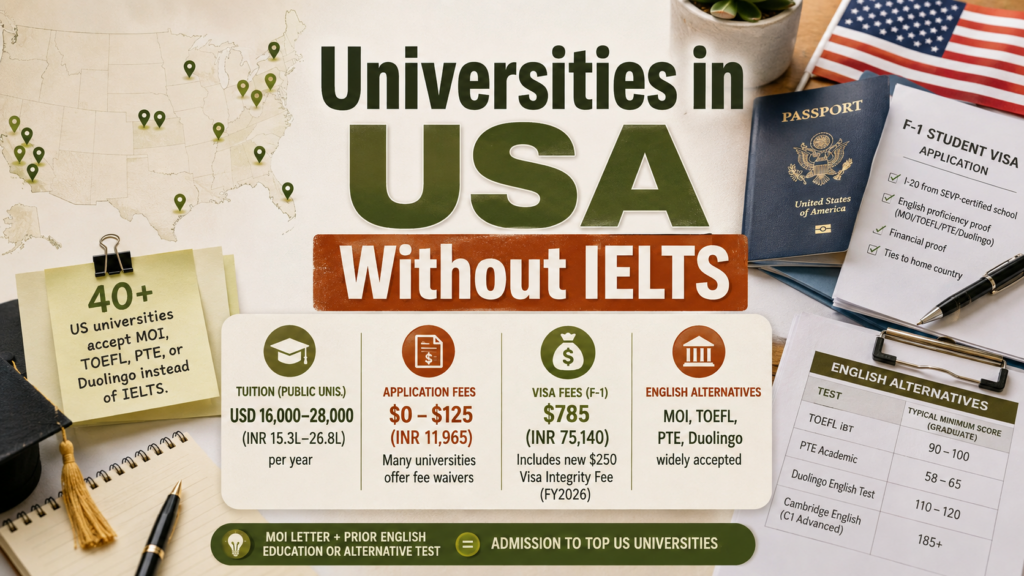
- 40+ US universities accept MOI, TOEFL, PTE, or Duolingo instead of IELTS.
- Public universities like Cal State and Colorado Boulder commonly accept English-medium education proof.
- F-1 visa approval depends on your I-20 and English proof, not IELTS specifically.
- Application fees range from $0 to $125 (INR 11,965), and many universities offer fee waivers.
Universities in USA Without IELTS
Universities in USA without IELTS are more common than most Indian applicants realize. Nearly every SEVP-certified institution, including many schools in USA without IELTS at the undergraduate level, accepts at least one alternative: TOEFL, PTE Academic, Duolingo, or an MOI letter.
Below is a list of universities in USA without IELTS for international students that Indian applicants commonly shortlist, with the alternative each accepts and the approximate annual tuition. This USA university list for masters and undergraduate programs alike shows why a university in USA without IELTS and TOEFL together is rare beyond a handful of MOI-only schools.

Choose your dream country
 UK
UK
 USA
USA
 Germany
 Australia
 Ireland
 Canada
 UAE
UAE
 France
 Sweden
 Italy
Italy
 Other
Other
When do you want to study abroad?
What's your highest level of education?
Have you completed Class 12th?
What was your Class 12 CGPA/percentage?
Are you a student or a parent/guardian?
What do you want to study?
Select your current city
How Leap will help you

Personalised University Shortlist

Express Applications with Quicker Admits

End-to-End Application Support
| University | Type | Accepted Alternative | Approx. Annual Tuition (USD/INR) |
| Harvard University | Private | TOEFL, MOI (case-by-case) | $54,000 (INR 51.7L) |
| Rice University | Private | TOEFL, Duolingo | $58,000 (INR 55.5L) |
| University of Colorado Boulder | Public | TOEFL, Duolingo, MOI | $38,000 (INR 36.4L) |
| University of Iowa | Public | TOEFL, Duolingo, MOI | $28,000 (INR 26.8L) |
| University of Delaware | Public | TOEFL, Duolingo, Cambridge English | $34,000 (INR 32.5L) |
| Drexel University | Private | PTE, Duolingo, MOI | $58,000 (INR 55.5L) |
| Syracuse University | Private | PTE, Duolingo | $58,000 (INR 55.5L) |
| California State University (system) | Public | TOEFL, Duolingo, PTE, MOI | $19,000 (INR 18.2L) |
| University of Dayton | Private | TOEFL, PTE | $45,000 (INR 43.1L) |
| Arkansas State University | Public | TOEFL, PTE | $16,000 (INR 15.3L) |
| University of New Orleans | Public | TOEFL, Duolingo, MOI | $24,000 (INR 23.0L) |
Always confirm current fees and English proficiency requirements on the university's own admissions page before applying, since these change every intake cycle.
Exchange rate note: 1 USD = INR 95.72 as of August 2026. Verify the current rate before finalizing your budget.
Sources: QS World University Rankings 2027 and the official admissions pages linked in the table above.
MOI-Accepted Universities in USA for Indian Students
A Medium of Instruction (MOI) letter is issued by your previous school or college confirming your education was taught in English. It's the fastest route for Indian students to skip IELTS, since most Indian boards teach in English and can issue this letter on request.
Universities in USA without IELTS that commonly accept MOI include the following:
| University | MOI Policy |
| California State University (system) | Accepts MOI in place of an English test for applicants with English-medium education |
| University of Colorado Boulder | Accepts MOI plus one year of study in an English-speaking country as an alternative |
| Drexel University | Accepts MOI alongside its University Preparation Summer Program route |
| University of New Orleans | Accepts MOI from applicants who completed schooling in English |
| University of Arkansas | Accepts MOI on a case-by-case basis for graduate applicants |
MOI acceptance is almost always evaluated case-by-case at the graduate level, less so at the undergraduate level. Request your MOI letter from your registrar at least eight weeks before your deadline, since some institutions take time to issue it on official letterhead with a signature and seal.
Counselor insight: Get your MOI letter drafted even before you shortlist final universities. Many Indian colleges are unfamiliar with the format US admissions offices expect, and revisions can take weeks during peak application season.
IELTS Alternatives Accepted by Universities in USA Without IELTS
Do all US universities accept IELTS? No. IELTS is widely accepted, but it is not universally required, and most universities in USA without IELTS instead ask for one of the following:
| Test | Typical Minimum Score (Undergraduate) | Typical Minimum Score (Graduate) |
| TOEFL iBT | 80–90 | 90–100 |
| PTE Academic | 53–58 | 58–65 |
| Duolingo English Test | 105–110 | 110–120 |
| Cambridge English (C1 Advanced) | 176–180 | 185+ |
Each university sets its thresholds, so treat this table as a starting range, not a guarantee. A university in USA without IELTS and TOEFL for international students is rare beyond MOI-only schools, since most institutions want at least one standardized measure of English unless MOI, prior English-medium education, or an interview substitutes for it.
Sources: ETS TOEFL, Pearson PTE Academic, Duolingo English Test.
Top Cheapest Universities in USA for International Students Without IELTS
If cost is your primary filter, the cheapest universities in USA without IELTS options are almost always public state universities, not private research institutions. These top cheapest universities in USA for international students without IELTS also tend to waive application fees, making them a strong pick for the cheapest universities in USA for international students without an IELTS and application fee together.
| University | Type | Approx. Annual Tuition (USD/INR) |
| Arkansas State University | Public | $16,000 (INR 15.3L) |
| Black Hills State University | Public | $9,000 (INR 8.6L) |
| University of New Orleans | Public | $24,000 (INR 23.0L) |
| California State University (system) | Public | $19,000 (INR 18.2L) |
| University of Iowa | Public | $28,000 (INR 26.8L) |
Exchange rate note: 1 USD = INR 95.72 as of August 2026. Verify the current rate before finalizing your budget.
Public universities in USA without IELTS typically cost 40 to 60 percent less than private universities offering the same MOI or TOEFL-based waiver, since state institutions receive government funding that private schools do not. The cheapest university in USA for international students without IELTS is almost never a private research university, so start your shortlist with state schools if budget is your biggest constraint.
Counselor insight: Cheapest does not always mean lowest total cost. Compare living costs in the city too. A INR 15.3L tuition in a high-cost-of-living state can end up more expensive overall than a INR 23L tuition in a smaller college town.
Source: NCES College Navigator, U.S. Department of Education, for published tuition data; verify against each university's admissions page linked above for the current intake.
Public Universities in USA Without Application Fee
Application fees add up fast. At $50 to $125 (INR 4,786 to INR 11,965) per school, applying to eight or ten universities can mean a lakh of rupees gone before you even get an admit letter. Universities in USA without IELTS and application fee for international students are worth hunting down for exactly this reason.
Public schools like California State University and University of New Orleans waive fees more consistently than private ones, and several also accept MOI, so schools in USA without application fees and schools in USA without IELTS and application fee are natural picks to shortlist together. Two routes get you there:
| Route | How It Works | Best For |
| Common App Fee Waiver | Need-based waiver requested in your Common App profile; your school counsellor confirms eligibility | Students with documented financial need |
| University-specific waiver | Offered by individual schools for early applicants, recruitment event attendees, or hardship cases | Students applying to a specific public university's own portal |
Nearly half of all Common App member colleges charge no application fee at all; filter for these directly on Common App's college search. Public universities in USA without application fees and IELTS, and public universities in USA for international students without IELTS, tend to be the same shortlist, since state schools with English-alternative policies usually run the more accessible waiver process too.
Note: Universities in USA without application fees and IELTS for international students rarely come as a single guaranteed package, since fee waivers and English test waivers are assessed separately by each admissions office. The same holds for universities abroad with no application fee outside the USA; universities that don't have an application fee anywhere in the world still set their English proficiency rules independently.
Source: Common App international applicant guidance.
Eligibility Criteria and Admission Process for Universities in USA Without IELTS
Here's the part most students overthink: colleges in USA for international students without IELTS are not looking for a magic loophole. They just want proof, in any acceptable form, that you can handle coursework taught in English. Universities in USA that do not require IELTS will accept one of these four instead:
- An MOI letter from your school or college, confirming your prior education was entirely in English.
- One completed academic year in an English-speaking country, including the USA itself.
- An alternative test score: TOEFL, PTE, Duolingo, or Cambridge English, whichever the university lists on its admissions page.
- A short interview, used by a smaller number of universities to judge spoken English directly rather than through a test.
How to Apply to Universities in USA Without IELTS?
Once you know which of these four applies to you, the rest of the process looks like any other US application:
- Shortlist universities and confirm their accepted alternative to IELTS on the official admissions page.
- Prepare transcripts, SOPs, letters of recommendation, and your MOI letter or test score.
- Submit applications through Common App or the university's own portal.
- Accept your offer and receive Form I-20 from your SEVP-certified school.
- Pay the SEVIS I-901 fee and apply for your F-1 visa.
Note: Don't leave your English proficiency proof until after you receive an admission offer. Universities usually verify this requirement while reviewing your application, and submitting it late can delay your admission by an entire semester.
Source: Study in the States, U.S. Department of Homeland Security, for the SEVP admission-to-visa sequence.
Scholarships for Studying in USA Without IELTS
Skipping IELTS doesn't shut you out of funding. Several well-known scholarships assess academic merit, leadership, or financial need, not which English test you submitted, so they're worth applying for alongside any university in USA without IELTS on your shortlist.
| Scholarship | Funded By | Coverage | Notes on English Proof |
| Fulbright Foreign Student Program | U.S. Government | Full tuition, living stipend, airfare | Merit-based; MOI or TOEFL accepted |
| Aga Khan Foundation International Scholarship | Aga Khan Foundation | 50% grant, 50% loan | For postgraduate students from developing countries |
| Clark University Merit Scholarships | Clark University | Up to $20,000 (INR 19.1L) per year | Awarded on academic record; MOI or TOEFL accepted |
| Hubert H. Humphrey Fellowship | U.S. Government | Full tuition and stipend for one year | For accomplished mid-career professionals |
Exchange rate note: 1 USD = INR 95.72 as of August 2026. Verify the current rate before finalizing your budget.
Pair your scholarship shortlist with an education loan comparison early rather than waiting for results. Leap Finance and similar Indian lenders offer collateral-free loans for students admitted to SEVP-certified US universities, which gives you a funding backup while scholarship decisions are still pending.
Source: Official individual scholarship pages for eligibility, funding coverage, and application requirements.
USA Study Visa Without IELTS: F-1 Visa Process and Fees
A USA study visa without IELTS follows the same F-1 process as any other applicant. The visa officer checks your I-20, financial proof, and ties to India, not which English test you submitted to your university.
| Fee | Amount (USD/INR) | Paid To |
| SEVIS I-901 Fee | $350 (INR 33,502) | Department of Homeland Security |
| MRV Visa Application Fee | $185 (INR 17,708) | U.S. Department of State |
| Visa Integrity Fee (new, FY2026) | $250 (INR 23,930) | U.S. Department of State, at visa issuance |
The $250 (INR 23,930) Visa Integrity Fee was introduced under the One Big Beautiful Bill Act and applies to most F-1 visas issued from fiscal year 2026 onward. It is charged at the time your visa is issued, not when you apply, and current guidance suggests it may be refundable if you fully comply with your visa terms and depart on time. Confirm with your consulate before your interview, since rollout has been uneven across posts.
Note: Conversions above use 1 USD = INR 95.72. Visa fees are set by the U.S. government and can change without much notice, so verify the current amount on the official portals linked below before you pay.
Sources: ICE SEVIS I-901 Fee, U.S. Department of State visa fees.
Cost of Studying in USA Without IELTS
Whether you get in through MOI, TOEFL, or Duolingo, you'll face the same tuition, living cost, and insurance numbers as any other international student. Use the table below to build a realistic annual estimate before you commit to a shortlist.
| Expense | Approx. Annual Cost |
| Tuition (Public Universities) | USD 16,000–28,000 (INR 15.3L–26.8L) |
| Tuition (Private Universities) | USD 45,000–58,000 (INR 43.1L–55.5L) |
| Living Expenses | USD 12,000–18,000 (INR 11.5L–17.2L) |
| Health Insurance | USD 1,500–2,500 (INR 1.4L–2.4L) |
Choosing a university in USA without IELTS does not reduce your total cost of study. It only removes one specific test from your application checklist, so budget for universities in USA without IELTS the same way you would for any US degree.
Exchange rate note: 1 USD = INR 95.72 as of August 2026. Verify the current rate before finalizing your budget.
Source: NCES College Navigator, U.S. Department of Education, for published tuition and cost-of-attendance data.
Document Checklist for Universities in USA Without IELTS
Not taking IELTS doesn't mean fewer documents. It just means you'll need to submit another accepted proof of English proficiency, such as an MOI letter or an alternative test score, along with the usual application paperwork.
| Document | Required For |
| MOI letter or alternative test score | English proficiency proof |
| Academic transcripts | All applications |
| SOP and letters of recommendation | All applications |
| Form I-20 | Visa application |
| SEVIS fee receipt | Visa interview |
| Financial proof (bank statements/loan sanction) | Visa interview |
Which Route Fits You? 3 Scenarios for Universities in USA Without IELTS
- Scenario 1: Class 12 graduate from an English-medium CBSE school: An MOI letter from your school, combined with a Duolingo or TOEFL score as backup, covers most public universities in USA without IELTS.
- Scenario 2: Bachelor's graduate applying for a master's, weak English test scores: Target MOI-accepting graduate programs like the University of Arkansas or Drexel, and lean on your bachelor's transcript as proof of English-medium instruction.
- Scenario 3: Budget-conscious applicant applying to 8+ schools: Prioritize Common App fee waiver eligibility first, then shortlist public universities in USA without IELTS such as California State University or Arkansas State University to control both application and tuition costs.
Timeline to Apply to Universities in USA Without IELTS
A university in USA without IELTS still runs on the same admissions calendar as any other US application. The only extra step is building in time for your MOI letter or alternative test, both of which take longer to arrange than most students expect. Here's a realistic month-by-month plan for a Fall intake:
| Timeline | Action | Why It Matters |
| 12 months before intake | Shortlist universities in USA without IELTS and confirm each one's accepted alternative | Policies vary by school and program level |
| 10–11 months before intake | Request your MOI letter from your registrar, or book your TOEFL/PTE/Duolingo test date | MOI letters take weeks to issue; test slots fill up close to deadlines |
| 8–9 months before intake | Submit applications and apply for any fee waivers you qualify for | Fee waiver requests are usually submitted alongside your application |
| 6–7 months before intake | Track admission decisions and finalise your funding plan | Loan sanction letters are often required before your visa interview |
| 4–5 months before intake | Accept your offer, receive Form I-20, and pay the SEVIS fee | You can't schedule a visa interview until your SEVIS record is active |
| 2–3 months before intake | Schedule and attend your F-1 visa interview | Slots at Indian consulates fill up fast in peak season (April to July) |
| 1 month before intake | Book flights and complete your pre-departure checklist | Leaves buffer for last-minute document requests |
What If Your MOI or Test Score Is Rejected?
If a university rejects your MOI letter or considers your test score insufficient, you have two fallback options: enroll in a university-run Intensive English Language Program (IELP) that leads directly into your degree, or retake TOEFL, PTE, or Duolingo before the next intake. Don't wait until your visa interview to discover the outcome; most universities flag gaps at the offer stage, giving you time to act.
Get expert answers to common questions about studying in the USA without IELTS from LeapScholar's Questions Hub.
3 Takeaways on Universities in USA Without IELTS
- Universities in USA without IELTS accept MOI, TOEFL, PTE, or Duolingo instead, with public universities like Cal State and University of Colorado Boulder among the most consistent MOI acceptors.
- Your F-1 visa process is unaffected by which English test you used to get admitted, but budget for the new $250 (INR 23,930) Visa Integrity Fee alongside the $350 (INR 33,502) SEVIS fee and $185 (INR 17,708) MRV fee.
- The cheapest universities in USA without IELTS are almost always public institutions, and application fee waivers through Common App can meaningfully cut your upfront costs.
Verified by: LeapScholar's USA counseling team, with hands-on experience guiding Indian students through MOI documentation, US university admissions, and F-1 visa applications.
Have questions about studying in the USA without IELTS? Book a free session with a LeapScholar counselor.
Frequently Asked Questions About Universities in USA Without IELTS
-
Do all US universities accept IELTS?
Not always. IELTS is common, but plenty of universities in USA without IELTS take TOEFL, PTE, Duolingo, or an MOI letter instead. Just double-check each university's own policy before you apply.
-
Which universities in USA accept MOI instead of IELTS?
Cal State, University of Colorado Boulder, Drexel, University of New Orleans, and University of Arkansas are among the MOI-accepted universities in USA that Indian students go for most often. Grad programs tend to be more consistent about accepting MOI than undergrad ones.
-
Is it possible to study in USA without IELTS for a bachelor's degree?
Yes. A USA university without IELTS at the undergrad level usually just wants an MOI letter, a TOEFL, or Duolingo score, as long as your prior schooling was in English. Don't assume a university in USA without IELTS is an easier ride, though; the academic bar stays the same.
-
Can I get a US study visa without IELTS?
Yes, a USA study visa without IELTS is completely normal. The consular officer cares about your I-20, your finances, and your ties back home, not which English test got you admitted.
-
What is the cheapest university in USA without IELTS for international students?
Public schools like Arkansas State University, Black Hills State University, and the California State University system rank among the cheapest universities in USA without IELTS, often 40 to 60 percent lower in tuition than private options offering the same waivers.
-
Are there universities in USA without an application fee and IELTS together?
Not as a guaranteed combo. Fee waivers and English-test waivers get assessed separately by each university, so you might qualify for one, both, or neither depending on your profile and the school's own policy.
-
What is an MOI letter, and who issues it?
It's a letter from your previous school, college, or university confirming your education was entirely in English. You'd usually request it from the registrar's office, and it needs to be on official letterhead with a signature and seal.
-
Can I do an MS in USA without IELTS?
Yes. A university in USA for masters without IELTS usually just wants an MOI letter from your bachelor's degree or a TOEFL, PTE, or Duolingo score. If you're planning to study masters in USA without IELTS, pull up each program's official USA university list for masters without IELTS on its admissions site first, since grad committees tend to be more flexible about the format than undergrad ones.
-
Do vocational schools in USA for international students without IELTS exist?
Yes, quite a few vocational schools in USA for international students without IELTS take TOEFL or PTE instead. Nursing schools in USA for international students without IELTS usually accept alternative tests too, though most add a spoken English interview since clinical communication matters. Best to confirm directly with each program's admissions office.








Have Questions? Get Guidance to reach your Dream University
Connect with India's finest counsellors and biggest study abroad community.
Get Guidance