
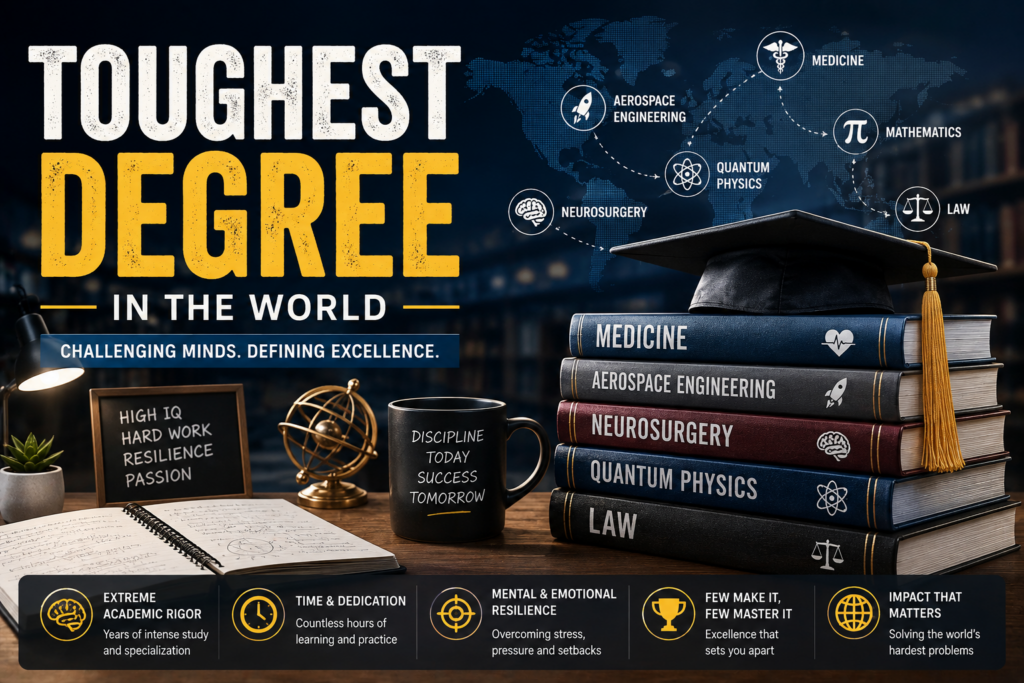
Quick Read
- Medicine, Law and Engineering top most global rankings of the toughest degree in the world.
- No single authority, including QS or Guinness, has ever named one official “toughest degree.”
- Chartered Accountancy has one of the lowest pass rates of any course Indian students attempt.
- Course difficulty depends on duration, workload, admission selectivity, and pass rates, not opinion alone.
What Makes a Degree the Toughest in the World?
There is no single global authority, including QS, Times Higher Education, or Guinness World Records, that has ever certified one official “toughest degree in the world.” What you see across university guides and student forums is a consensus built from four measurable factors: how long the course runs, how many hours of study it demands per week, how selective admission is, and how many students who start actually finish or pass.
By those four factors, the same handful of degrees keep appearing at the top of every serious list: Medicine, Law, Engineering, Architecture, Chartered Accountancy, Physics, Pharmacy, Dentistry, Aviation and Biotechnology. This guide ranks and explains each one, using verified duration, admission, and pass-rate data rather than opinion.

Choose your dream country
 UK
UK
 USA
USA
 Germany
 Australia
 Ireland
 Canada
 UAE
UAE
 France
 Sweden
 Italy
Italy
 Other
Other
When do you want to study abroad?
What's your highest level of education?
Have you completed Class 12th?
What was your Class 12 CGPA/percentage?
Are you a student or a parent/guardian?
What do you want to study?
Select your current city
How Leap will help you

Personalised University Shortlist

Express Applications with Quicker Admits

End-to-End Application Support
Counselor insight: When a student asks us, "Which is the toughest degree?" we usually flip the question. The more useful question is "Which of these will feel toughest to me specifically?" A CA aspirant who is strong at pattern-based problem solving can find CA more manageable than a Humanities graduate finds a 5-year Architecture program. Match the degree to your own strengths before you match it to a ranking.
Top 10 Toughest Degrees in the World 2026: Overview
The list below categorizes the toughest degree candidates in the world based on their duration and the primary reason each is difficult to complete.
| Course | Typical Duration | Core Difficulty Driver |
| Medicine | 5-6 years | Volume of content, clinical hours, low admission rates |
| Law | 4-5 years | Reading volume, argumentation, case analysis |
| Engineering | 4 years | Mathematical depth, lab load, project deadlines |
| Architecture | 5 years | Studio hours, design critique, technical precision |
| Chartered Accountancy (CA) | 4-5 years | Multi-stage exams, single-digit pass rates at Final level |
| Physics (Theoretical/Engineering) | 4-6 years | Abstract mathematics, research rigour |
| Pharmacy | 4-5 years | Biochemistry depth, clinical precision |
| Dentistry | 5 years | Manual precision combined with academic load |
| Aviation / Pilot Training | 2-4 years | Physical and mental testing, high-stakes simulator hours |
| Biotechnology | 4 years | Interdisciplinary lab and research demands |
1. Medicine
Medicine tops nearly every global ranking of the toughest degree in the world, and the reasons are structural rather than reputational. Programs typically run 5 to 6 years and combine dense theoretical content (anatomy, physiology, pharmacology) with years of supervised clinical practice.
Admission is genuinely difficult at the top end. At the University of Oxford, official 2025 admissions data puts the overall success rate for Medicine at 19.7% for state-school applicants and 25.8% for independent-school applicants, out of over a thousand UCAS applications for a small number of places. That selectivity, combined with the sheer duration of training, is why Medicine is consistently cited as the toughest course in the world.
Counselor insight: Indian students often underestimate how much of medical training abroad is clinical, not classroom-based. If you struggle with long, irregular hours rather than difficult content itself, it is worth testing your limits for yourself through a hospital shadowing stint before committing to a 5-6 year program in a country you have not lived in before.
2. Law
Law degrees demand a different kind of endurance: heavy reading volume, precise argumentation, and continuous case-based assessment across 4 to 5 years. Unlike Medicine, the difficulty is less about admission scarcity everywhere and more about the sustained intellectual load once you're in, since law programs rarely let up on reading and writing output from year one to graduation.
Counselor insight: If English isn't your strongest academic language, Law Abroad will test you harder than most other degrees on this list, since almost all assessment is written argumentation rather than numerical problem-solving.
3. Engineering
Engineering programs (mechanical, civil, electrical, and computer) typically run 4 years and combine mathematically dense coursework with continuous lab and project work. What makes it consistently rank among the toughest degrees in the world isn't any single hard subject; it's the sustained pace: new project deadlines overlap with ongoing coursework for most of the degree, with limited room to fall behind.
Counselor insight: Among Indian applicants, the branch matters more than the country. Electrical and Aerospace streams typically carry a heavier theoretical-mathematics load than Mechanical or Civil, so pick the branch based on your comfort with abstract math, not just placement statistics.
4. Architecture
Architecture blends creative and technical demands across a 5-year program: design studio work, technical drawing, structural calculations, and repeated project critiques. The workload is unusual in that it is rarely measured in exams; it's measured in studio hours and deadline-driven design submissions that can run through the night before a review.
Counselor insight: Architecture is one of the few courses on this list where a portfolio, not just grades, decides your admission abroad. Start building one at least a year before you apply, since a rushed portfolio is the single most common rejection reason we see.
5. Chartered Accountancy (CA)
CA is arguably the most quantifiably brutal course on this list. The ICAI's own November 2024 CA Final results show a pass percentage of just 13.44% across both groups combined, out of nearly 31,000 candidates who appeared for both groups. That is lower than the pass rate for most competitive international postgraduate entrance exams.
Unlike the other programs here, CA is also one of the least expensive courses on this list to pursue, which is part of why it remains one of the most attempted "toughest degree in the world" candidates among Indian commerce students specifically.
If you're weighing CA against other exam-heavy paths like NEET for Medicine or JEE Advanced for Engineering, see our full breakdown of the toughest exams in the world before you commit to a preparation timeline.
Counselor insight: CA's difficulty is compounding, not front-loaded. Most students find Foundation manageable but underestimate how much harder Intermediate and Final become once they add mandatory articleship hours on top of their exam preparation. Plan your study schedule around the articleship, not around your old school routine.
6. Physics (Theoretical or Engineering)
Physics programs, particularly theoretical and engineering physics tracks, run 4 to 6 years and are built almost entirely on abstract mathematical reasoning rather than memorization. Concepts like quantum mechanics and relativity require a comfort with abstraction that few other degrees on this list demand to the same degree, which is why Physics regularly appears alongside Medicine and Law in "hardest subject" rankings globally.
Counselor insight: If you're choosing between straight Physics and Engineering Physics, know that the latter adds an applied, project-based layer on top of the same theoretical core, which suits students who want research skills paired with clearer industry pathways.
7. Pharmacy
Pharmacy programs run 4 to 5 years and combine deep biochemistry and pharmacology content with clinical precision requirements, since errors in drug formulation or dosage calculation carry real consequences. The academic load is comparable to early medical training, without the multi-year clinical residency that follows Medicine.
Counselor insight: Pharmacy is a strong option for students who want the scientific rigor of a medical-adjacent field without committing to the full length of a Medicine degree. It is genuinely demanding, but the time-to-qualification is considerably shorter.
8. Dentistry
Dentistry takes around 5 years and layers manual, hands-on precision on top of a full scientific curriculum in oral anatomy, prosthodontics, and surgery. What distinguishes it from most degrees on this list is that a student can master the theory completely and still need years of separate practice to develop the physical dexterity the profession demands.
Counselor insight: Dentistry applicants abroad are often evaluated on manual aptitude tests in addition to academics. Ask any program you're shortlisting whether such an assessment is part of admission, since it isn't always advertised upfront.
9. Aviation / Pilot Training
Aviation is one of the few entries on this toughest degree in the world list that isn't a traditional academic program. Pilot training is shorter than most degrees on this list (2 to 4 years) but compresses an unusual mix of theoretical ground school, simulator hours, and live flight training into that window, alongside strict, recurring physical and psychological fitness testing throughout training, not just at entry.
Counselor insight: Unlike every other course here, failing a single medical fitness check can end a pilot training pathway regardless of academic performance. Get an aviation-specific medical assessment done before you commit financially to any program.
10. Biotechnology
Biotechnology programs run around 4 years and sit at the intersection of biology, chemistry and applied lab research. The difficulty here is less about any one subject and more about the interdisciplinary breadth: students are expected to be competent across molecular biology, chemistry, and increasingly, data analysis, within a single degree.
Counselor insight: Biotechnology is one of the more research-dependent degrees on this list. If you're applying for programs abroad, prior lab or research exposure (even a short internship in India) meaningfully strengthens your application compared to grades alone.
Toughness by Country: What Actually Varies
The core content of a degree doesn't change much by country, but how that difficulty is delivered does. This affects which country might suit your working style, independent of which degree you choose.
| Country | What Makes Courses Tough | Learning Style |
| United States | Research-intensive coursework, continuous assessment load | Project-based, ongoing evaluation |
| United Kingdom | Analytical, essay-heavy curriculum with deep argumentation | Self-directed study, fewer but higher-stakes exams |
| India | Competitive entrance exams, extensive syllabi | Structured, exam-driven |
| Europe (Germany, France, Netherlands) | Modular systems, technical specialisation, strict grading | Credit-based, practical internships |
| Australia & Canada | Applied learning through internships and capstone projects | Balanced theory and practice |
Counselor insight: Indian students used to India's exam-driven structure sometimes find the UK's fewer-but-heavier-exam model, or the US's continuous-assessment model, harder to adjust to than the actual subject content. Factor in learning style, not just subject difficulty, when picking a country for one of these degrees.
For students weighing which specific stream within engineering is hardest, see our detailed breakdown in the toughest engineering courses in the world guide.
Is There a Real “Toughest Course in India”?
Among Indian students specifically, Chartered Accountancy is the course most consistently cited as the toughest, based on its multi-stage exam structure and low Final-level pass rates, followed closely by Medicine (MBBS via NEET) and IIT-level Engineering through JEE Advanced. All three combine punishing entrance selectivity with years of sustained academic pressure once admitted.
See what our counselors say about which is the toughest course or degree in India if you're weighing one of these against a global option.
3 Key Takeaways on Toughest Degree in the World
- No single authority has ever certified an official toughest degree in the world, so treat any ranking, including this one, as a guide built on duration, workload, and pass-rate data, not a verdict.
- Match the degree to your own working style: CA and Medicine punish inconsistency, Architecture and Engineering punish poor time management, and Aviation punishes physical unpreparedness.
- Before committing to any of these programs abroad, verify country-specific admission data directly from the university, since selectivity for the same degree can vary sharply between institutions.
Are you considering one of these demanding degrees for study abroad? Talk to a LeapScholar counselor to check your profile against the toughest degree in the world you're targeting before you apply.
Frequently Asked Questions About the Toughest Degree in the World
-
What are the top 10 hardest degrees in the world?
The most consistently cited toughest degrees globally are Medicine, Law, Engineering, Architecture, Chartered Accountancy, Physics, Pharmacy, Dentistry, Aviation/Pilot Training, and Biotechnology. Rankings vary by source since no official global authority certifies a single order.
-
Which is the toughest course in the world?
Medicine is most often named the toughest course in the world due to its long duration (5-6 years), high clinical workload, and selective admission at top universities. Law, Physics and Engineering are close behind by most measures.
-
Is CA harder than Medicine?
By pass rate alone, CA is harder to clear. ICAI's November 2024 CA Final results show a 13.44% pass rate across both groups, lower than Medicine's admission success rates at most universities. Medicine is longer and more resource-intensive overall.
-
What is the toughest subject in the world to study?
Quantum Physics and advanced theoretical Physics are frequently named the toughest subjects due to their reliance on abstract mathematics. Medicine, Law and Architecture are considered tough for different reasons: workload, argumentation, and design precision, respectively.
-
Is Engineering or Medicine tougher?
Medicine generally involves a longer duration and more selective admission, while Engineering demands sustained mathematical and project workload across a shorter 4-year span. Neither is universally "tougher"; the better comparison is which workload style suits you.
-
Which is the toughest course in the world to gain admission to?
Medicine at highly selective universities like Oxford and Cambridge is among the hardest to gain admission to, with overall success rates typically below 25% even for strong applicants. Competitive Engineering and Law programs at top-ranked universities are similarly selective.
-
Do tougher degrees always lead to higher salaries?
Not automatically. Medicine, Law and Engineering are associated with strong long-term earning potential, but outcomes depend heavily on specialization, country, and experience, not degree difficulty alone. For a fuller cost and career-outcome breakdown, see our companion guide on hardest degrees in the world: difficulty, costs and career outcomes.
-
Is Aviation training considered a degree?
Pilot training is usually a licensing-based program rather than a traditional academic degree, though it is frequently included in "toughest course" rankings due to its physical, psychological, and technical demands.






Have Questions? Get Guidance to reach your Dream University
Connect with India's finest counsellors and biggest study abroad community.
Get Guidance