
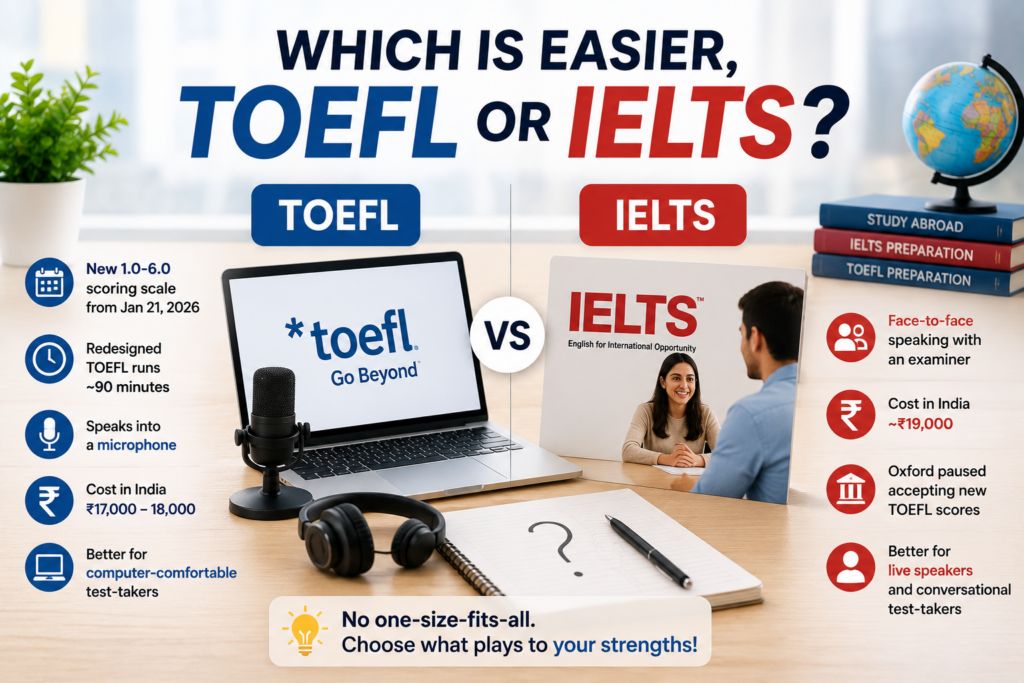
Quick Read
- TOEFL moved to a new 1.0-6.0 scoring scale on January 21, 2026.
- The redesigned TOEFL runs about 90 minutes, down from two hours.
- IELTS keeps face-to-face speaking; TOEFL records into a microphone.
- IELTS costs about Rs. 19,000 in India; TOEFL costs Rs. 17,000-18,000.
- Oxford has paused accepting TOEFL scores from the new format for now.
- TOEFL suits computer-comfortable test-takers; IELTS suits live speakers.
Which Is Easier, TOEFL or IELTS? The Short Answer
Quick definitions first, since these get mixed up more than you’d expect.
IELTS (International English Language Testing System) is jointly run by IDP and the British Council. It tests Reading, Writing, Listening, and Speaking, and it’s accepted for study, work, and immigration across more than 140 countries.
TOEFL (Test of English as a Foreign Language) is ETS’s English proficiency exam. It’s used mainly for university admissions and study visas, not work or immigration.
Neither test is objectively easier, and if a page claims otherwise without qualification, it usually indicates that the author hasn’t closely examined which test is easier, TOEFL or IELTS, for someone in your specific situation. It really comes down to a handful of things about you, not the exams themselves:
- Speaking style: live examiners suit confident talkers; a microphone with nobody watching suits people who freeze up in face-to-face situations.
- Reading comfort: academic textbooks favor TOEFL’s style; magazines, news, and everyday text favor IELTS.
- Typing vs handwriting: a fast, accurate typist has an edge on TOEFL’s fully computer-based format; IELTS still offers a paper option in some cities.
- Timing preference: a shorter, more clipped test now favors TOEFL at roughly 90 minutes; IELTS gives more breathing room per section, closer to three hours.
That said, a lot of the content answering “Is TOEFL easier than IELTS?” right now, including some pages published as recently as mid-2026, is working off a version of TOEFL that no longer exists. On January 21, 2026, TOEFL underwent its biggest overhaul in decades, genuinely changing how you should make this comparison.
My insight: Students who ask us which is easier, TOEFL or IELTS, almost always mean “Which one will I score higher on with less prep?” That’s a different question from which test is structurally simpler, and the honest answer depends more on your habits than on either exam’s design.
If you want the fuller picture, including PTE and Duolingo, this IELTS vs TOEFL vs PTE vs Duolingo comparison breaks down all four side by side.
What Changed in TOEFL’s 2026 Redesign, and Why It Matters
Here’s what ETS actually changed, since this is the part most comparison pages still get wrong, and it directly affects the answer to which is easier, TOEFL or IELTS, for anyone applying in 2027.
| Feature | Old TOEFL (before Jan 21, 2026) | New TOEFL (from Jan 21, 2026) |
|---|---|---|
| Scoring scale | 0-120 total | 1.0-6.0 band, CEFR-aligned |
| Test duration | About 2 hours | About 90 minutes |
| Reading and Listening | Fixed difficulty | Adaptive, adjusts to your performance |
| Speaking section | About 16-17 minutes | About 8 minutes |
| Section order | Reading, Listening, Speaking, Writing | Reading, Listening, Writing, Speaking |
| Results delivery | 4-8 days | Within 72 hours |
| Content style | Purely academic | Mix of academic and everyday, real-life content |
A few things actually matter here, not just the raw numbers:
- Score reports through 2028 show both scales, so nothing sent to a university is misinterpreted.
- TOEFL is now shorter and more adaptive than most IELTS vs TOEFL comparison pages online still describe.
- An article on the TOEFL test vs IELTS mentioning a four-hour TOEFL or a plain 0-120 score with no band equivalent was written before January 2026.
For a closer look at how demanding the new version actually feels day-to-day, this TOEFL exam difficulty breakdown covers section-by-section detail.

Excel in IELTS with India’s Top Online Coaching
Leap has helped more than 1 Lakh students achieve 7+ IELTS band.
TOEFL vs IELTS: Format, Score, and Fee Comparison
Now that the format is current, here’s how the two tests actually line up for anyone still asking which is easier, TOEFL or IELTS, once every recent change is accounted for.
| TOEFL (new format) | ||
|---|---|---|
| Category | IELTS | TOEFL (new format) |
| Conducted by | IDP / British Council | ETS |
| Duration | About 2 hours 45 minutes | About 90 minutes |
| Score range | 0-9 bands | 1.0-6.0 bands (CEFR-aligned) |
| Speaking format | Face-to-face with a human examiner | Recorded into a microphone, AI and human scored |
| Reading source material | Books, magazines, journals, everyday text | Mostly academic, now with some everyday content |
| Results | 3-5 days (computer-delivered) | Within 72 hours |
| Fee in India | Approximately Rs. 19,000 | Approximately Rs. 17,000-18,000 |
| Retake limit | Unlimited, no mandatory gap | Unlimited, but a short gap applies between attempts |
Source: ETS TOEFL scoring guide
For full fee and eligibility details, check our TOEFL exam syllabus, fees, and eligibility guide.
Excel in IELTS with India’s Top Online Coaching
Leap has helped more than 1 Lakh students achieve 7+ IELTS band.
Which Should You Take? A Decision Framework by Strength and Destination
For the TOEFL vs IELTS test, the honest starting point is your own comfort level, not a generic ranking. This is really where, which is easier, TOEFL or IELTS, stops being a trivia question and starts being a personal one.
If you get nervous talking to a live examiner: TOEFL’s recorded speaking section removes that pressure entirely. You’re speaking into a microphone with preparation time built in, which suits people who freeze up in face-to-face situations but speak confidently when they’ve had a moment to plan.
If you’re targeting the UK or migrating to the UK, Canada, or Australia: IELTS is often the safer, sometimes mandatory, choice. UK visa applications specifically require IELTS for UKVI in most cases, and several UK universities have been slower to formally adopt TOEFL’s new scoring scale.
Check which countries accept TOEFL before ruling it out entirely, since the list is broader than most students assume.
If you’re comfortable with computers and prefer a shorter test: The redesigned TOEFL, at roughly 90 minutes with adaptive sections, is now genuinely quicker to sit than IELTS, which still runs closer to three hours.
My insight: We’ve had students switch from TOEFL to IELTS mid-prep purely because they realized they think better out loud than into a screen. That’s a legitimate reason to switch, and it’s better to catch it during a diagnostic practice test than on exam day. It’s also the clearest real-world evidence that which is easier, TOEFL or IELTS, genuinely comes down to the individual, not the exam.
What to Do If Your Target University Hasn’t Updated to the New TOEFL Scale
This is the part almost nobody else is telling you, and it matters if you’re applying for a 2027 intake and still weighing which is easier, TOEFL or IELTS, for your specific university list.
- Check your target university’s English requirement page directly, not a third-party aggregator, since some institutions still list only the old 0-120 requirement even though they accept the new band score automatically during the dual-reporting period.
- If you’re applying to Oxford, Oxford’s own admissions guidance, as of mid-2026, states it won’t accept TOEFL iBT scores from tests taken on or after January 21, 2026, pending its review of the redesigned exam. This is a live policy, so confirm directly before booking TOEFL over IELTS.
- If your score report shows a low band number like 4.0 or 4.5, don’t panic before checking the legacy equivalent on the same report. A 4.5 band roughly maps to the old 87-99 range, which is competitive for most programs outside the very top tier.
If you’re closer to an IELTS band of 5.5, check which countries accept a 5.5 IELTS band before assuming you need to retake it.
- If you’re unsure which scale a university is quoting, ETS’s score reports carry both formats side by side through 2028, so point to the legacy number if a school’s page hasn’t caught up yet.
- If you’ve already booked TOEFL and are now worried about acceptance, IELTS remains the fallback with zero ambiguity, since its 0-9 scale hasn’t changed and every accepting university already recognizes it.
Once you know your target band, this useful IELTS score guide explains what counts as competitive for different program levels.
TOEFL and IELTS Booking Calendar for Fall 2027 Intake
Once you’ve settled the TOEFL vs IELTS question for yourself, here’s roughly how the timeline should look, working backward from a Fall 2027 start.
| Period | Milestone | What to Do |
|---|---|---|
| Sept-Oct 2026 | Early prep window | Take a diagnostic test for both TOEFL and IELTS to see which format suits you |
| Nov-Dec 2026 | Book your test | Register at least 4-6 weeks ahead, since popular slots fill up fast. If you need to move your date later |
| Jan-Feb 2027 | Sit the test | Aim to finish by February so you have time to retake if needed |
| Mar 2027 | Retake window if needed | Most schools want scores in hand before final application rounds close |
| Apr-May 2027 | Send official scores | Confirm your target universities have received the report directly from IDP or ETS |
| Jun-Aug 2027 | Visa and pre-departure | Some visa categories require a specific test type, so double-check before this stage |
3 Key Takeaways on Which Is Easier, TOEFL or IELTS?
- Get the facts right before you decide. TOEFL’s 2026 redesign changed the scale, duration, and speaking format completely, and a lot of comparison content online, even from mid-2026, still describes the old version.
- Match the test to your comfort, not a ranking. Live speaking versus recorded speaking is usually the single biggest factor in which is easier, TOEFL or IELTS, for any individual student.
- Verify your target university directly. With Oxford and a handful of others still reviewing the new TOEFL format, don’t assume your dream school has caught up on which is easier, TOEFL or IELTS, for their admissions page; check it yourself before you book. Cambridge has gone further and stopped accepting TOEFL entirely for anyone testing after December 31, 2025, and Glasgow no longer accepts TOEFL iBT for postgraduate applicants at all, check your specific UK shortlist, not just Oxford.
Verified by: LeapScholar’s test prep counseling team, with hands-on experience guiding Indian students through English proficiency exam choices.
Have questions about choosing between TOEFL and IELTS? Book a free session with a LeapScholar counselor.
Frequently Asked Questions About Which is Easier, TOEFL or IELTS?
-
Which is easier, TOEFL or IELTS?
Neither wins outright, and anyone who tells you otherwise is probably guessing. It really depends on whether you’d rather talk to a real person or a microphone and whether academic-style reading or everyday, conversational text feels more natural to you. Most people figure this out after one practice test of each, not from reading yet another article about it.
-
Is TOEFL easier than IELTS after the 2026 redesign?
It’s definitely shorter and more adaptive now, and a lot of test-takers find that less draining. But “easier” still depends on you. The new 90-minute format with its 1.0-6.0 scale feels friendlier if you’re already comfortable with computers, though let’s be clear, the actual English skills being tested haven’t gotten any easier.
-
What is the new TOEFL scoring scale in 2027?
It’s the same system that launched in January 2026 and has remained unchanged since. Each of the four sections is scored from 1.0 to 6.0 in half-point steps, and your overall band is the average of those scores. Score reports through 2028 still show the old 0-120 number, so a university’s outdated page won’t leave you stuck.
-
Which test is cheaper in India, TOEFL or IELTS?
TOEFL is usually a bit cheaper, costing roughly Rs. 17,000 to 18,000, while IELTS is around Rs. 19,000. But honestly, a Rs. 2,000 difference shouldn’t be the deciding factor for you when it comes to which test is easier, TOEFL or IELTS. Fees shift now and then, so double-check the official booking page before you pay either way.
-
Do universities accept the new TOEFL 1-6 score yet?
Mostly yes. Score reports carry both the new band and the old 0-120 number right up until 2028, which settles most of the confusion around which is easier, TOEFL or IELTS, in terms of acceptance risk. A few holdouts exist, though, Oxford being the one everyone brings up, since it’s paused accepting the new format while it reviews things. If you’re aiming somewhere highly selective, just check directly rather than assuming.
-
Which test should I take for the USA, UK, or Canada?
UK-bound? Go with IELTS, especially for visas. Heading to the US or Canada? Either option works fine, so it comes down to comfort rather than acceptance. Always double-check your specific university’s page, since requirements vary by program.
-
How long are TOEFL and IELTS scores valid?
Two years for both, no exceptions. An application timeline running longer than that means a retake, regardless of which test you chose.
-
Can I retake the TOEFL or IELTS if I don’t get the score I need?
Yes, and there’s no cap on either one. TOEFL makes you wait a short gap between attempts; IELTS doesn’t even require that. Most people still give themselves a few weeks in between, though, since retaking without actually improving anything rarely changes, making it easier to choose between TOEFL and IELTS for that particular attempt.
-
Is IELTS harder than TOEFL for the reading section specifically?
A lot of test-takers say yes, mostly because IELTS pulls from real magazines and books rather than dense academic text. TOEFL’s reading is still more academic overall, though the redesign added some everyday content too, narrowing that old gap.









Have Questions? Get Guidance to reach your Dream University
Connect with India's finest counsellors and biggest study abroad community.
Get Guidance