
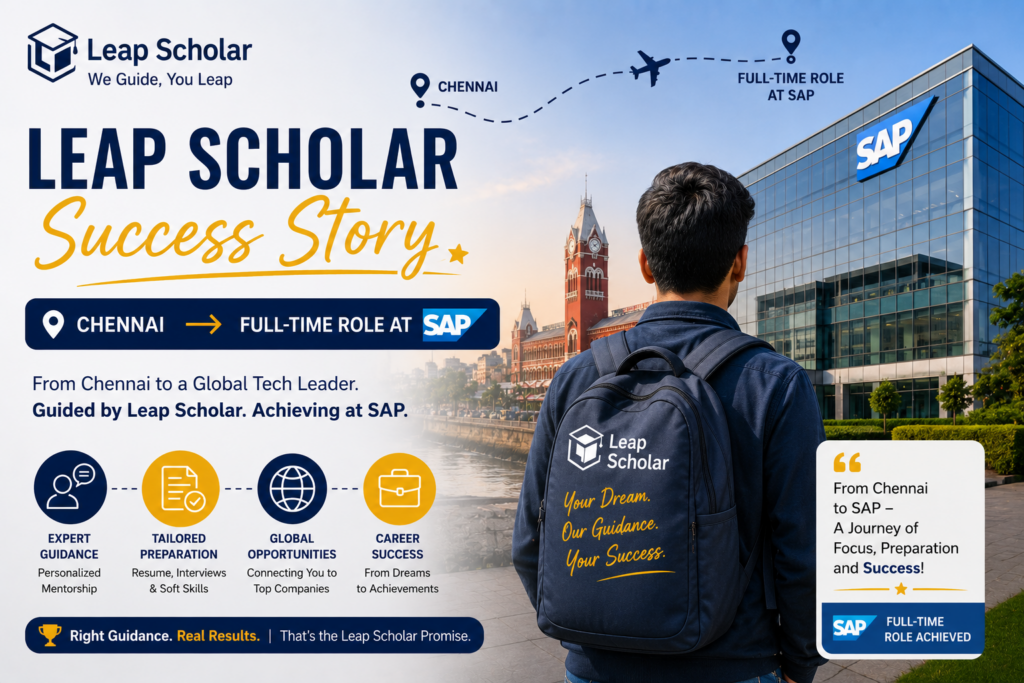
I never wanted the typical path: finish a degree, take a basic entry job, and climb slowly from there. So when I finished my bachelor’s, I chose a masters abroad instead of a regular job in India. Here’s my story, in my own words, on skipping the crowded US and Canada route, landing in Germany almost by accident, and building a real career at SAP despite a rocky start.
Q1. Why did you decide to move abroad in the first place?
A) Honestly, I didn’t want a typical lifestyle, finishing your bachelor’s and then going straight into a nine-to-five, starting at a basic position and slowly working up from there. I wanted to try something different. After my bachelor’s, it came down to two options: take a job right away or do a masters first. I chose the masters, and luckily, it worked out well.
Q2. What did the whole move and degree end up costing you?
A) My masters was a two-year course at a private university, and by the time I enrolled, it cost close to 20,000 euros. The same course is significantly more expensive now. In rupees, that would be around 21 to 22 lakhs. On top of that, there’s something called a blocked account here, essentially money you deposit that gets released to you monthly for living expenses. That was another 12,000 euros back in 2022, roughly another 12 to 13 lakhs.

Choose your dream country
 UK
UK
 USA
USA
 Germany
 Australia
 Ireland
 Canada
 UAE
UAE
 France
 Sweden
 Italy
Italy
 Other
Other
When do you want to study abroad?
What's your highest level of education?
What do you want to study?
Select your current city
How Leap will help you

Personalised University Shortlist

Express Applications with Quicker Admits

End-to-End Application Support
Q3. How did you actually fund all of that?
A) My parents covered it, and honestly, they put their entire savings into it for me; it wasn't just luck. I did try for education loans, but I couldn't get approved, or the interest rates were far too high to make sense. I felt genuinely hesitant taking that much from my parents, but my father was firm that we'd manage with whatever we had.
Q4. Was Germany always your plan, or did you consider other countries first?
A) Not at all, initially. The US was a hard no for me, honestly, for no deeply scientific reason; it just felt like everyone defaults there without really thinking it through. It also comes with GRE, GMAT, and IELTS, and it's genuinely expensive. Canada felt similar, just the second version of that same crowded path. Germany came into the picture through my cousin, who was already living there. He gave me real, valuable information about the universities and opportunities. Back then, in the early 2020s, almost nobody was talking about studying or working in Germany; it felt like a hidden option. Once I started exploring it properly, I knew that was the country for me.
Q5. What did you actually study, and was that a common choice at the time?
A) I did my masters in Data Science and Analytics with a focus on AI. When I was applying, that specific combination made up maybe 10 percent of applications; most people were doing a standard Masters in Computer Science with some electives. I deliberately went for that less common 10 percent, and it turned into a genuinely good opportunity.
Q6. Walk me through your actual timeline.
A) I finished school in 2017 and started my B.Tech in Information Technology in Chennai that same year. COVID hit during college, so about a year and a half of my later years were spent studying entirely from home, which honestly left me feeling a bit behind and unsure about timing. I completed my bachelor's around August or September 2021. My original plan was to start my masters in Germany by April 2022, but I lost about six months to a bad experience with a private consultancy, so I ended up starting in September 2022 instead. I graduated in November 2024, technically finishing coursework by September that year. While studying, I got a working-student position at SAP, part-time but structured like a real professional role. I had to step away from that for my fourth semester to focus on my thesis, went through four to five months without any job while job hunting, and eventually landed my full-time role back at SAP in May 2025.
Q7. What went wrong with that consultancy?
A) There was a lot of miscommunication; they just weren't transparent or responsive, including during my visa process. I genuinely regret going with them. In the end, I had to redo almost the entire application process myself the second time around. That mistake cost me real time, about six months I could have used productively instead. If I'm honest, even when you hand a process to someone else, you still need enough knowledge yourself to ask the right questions and check on what's actually happening. I learned that one the hard way.
Q8. Was there any resistance from your family when you decided to leave?
A) None at all, genuinely. My parents aren't highly educated themselves, but they gave my brother and me everything they could, and once we decided something, they trusted us completely. I never once heard them criticize a decision or ask why something went wrong. That kind of quiet trust actually put a real, positive pressure on me to make sure I did things properly, since I didn't want to let that trust down.
Q9. What was the hardest part of actually settling into your job at SAP?
A) Starting was overwhelming. I'd studied Data Science and Analytics, which is heavily rooted in Python and open-source tools, and I landed on a team using ABAP, which is a much older, SAP-specific language. I hadn't even properly learned Java before that, so ABAP felt like a huge jump backward in some ways. For the first couple of months I genuinely considered trying to move to a data science team instead. What stopped me was my team itself; they were incredibly supportive and patient, and I didn't want to walk away from people who were investing that much in me. That decision turned out to be one of the best I've made; I've since built several agents on that same product, and I have no interest in switching teams anymore.
Q10. How big a factor was the German language in your job search?
A) Bigger than I expected, and it grew over time. Language proficiency here runs from A1 and A2, the basics, through B1 and B2, intermediate, up to C1 and C2, which are close to native fluency. Most jobs expect at least a B1, and around 30 to 40 percent specifically ask for B2. When I first started, things felt a bit more relaxed, especially outside management-focused courses. But by 2024 and 2025, the market had tightened dramatically, some job postings were getting 500 to 600 applications within a single day, and German became one of the first filters companies used to cut that pool down. I started learning German before I even arrived and reached B1 by my second or third semester. I'm at SAP now, which has an English-speaking, multinational team, so I have some breathing room, but I still need that B1 certification for my permanent residency and passport process.
Q11. What have you learned outside of your actual degree?
A) A lot, honestly, especially around finances. I think everyone goes through a phase early on where you convert every price back to Indian rupees in your head, and that habit genuinely saved me money. Cooking was a disaster at first; I still remember my very first attempt at rice, and it was a complete failure. I'm a decent cook now, though. Planning changed for me too. Life here is far more structured, since you don't casually own a car or bike the way you might in India; you earn that eventually, but until then you're on someone else's schedule: buses, trains, and trams. That forced me to become far more systematic and timeline-driven than I ever was back home.
Q12. Do you think you'd have achieved the same things if you'd stayed in India?
A) Maybe, but I'd still choose this path. In India, you can earn and save, but you don't necessarily learn how to do everything yourself the way you do here. Being independent when family is just a short trip away is different from being independent when going home isn't really an option. I learned a lot of things the hard way here and some the good way, but all of it feels genuinely valuable. If I'd stayed in India, I think I might have grown maybe 30 to 40 percent as much as I have here. That's why I'd still choose this.
Q13. What do you miss most about India?
A) Home, my parents, my family, and the people I love. I try to visit when I can, though I wish it were more often. Family gatherings, and honestly, food. It's more expensive here, and it's just not the same authentic taste. That's probably what I miss the most.
Q14. Does Germany feel like home now?
A) It genuinely does, a second home at least. My mom still won't let me call it home outright; we joke-argue about that every time it comes up. What's helped is that I've stayed in the exact same area since I landed here four years ago. I still know every street, every shop. A lot of people I know had to move cities and start over, but I got to build real roots in one place, and now that I have a stable job here too, there's no real reason to move again.
Q15. Are you able to save money now or send anything back home?
A) Yes, definitely. Now that I'm working full time, I can save comfortably and still send money home regularly. Earning here genuinely makes it easier to support family back home while still living well yourself.
Q16. What's one thing you'd tell your younger self, or anyone just starting this process?
A) Put in real effort; don't look for shortcuts. Even if you hand parts of the process to someone else, stay informed enough to ask the right questions and check on progress yourself; that's exactly where I went wrong the first time, and it cost me a full semester. If I were doing this today, I'd also say, use everything available to you now; tools like AI chat assistants can answer even the most basic question instantly, without judgment. I didn't have that in 2022, and it would have saved me a lot of trouble.
From a bad consultancy experience that cost him six months to building AI-driven tools on a legacy system he once wanted to abandon, this journey is proof that the less obvious path, both in country choice and career choice, can turn into the better one. For anyone weighing Germany against the usual US or Canada route, or wondering whether to trust a process fully to someone else, this success story is worth sitting with.








Have Questions? Get Guidance to reach your Dream University
Connect with India's finest counsellors and biggest study abroad community.
Get Guidance