
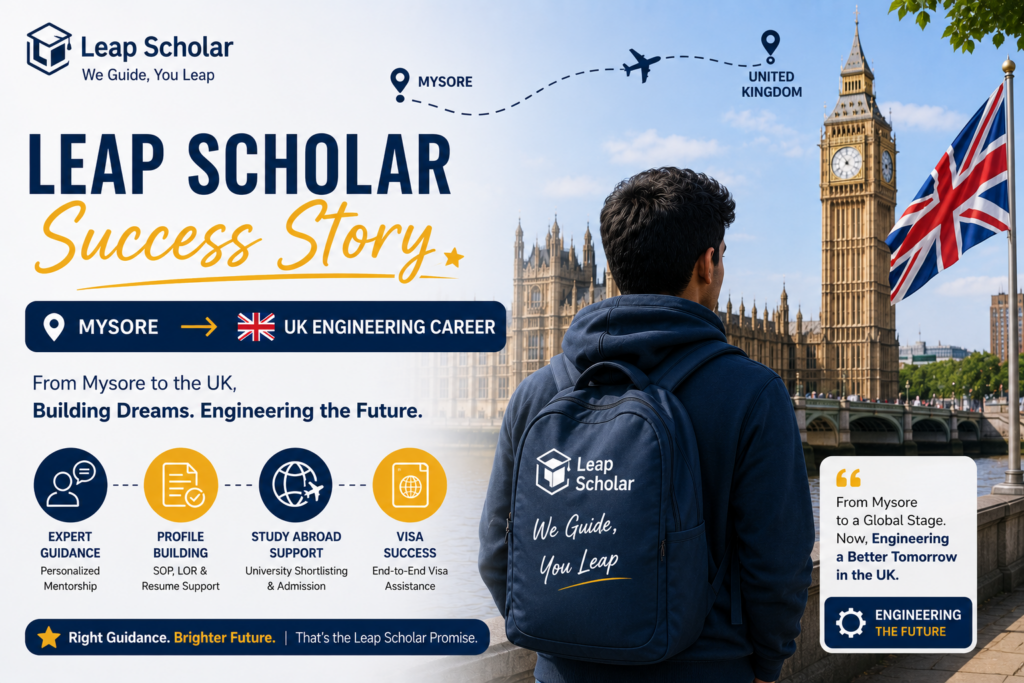
I was three months away from figuring out my next step in life when an Instagram ad about studying in Europe changed my whole plan. Here’s my story, in my own words, on trading a domestic master’s I could barely afford for a UK degree, surviving a visa process nobody warned me about, and building a career I’m genuinely proud of, seven years later.
Q1. Why did you decide to move abroad in the first place?
A) I come from a civil engineering background, and in my third or fourth year, I wanted to do something nobody else around me was doing. I first thought about preparing for KAS and IAS exams, but coaching access was genuinely difficult where I was. So I looked at continuing in the same engineering field instead. There was an institute, NICMAR, in Pune, that offered a masters, but it would have cost around 12 to 15 lakhs for a two-year, fully residential program. I’d already spent so much on my engineering degree that I had to be really careful about spending more. Around that time, I was scrolling through Instagram and saw an ad saying studying in Europe could cost less than 15 lakhs. That’s what pulled me in.
Q2. How did that Instagram ad turn into an actual plan?
A) It was still early in my fourth year, so there was time. I spoke to my parents, and around then, a consultancy came to my college and gave a short session on studying abroad, the perks, and the process. That’s what really got me interested. After that, I went to a local consultancy in Mysore, but there were only one or two, and they mostly handled Australia, the USA, and New Zealand, not Europe or the UK. So I traveled to Bangalore and visited five or six consultancies in a single day. They gave me a much clearer picture of the price points across countries, and that’s when Europe, with some countries offering free or low-cost education, started to look genuinely realistic.

Choose your dream country
 UK
UK
 USA
USA
 Germany
 Australia
 Ireland
 Canada
 UAE
UAE
 France
 Sweden
 Italy
Italy
 Other
Other
When do you want to study abroad?
What's your highest level of education?
What do you want to study?
Select your current city
How Leap will help you

Personalised University Shortlist

Express Applications with Quicker Admits

End-to-End Application Support
Q3. Where did you end up applying, and how did that go?
A) Through those consultancies, I applied to universities in Italy and Germany, Politecnico di Milano and a couple of Frankfurt universities, for civil engineering, structural, environmental, or construction management; I was open to any of them. I ended up with three or four offers, including one from Milan. But I paid around 10 to 15 thousand rupees per university just for consultancy fees, even though the applications themselves were free. Across three or four consultancies, that added up to 50 to 60 thousand rupees total.
Q4. So how did you actually end up in the UK instead?
A) Funnily enough, I dropped all four consultancies I'd been working with. A friend of mine, who was applying to the US, Canada, Australia, and the UK, was using an online platform called Shiksha dot com. Through her, I found out the UK was an English-speaking country, so I wouldn't have to deal with a language barrier, and the cost was actually more manageable than I'd assumed. That was enough to make me switch entirely. The whole process with Shiksha was online; I never had to leave my home city again to finish it.
Q5. Did that platform handle everything for you?
A) Only up to a point. They guided me well through the university applications. I got responses from a few UK universities and ended up leaning toward London, choosing University of East London for my masters in structural engineering. But that's where their help stopped. The loan process, the visa application, none of it was covered. I had no idea how the UK education system worked or how to even fill out a visa application. I remember sitting in a cybercafe repeatedly over the final 45 days before I left, trying to sort out my CAS letter and loan documentation almost entirely on my own. It was genuinely one of the most stressful stretches of the whole journey, and if I'd had proper support through that part, I think I could have actually enjoyed the lead-up to moving instead of just surviving it.
Q6. What did the whole move actually cost you?
A) I can break it into two years. My first year cost around 15,500 to 16,000 pounds in tuition, plus around 12,000 pounds a year for living costs, so roughly 28 to 30 lakhs in total at the exchange rate back then. My second year was much lighter on tuition, only about 2,000 pounds, since it was mostly thesis work, but living costs stayed similar. I chose shared accommodation instead of university halls specifically to save money; that alone made a real difference.
Q7. How did you manage the finances day to day?
A) I took an education loan, but I only used what I needed for the first year rather than borrowing the full amount. About two to three months after arriving, in September, I got my first part-time job, and from there, part-time income covered my bills, accommodation, and everything else alongside the loan.
Q8. What kind of part-time work did you do while studying?
A) My very first job was at Poundland. After that, I did some event management and bartending work over a Christmas season, then became a barista at Costa Coffee for about a year and a half. Costa was physically demanding; you were on your feet constantly, so I eventually moved to an easier job at a betting company, Ladbrokes Coral, on a friend's recommendation. Even after landing my proper civil engineering graduate role, I kept working there on weekends until my visa status required me to stop and work solely for my sponsoring employer.
Q9. How long did it take you to land your first proper job after graduating?
A) About three months, which I now realize was actually fast. I've since heard about people who never found a job before their Post-Study Work visa ended and had to go back home. I took my loan repayment seriously too; I fully cleared my student loan within about a year of starting full-time work, before my PSW route even ended.
Q10. How's your career looking now?
A) Genuinely strong. This December will mark five years in my career, and I've moved across three or four companies along the way. Civil engineering in the UK has a lot of long-term project pipelines, ten to twenty years' worth, so the industry itself feels stable and secure. I've been on a Tier Two visa since 2023, and I'm on track for my ILR in about two more years.
Q11. How did your parents react when you first told them?
A) Honestly, they were never happy about it. I'd never left my home city before, not even for a week, and this was a huge jump for them to accept. They were scared I'd never come back. But over time, watching how things worked out, that fear turned into pride. And it didn't stop with me either; after I moved, the door opened for my whole family. My brother followed, and two of my cousins moved abroad too, one to the US, one to London. I think I made the path a bit easier for everyone who came after me.
Q12. What's something you've learned outside of your degree entirely?
A) Cooking, definitely. Before I left, I barely knew how to make instant noodles or tea. Now I can cook for ten to fifteen people without blinking. I also started a YouTube channel about two years after graduating. I've been inconsistent with it lately, but I plan to pick it back up. For a while, I also did informal one-on-one counseling calls for people wanting to study abroad, just to pass on what I'd learned the hard way.
Q13. Do you think you'd have achieved the same things staying in India?
A) No, honestly. In India, you're weighing salary against savings very differently, and you're often still living with parents or in a property you already own, so the comparison isn't quite fair. But beyond finances, civil engineering and construction can be a genuinely tough field for women in India, especially in site-based roles. I think I'm in a better place professionally here than I would have been back home.
Q14. What's the one piece of advice you'd give someone just starting this process?
A) Get two to three years of work experience in India before moving abroad if you can. The market's far more competitive than it was when I moved in 2019, since visa sponsorship now often comes down to prior experience, not just a degree. And don't rely purely on luck; focus on your education seriously, since the job and the good outcomes genuinely follow from that. If I'm honest about my own regret, I wish I'd started looking for an internship right at the start of my second semester instead of waiting until a month before it began. That's the one thing I'd change if I could do it all again.
Q15. What do most people ask you when they're considering this move?
A) Almost everyone leads with "how much can I earn from a part-time job," and almost nobody asks how they'll actually sustain themselves once they're here. I always tell them, Use your education loan wisely; most banks offer them, and universities let you pay in installments rather than all at once. Cover your tuition and your first semester's living costs with that, settle in properly, and then look for work. The part-time job market has gotten genuinely tight; my own brother and sister went six to seven months without finding one when they arrived. Chasing a job immediately isn't worth losing sight of why you actually came.
Q16. What do you miss most about India?
A) My parents, honestly, and the food, though I've managed to master Indian cooking here too. If there's one thing that would ever pull me back permanently, it would be them.
From a domestic masters she couldn't quite afford to a UK structural engineering career built almost entirely through her own resourcefulness once the formal support ran out, this journey is proof that the parts nobody warns you about, the visa paperwork and the loan documentation, often matter more than the university choice itself. For anyone weighing a masters abroad and wondering what happens after the offer letter, this success story is worth reading closely.







Have Questions? Get Guidance to reach your Dream University
Connect with India's finest counsellors and biggest study abroad community.
Get Guidance